
The cleanest legal comparison between Kalshi and sportsbooks starts with the license, not the screen a user sees. Kalshi operates as a Commodity Futures Trading Commission-regulated designated contract market under the Commodity Exchange Act. A sportsbook operates through state gaming licenses, subject to the state gambling code and the continuing supervision of a state gaming commission. Those two labels do not merely describe different agencies. They point to different statutes, different remedies, different compliance staff, and different answers when a regulator says the product must stop.
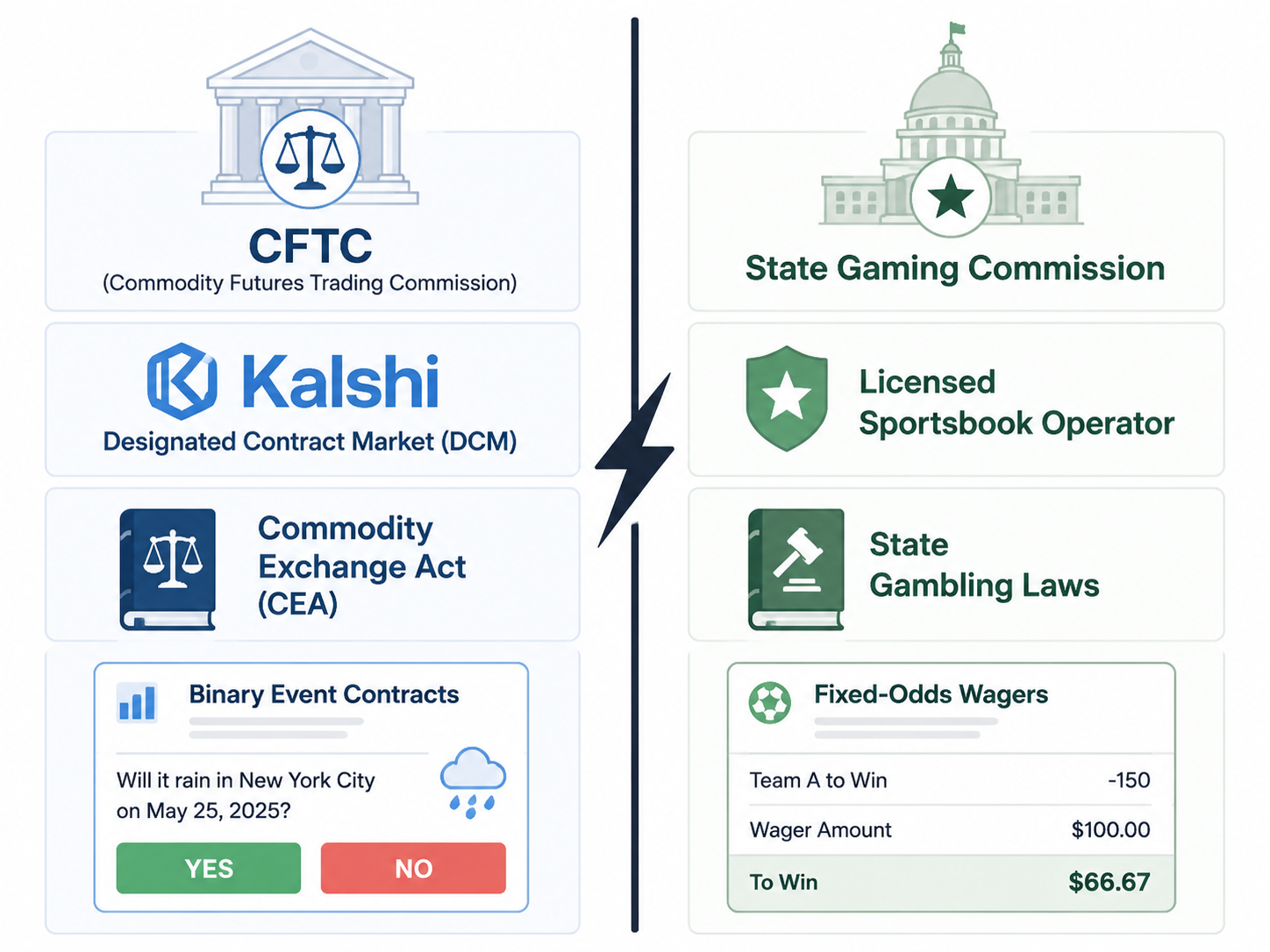
That is why the shorthand comparison to DraftKings or FanDuel is useful only up to the point where it becomes legally misleading. Kalshi’s asserted home is the federal commodities regime: DCM registration, CFTC oversight, Commodity Exchange Act exclusivity, and the Dodd-Frank event-contract review framework often discussed through CFTC Rule 40.11. Sportsbooks have no equivalent federal sports-betting license. Their permission to operate comes state by state, with state-specific conditions on licensing, responsible gaming, advertising, geolocation, age controls, tax collection, and enforcement cooperation.[1][2]
| Issue | Kalshi model | Sportsbook model |
|---|---|---|
| Regulatory identity | CFTC-regulated designated contract market | State-licensed gaming operator |
| Legal instrument | Binary event contract treated as a swap or commodity interest | Wager governed by state gambling law |
| Counterparty structure | Peer-to-peer market with contracts settled in cash | House-banked fixed-odds betting |
| Primary regulator | CFTC under the Commodity Exchange Act | State gaming commission or equivalent authority |
| Current legal pressure point | Whether federal law preempts state gambling enforcement | Whether state licensing and gambling-law limits apply |
The Product Difference Matters Because the Statutes Treat It Differently
Kalshi’s sports markets are structured as binary event contracts: a participant buys or sells a position tied to whether a stated event will occur, and the contract settles in cash. The platform does not function as the house taking the other side of each bet in the ordinary sportsbook sense. A sportsbook, by contrast, offers fixed odds to customers and books wagers against the house, with the operator’s margin built into the pricing and risk management of the book.[3]
That structural distinction is doing much of the work in Kalshi’s legal position. If the instrument is a CEA-regulated swap or event contract listed on a registered DCM, the argument runs, the CFTC is the relevant federal regulator and state gambling regulators cannot relabel the same federally supervised contract as illegal sports wagering. If the instrument is functionally a sports bet offered to residents of a state, the states answer that the exchange label cannot erase their gambling statutes.
The harder question is not whether the two products feel similar to a retail user. They often will. A user who predicts the winner of a basketball game may experience both interfaces as a way to stake money on a sports outcome. The legal question is whether that practical similarity is enough to trigger state gambling law when the contract is listed through a federally regulated commodities exchange.
Kalshi’s Federal Theory: CEA Exclusivity and a Regulated Market, Not a State-Licensed Book
Kalshi’s preemption theory depends on the Commodity Exchange Act doing more than merely permitting federal oversight. The stronger version says Congress placed trading on registered contract markets within an exclusive federal field, so a state cannot use gambling law to prohibit contracts the federal regime allows. A narrower version says that even if the field is not fully occupied, state enforcement conflicts with the CEA when it blocks federally regulated trading.
The event-contract framework is important here because it is not regulatory silence. Law firm analyses of the market structure describe the Dodd-Frank special rule as a mechanism under which certain event contracts may be reviewed, including public-interest constraints, rather than as an absence of regulation.[1][2] That matters for preemption: a court more likely to see active federal supervision may also be more willing to see state prohibition as interference.
But federal registration is not a universal solvent. It answers who approved the exchange and which federal regime supervises the contract market. It does not, by itself, answer every state police-power question. The preemption analysis still has to identify the statutory command: express preemption, field preemption, conflict preemption, or some combination. Courts are now disagreeing over exactly that step.
The State Response: Sports Event Contracts Still Land in Gambling Territory
State regulators are not treating the dispute as a taxonomic exercise. Their position is practical and territorial: residents are being offered a paid opportunity to profit from sports outcomes, and states have long regulated that activity as gambling. From that view, the CFTC’s role over commodity markets does not strip states of authority to enforce gambling prohibitions, licensing rules, or consumer-protection conditions against activity inside their borders.
This is where the sportsbook comparison becomes legally consequential. A sportsbook cannot enter New York, New Jersey, Michigan, Arizona, or Minnesota by pointing to a federal financial-market registration. It needs state authorization. State officials looking at sports event contracts see a competing product reaching the same sports-wagering demand while bypassing the licensing architecture imposed on conventional operators.
The state argument gains force when the remedy sought is not theoretical. If a state can enforce, the consequences may include cease-and-desist orders, injunctions, criminal exposure, licensing consequences for affiliates, or statutory penalties. If the CEA preempts that enforcement, a state gambling regulator may have little immediate leverage over a federally registered exchange offering the contracts.

New Jersey: The Third Circuit Accepted Preemption
The most important pro-Kalshi decision in the current record is the Third Circuit’s April 6, 2026 ruling in KalshiEX v. Flaherty, No. 25-1922. In a 2-1 decision, the court held that New Jersey could not regulate Kalshi’s prediction market under state gambling law as applied to the sports contracts at issue.[4]
The ruling matters because it did not merely say Kalshi had a plausible claim at the pleading stage. The court accepted preemption arguments in a way that treated the CEA’s federal market structure as displacing state gambling enforcement for those contracts. Reporting and legal commentary describe the decision as relying on field and conflict preemption theories, with the majority viewing New Jersey’s attempted regulation as incompatible with the federal commodities framework.[4][5]
For compliance purposes, that is a materially different posture from a temporary restraining order or a narrow procedural ruling. It gives Kalshi and similarly situated platforms appellate authority in one circuit for the proposition that a state cannot simply apply gambling law to stop federally listed sports event contracts. It also gives state regulators and sportsbook operators a clear target: if the Third Circuit’s reading spreads, state licensure may become less decisive for prediction markets than it is for sportsbooks.
New York: SDNY Rejected Express, Field, and Conflict Preemption
The July 7, 2026 ruling from Judge Analisa Torres in KalshiEX v. Williams, No. 1:25-cv-08846, moved the other way. The Southern District of New York rejected Kalshi’s express preemption, field preemption, and conflict preemption theories and allowed New York enforcement to proceed.[6]
That rejection is not a minor variation on the Third Circuit result. It reflects a different reading of the statutory fit. Under this approach, the CEA’s regulation of commodity markets does not necessarily mean Congress displaced state gambling authority whenever a federally registered exchange lists a contract tied to sports outcomes. Nor does state enforcement automatically conflict with the CEA simply because it makes a particular category of sports event contract harder, or impossible, to offer in that state.

The New York ruling also prevents the dispute from being reduced to a simple federal-license-versus-state-license slogan. A DCM registration remains legally significant. It just may not carry the same preemptive force in every court. The immediate consequence is that counsel cannot treat the Third Circuit ruling as a national safe harbor, and state regulators cannot assume their gambling statutes will survive preemption challenges everywhere.
Why the Same Architecture Produces Opposite Results
The disagreement is not about whether Kalshi is federally regulated. It is. Nor is it about whether states traditionally regulate gambling. They do. The dispute is over priority when a sports-outcome contract can be characterized under both vocabularies: a federally listed event contract and a state-regulated wager.
A court inclined toward field preemption will ask whether Congress gave the federal commodities regime exclusive control over trading on registered contract markets. If yes, a state gambling-law prohibition begins to look like an intrusion into a federally occupied field. A court skeptical of field preemption will ask whether gambling enforcement is a separate state police-power function that survives alongside federal market regulation.
Conflict preemption turns on a slightly different pressure point. Kalshi can argue that it cannot comply with the federal regime’s permission to list and trade the contracts if a state can forbid the same conduct. States can answer that federal registration does not guarantee every listed product may be sold in every state free from otherwise valid state law. Those are not semantic differences. They decide whether the remedy belongs to the CFTC, the state gaming regulator, or both.
The Enforcement Stakes Are Already Concrete
The preemption question now carries immediate enforcement risk. Arizona filed what was described as the first criminal case against a CFTC-registered exchange in this context, with 20 misdemeanor counts reported in March 2026. Minnesota enacted what was described as the first felony ban on prediction-market operation, effective August 1, 2026. Michigan’s dispute included a temporary restraining order posture with a reported $120,000-per-day fine at issue.[7]
Those examples do more work than market-size claims because they show who bears the consequence of the classification dispute. A platform lawyer has to decide whether the Third Circuit’s preemption reasoning justifies continued access. A gaming regulator has to decide whether non-enforcement would concede the field to a federal market structure. A sportsbook compliance team has to evaluate whether competitors are operating under a materially lighter state-law burden. None of those decisions can wait for a final national answer.
The state-by-state posture should be read cautiously. Some public tables sit close to promotional or affiliate material, and the litigation record changes quickly. Still, the reported enforcement tools are the right signals to watch: criminal charges, felony statutes, injunctions, daily fines, and appellate stays. They are more legally probative than whether a prediction market offers a better price on a given game.
Practical Consequences of Classification
Once the classification changes, downstream rules change with it. Tax treatment is one example. Prediction-market gains have been described as capital gains, while sportsbook winnings are treated as gambling income, with federal withholding and state tax consequences depending on the bettor and jurisdiction.[8] That difference follows from the regulatory category; it is not the reason the category exists.
Age rules show the same pattern. Kalshi has been reported as available to users at 18, while sportsbooks generally require 21, with limited state exceptions.[7] That gap matters for consumer access and compliance screening, but it remains derivative of the governing legal framework. A platform regulated as a DCM is not being supervised under the same state gaming-license conditions that apply to a sportsbook.
Consumer protection also diverges. Sportsbook regulation usually comes bundled with state-specific responsible-gaming obligations, exclusion lists, advertising restrictions, and geolocation controls. A CFTC-regulated market is supervised through a commodities-law lens. That does not mean one system has no consumer protections and the other has perfect ones. It means the protections are built for different statutory problems.
What Counsel Can Safely Say in Q3 2026
As of Q3 2026, the safest legal description is narrow. Kalshi is not regulated like a sportsbook. It operates under federal commodities oversight as a designated contract market, while sportsbooks operate under state gaming licenses. That distinction is real, and it changes the regulator, the instrument, the counterparty model, and the compliance obligations.
The unresolved question is whether that federal status prevents states from enforcing gambling laws against sports event contracts offered to their residents. The Third Circuit’s New Jersey decision supports Kalshi’s preemption position. The Southern District of New York’s ruling supports continued state enforcement. Pending appellate activity may clarify the map, but it has not yet produced a uniform national rule.
So the legal comparison does not end with “prediction market” on one side and “sportsbook” on the other. It ends at the collision point between federal commodities exclusivity and state gambling authority. Kalshi is federally regulated today. Whether that lets it operate nationwide without state gaming authorization is the question the courts are still deciding.
References
- Sportsbooks or Commodity Exchanges? The Rising Legal Tensions Between Sports Betting and Prediction Markets, Stinson LLP
- Event Contracts Versus Sportsbooks: Charting the Legal Divide in U.S. Gambling Law, Snell & Wilmer
- Trading the Score: Are Kalshi’s Sports Event Contracts Markets or Mere Bets?, Sports Litigation Alert
- New Jersey cannot regulate Kalshi's prediction market, US appeals court rules, Reuters, April 6, 2026
- Update on Prediction Markets, National Law Review
- Kalshi Loses New York Ruling; Federal License Fails to Block State Gambling Law, TechTimes, July 10, 2026
- Prediction Market Legal States, CBS Sports
- Prediction Markets vs Sports Betting, SI.com
Comments
Join the discussion with an anonymous comment.