
The 2026 World Cup turned Kalshi’s sports event contracts from a clever jurisdictional argument into a live enforcement problem. During the tournament, third-party analytics cited by NPR estimated roughly $40 billion in Kalshi World Cup volume, compared with about $4 billion at traditional sportsbooks; that is not audited Kalshi reporting, but it explains why state regulators stopped treating prediction markets as a theoretical edge case.[1]
The practical answer for anyone using this as a Kalshi World Cup betting legal guide is therefore unsatisfying but necessary: as of July 20, 2026, there is no single reliable nationwide legal status for Kalshi sports event contracts. Kalshi’s federally regulated designated contract market structure gives it a serious preemption argument under the Commodity Exchange Act. It does not, today, give lawyers or compliance teams a clean all-states answer.
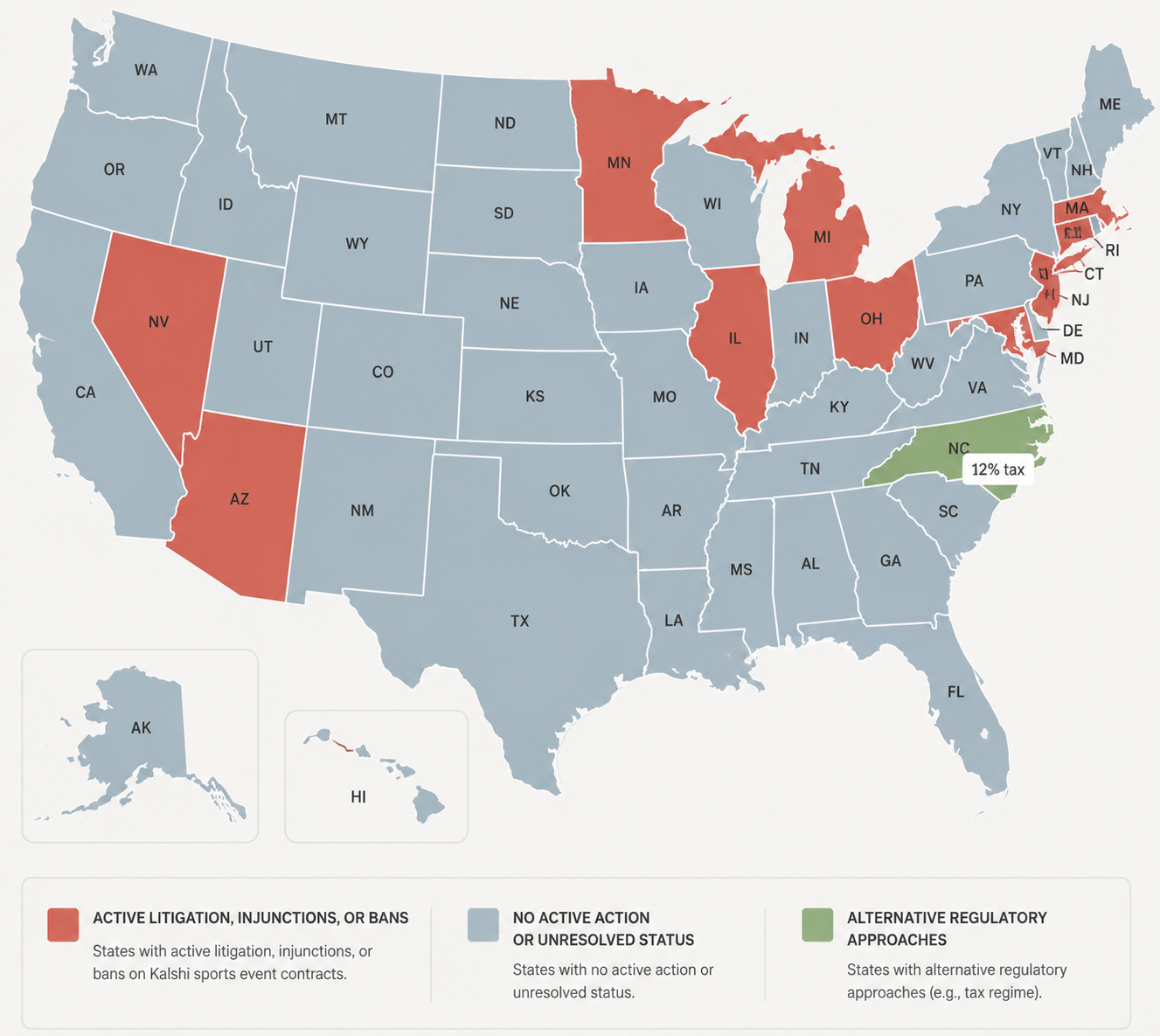
State Status Snapshot as of July 20, 2026
Use this table as a starting point, not a clearance memo. The posture can change with a stayed injunction, a new state order, or a federal court ruling. State availability figures also vary by source: CBS Sports described Kalshi as available in all 50 states with caveats, while FOX Sports described availability in 42 states, a discrepancy that reflects how quickly the litigation map was moving during the World Cup.[2][3]
| State or category | Current posture | Operational read | Source confidence |
|---|---|---|---|
| Massachusetts | State-initiated injunction litigation against Kalshi sports event contracts. | Treat as actively contested; do not rely on generic national availability language. | High for active litigation posture.[4][5] |
| Nevada | Federal court dissolved Kalshi’s preliminary injunction protection. | Material enforcement risk; Nevada is not a clean Kalshi-access state for sports contracts. | High for injunction posture.[4][5] |
| Arizona | Criminal charges reported, with proceedings paused; also named in the April 2, 2026 CFTC/DOJ federal action against state enforcement. | One of the highest-risk states because both criminal and federal preemption tracks are implicated. | High for contested status; narrow conclusions only on the reported pause.[4][6] |
| Michigan | Temporary halt reported in litigation coverage. | Treat as restricted or at least not operationally settled until current orders are checked. | Medium-high; confirm current docket before relying.[4][5] |
| Minnesota | Ban enacted against the relevant prediction-market activity. | Do not treat Kalshi sports contracts as simply available absent later relief. | High for restriction posture.[4][5] |
| New Jersey | State lost at the Third Circuit on preliminary-injunction review in KalshiEX v. Flaherty. | Kalshi has its strongest appellate leverage here, but the ruling is preliminary and not a final merits judgment. | High for appellate posture.[6][7] |
| Ohio | Active case identified in litigation map coverage. | Contested; state-specific review required before promotion, partnership, or compliance classification. | Medium-high; active litigation reported.[4][5] |
| Maryland | Active case identified in litigation map coverage. | Contested; do not infer legality from federal registration alone. | Medium-high; active litigation reported.[4][5] |
| Illinois | Active case identified; also named in the April 2, 2026 CFTC/DOJ federal preemption action. | Contested at both state and federal levels; current injunction posture matters. | High for contested status.[4][6] |
| Connecticut | Active case identified; also named in the April 2, 2026 CFTC/DOJ federal preemption action. | Contested at both state and federal levels; current injunction posture matters. | High for contested status.[4][6] |
| California and Texas | Reported as important access states because sports betting remains illegal there while prediction-market access was promoted or described as available. | Availability is not the same as settled legality; these states illustrate the market-expansion pressure, not a resolved court answer. | Medium for access framing; no specific enforcement action in the provided sources.[2][3] |
| North Carolina | State-level revenue response: prediction-market tax reported at 6%, compared with a 23% sportsbook tax. | A tax response is not a merits ruling on legality, but it shows why states care about classification. | High for tax comparison as reported by NPR.[1] |
| Other states | No specific enforcement action identified in the cited sources. | Do not treat silence as approval; verify state gaming, consumer-protection, tax, and advertising rules before launch activity. | Low for any state-specific conclusion. |
Why the World Cup Made the Fight Immediate
Kalshi’s sports contracts sit on a different legal rail from a conventional sportsbook ticket. A sportsbook wager is licensed state by state under gaming statutes. Kalshi’s position is that its event contracts trade on a CFTC-regulated exchange, and that the Commodity Exchange Act displaces state gambling-law interference with those contracts. For a fuller framework comparison, see the Kalshi-versus-sportsbook legal comparison.
That distinction mattered less when prediction markets looked like a niche financial product. It mattered much more when World Cup trading offered a functionally familiar consumer experience in places where state-licensed sports betting is unavailable or restricted. CBS Sports and FOX Sports both emphasized access differences during the tournament, including Kalshi’s lower minimum age of 18 compared with the 21-year-old threshold used by sportsbooks in most states, and access in major non-sportsbook states such as California and Texas.[2][3]
For state regulators, the concern is not just semantics. If a sports outcome contract can be offered nationally through a federal exchange, then state licensing, age-gating, responsible-gaming rules, advertising review, exclusion lists, and tax structures may be bypassed or weakened. North Carolina’s reported 6% prediction-market tax, compared with its 23% sportsbook tax, is the cleanest reported example of a state trying to capture revenue from the channel rather than relying only on prohibition.[1]
The market-impact story is covered separately in the World Cup and DraftKings regulatory analysis. The legal point is narrower: high-volume sports contracts made old federalism questions operational. Someone had to decide whether the product could be offered, advertised, integrated, taxed, or blocked in a particular state while the appellate courts were still writing the rules.
The Concrete State Actions Matter More Than the Slogan
“Legal in all 50 states” is not a compliance conclusion. It is, at best, a marketing-facing compression of a legal theory. The more useful question is what a state has actually done and whether a court has stopped it from continuing.
Massachusetts belongs near the top of any current file because the state initiated injunction litigation. Nevada matters because Kalshi’s preliminary injunction protection was dissolved. Arizona is more serious still because the reported record includes criminal charges, a pause in those proceedings, and a later federal offensive involving the CFTC and DOJ. Michigan, Minnesota, and New Jersey each belong in the same working list for different reasons: temporary halt, enacted ban, and appellate preemption ruling, respectively.[4][5][6]
Ohio, Maryland, Illinois, and Connecticut should not be treated as filler states. They appear in the active-case map, and Illinois and Connecticut were also named, with Arizona, in the April 2, 2026 CFTC/DOJ lawsuit asserting federal preemption against state enforcement. Holland & Knight described that federal action as an unprecedented federal offensive in the prediction-market fight.[4][6]
Those distinctions affect everyday decisions. A media affiliate deciding whether to run World Cup market copy faces a different risk in a state with only theoretical uncertainty than in a state with a live cease-and-desist posture, dissolved injunction, criminal matter, or federal-state lawsuit. A payment processor, data vendor, team partner, or tax department needs the same map, but for different reasons.
The Third Circuit Helps Kalshi, But It Does Not Settle the Country
Kalshi’s strongest appellate signal came on April 6, 2026, when the Third Circuit ruled 2-1 in KalshiEX v. Flaherty that New Jersey could not regulate Kalshi’s prediction market at the preliminary-injunction stage. The majority held that Kalshi had shown a reasonable likelihood of success on its argument that the Commodity Exchange Act preempts state gambling laws as applied to the challenged sports event contracts.[6][7]
Judge Porter’s majority reasoning matters because it treated the contracts as swaps within the CFTC-regulated exchange framework. If the product is within that federal structure, then a state gambling regulator cannot simply relabel the same contract as illegal gambling and impose a conflicting state regime. That is the core move in Kalshi’s preemption case.[6]
Judge Roth’s dissent is just as important for anyone advising outside the Third Circuit. The dissent rejected the majority’s approach to preemption and would have allowed more room for state gambling enforcement. Because the decision was divided and preliminary, it changes negotiating leverage, injunction strategy, and settlement posture. It does not produce a final merits ruling binding every state regulator.[6]
That limitation is not academic. New Jersey is in the Third Circuit. Nevada is not. Arizona is not. Illinois and Connecticut are not. A favorable preliminary ruling in one circuit is powerful authority, especially for Kalshi’s lawyers, but it is not a nationwide operating license.
The Emerging Circuit Split Is the Real Compliance Problem
The cited sources point to parallel federal appellate movement outside the Third Circuit: Ninth Circuit arguments on April 16, 2026, Fourth Circuit activity on May 7, 2026, and a Sixth Circuit intra-circuit split. The details matter less here than the resulting posture: no single federal appellate rule governs the country.[4][6]
That is why a national product can be operationally live while still being legally unstable. Kalshi can point to CFTC registration, exchange supervision, and the Third Circuit’s preemption reasoning. States can point to their police powers, gambling statutes, consumer-protection mandates, tax leakage, and the dissenting view that federal commodities law should not disable state gaming regulation so easily.
The April 2, 2026 CFTC/DOJ lawsuit against Arizona, Connecticut, and Illinois sharpened the conflict because it moved the federal government from passive regulator to affirmative litigant against state enforcement. That is a significant escalation, but it is still litigation, not a final Supreme Court rule or a congressional amendment.[6]
Gaming attorney Daniel Wallach projected that six more states would join litigation by the end of 2026. That projection is useful as a litigation-risk signal, not as a fact about what has already happened.[4]
Federal Legislation Is on the Board, Not in Force
Congress has at least noticed the classification problem. The Prediction Markets Are Gambling Act, associated with Curtis-Schiff, was introduced on March 23, 2026 and would reclassify sports event contracts as gambling.[6]
No later legislative-status information was identified in the sources cited here. That caveat matters. Introduced legislation can influence litigation narratives and agency posture, but unless enacted it does not answer whether Kalshi World Cup sports contracts may operate in Massachusetts, Nevada, Arizona, or any other state today.
How to Use This Guide Without Overreading It
The safest professional use of this guide is as a maintained reference point. Before relying on any operational conclusion, check four things: the specific state, the current docket posture, the restriction type, and the date of last review.
- State: Do not substitute a national Kalshi availability statement for state-specific review.
- Docket posture: A preliminary injunction, dissolved injunction, stayed order, criminal pause, or appeal can change the practical answer.
- Restriction type: A tax measure, gaming ban, cease-and-desist order, criminal case, and federal preemption lawsuit do different legal work.
- Evidence source: Distinguish audited platform data from third-party analytics, and distinguish adoption from legal effectiveness.
- Review date: In this area, a conclusion that was careful last month can be wrong after one appellate order.
Prediction-market traders reportedly assigned a 64% probability that the Supreme Court would accept a sports event contract case by the end of 2026. That is market data, not a legal forecast. It is useful mainly because it shows that market participants understand the dispute has not reached a final national endpoint.[4]
As of Q3 2026, Kalshi’s CFTC-regulated status gives it a serious federal preemption argument, and the Third Circuit has given that argument real appellate force. But sports event contracts remain jurisdiction-sensitive until final merits rulings, higher-court review, or federal legislation resolves the split. Verify the state, the current docket, and the last-review date before treating any Kalshi World Cup sports-contract conclusion as operationally reliable. This article is informational only and is not legal advice.
References
- Kalshi sports betting prediction markets DraftKings FanDuel World Cup, NPR, July 17, 2026.
- Kalshi World Cup 2026, CBS Sports.
- How to trade World Cup in your state: Kalshi, Polymarket, FOX Sports.
- Prediction Markets v. State Gaming Laws: The Kalshi Litigation Gamble, Epstein Becker Green.
- Five Legal Cases Defining Prediction Markets, PlayUSA.
- Federal Appeals Court CFTC Jurisdiction Over Sports Event Contracts, Holland & Knight, April 2026.
- New Jersey cannot regulate Kalshi's prediction market, US appeals court rules, Reuters, April 6, 2026.
Comments
Join the discussion with an anonymous comment.