
The July 2026 Mitch McConnell episode is a clean illustration of why “proof of life” has become useful legal-technology shorthand before it has become a formal legal term. First, an image circulated showing McConnell on life support. Snopes reported on July 8 that OpenAI’s verification tool found Google’s SynthID invisible watermark in two versions of the image, confirming that those versions were AI-generated.[1] Then McConnell’s office released a different kind of proof object: a photo of the senator holding a current Washington Post sports section. That photo, meant to rebut the rumor, was itself immediately accused of being AI-generated.[2]
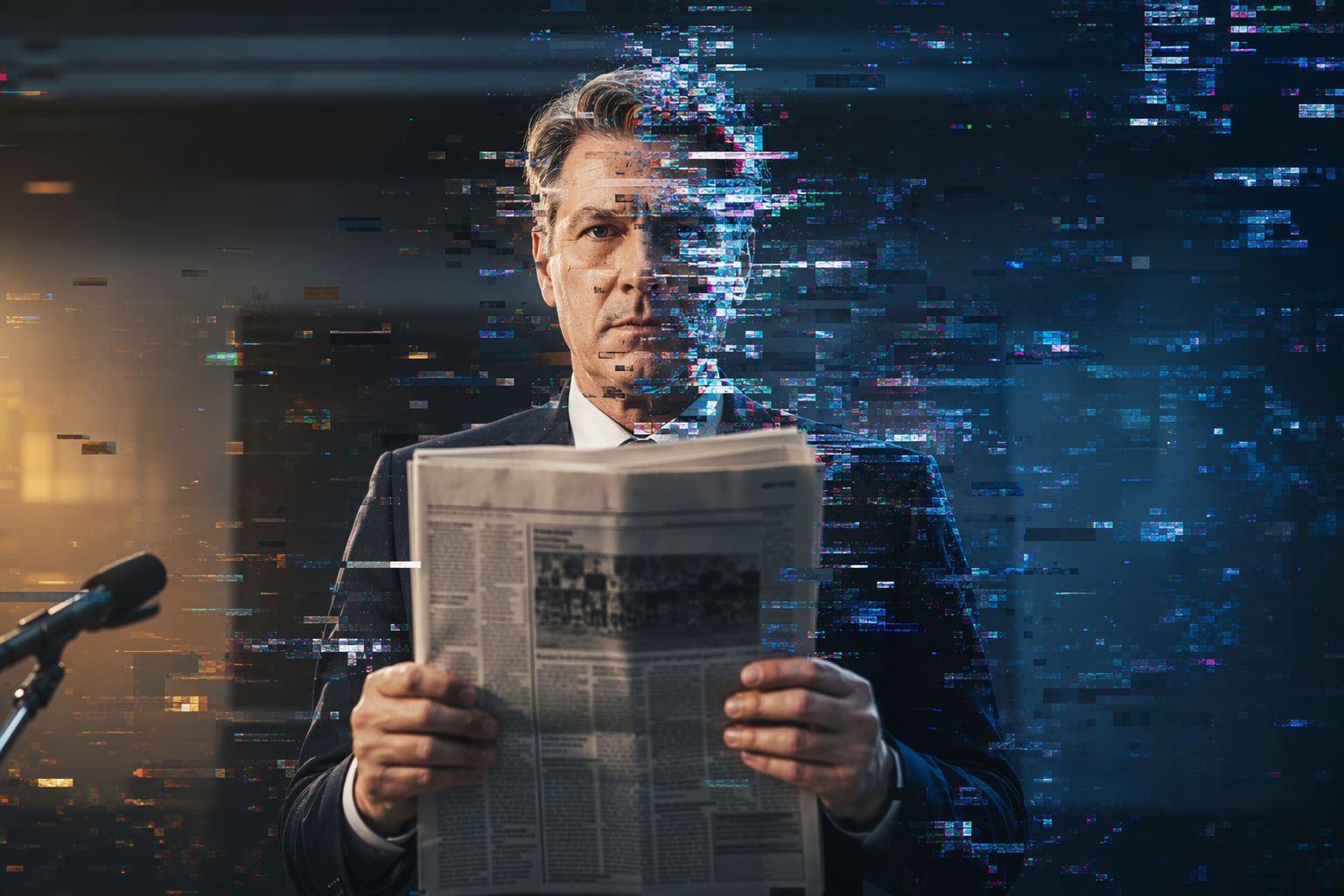
That sequence matters more than the rumor itself. A fake image was technically debunked; a real image was then offered as a familiar verification gesture; and the same public environment that made the first fake plausible made the second proof object suspect. PolitiFact, published by Poynter, reported that Hany Farid of UC Berkeley and Matthew Stamm of Drexel found no evidence that the office-released photo was AI-generated. The same report said SynthID, OpenAI verification, SightEngine, and WasItAI returned negative results for AI markers.[3]
For legal and compliance readers, the important point is not that every online allegation deserves an evidentiary response. It is that the act of verification no longer ends the dispute as reliably as it once did. A document, image, or recording can survive a technical check and still be treated by an audience as procedurally contaminated because synthetic media is now part of the background condition.
What “Proof of Life” Means Now
In its older kidnap-and-ransom sense, proof of life meant evidence that a captive was alive at a particular time. The classic proof object was deliberately time-specific: a hostage holding that day’s newspaper, repeating a current phrase, or displaying a requested number of fingers. BBC Future described this older protocol while testing how hard it has become for ordinary people to prove that they are not AI-generated; PR Daily made the same bridge in explaining why fingers have become a new public verification gesture.[4][5]
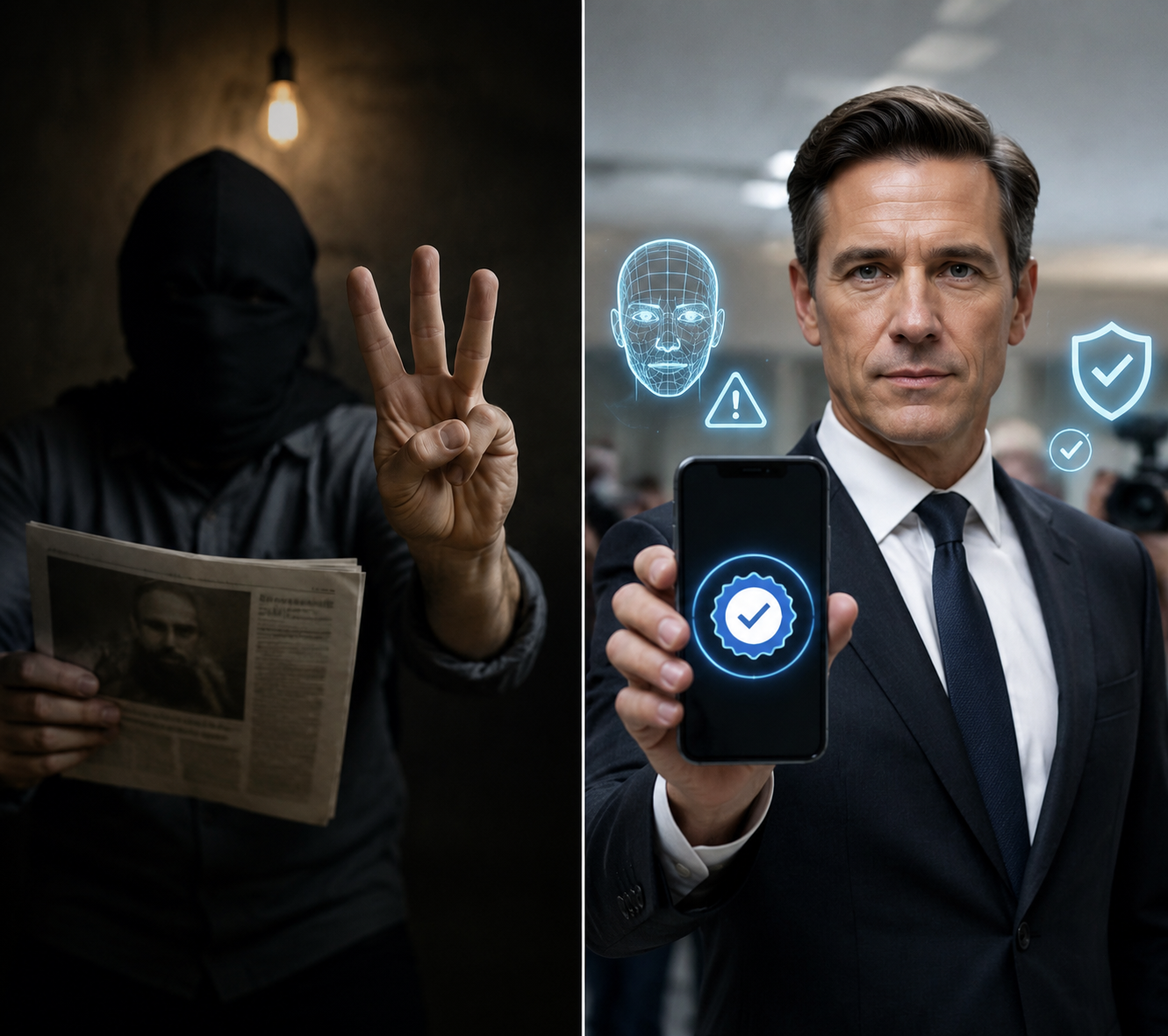
In the AI-era usage, “proof of life” describes a public verification act intended to establish that a person, appearance, or recording is real rather than synthetic. The action often borrows from hostage protocols: hold a newspaper, show fingers, appear in a current place, or perform something that seems difficult to pre-generate. The difference is the receiving audience. A ransom negotiator once asked whether the proof tied the captive to a time and instruction. A modern fact-checker, lawyer, campaign counsel, or newsroom editor must ask a second question: even if the object is authentic, will the relevant audience accept it as reliable?
That is why the McConnell controversy is not simply a misinformation anecdote. It shows the whole verification chain under stress: synthetic evidence, watermark detection, an attempted real-world rebuttal, forensic review, and continued disbelief.
The McConnell Case: Fake Evidence, Real Proof, Renewed Doubt
The first McConnell image was the easier technical problem. It depicted a gravely ill public figure, it spread rapidly, and investigators had a concrete artifact to test. Snopes reported that two versions carried SynthID, Google’s invisible watermark for AI-generated media, and that OpenAI’s verification tool detected it.[1] TechCrunch separately reported that Google’s deepfake detector system had been used to debunk the McConnell hoax picture, placing the episode among the first high-profile public demonstrations of SynthID’s practical value.[6]
The second image was harder because it was not a fake that needed identifying. It was a real-world rebuttal that had to overcome a public presumption of fakery. McConnell’s office released a photo of him holding the Washington Post sports section. The newspaper page was the familiar proof-of-life device: current, physical, and apparently difficult to stage before the fact. Yet Snopes reported on July 13 that conspiracy theorists, including Grok, X’s AI chatbot, claimed or suggested the photo was AI-generated.[2]
The available checks pointed the other way. PolitiFact/Poynter reported that Farid and Stamm found no evidence of AI generation, and that multiple detection tools returned negative results for AI markers.[3] France24 also found no evidence that McConnell’s “proof of life” photo was fake or AI-generated.[7] None of that converts the photo into omniscient proof of every surrounding fact about McConnell’s condition or schedule. It does support the narrower conclusion that the office-released newspaper photo was not shown by the cited forensic reviews to be AI-generated.
That narrower conclusion is the one professionals can actually use. A negative AI-detection result is not the same as a certificate of authenticity. A forensic expert’s “no evidence of AI generation” finding is not the same as proof that no manipulation occurred anywhere in the media chain. But it is also not nothing. In practice, it changes the burden of responsible discussion: a person claiming the photo is fake needs more than the ambient fact that AI exists.
The Netanyahu Precedent
McConnell was not the first high-profile 2026 case. In March, Benjamin Netanyahu posted a video from a Tel Aviv coffee shop after a fake AI-generated image circulated showing him appearing sick and weak. The New York Times reported that the video showed Netanyahu holding up five fingers as a proof-of-life response to AI-driven rumors, and that Grok mislabeled the real footage as AI-generated.[8]
The BBC later discussed the Netanyahu episode in the broader context of ordinary verification gestures becoming unstable in an AI environment, and BBC verification and NewsGuard confirmation of the disinformation origin form part of the case record.[4] The details are different from McConnell’s, but the procedural pattern is the same: a synthetic or misleading health rumor appears, the subject performs an embodied current-time gesture, and an AI-skeptical audience still has to decide whether the proof is real.
The five fingers mattered because hands have been treated, sometimes casually and sometimes credibly, as a weak point in generated imagery. But that is not a durable legal test. Models improve; compression and camera angle can create false alarms; and a real person can look strange in a real image. The useful lesson from Netanyahu is not “count the fingers.” It is that proof of life has moved from a private verification protocol into a public contest over what counts as adequate evidence.
The Liar’s Dividend Is the Mechanism
The legal concept that best explains these cases is the “liar’s dividend.” The Brennan Center uses the term in its analysis of deepfakes and elections to describe how the existence of synthetic media lets people cast doubt on genuine evidence.[9] Once deepfakes are common enough to be plausible, a denial does not have to prove fabrication. It can exploit uncertainty.
The McConnell episode is a compact version of that problem. The first image gave the public a reason to be suspicious because it was fake. The second image then suffered from the suspicion created by the first. The fake did not merely misinform viewers about McConnell; it weakened the evidentiary force of later genuine-looking material.
This is where unsupported skepticism becomes operationally expensive. A courtroom, campaign office, platform trust-and-safety team, or newsroom cannot treat every doubt as evidence. At the same time, it cannot ignore the fact that some visual proof objects now are synthetic. The professional task is not to believe images less. It is to separate evidence, verification, and post-verification acceptance.
| Question | Professional Relevance |
|---|---|
| Is the media file synthetic or manipulated? | Forensic review, metadata, watermark detection, source tracing, and chain-of-custody analysis address this question. |
| Can the verification method rule out all fabrication? | Usually no. A missing watermark or negative detector result narrows the inquiry but does not prove authenticity. |
| Will the audience accept the verified result? | Not necessarily. The liar’s dividend allows genuine evidence to remain rhetorically disputed after technical checks. |
What Watermarks Can and Cannot Settle
SynthID deserves attention because it worked in the first McConnell incident. Google DeepMind describes SynthID as a system for embedding and detecting imperceptible watermarks in AI-generated content.[10] In the McConnell hospital-image case, that invisible signal gave investigators a concrete basis for saying the image versions they tested were AI-generated.[1]
But watermark detection only answers the question it is designed to answer. TechCrunch reported that Gemini and OpenAI had joined the SynthID program, while Anthropic had not; the same reporting noted the practical limitation that the watermark is detectable only when the generation tool participates in the program.[6] Open-source models and nonparticipating systems do not become trustworthy simply because no SynthID mark appears.
That distinction is easy to lose in public argument. “SynthID found” is affirmative evidence of a particular kind. “SynthID not found” is not affirmative evidence that the image is real. The McConnell office photo appears to have passed several available checks, but those negative results are best read together with expert review, provenance, publication context, and the absence of contrary evidence—not as a single dispositive machine verdict.[3]
Content provenance standards try to solve a related problem from the other direction. The SecureRedact/ABA discussion of deepfakes and the justice system notes adoption of C2PA-style provenance by camera manufacturers, software companies, and media organizations, while also noting that smartphone integration remains years away.[11] Provenance can help show where a file came from and how it moved. It does not guarantee that every important public image will arrive with a clean credential.
Why the Term Is Showing Up in Legal-AI Discussions
The social conditions behind these proof-of-life controversies are not marginal. Inc., citing Wall Street Journal reporting, stated that deepfakes shared on social media jumped 1,500% from 2023 to 2025 and reached about 8 million.[12] BBC Future, citing AARP, reported that AI-enabled scams rose 20-fold between 2023 and 2025.[4] Those figures do not prove that any particular challenged image is fake. They explain why ordinary viewers, clients, and institutions have become easier to move into suspicion.
For lawyers, the term is likely to appear around evidentiary objections, campaign communications, platform disputes, crisis response, and professional responsibility. A witness may say a damaging video is synthetic. A candidate may issue a proof-of-life clip after a health rumor. A newsroom may ask whether a public figure’s verification gesture has been independently checked. A compliance officer may need to decide whether a political ad using AI-generated media triggers a disclaimer or ban.
Political-ad law is already moving faster than legal vocabulary. Wiley reported that more than 30 U.S. states had passed laws regulating AI-generated media in political advertising as of June 2026, generally through disclaimer requirements, prohibitions, or quasi-property and right-of-publicity protections.[13] MultiState separately counted 31 state deepfake laws as of April 2026, illustrating that the exact count varies by date and classification method.[14]
The constitutional boundaries remain unsettled. The SecureRedact/ABA discussion identifies First Amendment challenges to California deepfake laws, including federal-court rulings involving the Babylon Bee and Musk/X matters, and notes that satire and news exemptions remain contested. It also notes Arizona’s ethics-rule comment effective January 1, 2026, addressing attorneys’ obligations around deepfakes, and the federal Take It Down Act of 2025 for AI-generated non-consensual sexual content.[11]
Those developments do not make “proof of life” a codified legal-AI doctrine. The term is better treated as an emerging professional shorthand: a way to describe the verification act and the trust failure around it. It is useful precisely because the McConnell and Netanyahu cases are concrete. A person did the old thing—held up a newspaper, appeared in a current location, showed fingers—and still encountered an audience prepared to disbelieve the medium.
Definition
In the AI era, “proof of life” means a public verification act meant to establish that a person, appearance, or recording is real and current rather than AI-generated or otherwise fabricated. The term retains its older association with time-specific hostage verification, but its modern significance lies in the failure of ordinary visual proof to end disputes once synthetic media has made disbelief cheap.
As of July 18, 2026, the term is observationally grounded in the McConnell and Netanyahu cases and is useful for legal-AI discourse. It should not be described as a formally codified doctrine, evidentiary standard, or settled regulatory category.
References
- Fake Mitch McConnell hospital image spreads, Snopes, July 8, 2026
- Is this Mitch McConnell photo real?, Snopes, July 13, 2026
- The internet says Mitch McConnell's hospital photo is fake. The evidence says otherwise., Poynter, July 14, 2026
- I tried to prove I'm not AI. My aunt wasn't convinced, BBC, March 2026
- The Scoop: The new 'proof of life' is showing your fingers, PR Daily
- Google's deepfake detector system used to debunk McConnell hoax pic, TechCrunch, July 8, 2026
- No evidence Mitch McConnell's 'proof of life' photo is fake or AI-generated, France24
- Netanyahu Posts 'Proof of Life' Video as A.I. Sows Doubts About What's Real, New York Times, March 17, 2026
- Deepfakes, Elections, and Shrinking the Liar's Dividend, Brennan Center
- SynthID, Google DeepMind
- The liar's dividend: how are deepfakes impacting the justice system?, SecureRedact/ABA, February 2026
- A Disturbing Mitch McConnell Image Went Viral. Then Investigators Found a Hidden AI Fingerprint, Inc., July 9, 2026
- AI Restrictions in Political Ads: What to Know About 'Deepfake' Disclaimers and Bans, Wiley Law, June 30, 2026
- State Deepfake Laws in 2026, MultiState, February 12, 2026
Comments
Join the discussion with an anonymous comment.