
What Is the Unauthorized Practice of Law?
The unauthorized practice of law (UPL) refers to the act of providing legal services — giving legal advice, drafting legal documents, representing another person in court, or negotiating legal rights on behalf of someone else — without being licensed to practice law in the relevant jurisdiction. The core prohibition is codified in ABA Model Rule 5.5, which states that a lawyer shall not practice law in a jurisdiction where doing so violates the regulation of the legal profession in that jurisdiction, nor assist another in doing so. The rule applies equally to individual attorneys and to the entities they work for or through.
The activities that typically constitute the practice of law include:
- Giving legal advice — applying law to a specific set of facts and recommending a course of action.
- Drafting legal documents — wills, contracts, pleadings, or other instruments that affect legal rights.
- Representing others in court — appearing before a tribunal on behalf of a client.
- Negotiating legal rights — engaging with third parties to settle claims or modify legal obligations.
The Definitional Problem: No Uniform Standard
There is no single national definition of the practice of law. The American Bar Association attempted to create one in 2002, when its Taskforce on the Model Definition of the Practice of Law proposed a uniform definition. By March 28, 2003, the ABA abandoned the effort entirely, unable to reach consensus among the states. The final Task Force recommendation was that each jurisdiction should apply its own "common sense" to the question. The Model Rules now contain an official comment stating that "the definition of the practice of law is established by law and varies from one jurisdiction to another."
The result is a fragmented regulatory landscape. As Stacey Marz, Administrative Director of the Alaska Supreme Court, noted in a Thomson Reuters Institute webinar, UPL regulations represent "a real varied continuum of scope and clarity." Consider the range:
- Ohio defines the practice of law broadly, encompassing any activity that requires legal knowledge or skill, as established in the Dworken case and codified in Ohio UPL Advisory Op. 11-01 (2011).
- Virginia takes an unusual approach: its definition of the practice of law explicitly excludes advice given to one's "regular employer," creating a carve-out for in-house counsel and corporate legal departments.
- Alaska uses a narrow rule: UPL liability arises only if a person represents themselves to be a lawyer and, for compensation, gives advice or prepares documents affecting legal rights.
This jurisdictional patchwork matters because AI tools operate across state lines. A chatbot trained on general legal principles cannot know which state's UPL definition applies to a given user query — and neither can the user.
How AI Triggers UPL Concerns
AI systems can appear to perform acts that meet many states' definitions of practicing law. When a consumer-facing chatbot like DoNotPay or ChatGPT applies legal rules to a user's specific facts and recommends a course of action — "you should file a small claims case" or "this contract clause is unenforceable in your state" — that interaction closely resembles the core activity that UPL rules are designed to regulate.
The specific scenarios where AI triggers UPL concerns include:
- Consumer-facing legal chatbots — services like DoNotPay that market themselves as "robot lawyers" and generate legal documents or advice for users without attorney involvement.
- AI-assisted document assembly — platforms that generate wills, contracts, or court filings based on user inputs, where the AI determines which legal provisions apply.
- Legal information platforms — websites or apps that use generative AI to answer legal questions, even when disclaimers state the output is "not legal advice."
- Attorney-facing AI tools — when a lawyer uses an AI tool to draft pleadings or research case law, the lawyer remains responsible, but the tool itself may be performing tasks that would constitute UPL if done by an unlicensed person.
The Personhood Puzzle: Can AI 'Commit' UPL?
A foundational legal question underlies the entire debate: can an AI system commit unauthorized practice of law? The short answer, as Cathy Cunningham stated in the Thomson Reuters Institute webinar, is that "AI, at this time, does not have legal personhood status. So, AI can't commit unauthorized practice of law because AI is not a person." UPL rules are designed to regulate human conduct — they presuppose a person who can be licensed, disciplined, and held accountable.
But the analysis does not end there. As Nathanael Player of the Utah Courts pointed out in the same discussion, "AI does have a corporate personhood. There is a corporation that made the AI, the corporation providing that does have corporate personhood." This creates an unresolved liability question: if a corporation's AI system provides legal advice to a consumer, has the corporation engaged in UPL? Player acknowledged that "it's not clear, I don't think we know whether or not there is some sort of consequence for the provision of ChatGPT providing legal services."
A related doctrinal thread comes from the Lola v. Skadden Arps case (2nd Cir. 2015), where the court held that a contract lawyer performing document review under such tight constraints that she exercised no legal judgment was not practicing law. Legal scholars have drawn an implication from this: "if a lawyer is performing a particular task that can be done by a machine, then that work is not practicing law." This "machine test" cuts both ways — it suggests that some tasks currently performed by AI may fall outside the definition of practicing law, but it also raises the question of where the line between machine-appropriate tasks and human-required legal judgment lies.
"It's not clear, I don't think we know whether or not there is some sort of consequence for the provision of ChatGPT providing legal services." — Nathanael Player, Utah Courts, speaking at a Thomson Reuters Institute / NCSC AI Policy Consortium webinar
Regulatory Responses: Three Reform Paths and the FTC Action
Recognizing that existing UPL frameworks were not designed for AI, the National Center for State Courts (NCSC) and Thomson Reuters Institute AI Policy Consortium published a policy paper outlining three paths for modernizing UPL regulations. The consortium's framing is explicit: "Doing nothing is no choice at all and will perpetuate the access to justice crisis and cede the future of legal services to unregulated, and potentially harmful, market forces."
| Reform Path | Description | Example / Status |
|---|---|---|
| Path 1: Permissive Regulation | Revise UPL rules to explicitly permit vetted AI tools, with requirements for disclosure, data security, and transparency. | Colorado's Access to Justice Commission asked the Colorado Supreme Court to consider revising UPL rules regarding technological advances. |
| Path 2: Regulatory Sandbox | Create a sandbox allowing non-traditional providers and services to operate under supervision while collecting data on outcomes. | Utah's Supreme Court Standing Order Number 15 — which asks not whether services match what lawyers provide but "is this better than the absolute nothing that people currently have available to them?" |
| Path 3: Narrow Human-Conduct UPL | Revise the UPL definition so that only licensed persons may hold themselves out as lawyers, represent others in court, or provide legal advice affecting legal rights. | Alaska's existing rule — creates liability only if one represents oneself to be a lawyer and, for compensation, gives advice or prepares documents. |
While these state-level reforms are debated, the federal government has already acted. On February 11, 2025, the Federal Trade Commission finalized an order against DoNotPay, the company that marketed itself as "the world's first robot lawyer." The FTC's complaint, announced in September 2024, charged that DoNotPay failed to test whether its AI chatbot operated to the level of a human lawyer when generating legal documents and giving advice, and did not hire or retain attorneys to test the quality and accuracy of its law-related features.
The final order, approved by a 5-0 Commission vote on January 16, 2025, requires DoNotPay to:
- Pay $193,000 in monetary relief.
- Notify consumers who subscribed between 2021 and 2023 about the settlement.
- Cease advertising that its service performs like a real lawyer without sufficient evidence.
Practical Implications for Attorneys Using AI Tools
For practicing attorneys, the UPL question is not abstract — it connects directly to professional responsibility obligations under ABA Model Rule 5.3, which governs supervision of nonlawyer assistants. While the Model Rules were written with human paralegals and support staff in mind, the principle extends to AI tools: a lawyer who uses an AI system to perform tasks that would constitute UPL if done by an unlicensed person may be held responsible for that conduct.
The practical obligations for attorneys using AI tools include:
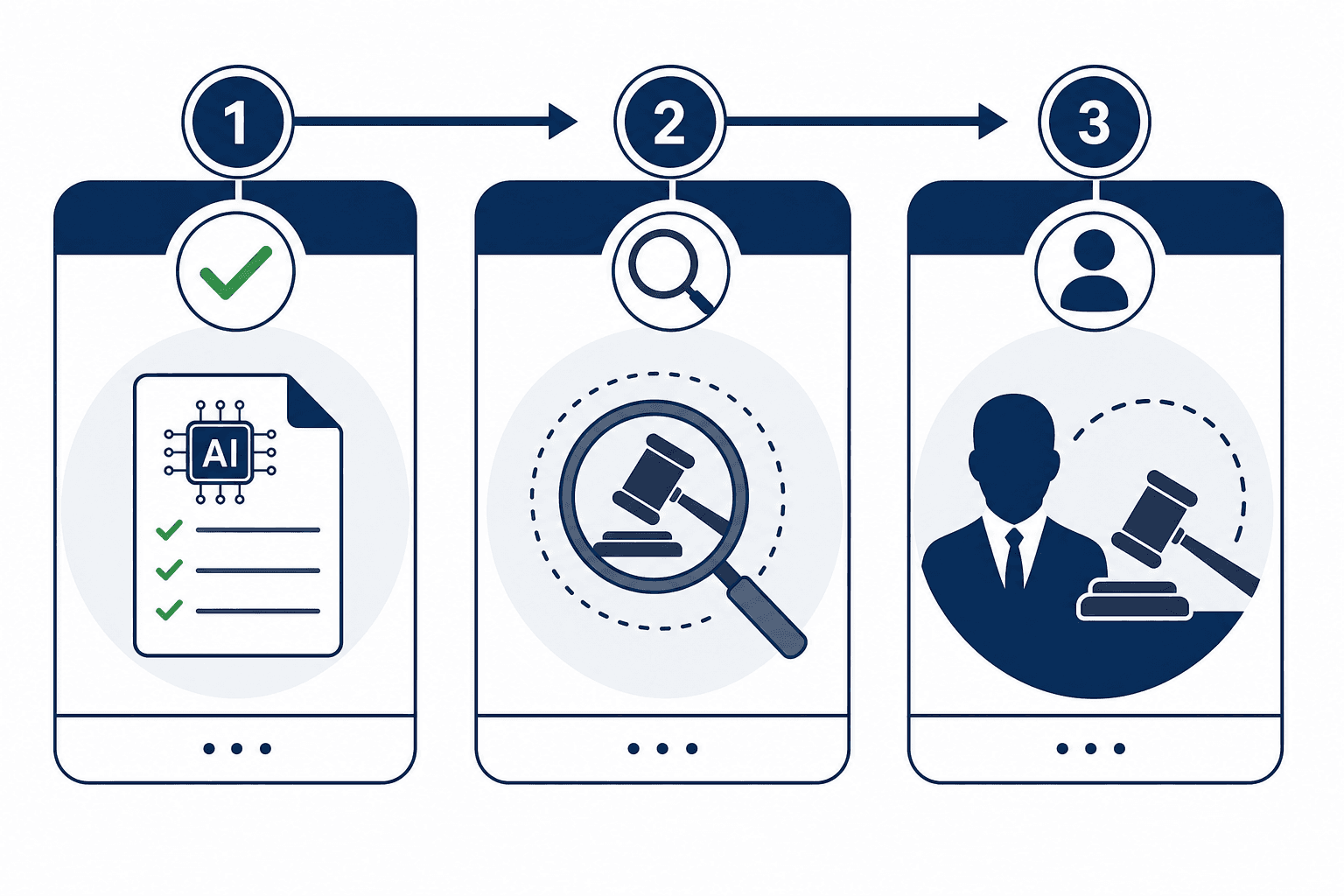
- Verify the output — AI-generated legal documents and research must be independently reviewed and validated by a licensed attorney before use.
- Understand the tool's limitations — know what the AI system can and cannot do, and where it is likely to produce errors or hallucinations.
- Know your jurisdiction's rules — UPL definitions vary by state, and some states have issued specific ethics guidance on AI use.
- Do not delegate judgment — tasks requiring legal judgment, such as determining which legal theory applies to a client's facts, must remain with the attorney.
- Disclose AI use where required — some courts now mandate disclosure of AI-generated content in filings.
The historical pattern is instructive. As law professor Thomas Spahn wrote in the Richmond Journal of Law and Technology in 2018, "lawyers often fight rearguard actions... but lawyers ultimately lose each fight. It would be safe to presume that the same outcome will occur with artificial intelligence." From the late-1800s book "Every Man His Own Lawyer" through Norman Dacey's "How to Avoid Probate!" in the 1960s, to LegalZoom's launch in 2001, each wave of technology that expanded access to legal information initially triggered UPL enforcement actions, and each wave ultimately led to regulatory accommodation.
The difference with AI is the scale and autonomy of the technology. Previous tools — books, software, online forms — were static. AI systems are dynamic: they generate new content for each user, adapt to inputs, and improve over time. This is why the personhood gap and the corporate liability question matter. The legal profession is not deciding whether to accommodate AI; it is deciding how to regulate a technology that is already operating in the gap between what UPL rules prohibit and what the law can practically enforce.
Key Takeaways
- UPL is defined by state law, not federal statute. There is no single national definition — the ABA abandoned its attempt to create one in 2003, and the Model Rules defer to each jurisdiction.
- AI systems can appear to perform acts that meet many states' definitions of practicing law — applying law to specific facts and recommending a course of action — but regulatory frameworks remain unclear.
- The "personhood gap" means AI cannot itself commit UPL because it lacks legal personhood, but the corporation providing the AI has corporate personhood, creating unresolved liability questions.
- Three reform paths have been proposed by the NCSC/TRI AI Policy Consortium: permissive regulation, regulatory sandboxes (Utah model), and narrowing UPL to human conduct only.
- The FTC's 2025 finalized order against DoNotPay ($193K relief, prohibition on "robot lawyer" claims) establishes that marketing AI as equivalent to a human lawyer triggers federal consumer protection liability.
- Attorneys remain responsible for supervising AI tools under Model Rule 5.3, and must verify output, understand tool limitations, and know their jurisdiction's specific rules.
Comments
Join the discussion with an anonymous comment.