
Last updated: July 18, 2026. This article addresses the post-election incapacity mechanism in Section 4 of the 25th Amendment. For the separate pre-election transparency question, see our companion analysis of candidate health-disclosure legal requirements. This is informational analysis, not legal advice.
Section 4 of the 25th Amendment does not begin with a medical diagnosis. It begins with a written declaration. The constitutional question is not whether observers, physicians, aides, voters, or commentators believe a president shows cognitive decline. The legal question is who is empowered to convert evidence of inability into a temporary transfer of presidential power, and what must happen after that conversion begins.
The operative sentence is exacting about actors and documents: whenever the Vice President and either a majority of the principal officers of the executive departments, or another body that Congress may provide by law, transmit to the President pro tempore of the Senate and the Speaker of the House their written declaration that the President is unable to discharge the powers and duties of the office, the Vice President immediately assumes those powers and duties as Acting President.[1]

The Procedure Section 4 Actually Creates
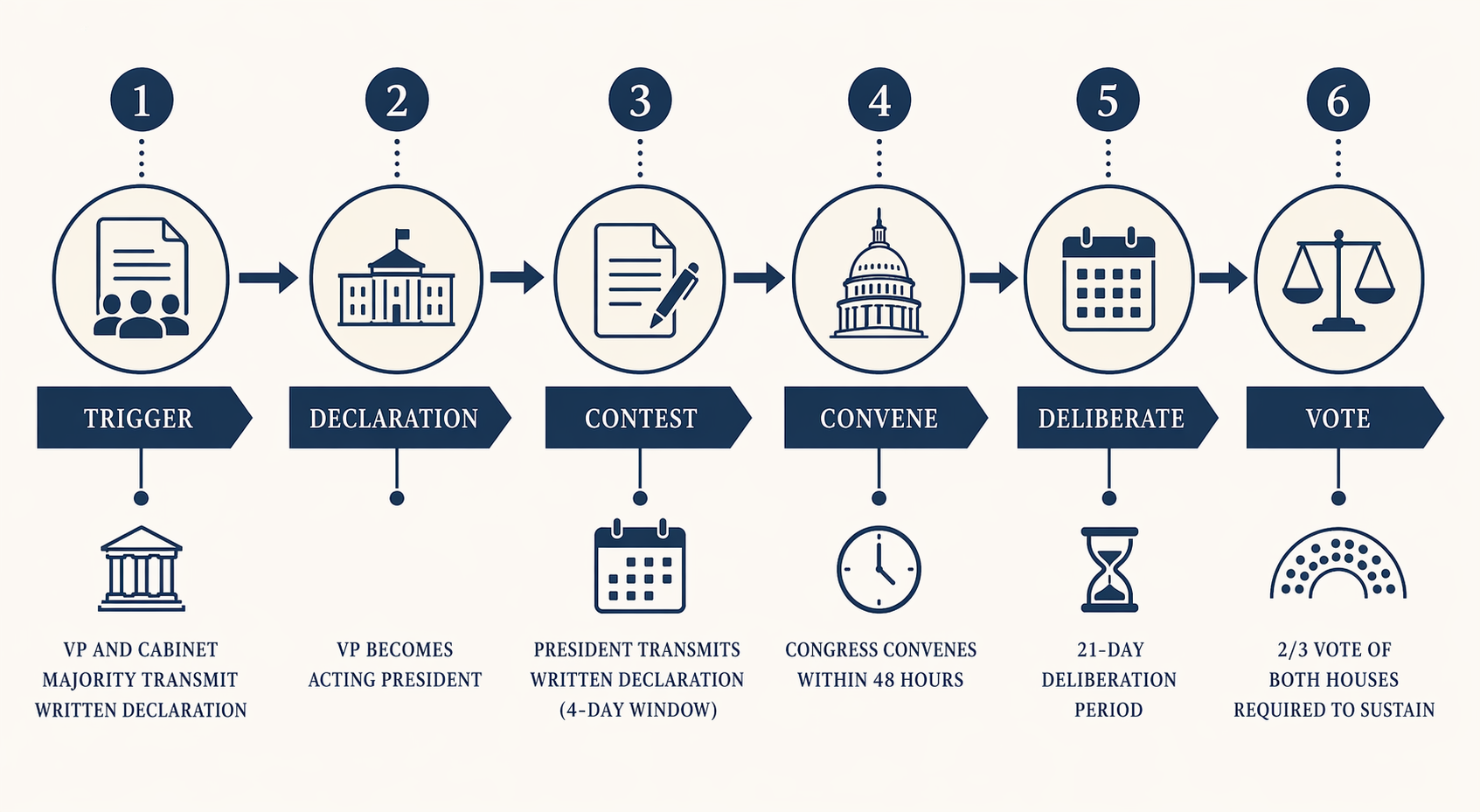
The cleanest way to read Section 4 is as a sequence. It is not a general permission slip for removal, and it is not a medical-review statute. It is a constitutional mechanism for deciding who exercises presidential power while a contested incapacity judgment is pending.
| Stage | Constitutional act | Immediate legal effect |
|---|---|---|
| Trigger | The Vice President acts with either a majority of the principal executive officers or an “other body” Congress has provided by law. | No transfer occurs until the required written declaration is transmitted. |
| Declaration | The declaration goes to the President pro tempore of the Senate and the Speaker of the House. | The Vice President immediately becomes Acting President. |
| Presidential contest | The President may transmit a written declaration stating that no inability exists. | The President resumes the powers and duties unless the Vice President and triggering body contest within four days. |
| Counter-declaration | The Vice President and triggering body may transmit another written declaration that the President remains unable. | Congress must decide the issue. |
| Congress convenes | If Congress is not in session, it must assemble within 48 hours. | The dispute moves from executive declaration to congressional decision. |
| Congress votes | Congress has 21 days after receiving the later declaration, or 21 days after assembling, to determine the issue. | The Vice President remains Acting President only if two-thirds of both houses agree that the President is unable. |
The first practical consequence is that the Vice President is indispensable under the currently operable route. A Cabinet majority alone cannot trigger Section 4. Nor can congressional leaders, military officers, physicians, agency heads outside the constitutional category, or courts initiate the transfer by themselves. The Vice President must join the declaration.
The second consequence is that Section 4 uses formal notice, not informal consensus. The declaration must be written, and it must be transmitted to two named congressional officers. That does not answer what evidence should be assembled before the declaration. It does mean that, constitutionally, the transfer of authority turns on a defined institutional act rather than on a leaked diagnosis, a staff memorandum, or a public demand.
The third consequence is easy to miss: the initial transfer is immediate. Once the required declaration is transmitted, the Vice President assumes the powers and duties of the office as Acting President. The President has not been removed from office. The President remains President, but the Vice President exercises presidential authority.
The President’s Rebuttal Starts the Harder Clock
Section 4 then gives the President a direct procedural answer. The President may transmit a written declaration to the same two congressional officers stating that no inability exists. If the Vice President and the triggering body do nothing further, the President resumes the powers and duties of the office.[1]
If the Vice President and the majority of the Cabinet, or the authorized other body, disagree, they have four days to send another written declaration that the President is unable. That four-day period is not a general reflection period for the public. It is a constitutional rebuttal window for the institutional actors who made the original incapacity judgment.[1]
Once the counter-declaration is transmitted, Congress decides. If Congress is not in session, it must assemble within 48 hours. Congress then has 21 days to determine whether the President is unable to discharge the powers and duties of the office. If two-thirds of both the House and Senate agree, the Vice President continues as Acting President. If that two-thirds threshold is not met, the President resumes the powers and duties.[1]
This is why the phrase “invoke the 25th Amendment” is too loose for careful use. Section 4 has at least three distinct legal moments: the initial executive-branch declaration, the President’s rebuttal, and the congressional supermajority decision if the rebuttal is contested. A cognitive-fitness dispute would not be resolved merely by producing medical evidence. It would be resolved, if contested, by whether the constitutionally specified actors can carry the process through those stages.
What “Unable” Does Not Define
The word doing the most substantive work is “unable.” Section 4 does not define it. It does not say “medically incapacitated,” “cognitively impaired,” “diagnosed with dementia,” “unable to pass a cognitive examination,” or “unfit in the opinion of physicians.” The omission was not an overlooked drafting gap that later lawyers can close by selecting a clinical screen.
The Yale Law School Rule of Law Clinic and American Constitution Society reader’s guide emphasizes the institutional consequence of that choice: medical evidence may inform the process, but Congress must make its own judgment under the constitutional standard.[2] That formulation matters. Medical evidence can describe symptoms, functional limitations, diagnoses, fluctuations, medication effects, or prognosis. Section 4 asks whether the President is unable to discharge the powers and duties of the office.
Rep. J. Edward Hutchinson warned during the 1965 House debate that the determination “will be a political one.”[2] The line is often read as a concession to partisanship. It is better read as a statement about constitutional design. Section 4 assigns the final contested judgment to elected and appointed constitutional actors, using written declarations, congressional officers, strict timing rules, and supermajority votes. It does not outsource the legal conclusion to a clinician.
That does not make medicine irrelevant. In a cognitive-fitness case, medical evaluation could be central to the factual record. It could help distinguish ordinary aging, episodic illness, medication effects, psychiatric symptoms, neurological disease, temporary confusion, or a severe inability to understand and execute official responsibilities. But the evidence would still have to be translated into a constitutional judgment by the actors Section 4 names.
The Missing “Other Body”
Section 4 gives Congress an option it has never completed. The Vice President may act with “a majority of either the principal officers of the executive departments or of such other body as Congress may by law provide.”[1] Congress has not enacted legislation establishing that other body. As a result, the alternative mechanism exists in the Constitution but not in operative statutory form.
That absence is not decorative. If the concern is cognitive decline, the difference between a Cabinet majority and an independent or congressionally created capacity body could be substantial. Cabinet officers are politically appointed executive officials who work for the President. A separate body might include physicians, former officials, judges, or other experts, depending on how Congress designed it. But until Congress creates such a body by law, it cannot perform the triggering role Section 4 contemplates.
Rep. Jamie Raskin’s 2026 push for a Commission on Presidential Capacity Act, H.R. 8275, is therefore best understood as a live attempt to operationalize this dormant clause, not as an amendment to the basic Section 4 sequence. The constitutional option is already there. The statutory institution is what remains absent.
For lawyers advising in this space, that distinction is important. The “other body” language is not an invitation for private panels, medical associations, congressional committees, or ad hoc expert groups to substitute themselves into Section 4. Without enacted legislation, their assessments may inform public or official judgment, but they are not the constitutionally authorized triggering body.
Why the Supermajority Threshold Changes the Practical Meaning
The Brennan Center’s critique of Section 4 focuses less on the opening trigger than on the endgame. Because a contested declaration must be sustained by two-thirds of both houses of Congress, the Vice President remains Acting President only if the incapacity judgment commands overwhelming congressional support.[3]
That threshold is higher than impeachment’s removal threshold in one respect: impeachment requires a two-thirds vote in the Senate after House impeachment, while Section 4 requires two-thirds in both chambers to keep power with the Acting President after the President contests the finding.[1][3] The comparison should not be pushed too far, because impeachment and incapacity serve different constitutional purposes. But the vote requirement shows how hard it would be to sustain a disputed incapacity determination in a divided Congress.
The Brennan Center argues that this makes Section 4 effectively inoperable except in cases approaching near-unanimity.[3] That is a practical judgment about institutional threshold, not proof that the amendment has no legal function. The threshold may deter weak or opportunistic attempts. It may also prevent action where evidence of inability is serious but political agreement is not broad enough to satisfy the constitutional requirement.
Cognitive-fitness disputes sharpen that difficulty. A president who is unconscious, missing, or physically unable to communicate may present a clearer record than a president whose cognitive function is intermittent, contested, or observable only through fragments of performance. Section 4’s deadlines are precise, but the vote threshold means ambiguity tends to favor restoration of the President’s powers unless the supermajority is reached.
The Historical Predicate Was Incapacity, Not Diagnosis
The amendment’s history explains why the mechanism exists without turning every later dispute into a medical-history exercise. The familiar predicate episodes include President James Garfield’s 80-day incapacity after he was shot in 1881, President Woodrow Wilson’s approximately seven-month stroke-related disability in 1919, President Dwight Eisenhower’s three serious illnesses from 1955 to 1957, and President John F. Kennedy’s assassination in 1963.[2]
Those episodes exposed different problems: physical incapacity, concealed disability, temporary illness, succession after death. Section 4 addresses the case in which the President is alive but unable, and either cannot or will not invoke the voluntary transfer mechanism in Section 3. It was built for a constitutional problem of authority, not for a comprehensive taxonomy of presidential health.
That background also explains why cognitive decline is a difficult fit. Cognitive impairment may be gradual rather than sudden. It may be disputed by loyal advisers and suspected by outsiders. It may affect judgment, memory, attention, impulse control, or communication in ways that do not map neatly onto the formal powers of the presidency. Section 4 can receive that evidence, but it does not tell the decision-makers how much of it is enough.
Competency Evidence Can Inform the Judgment, But It Cannot Supply the Rule
Brookings’ analysis of presidential competency frames the problem as a “who decides” question.[4] That is the right emphasis for Section 4. The most sophisticated clinical account still has to be placed into a constitutional process that assigns decision-making authority to the Vice President, Cabinet or authorized body, and ultimately Congress if the President contests the finding.
The Lawfare analysis of presidential disability likewise treats the process as a set of practical institutional moves rather than a single diagnostic event.[5] Who has access to the President? Who can credibly assess performance? Who signs the declaration? What happens if the President responds? How fast can Congress assemble? Those questions are procedural, but they determine whether evidence can have legal effect.
No existing cognitive assessment tool measures, in a legally controlling way, the specific skill set required for presidential command. That point is narrow. It does not mean cognitive testing is useless. It means a test result cannot, by itself, answer the constitutional question. The presidency involves classified information, crisis response, delegation, judgment under uncertainty, command authority, and sustained executive supervision. Section 4 does not reduce those functions to a score.
The 1983 Miller Center commission took a more science-forward view, arguing that medical expertise could play a larger role in presidential incapacity determinations.[2] That view remains in tension with the framers’ decision not to define inability. It is possible to want better medical input and still acknowledge that the Constitution has not made any medical standard legally dispositive.
No Court Has Interpreted Section 4
The most uncomfortable limitation is also the simplest: Section 4 has never been judicially interpreted in a contested presidential incapacity case. Its text is available. Its legislative history is available. Academic and institutional commentary is available. A body of case law applying “inability” to cognitive fitness is not.
That absence should discipline the analysis. It is possible to describe the written-declaration process, the four-day rebuttal period, the 48-hour convening requirement, the 21-day decision window, and the two-thirds vote requirement with confidence because those rules are in the constitutional text.[1] It is not possible to say with the same confidence how a court would treat a disputed cognitive-fitness record, whether such a dispute would be justiciable, or what evidentiary standard a court would apply if it ever reached the merits.
The likely practical reason is built into the design. Section 4 sends the contested judgment to Congress and uses a demanding political threshold. A court asked to intervene in the middle of that process would confront not only the undefined word “unable,” but also the Constitution’s express assignment of the decision to Congress after competing declarations have been transmitted.
What a Cognitive-Fitness Process Would and Would Not Decide
A Section 4 cognitive-fitness process would not decide whether the President is a good decision-maker, whether voters should have known more before the election, whether the President’s public performances were reassuring, or whether a particular diagnosis carries political stigma. Those may be serious public questions, but they are not the operative Section 4 question.
The operative question is narrower and harsher: is the President unable to discharge the powers and duties of the office, and can the constitutionally authorized actors sustain that judgment through the required declarations and votes? If the President does not contest the declaration, the Vice President serves as Acting President while the inability continues. If the President contests and Congress fails to reach the two-thirds threshold in both houses, the President resumes the powers and duties.[1]
A medical record could be persuasive without being legally sufficient. A public pattern could be alarming without being constitutionally conclusive. A Cabinet could believe the evidence is grave and still fail to persuade Congress by the required supermajorities. Conversely, the formal mechanism could move quickly if the Vice President, Cabinet, and Congress broadly agreed that the inability was real.
That is the shape of the 25th Amendment cognitive fitness legal process. The law is precise about signatures, recipients, timing, institutional actors, and vote thresholds. It is silent about the medical standard that many people want it to contain. Because no court has interpreted Section 4, no statute has created the “other body,” and no cognitive test has been made legally controlling, cognitive evidence can inform the constitutional process. It cannot complete it.
References
- Amendment XXV, Cornell Legal Information Institute.
- The Incapacitation of a President and the Twenty-Fifth Amendment: A Reader’s Guide, American Constitution Society.
- The Unworkable Amendment, Brennan Center for Justice.
- 25th Amendment: How do we decide whether the president is competent?, Brookings.
- How Unraveled Does Trump Have to Be? Presidential Disability and the 25th Amendment, Lawfare.
Comments
Join the discussion with an anonymous comment.