
The newest argument over the 25th Amendment’s removal process began, formally, with a bill. On April 14, 2026, Rep. Jamie Raskin announced legislation to create a 17-member Commission on Presidential Capacity, with equal party representation and designed to serve as the “other body” that Section 4 allows Congress to authorize for judging presidential inability. [1]
The timing was not quiet. USA Today reported the bill in the context of President Donald Trump’s threats involving Iran, while Axios reported that more than 85 House Democrats had called for impeachment or removal in that political moment. [2][3] Those are related facts, but not the same fact. The Raskin bill’s co-sponsors, the broader group calling for impeachment or removal, and the constitutional actors who could actually trigger Section 4 occupy different places in the machinery.
That distinction is the first useful discipline in any history of the 25th Amendment’s removal process. Section 4 has not remained unused because no one thought about presidential incapacity. It has remained unused because thinking about it is not the same as invoking it. The Constitution does not permit commentators, members of Congress acting alone, physicians acting alone, or a House majority acting alone to remove a president through Section 4. It requires particular officers to sign a declaration, gives the president a way to contest it, and then demands supermajorities in both chambers if the dispute reaches Congress.
The mechanism Congress left almost untouched
Section 4 is the involuntary transfer provision of the 25th Amendment. It is different from Section 3, which lets a president temporarily transfer power voluntarily. Section 4 begins when the Vice President and a majority of the principal officers of the executive departments — or the Vice President and another body Congress may provide by law — transmit a written declaration that the president is unable to discharge the powers and duties of the office. [4]
At that point, the Vice President immediately becomes Acting President. If the president does not contest the declaration, the transfer holds. If the president sends a written declaration saying that no inability exists, the president resumes the powers and duties of the office unless the Vice President and the Cabinet majority, or the Vice President and the congressionally authorized body, respond within four days with another written declaration. [4]
Then Congress becomes the deciding forum. If Congress is not in session, it must assemble within 48 hours. Congress then has 21 days to decide the question. To keep the Vice President as Acting President, two-thirds of both the House and the Senate must determine that the president is unable to discharge the office. If either chamber falls short, the president resumes power. [4]
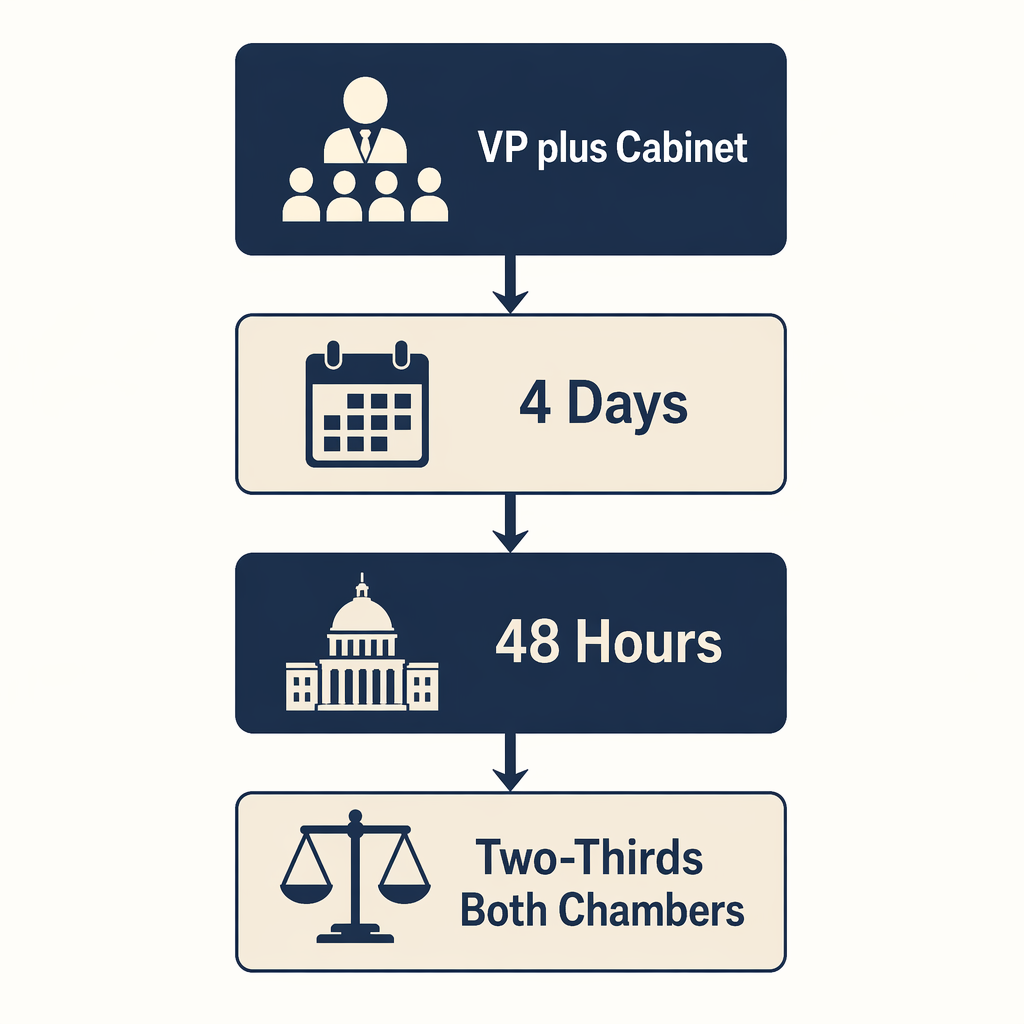
That last threshold is not decorative. It is higher than the Senate vote needed to convict after impeachment, and it applies in both chambers. For a separate comparison of those two procedures, see the legal analysis of Section 4 and impeachment. The practical consequence is that a contested Section 4 removal cannot survive as a narrow party-line operation. It must become a congressional consensus large enough to include members who may be asked to disable a president of their own party.
Why the drafters wrote a hard-to-use provision
The 25th Amendment was ratified in 1967, but its problem was older than the Cold War presidency. President James Garfield lingered for roughly two and a half months after being shot in 1881, with the government forced to operate around a wounded president. President Woodrow Wilson’s 1919 stroke was concealed from much of the public and from many officials while others controlled access to him. President Dwight Eisenhower, after health episodes during the 1950s, reached informal understandings with Vice President Richard Nixon about how temporary disability might be handled. [5][6]
These were not abstract law-school puzzles. They exposed a constitutional hole: the country had rules for death, resignation, and removal by impeachment, but no settled process for the president who was alive yet unable to act, or unable to acknowledge inability. Informal arrangements could work only while the relevant people were cooperative, trusted one another, and faced a disability that fit their private agreement.
The assassination of President John F. Kennedy in 1963 supplied the urgency. Vice President Lyndon B. Johnson became president, but Kennedy’s death sharpened attention to succession and disability at the top of the executive branch. Senator Birch Bayh became the principal congressional architect of the amendment, and John Feerick, then a young lawyer who had studied succession, played a major role in the drafting process. [5][6]
One of the most consequential drafting choices was what the amendment did not define. “Inability” was left open. That was not an oversight. A precise definition might have been too narrow for the next crisis or too easily gamed by political actors. The drafters were building a process for unknown emergencies, not a diagnostic manual. The price of that flexibility is visible in every later episode: before anyone reaches the two-thirds congressional vote, someone must decide that the president’s condition fits an undefined constitutional term. [5][6]
The four serious near-invocations
Section 4’s record is best read as a sequence of institutional tests. In each episode, the relevant question is not simply whether the president looked incapacitated, alarming, impaired, or dangerous to some observers. The question is whether the Vice President and Cabinet, or a Congress-created substitute body acting with the Vice President, actually moved the constitutional paperwork.
| Year | President | Why Section 4 came into discussion | Who actually moved? |
|---|---|---|---|
| 1981 | Ronald Reagan | He was shot and underwent emergency surgery after an assassination attempt. | No Section 4 declaration was transmitted. |
| 2018 | Donald Trump | Deputy Attorney General Rod Rosenstein reportedly discussed the possibility after Trump fired FBI Director James Comey. | No Vice President-and-Cabinet action occurred. |
| 2021 | Donald Trump | Officials discussed Section 4 after the January 6 attack on the Capitol. | No Section 4 declaration was transmitted before Trump left office. |
| 2026 | Donald Trump | Raskin introduced legislation to create the congressional “other body” for presidential capacity. | The bill proposed an institutional body; the materials supplied do not establish enactment or invocation. |
1981: Reagan’s shooting and the first practical test
On March 30, 1981, President Ronald Reagan was shot in an assassination attempt and underwent emergency surgery. The situation looked like the sort of sudden physical crisis Section 4 had been written to address: the president was alive, the executive branch needed continuity, and the inability question could not wait for ordinary politics to settle. [5]
The amendment still was not invoked. Vice President George H. W. Bush was not in Washington when the shooting occurred, and officials debated how to handle the chain of command. Secretary of State Alexander Haig’s public statement that he was “in control here” became the famous line from the day, but it was not a Section 4 act. No written declaration from the Vice President and a Cabinet majority was transmitted. [5]
The Reagan episode is important because it was not a partisan incapacity claim. It was a physical trauma, public and immediate. If Section 4 were simply an emergency switch, 1981 would have been the clean case. Instead, officials relied on continuity, communication, and the expectation that Reagan’s condition would stabilize. The constitutional formality remained in reserve.
2018: the Rosenstein discussions and the problem of intent
The 2018 episode was different. It was not a hospital-room crisis. According to later reporting summarized in accounts of the amendment’s history, Deputy Attorney General Rod Rosenstein discussed the possibility of invoking the 25th Amendment after President Trump fired FBI Director James Comey. [5] The factual record around those discussions has been contested, including disputes over whether comments were serious, sarcastic, or exploratory. That uncertainty matters because Section 4 is not triggered by concern inside the Justice Department. It requires the Vice President and Cabinet majority, or the Vice President and a congressionally authorized body.
This is where much public discussion of Section 4 tends to slide from law into metaphor. A president may be described as erratic, reckless, or unfit by critics; executive officials may privately worry about conduct; legislators may believe the country is in danger. None of that supplies the required signatures. The relevant legal actor in the first instance is the Vice President, whose exposure is unlike anyone else’s. The Vice President would not merely comment on presidential fitness. The Vice President would become Acting President while inviting a direct contest from the elected president.
For readers focused on mental capacity and behavioral fitness, the separate cognitive-fitness process analysis explains why Section 4 does not operate as a standing medical examination regime. The 2018 episode shows the same point from another direction: informal alarm is not a constitutional declaration.
2021: January 6 and the shortest clock
The most intense modern pressure on Section 4 came after January 6, 2021, when a mob attacked the Capitol as Congress met to count electoral votes. In the aftermath, officials and members of Congress discussed whether Vice President Mike Pence and the Cabinet should invoke the 25th Amendment against President Trump. [5]
Here the institutional barriers were not hidden; they were compressed by time. Section 4’s contested process can consume days even after the initial declaration: a presidential response, a four-day period for the Vice President and Cabinet or other body to persist, congressional assembly if needed, and then up to 21 days for the final determination. [4] In January 2021, the presidency was already near its scheduled transfer. The constitutional question therefore collided with a calendar question: could the mechanism be initiated, sustained, and resolved before the term ended?
No Section 4 declaration was transmitted. The House instead impeached Trump for incitement of insurrection, and the Senate trial occurred after he left office. [5] That route had its own constitutional and political disputes, but it did not require the Vice President to lead the initial displacement of the president from within the executive branch.
2026: the Raskin Commission bill and the unused “other body”
The 2026 Raskin bill is different from the earlier episodes because it does not purport to invoke Section 4 by itself. It tries to build a missing institutional part: the “other body” that Section 4 says Congress may provide by law. Raskin’s announcement described a 17-member Commission on Presidential Capacity with equal party representation. [1]
That design choice matters. The Cabinet route has always been legally available, but it asks the president’s own senior executive officers to declare the president unable. Cabinet officers may have direct knowledge of the president’s functioning, but they also serve in the president’s administration, may owe their offices to the president, and may be asked to act in a crisis with profound partisan consequences. A standing commission would not eliminate those consequences, but it would give Congress a preauthorized body rather than forcing improvisation after the emergency begins.
The bill should not be confused with actual removal. Even if enacted, a commission could not displace a president alone. Section 4 still requires the Vice President to act with the relevant body. If the president contested the transfer, two-thirds of both chambers would still be needed to keep the Vice President as Acting President. [4] The commission would make one dormant pathway operational; it would not lower the constitutional threshold.
Nor should the 2026 political numbers be collapsed into one another. Axios reported more than 85 House Democrats calling for impeachment or removal, while Raskin’s own release concerned legislation creating the commission. [1][3] The supplied materials establish introduction and public support in that moment; they do not establish that the bill had become law as of the July 19, 2026 research date.
Why availability has not become use
The Brennan Center has described the amendment as “unworkable,” not because the text is impossible to read, but because its politics are so forbidding. [7] That critique lands most sharply in contested cases. If the president accepts incapacity, Section 3 or an uncontested Section 4 transfer may handle the problem. If the president fights, the process becomes a constitutional confrontation among the Vice President, Cabinet or commission, the president, and Congress.
The first barrier is personal and institutional. The Vice President must move first. That requirement was a stabilizing choice: it prevents an outside board, a faction of Congress, or a group of doctors from unilaterally sidelining a president. It also means the official with the clearest succession interest must put a name on the declaration. In a real crisis, that signature may look either like constitutional courage or attempted usurpation, depending on who is judging it.
The second barrier is evidentiary without being formally evidentiary. Section 4 does not define inability, does not prescribe a medical standard, and does not say what degree of risk is enough. Physical unconsciousness, major surgery, cognitive impairment, psychiatric instability, refusal to perform duties, and dangerous abuse of office do not all present the same constitutional question. Some may fit more easily than others, but the text does not sort them for the actors who must decide.
The third barrier is congressional. A contested Section 4 transfer survives only if two-thirds of the House and two-thirds of the Senate agree that the president is unable. [4] That requirement is not a procedural afterthought. It is the final safeguard against converting incapacity into ordinary political removal. It is also the reason Section 4 may be hardest to use precisely when the country is most divided about the president’s conduct.
The history since 1967 therefore reads less like neglect than restraint built into the architecture. In 1981, officials faced physical incapacity but did not formalize the transfer. In 2018, reported internal discussions never became action by the Vice President and Cabinet. In 2021, the mechanism was discussed under emergency political pressure but not invoked before the term ended. In 2026, Raskin’s bill tried to make the alternative body real, while leaving the central Section 4 thresholds intact. [1][5]
That is the sober answer behind the familiar phrase “25th Amendment removal.” The process exists. It has been contemplated repeatedly. It has not been used because the Constitution assigns the first move to actors closest to the president and the final contested judgment to congressional supermajorities. The 2026 bill matters because it would organize the “other body” the amendment has always allowed. The remaining obstacle is the one the drafters put there: removal through Section 4 must be more than alarm, more than opposition, and more than a bare majority’s conclusion that the president should no longer serve.
References
- Ranking Member Raskin Introduces Legislation Establishing Independent Commission on Presidential Capacity, Rep. Jamie Raskin, April 14, 2026.
- How 25th Amendment could affect Trump, USA Today, April 14, 2026.
- Trump 25th Amendment impeachment Iran Democrats, Axios, April 14, 2026.
- Amendment XXV, National Constitution Center.
- Twenty-fifth Amendment to the United States Constitution, Wikipedia.
- The 25th Amendment: Succession of the Presidency, National Archives Prologue, 2017.
- The Unworkable Amendment, Brennan Center for Justice.
Comments
Join the discussion with an anonymous comment.