
The first legal problem after the July 20 attack at 26 Federal Plaza is not whether the facts sound frightening. An incendiary device was allegedly thrown or set off at a federal building in Manhattan, injuries were reported, and a suspect was in custody, but as of July 21, 2026, no formal federal charging document had yet fixed the case into counts, elements, and penalty ranges.[1][2] That distinction matters for any discussion of legal charges and terrorism in the 26 Federal Plaza incendiary-device attack: the public label can move faster than the indictment, while the indictment has to survive statutory sequencing.
On the visible record, the strongest federal charging vehicle is 18 U.S.C. §844(f), the statute that covers malicious damage or destruction, by fire or explosive, of property owned, possessed, or leased by the United States. If prosecutors allege personal injury, subsection (f)(2) becomes the center of the case rather than a footnote, because Congress wrote a separate injury-based penalty tier into the statute.[3]

Start With §844(f), Not With the Label
Section 844(f) does most of the work before anyone reaches the terrorism question. It applies when a person maliciously damages or destroys, or attempts to damage or destroy, by fire or explosive, a building, vehicle, or other property owned, possessed, or leased by the United States, or by any institution or organization receiving federal financial assistance.[3] For 26 Federal Plaza, the federal-property part is not difficult to see. The harder work would be proving the act, the device, malice, causation, and the injury tier.
| §844(f) tier | Trigger | Penalty consequence |
|---|---|---|
| §844(f)(1) | Malicious damage or destruction, or attempt, by fire or explosive, involving covered federal or federally assisted property | Imprisonment for not less than 5 years and not more than 20 years |
| §844(f)(2) | Conduct under §844(f) that directly or proximately causes personal injury | Imprisonment for not less than 7 years and not more than 40 years |
| §844(f)(3) | Conduct under §844(f) that directly or proximately causes death | Death penalty or imprisonment for any term of years or for life |
That tiering is why reported injuries matter more than generalized descriptions of alarm. A no-injury federal-property fire or explosive case under §844(f)(1) carries a 5-year mandatory minimum and a 20-year maximum. If the conduct directly or proximately causes personal injury, §844(f)(2) raises the range to a 7-year mandatory minimum and a 40-year maximum. If death results, §844(f)(3) moves to life-or-death-eligible sentencing territory.[3]
The injury tier also affects the terrorism analysis later. Section 2332b(g)(5)(B), the federal-crime-of-terrorism list, does not simply point to all of §844(f) in one undifferentiated way for this issue; it expressly lists §844(f)(2) and §844(f)(3).[4] That means an injury-producing §844(f)(2) charge is not just a more serious arson-or-explosives count. It is the statutory doorway through which the federal terrorism framework can enter.
The Crosswalk: Offense, Terrorism Classification, Sentencing Effect
The cleanest way to analyze the case is in three steps. First, identify a chargeable offense. Second, ask whether that offense qualifies as a “Federal crime of terrorism” under 18 U.S.C. §2332b(g)(5). Third, if it does, ask whether the sentencing guideline enhancement in USSG §3A1.4 applies.
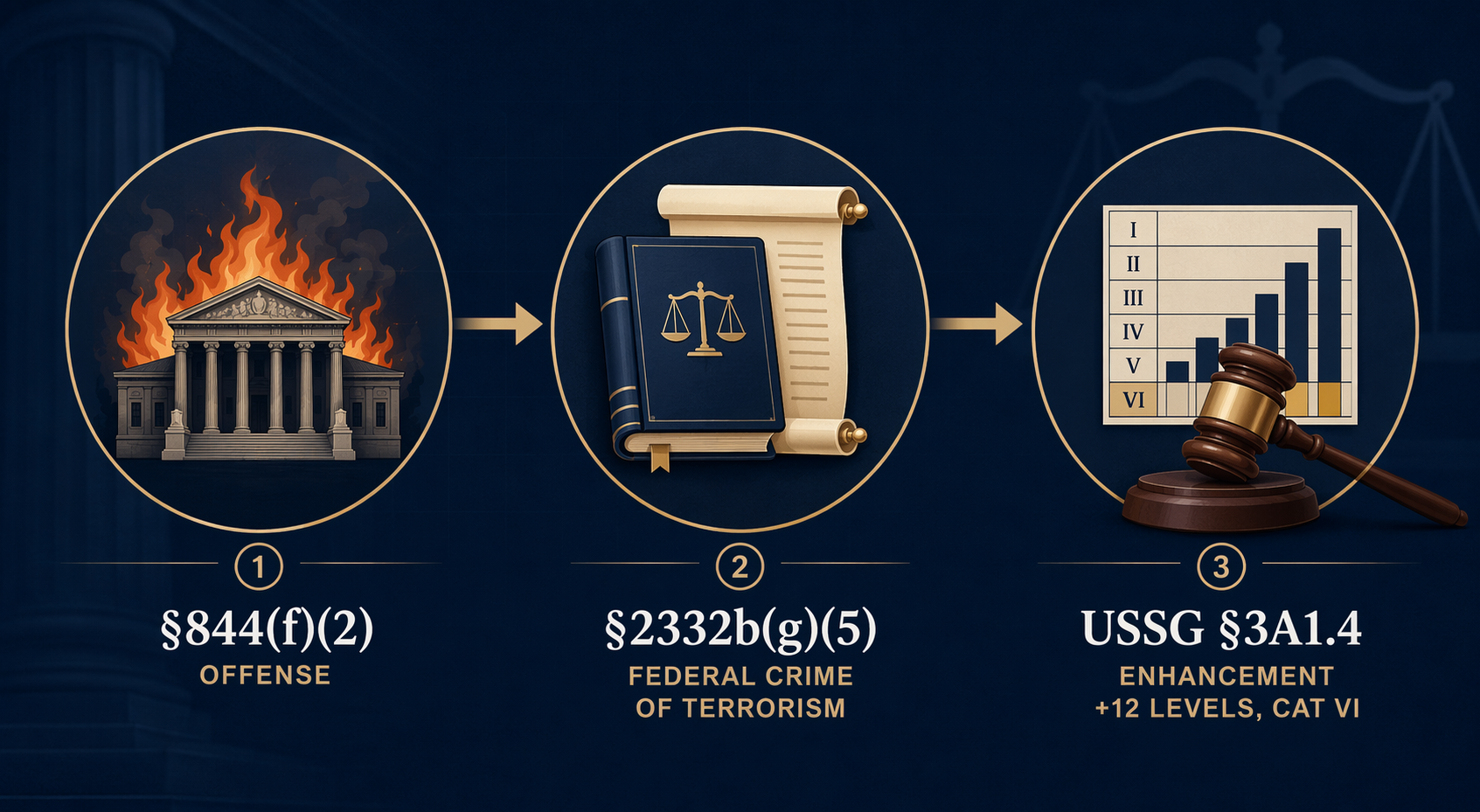
The first step is §844(f)(2), if the government can prove the federal-property fire-or-explosive offense and personal injury. The second step is §2332b(g)(5), which has two parts: the offense must be one of the listed statutes, and it must be “calculated to influence or affect the conduct of government by intimidation or coercion, or to retaliate against government conduct.”[4] The third step is §3A1.4, which increases the offense level by 12 levels, or to level 32 if the resulting level would otherwise be lower, and places the defendant in criminal history Category VI when the offense is a felony that involved, or was intended to promote, a federal crime of terrorism.[5]
That is a large sentencing consequence. It is also why the legal fight would not be limited to whether the device burned, exploded, or injured someone. Once §844(f)(2) is in play, the motive clause in §2332b(g)(5)(A) becomes a practical battleground.
Where the Reported Statements Fit
The reported statements attributed to the suspect, Bretton Arrabaca, matter here if they are admissible and accurately reported. ABC News reported that he said he was “targeting the building” and was “OK if he hurt or killed people.”[2] The first statement would bear on whether the object was the federal building itself, rather than a random street-level disturbance. The second would bear on knowledge, intent, and the foreseeable injury consequences, though it does not by itself prove the government-conduct motive required by §2332b(g)(5)(A).
For the terrorism enhancement, the government would need more than a dangerous act at a federal site. It would need to connect the act to influencing, affecting, or retaliating against government conduct. A statement that the building was the target helps, because 26 Federal Plaza is not merely a private address with federal tenants in the background. But “targeting the building” and “calculated to influence or affect government conduct” are not identical propositions. One is reported speech. The other is a statutory finding with sentencing consequences.
No Standalone Domestic Terrorism Charge Does Not End the Inquiry
There is no general standalone federal domestic terrorism offense. That point is often where public discussion gets muddy. “Domestic terrorism” can describe conduct in statutory definitions and public statements without appearing as the caption of a count in an indictment. The International Center for Not-for-Profit Law’s February 2026 explainer makes the same distinction and notes that federal terrorism law can still affect prosecutions through sentencing enhancements and related statutory mechanisms.[6]
The absence of a standalone domestic terrorism count therefore does not prevent a terrorism enhancement. It changes the route. Prosecutors would not need to charge “domestic terrorism” as its own offense. They would need a felony offense that qualifies under §2332b(g)(5), plus proof that the offense involved, or was intended to promote, a federal crime of terrorism for §3A1.4 purposes.[4][5]
Nor is the enhancement limited to cases with mass-casualty plans or foreign terrorist organizations. ICNL’s explainer notes that courts have applied the federal terrorism enhancement to property-damage activists.[6] That does not make the enhancement automatic in this case. It does make it a real prosecutorial tool rather than a theoretical add-on reserved only for the most familiar terrorism fact patterns.
The FBI’s Public Caution Matters, But It Is Not the Statute
At the press conference, FBI Assistant Director in Charge Christopher Barnacle declined to call the attack terrorism, according to the Associated Press report carried by WFLX.[1] That statement should not be treated as a binding legal ruling. It should be treated as a serious signal about the posture of the investigation at that moment.
There are several reasons that caution may coexist with a later enhancement request. Investigators may not yet have searched devices, interviewed witnesses, completed lab work, or developed motive evidence. Prosecutors may also decide that the initial complaint should charge the most readily provable offense and leave enhancement litigation for sentencing. Conversely, the same caution could foreshadow a decision not to seek the terrorism framework unless additional evidence supplies the government-conduct motive.
The Justice Manual’s archived §9-63.900 says the FBI has primary investigative jurisdiction over §844(f) matters perpetrated by terrorist or revolutionary individuals.[7] Because the page is archived, it should not be overstated as current 2026 charging policy. Used carefully, it explains why the FBI frame is unsurprising when a federal building and an incendiary or explosive device are involved. It does not answer whether this defendant’s conduct will be formally treated as terrorism.
What a Charging Document Would Need to Do
A complaint or indictment built around §844(f)(2) would need to do more than say an incendiary device was used at 26 Federal Plaza. It would need to allege facts supporting the covered-property requirement, the malicious use of fire or explosive, the damage or attempted damage, and the direct or proximate personal injury connection. The injury allegation is not decoration; it is what moves the case from §844(f)(1)’s 20-year maximum to §844(f)(2)’s 40-year maximum.[3]
- For the base charge, prosecutors would focus on the device, the federal property, the act of damage or attempted damage, and malice.
- For §844(f)(2), they would add proof that personal injury was directly or proximately caused by the conduct.
- For the federal-crime-of-terrorism classification, they would rely on §844(f)(2)’s placement in §2332b(g)(5)(B) and evidence satisfying §2332b(g)(5)(A).
- For USSG §3A1.4, they would litigate whether the felony involved, or was intended to promote, a federal crime of terrorism.
The defense would have obvious pressure points. It could challenge whether the device qualifies as charged, whether damage or attempted damage to covered property is provable, whether injuries were directly or proximately caused by the alleged conduct, and whether any statements actually show a purpose to influence or retaliate against government conduct rather than anger, instability, recklessness, or some other motive that does not satisfy §2332b(g)(5)(A).
The sentencing phase is where those distinctions become unusually consequential. A defendant can face a serious explosives or fire-damage sentence without the terrorism enhancement. But if §3A1.4 applies, the guideline calculation changes sharply because of the 12-level increase and automatic criminal history Category VI treatment.[5] That is why the enhancement decision is not just a label fight. It changes the advisory sentencing range architecture.
The Narrow Legal Bottom Line
Under the facts reported so far, §844(f)(2) is the strongest visible federal charging vehicle for the 26 Federal Plaza incendiary device attack if prosecutors can prove personal injury. That statute carries a 7-year mandatory minimum and 40-year maximum, and it is expressly listed in §2332b(g)(5)(B) as a federal crime of terrorism.[3][4]
That listing can legally unlock USSG §3A1.4, with its 12-level increase and criminal history Category VI effect, but only if the government can also satisfy the motive component tied to influencing, affecting, or retaliating against government conduct.[4][5] The reported statements that the building was the target and that injuries or deaths were acceptable would be relevant to that fight, not a substitute for it.[2]
The remaining uncertainty is not cosmetic. The FBI publicly declined to apply the terrorism label in the immediate aftermath, and no formal charges had been filed as of July 21, 2026.[1] Prosecutors may still charge §844(f)(2), may still preserve a terrorism-enhancement path, and may still decide not to invoke that framework. The statutes line up far enough to make the enhancement legally available on the right proof. They do not make the charging decision inevitable.
References
- Man in custody after allegedly throwing incendiary device in NYC federal building, authorities say, WFLX/AP, July 20, 2026.
- Man in custody after setting off incendiary device at federal building, ABC News.
- 18 U.S. Code § 844 - Penalties, Cornell Legal Information Institute.
- 18 U.S. Code § 2332b(g)(5) - Federal crime of terrorism, Cornell Legal Information Institute.
- §3A1.4. Terrorism, United States Sentencing Commission.
- Federal Terrorism Law and U.S. Civil Society: An Explainer, International Center for Not-for-Profit Law, February 2026.
- 9-63.000 - Protection Of Public Order, U.S. Department of Justice Justice Manual.
Comments
Join the discussion with an anonymous comment.