
American Airlines Flight AA584 did not end where passengers expected. The July 17, 2026 flight from Dallas Fort Worth to Tucson diverted to Phoenix, reportedly because of operational constraints rather than a mechanical failure, and passengers were then bused from Phoenix to Tucson.[1] That is the practical fact that turns an aviation operations story into a legal question: the airplane appears to have landed before the crew crossed the fuel-reserve line, but the passengers still experienced the consequences of a plan that did not get them to the contracted airport by air.
On the presently available public record, no confirmed FAA enforcement action, NTSB investigation, or filed lawsuit tied specifically to AA584 has been identified. The legal issue is therefore not whether American has already been charged with a violation. It is whether the diversion creates regulatory and civil exposure worth examining: dispatch release, fuel uplift, alternate-airport assumptions, weather and routing constraints, passenger remedies, and whether a similar low-fuel diversion from American’s DFW operation one day earlier changes the way regulators or plaintiffs would read the event.

The 45-Minute Reserve Is a Legal Floor, Not a Comfort Margin
For domestic Part 121 operations, the central rule is 14 CFR § 121.639. It requires enough fuel to fly to the airport to which the aircraft is dispatched, then to the most distant alternate airport specified in the dispatch release, and then for 45 minutes at normal cruising fuel consumption.[2] The rule does not say that a carrier may plan to arrive with whatever fuel remains after ordinary delays, nor does it treat the 45 minutes as a buffer to be casually consumed when the operation becomes inconvenient.
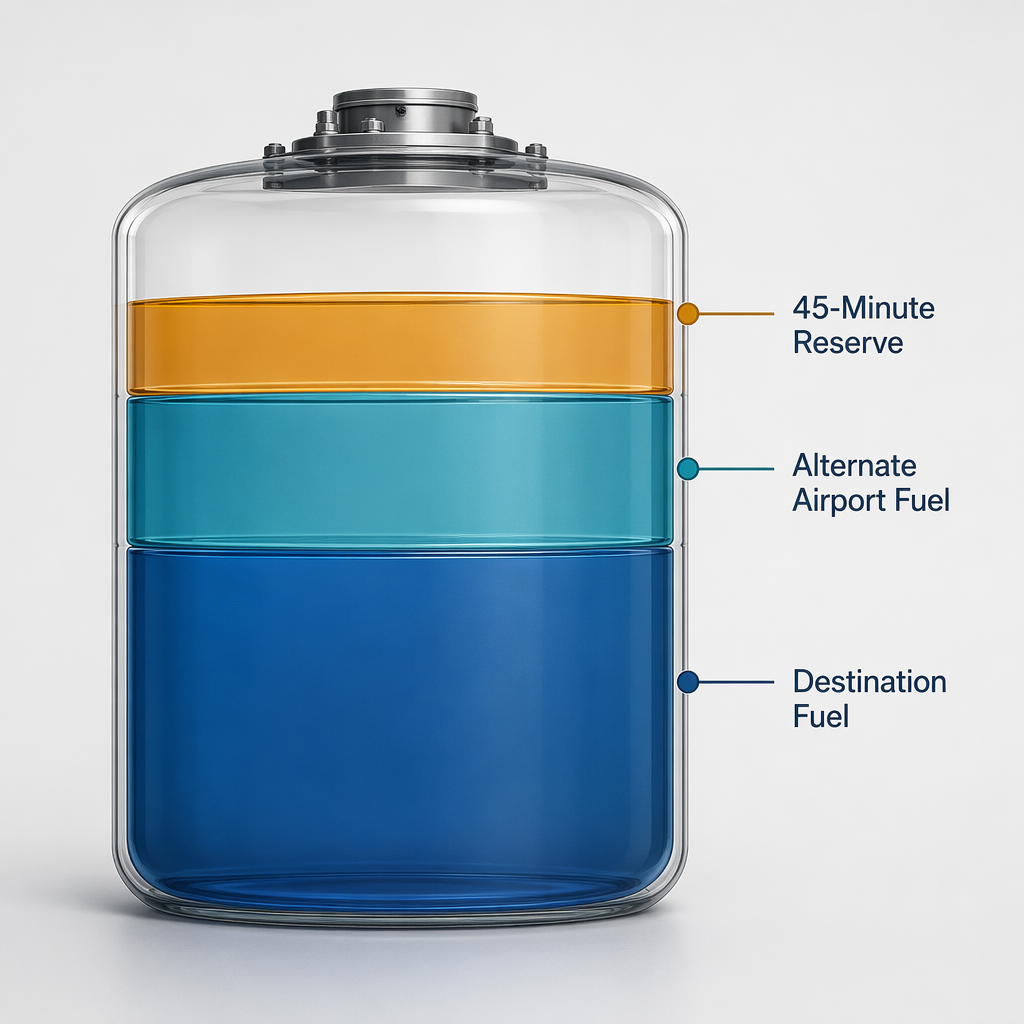
That distinction matters for AA584. A diversion to Phoenix before the legal reserve became fragile is not, by itself, evidence that the pilots violated the fuel rule. It may indicate the opposite: the crew recognized that continuing to Tucson would create an unacceptable fuel posture and chose a safer, nearer airport. Part 121 fuel compliance is not judged only at the moment the wheels touch down. It begins with the dispatch release and the planned fuel supply for the destination, the alternate, and the required reserve.
| Fuel component under § 121.639 | Legal significance for AA584 |
|---|---|
| Fuel to destination | The plan had to support DFW-to-Tucson completion under the conditions used for dispatch.[2] |
| Fuel to most distant alternate | The dispatch release assumptions matter because the rule measures beyond the destination, not merely to it.[2] |
| 45-minute normal-cruise reserve | The reserve is the regulatory floor; diverting before breaching it may be prudent rather than incriminating.[2] |
The harder question is upstream. If American dispatched AA584 with legally adequate fuel based on reasonable assumptions, and the flight encountered constraints that made Phoenix the correct safe choice, the diversion may be a compliant operational outcome. If, however, the route, weather, ATC constraints, alternate planning, or fuel uplift made Tucson unrealistic without leaning on the reserve, then the legal focus shifts away from cockpit judgment and toward operational control.
Section 121.645, which governs fuel supply for flag and supplemental operations, sits nearby in the regulatory landscape but does not need to carry this incident analysis. The AA584 issue, as publicly described, is more directly framed by the domestic fuel rule and the dispatch-planning discipline implied by Part 121 operations.[2]
Why a Legally Prudent Diversion Can Still Create Exposure
Airline fuel events are easy to overstate. A low-fuel diversion does not automatically prove that the aircraft was below regulatory reserve, that the crew delayed too long, or that the airline committed a violation. The public facts about AA584 support a narrower conclusion: the crew appears to have avoided a reserve problem by choosing Phoenix, while the diversion raises questions about why the original plan could not be completed to Tucson.
Those questions would not be answered by the passenger-facing explanation alone. A meaningful review would look at the dispatch release, the fuel actually uploaded, the alternate listed, expected and actual routing, Tucson and Phoenix weather, enroute delays, aircraft performance assumptions, and communications between the crew and dispatch. The legal point is procedural rather than theatrical: if the documents show a compliant plan overtaken by circumstances, the diversion is easier to defend; if the documents show thin planning, the safe landing does not erase the planning issue.
That is also why the passengers’ eventual arrival in Tucson by bus does not close the file from a legal perspective. Transportation was completed in a practical sense. But the airline sold carriage by air to Tucson, landed at a different airport, and substituted ground transport after the flight ended at Phoenix. That sequence may matter for refund rights, contract analysis, and damages even if it does not establish a fuel-reserve violation.
FAA Scrutiny Would Start With Dispatch, Not With Blaming the Crew
If the FAA examined AA584, the most productive path would likely be dispatch compliance and operational control. Part 121 carriers do not operate on a pilot-only planning model. Dispatchers and airline systems share responsibility for releasing flights that satisfy regulatory fuel requirements and for monitoring operational developments after departure. A diversion made before the reserve is exhausted can still prompt the regulator to ask why the release became unworkable.
The distinction matters because enforcement files often turn on records rather than headlines. The agency would not need to prove that passengers were frightened or that a flight attendant made a dramatic announcement. It would need to understand whether American’s dispatch process complied with the applicable fuel rule and whether the assumptions in the release were reasonable when made. Operational explanations that stop at “constraints” leave the legally important noun unspecified.
The NTSB has separately warned pilots about fuel-starvation and fuel-exhaustion risks in general aviation through its “Flying on Empty” safety alert, a reminder that fuel management errors are a recognized safety concern even when a particular commercial diversion ends uneventfully.[3] That background should not be stretched into a finding about AA584. It simply explains why fuel facts tend to receive more serious regulatory attention than ordinary delay facts.
The Refund Question Is More Ambiguous Than Passengers May Expect
The passenger-rights issue is not limited to whether American eventually got people to Tucson. In April 2024, DOT announced a final rule requiring automatic cash refunds when airlines cancel flights or make significant changes and the passenger does not accept the changed transportation or travel credits.[4] The Federal Register version defines significant changes to include, among other things, domestic arrival or departure changes of more than three hours, arrival at or departure from a different airport, and increased number of connections.[5]
A Phoenix landing followed by bus transportation to Tucson sits in the uncomfortable part of that rule. On the text, a different arrival airport is plainly relevant, and a delay of three hours or more would also matter if the timing threshold was met.[5] But DOT guidance and airline practice may resist treating every diversion as a refund-triggering event where the carrier ultimately transports passengers to the ticketed destination. That tension is not a drafting curiosity; it is where passenger claims would likely be argued.
| Passenger consequence | Likely legal posture |
|---|---|
| Aircraft landed at Phoenix instead of Tucson | Potentially relevant because DOT’s significant-change definition includes a different arrival airport.[5] |
| Passengers were bused onward | May support the airline’s position that transportation was ultimately provided, but does not eliminate the different-airport fact.[1][5] |
| Arrival was three or more hours late | Would matter if documented, because DOT’s domestic threshold is more than three hours.[5] |
| Passenger accepted substitute transportation | Could affect refund entitlement under the automatic refund framework.[4][5] |
Consumer-rights summaries make the same practical point in less technical language: the new refund regime strengthened passenger rights, but the outcome can still depend on whether the passenger accepted the alternative offered and how the disruption fits the rule’s categories.[6] Diversion-specific passenger guidance likewise tends to distinguish care, rebooking, and compensation from an automatic right to a refund in every diversion scenario.[7] For AA584 passengers, the most useful facts would be actual arrival time in Tucson, what American offered, whether passengers had a meaningful choice, and how the itinerary was recorded in the airline’s system.
Civil Claims Would Face Causation Problems, but Not Imaginary Ones
A lawsuit over AA584 would not be as simple as alleging that the plane diverted and passengers were inconvenienced. Commercial airline disputes often run into contract-of-carriage limits, federal preemption arguments, damages questions, and the practical difficulty of proving that a different fuel decision would have avoided the loss without creating a safety issue. Plaintiffs would need more than frustration and a bus ride.
The stronger civil theories, if the facts supported them, would likely focus on negligent operational planning or breach of the promised transportation service. A passenger could argue that American failed to plan the flight with adequate regard for foreseeable constraints, causing arrival at the wrong airport, delay, missed plans, or added costs. The airline would answer that the crew made a safety-driven diversion, that substitute transportation was provided, and that operational contingencies are governed by the contract of carriage.
The legal value of the fuel-reserve rule in that setting is indirect. Section 121.639 does not automatically create a private damages claim every time a flight diverts. But regulatory compliance records can shape negligence arguments, settlement pressure, and discovery. If dispatch documents show reasonable compliance, they help American. If they show repeated thin margins or avoidable planning choices, they become the kind of evidence that changes a passenger inconvenience case into a risk-management problem.
The July 16 AA1049 Diversion Matters Only as Pattern Evidence
AA584 is not the only recent American Airlines low-fuel diversion tied to DFW operations. On July 16, 2026, American Airlines Flight AA1049 from Dallas Fort Worth to New York JFK diverted to Philadelphia after encountering a low-fuel situation, according to Simple Flying.[8] One incident may be operationally explainable. Two consecutive low-fuel diversions connected to the same hub invite a different level of document review.
That does not prove common causation. The two flights involved different routes and destinations, and the public record does not establish that the same dispatch assumptions, weather systems, ATC constraints, aircraft performance issues, or fuel-uplift practices drove both events. Treating the incidents as a confirmed systemic failure would outrun the evidence.
Still, pattern evidence changes legal significance. A regulator deciding whether AA584 was an isolated operational judgment call could reasonably ask whether DFW dispatch practices were under fuel pressure that week. Plaintiffs considering civil claims would ask the same question in discovery. Internal risk officers would ask it sooner, because the answer determines whether the remedial action is a single-flight review or a hub-level planning audit.
American’s Enforcement History Is Context, Not Proof
American also has recent DOT enforcement history, though not for this type of fuel issue. In 2023, DOT fined American Airlines $4.1 million for unlawfully keeping thousands of passengers on tarmacs for hours without giving them an opportunity to deplane.[9] That penalty does not prove anything about AA584 fuel planning. It does show that DOT has recently taken significant public enforcement action against American when passenger disruption and operational control failures intersected.
For AA584, the more immediate agency would likely be the FAA if the concern is fuel planning, dispatch release, or operational control. DOT becomes more central if the question is whether passengers received required refunds or other consumer protections after being delivered to Tucson by ground transportation. The agencies would be looking at different duties, different records, and different legal standards.
What the Available Facts Support
The cleanest reading of the public record is restrained. AA584 does not presently appear to show that the crew violated the 45-minute reserve requirement. A diversion to Phoenix before the reserve was breached is exactly the kind of decision one would expect from pilots who understand that the reserve is not there to be spent finishing a marginal plan.
The same facts leave American Airlines with legally meaningful questions. Why did a DFW-to-Tucson flight need to stop short at Phoenix? What did the dispatch release assume about destination fuel, alternate fuel, and the 45-minute reserve? Were the relevant constraints foreseeable before departure? Did passengers arrive more than three hours late, land at a different airport for DOT purposes, or accept substitute transportation in a way that affects refund rights? Does the AA1049 diversion one day earlier suggest a DFW planning pattern or merely coincidence?
Those are not sensational questions, but they are the ones that matter. On the facts now public, AA584 is better understood as a prudent in-flight diversion that avoided a reserve violation while exposing possible pre-flight planning, passenger-refund, and pattern-risk issues for American Airlines.
References
- American Airlines AA584 diversion to PHX on July 17, 2026, Travel and Tour World, July 17, 2026.
- 14 CFR § 121.639 - Fuel supply: All domestic operations, Legal Information Institute.
- Flying on Empty, National Transportation Safety Board.
- Biden-Harris Administration Announces Final Rule Requiring Automatic Refunds of Airline Tickets and Ancillary Service Fees, U.S. Department of Transportation, April 2024.
- Refunds and Other Consumer Protections, Federal Register, April 26, 2024.
- New airline passenger rights explained, with effective dates, PIRG Education Fund.
- Flight Diversion Passenger Rights Guide, Simple Flying.
- Dallas-New York American Airlines Flight Diverts Low Fuel, Simple Flying, July 16, 2026.
- DOT Fines American Airlines $4.1 Million for Unlawfully Keeping Thousands of Passengers on the Tarmac, U.S. Department of Transportation, 2023.
Comments
Join the discussion with an anonymous comment.