
The current ACLU litigation over school social media bans and First Amendment limits now points to something broader than a single dispute over a student’s post or a district’s Facebook comment rule. Since Mahanoy Area School District v. B.L., the pressure has spread across several fault lines at once: student clubs, parent critics, teacher personal accounts, district-operated social media pages, and state laws that regulate minors’ access to online platforms.
Mahanoy is the necessary starting point, but not because it answered every hard question. In 2021, the Supreme Court ruled 8-1 that a school district could not punish a student for vulgar off-campus Snapchat speech, while declining to give lower courts a comprehensive rule for all off-campus online student speech disputes.[1] That combination matters: the student won, school authority narrowed, and the map remained incomplete.

The cases that followed are not identical. A blocked parent is not an employee discipline case. A student club settlement is not a statewide age-verification injunction. But for school counsel, the pattern is more useful than any one pleading: policies written to manage online conflict are being tested as First Amendment instruments, and many were never drafted with that burden in mind.
The Post-Mahanoy Map Is Multi-Front
A compact view of the current landscape shows why isolated case tracking can mislead. The ACLU’s activity is not limited to student discipline after an off-campus post. It reaches the moderation of government accounts, speech by parents on district pages, club speech inside schools, employee speech outside school, and statutory efforts to regulate youth access to online content.
| Pressure point | Representative matter | Current posture | Why it matters |
|---|---|---|---|
| District account moderation | Mayer v. Smithfield School District | Filed June 9, 2025; settled July 1, 2025 | A 22-day path from blocked critic to fee-bearing settlement |
| Student organization speech | Arab Student Union v. DC Public Schools | Settlement announced September 9, 2025 | System-wide guidelines tied student club speech protections to Tinker |
| Teacher personal speech | Duncan v. Russellville School District | Filed July 8, 2026 | Newly filed claim; no ruling or settlement yet |
| Parent comment restrictions | LAUSD parent social media policy challenge | ACLU demand letter in September 2025; no lawsuit filed as of the reported coverage | A policy barring “disparaging” parent comments became a First Amendment issue before litigation |
| State youth online laws | Texas, Arkansas, Ohio, and federal proposals | Mixed and changing postures | The background law for youth online speech regulation remains unstable |
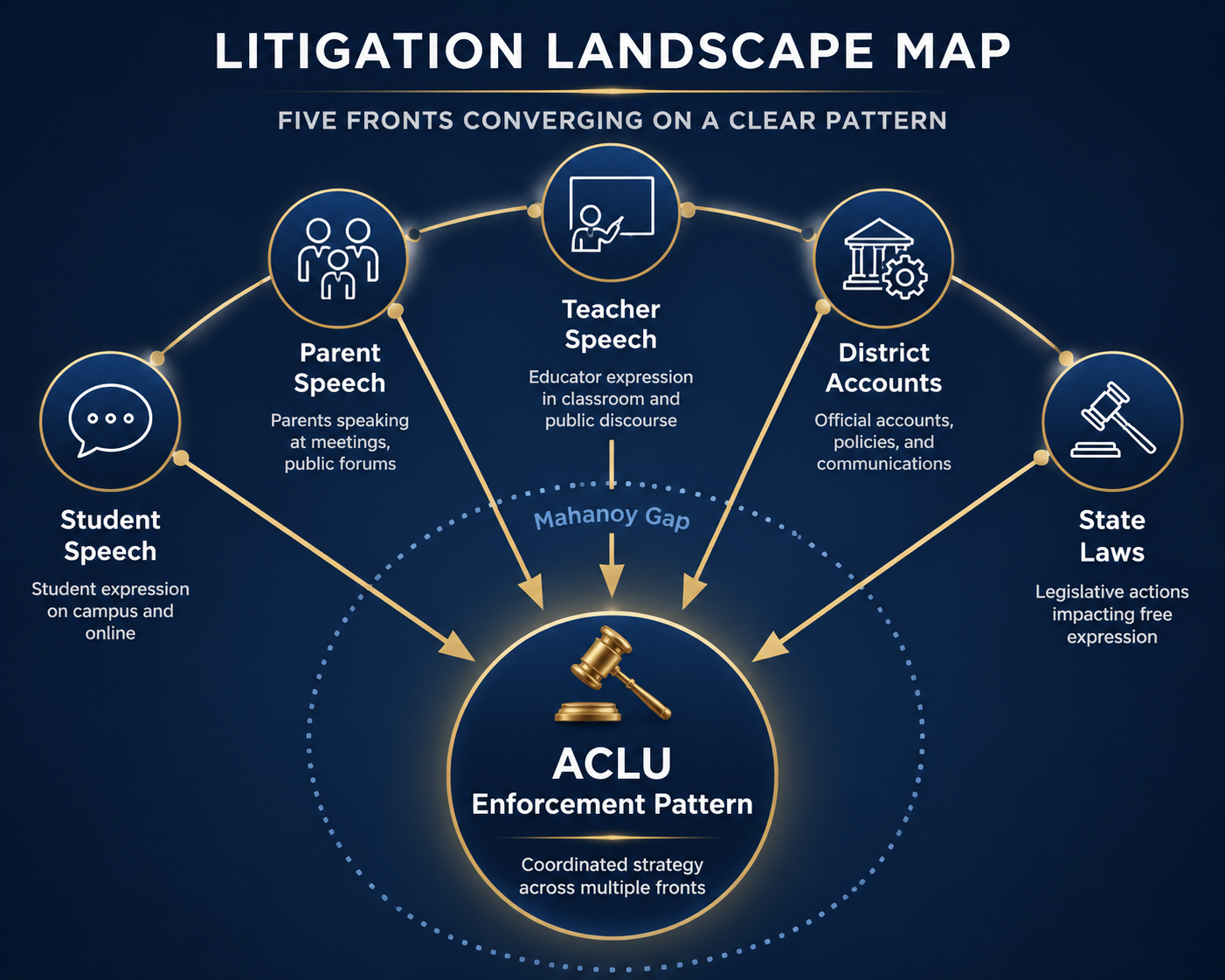
That spread changes the risk calculation. A district may think it is solving a communications problem when it blocks a critic, requires pre-approval for comments, or bars “disparaging” remarks. Once the account is operated by a public entity, however, the question can quickly become whether the district has created a forum and then discriminated by viewpoint.
Smithfield Shows How Fast Account Moderation Can Become Litigation
The Smithfield dispute is small only if measured by geography. In June 2025, the Rhode Island ACLU sued the Smithfield School District after resident Elizabeth Mayer was blocked from district X accounts after advocating for the superintendent’s resignation.[2] Less than a month later, the case settled: the district agreed to unblock her, stop viewpoint-based blocking, remove pre-approval requirements, and pay $12,000 in fees.[3]
The 22-day timeline is the fact that should make central offices pause. A social media administrator’s decision to exclude a persistent critic did not remain an informal moderation choice. It became a filed First Amendment case, then a settlement with monetary consequences before the district could plausibly treat the dispute as old news.
The legal exposure does not depend on whether the resident’s underlying view was wise, polite, or administratively convenient. Once a district uses an official account to communicate public business and permits public interaction, it needs a forum theory before it needs a tone-policing instinct. A rule against threats, spam, or truly off-topic material presents a different question from blocking a user because she wants a superintendent gone.
Smithfield also illustrates the asymmetry that makes these disputes hard for school boards. Leaving critical comments visible can create political cost. Removing or blocking them can create constitutional cost. The latter may include attorney’s fees, not just embarrassment.
Student Club Speech: The DCPS Settlement Reaches Beyond One Event
The Arab Student Union settlement with D.C. Public Schools has a different institutional significance. The settlement, announced September 9, 2025, produced new DCPS-wide guidelines explicitly grounding student club speech protections in the Tinker standard.[4] That is more than a one-off permission slip for one student organization.
For district lawyers, the important feature is the move from event-level discretion to system-level guidance. A school can have real reasons to monitor student events, especially when administrators anticipate disruption. But a rule or practice that makes one student group guess which political or identity-based viewpoint is tolerable creates the kind of record that civil liberties litigators know how to frame.
Tinker still permits schools to respond to material and substantial disruption. Mahanoy did not erase that doctrine. The harder post-Mahanoy problem is documentation: what disruption did the school identify, when did it arise, and why was the response tied to that disruption rather than to discomfort with the message? The DCPS settlement matters because it treats that question as a policy-design issue, not merely as a litigation defense.
Russellville Is an Employee-Speech Warning, Not Yet a Precedent
The Russellville case should be handled carefully because it is new and unresolved. On July 8, 2026, the ACLU of Arkansas sued the Russellville School District over the firing of an 18-year veteran biology teacher for a personal Facebook post; the ACLU also reported that more than 1,700 community members signed a petition opposing the termination.[5] As of the research date, there is no ruling or settlement to convert those allegations into judicial findings.
Even at the pleading stage, the case belongs on the school social media risk map because it shows another route by which online speech disputes enter constitutional litigation. Student speech doctrine does not simply transfer wholesale to public employee speech. A teacher’s role, the school’s operational interests, and the content and context of the post all matter. That is exactly why a district that reacts first and builds the record later can find itself defending more than a personnel decision.
The safest reading is narrow: Russellville does not establish that firing a teacher over a personal post is always unconstitutional. It does show that the ACLU is willing to treat teacher off-campus social media discipline as part of the same broader speech-enforcement environment.
The Word “Disparaging” Is Doing Too Much Work
Los Angeles Unified has not, on the available record, become an ACLU lawsuit. That distinction matters. The reported posture is a September 2025 ACLU demand letter challenging a 2018 parent social media policy that prohibited “disparaging” comments, with the district confirming that the policy was under review.[6]
Still, the dispute is worth more than a footnote because “disparaging” is the sort of word that looks manageable to communications staff and dangerous to First Amendment lawyers. It does not merely target obscenity, threats, harassment, or irrelevant commercial clutter. It can reach criticism of a principal, a superintendent, a bond measure, a discipline practice, or a curriculum decision.
That is the forum problem in plain form. If parents are invited to comment on district business, the district cannot make praise easier to post than criticism simply by calling criticism “disparaging.” The policy may have been written to reduce conflict. In litigation, however, the first question would likely be whether it authorizes viewpoint discrimination.
The State-Level Cases Are the Weather System Around District Policy
The school-district cases carry the most direct operational risk, but they sit inside a larger fight over youth speech online. The ACLU’s involvement in state social media and age-verification litigation matters because legislatures, school boards, and parents are often responding to the same anxiety: minors are online, platforms are powerful, and adults want a regulatory lever that works.
The legal results are not moving in one clean direction. In Texas, the ACLU filed a July 2025 amicus brief in CCIA v. Paxton challenging provisions of the SCOPE Act, and provisions were enjoined.[7] In Arkansas, Act 689 was permanently blocked in September 2023.[8] In Ohio, HB33’s age-verification provisions were permanently enjoined by a district court in April 2025, but the Sixth Circuit reversed the injunction in June 2026, leaving the posture in flux.[9]
Free Speech Coalition v. Paxton complicates the picture, but it should not be overread. In June 2025, the Supreme Court upheld Texas age verification for sexual content specifically.[10] That is not a blanket authorization for school districts to restrict student, parent, or teacher speech on ordinary social media channels. It does, however, contribute to uncertainty about how courts will review online speech regulations when the government frames the law around child protection.
The Kids Online Safety Act remains part of the same background debate. The ACLU opposes the pending federal legislation on speech grounds, arguing that efforts to regulate children’s online safety can become mechanisms for restricting protected expression.[11] For school lawyers, the relevance is indirect but real: state and federal fights shape the vocabulary local boards borrow when they justify school-level restrictions.
Classroom Censorship Cases Pull the Same Thread
The classroom censorship cases are not social media cases in the narrow sense, but they reinforce the same constitutional concern: vague restrictions on speech about contested subjects invite overbreadth and viewpoint-discrimination challenges. In Pernell v. Lamb, the Eleventh Circuit struck down higher education provisions of Florida’s Stop W.O.K.E. Act.[12] In Texas, a federal court issued a preliminary injunction in February 2026 against key provisions of SB12 censoring identity and inclusion in K-12 schools in three districts.[13]
These cases do not mean every curricular rule is unconstitutional. Schools retain authority over curriculum in ways they do not over a parent’s comment on a district account. But the overlap is practical: when a school system writes broad rules around “divisive,” “disparaging,” or identity-related speech, it should expect lawyers to ask whether the rule identifies a permissible school interest or suppresses a disfavored viewpoint.
The Legal Theories That Travel Across the Cases
The litigation pattern is easier to see if the cases are sorted by theory rather than by headline. Four theories recur often enough to shape district risk.
- Public forum treatment of district accounts: when a district opens an official social media space for public comment, moderation choices may be judged as government control of a speech forum.
- Viewpoint discrimination: rules against criticism, “disparaging” comments, or particular political positions are more vulnerable than content-neutral rules tied to threats, spam, or genuine disruption.
- Tinker after Mahanoy: schools may still address material and substantial disruption, but off-campus and online speech requires a careful record connecting the speech to a legally sufficient school interest.
- Overbreadth: state and local rules that sweep protected speech into a child-safety or civility rationale can be attacked before every possible application occurs.
The common problem is not that schools can never regulate online conduct. They can, and sometimes must. The problem is that many policies are drafted at the level of administrative frustration. They prohibit disrespect, negativity, controversy, or reputational harm without explaining whose speech is covered, what forum exists, what disruption is being prevented, or what neutral criteria govern enforcement.
That drafting style may survive a tense board meeting. It is less reliable once a blocked parent, student group, or disciplined employee is represented by counsel seeking injunctive relief, damages, and fees.
Why the Risk Is Now a Monitoring Problem
By Q3 2026, the useful question is no longer whether the ACLU has filed one notable lawsuit over a school social media ban. The more accurate question is where a district’s policy falls within a recognizable enforcement pattern.
A district may still win some fights. Courts may credit better-developed safety records. Employee speech cases may turn on facts that favor the employer. Age-verification cases involving sexual content may not follow the same path as broad social media access laws. Mahanoy itself left room for school authority in serious circumstances.
But vague, viewpoint-sensitive, and poorly documented restrictions now carry a different level of exposure. The Smithfield settlement shows how quickly account moderation can become a fee-bearing constitutional dispute. The DCPS settlement shows that student speech claims can produce system-wide policy changes. Russellville shows the ACLU is watching teacher personal social media discipline, even though that case remains unresolved. LAUSD shows that a demand letter can force review before a complaint is filed.
That is the liability landscape after Mahanoy: not a single controlling answer, but a set of doctrinal seams that are being tested repeatedly. School counsel now has to monitor the pattern, not just the precedent.
References
- Mahanoy Area School District v. B.L. — ACLU.
- ACLU Sues Over Social Media Censorship by Smithfield School District — RI ACLU, June 9, 2025.
- Settlement Reached in Smithfield School District Social Media Censorship Lawsuit — RI ACLU, July 1, 2025.
- Arab Student Union Wins D.C. Public School Guideline Changes in Settlement of Pro-Palestinian Speech Censorship Lawsuit — ACLU DC, September 9, 2025.
- ACLU of Arkansas Sues Russellville School District Over Teacher’s Firing for Protected Speech — ACLU of Arkansas, July 8, 2026.
- LAUSD’s Social Media Policy For Parents Draws First Amendment Challenge From ACLU — LAist.
- CCIA v. Paxton — ACLU.
- NetChoice v. Griffin — ACLU.
- ACLU of Ohio Files Amicus Brief Raising First Amendment Concerns Regarding Age Verification Laws — ACLU of Ohio.
- Free Speech Coalition v. Paxton — ACLU, June 2025.
- Lawmakers Renew Push to Regulate Kids’ Speech Online Despite Speech Protections — ACLU.
- Pernell v. Lamb — ACLU.
- Federal Court Halts Enforcement of Key Provisions of Law Censoring Identity and Inclusion in K-12 Schools in Three Texas School Districts — ACLU of Texas, February 2026.
Comments
Join the discussion with an anonymous comment.