
When an apartment fire report arrives in discovery with some trace of AI in its drafting history, the first admissibility question is not whether AI is good or bad. It is whether the tool cleaned up the investigator’s work or participated in the expert’s origin-and-cause reasoning. That distinction matters immediately in apartment fire litigation because the report may carry the negligence theory, the product defect theory, the landlord’s notice defense, or the tenant’s causation defense.
A transcription tool that turns dictated field notes into readable text presents a different problem from an AI system that identifies a likely origin area from burn-pattern inputs. A drafting assistant that formats a chronology is not the same thing as a model that supplies causal language. The report may look equally polished in both situations, but the evidentiary question changes: who actually made the expert judgment, and can that process be explained under oath?
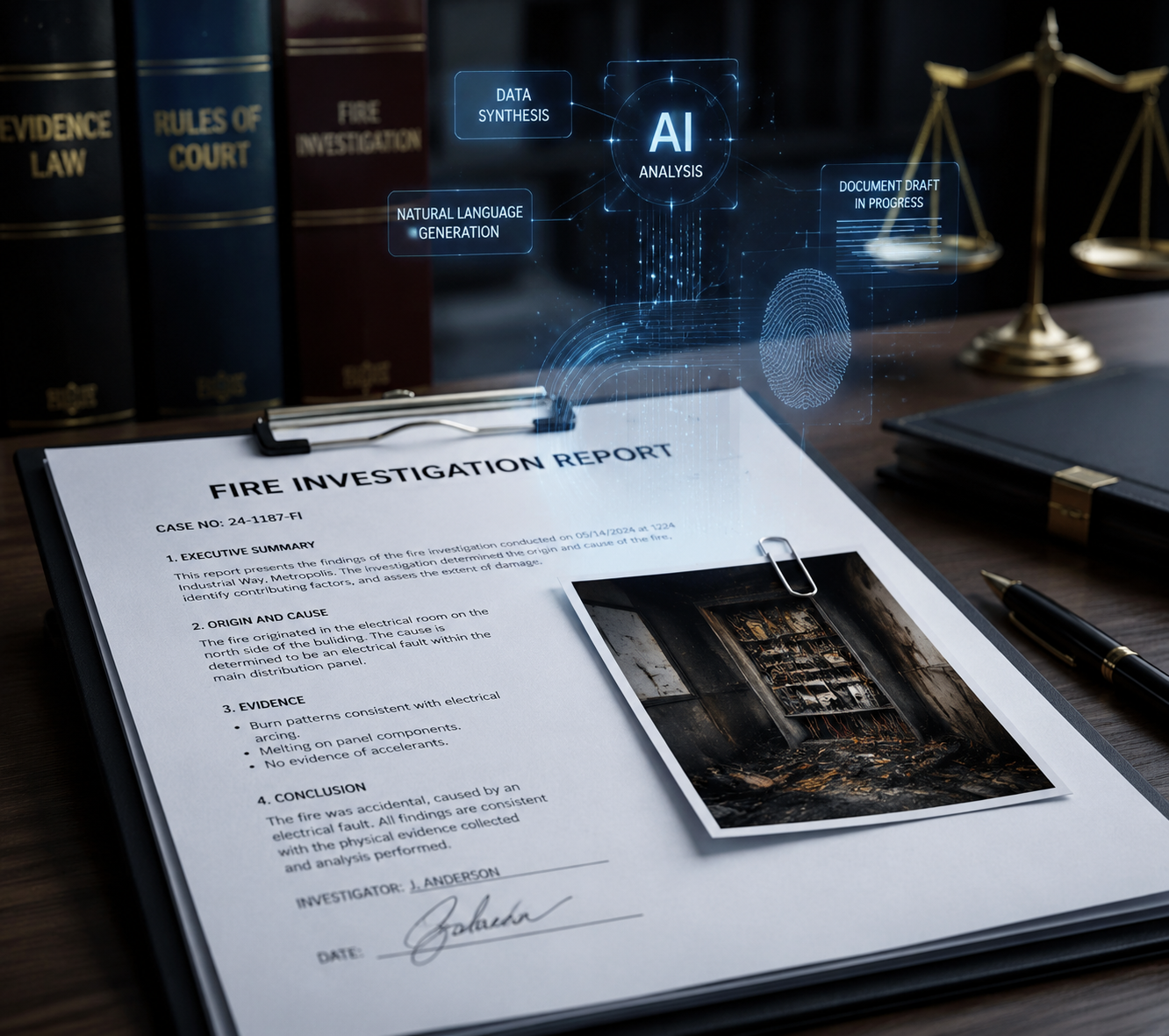
Start With The AI’s Role, Not The AI Label
The phrase “AI-assisted report” hides the issue a court will eventually need to see. Blazestack’s practical guidance for AI fire investigation reports draws a useful line between clerical uses, such as transcription, formatting, summarization, and report organization, and cognitive uses, where the tool helps identify patterns, develop findings, or generate origin-and-cause conclusions.[1] That is an industry source, not a court ruling, but the distinction is exactly the one attorneys need before they decide whether to defend, disclose, challenge, or supplement the report.
| AI Use In The Report | Likely Evidentiary Concern | Attorney’s First Question |
|---|---|---|
| Dictation cleanup or transcription | Authentication and accuracy of the final text | Did the investigator review the transcript against notes, photos, and memory? |
| Formatting, chronology building, or summarization | Completeness and risk of omitted context | What source materials were summarized, and what was checked? |
| Drafting causal language | Whether the expert adopted or merely accepted AI reasoning | Can the investigator explain the conclusion without relying on the model? |
| Pattern recognition for origin analysis | Daubert reliability, NFPA 921 methodology, and black box reasoning | How did the tool reach the inference, and can that method be tested? |
The safest version is mundane: the investigator dictates observations at the scene, a tool produces text, and the investigator later verifies every factual statement against photographs, measurements, witness information, and physical evidence. That still requires authentication, but it does not turn the software into an expert witness. The dangerous version is subtler: the AI’s suggested phrasing supplies the causal bridge between the field observations and the legal theory, and nobody can later say where the expert’s analysis ended and the model’s inference began.
FRE 702 Turns The Drafting History Into A Methodology Question
Under FRE 702 and Daubert, the proponent of expert testimony must be prepared to show that the opinion rests on sufficient facts or data, uses reliable principles and methods, and reliably applies those principles and methods to the facts. Fire investigation evidence is usually tested through that lens, and Blazestack’s Daubert discussion frames the problem in the familiar terms of qualifications, methodology, documentation, and reliable application.[2]
AI does not automatically defeat any of those elements. It does, however, add another layer of proof. If the expert used AI only to organize field notes, the method being tested remains the fire investigation method. If the expert used AI to classify patterns, weigh scenarios, or produce a likely ignition sequence, the attorney has to show why that AI-supported method itself is reliable and how it was applied.
That distinction matters in apartment cases because the facts often arrive from multiple directions: fire department observations, maintenance records, tenant accounts, appliance evidence, electrical inspections, photographs, and sometimes criminal or insurance investigative material. If AI compresses those materials into a single narrative, counsel needs to know whether it preserved disagreements and uncertainty or quietly turned contested inputs into a clean conclusion.
NFPA 921 Is Where The Opinion Has To Land
NFPA 921 is central because it gives courts a recognized methodology for fire investigation. The ABA has described NFPA 921 as an important gatekeeping standard in fire litigation and discusses how departures from it can affect admissibility.[3] The point is not that every sentence in a report must quote NFPA 921. The point is that the investigator should be able to walk from data collection through hypothesis development, testing, and elimination in a way the court can examine.
AI-assisted drafting becomes vulnerable when it interrupts that walk. If the report says the fire originated near a receptacle because the model recognized a pattern, but the expert cannot explain how alternative hypotheses were tested and rejected, the report has a methodological gap. If the expert can instead testify that the AI only helped organize notes and that each origin-and-cause finding came from scene examination, evidence review, and NFPA 921 analysis, the AI issue becomes narrower.
The ABA article discusses Werth v. Hill-Rom, a medical-device fire case, as an example of expert exclusion tied to NFPA 921 reliability issues.[3] That case is not an apartment fire case and it is not an AI case. Its relevance is more limited and more useful: courts can and do examine whether a fire expert followed a reliable fire investigation method. AI adds a new way for that same examination to become uncomfortable.
Authentication Requires A More Specific Record
FRE 901 asks whether the proponent has enough evidence to support a finding that the item is what the proponent claims it is. For an AI-assisted report, that means counsel should be able to authenticate not only the final PDF but the process by which the report was created. The useful record is practical: original notes, photos, measurements, audio files if available, AI prompts or task descriptions where retained, drafts, review logs, and the investigator’s verification steps.
Disclosure should not be vague. Blazestack gives examples of disclosure language that identifies the tool, its limited function, and the investigator’s independent review.[1] That kind of language is valuable because it tells the opposing party what actually happened. “AI assisted in formatting the report after the investigator completed the origin-and-cause analysis” is a different disclosure from “AI analyzed scene photographs and suggested probable origin.”
- Identify the tool or platform used, without treating the brand name as a substitute for methodology.
- Describe the task the tool performed: transcription, formatting, summarization, image organization, pattern recognition, or drafting.
- Preserve the source materials the AI processed, including notes, photos, measurements, and report drafts where available.
- Document the investigator’s independent verification of every factual conclusion and every origin-and-cause opinion.
- Separate the investigator’s final opinion from any AI-generated suggestion that was rejected, edited, or adopted.
The verification record should be built before a Daubert motion, not reconstructed after one. A clean final report with no drafting trail is not stronger merely because it looks professional. It may be weaker if the opposing lawyer can show that the expert cannot identify which statements came from observation, which came from inference, and which came from software output.
The Black Box Problem Is Most Serious In Origin Analysis
The hard problem is not grammar. It is an unexplained causal inference. Origin & Cause’s discussion of AI in fire investigation focuses on the “black box” problem: AI may produce a conclusion without a transparent account of how it got there, raising reliability and legal concerns when the output is used in origin analysis.[4]
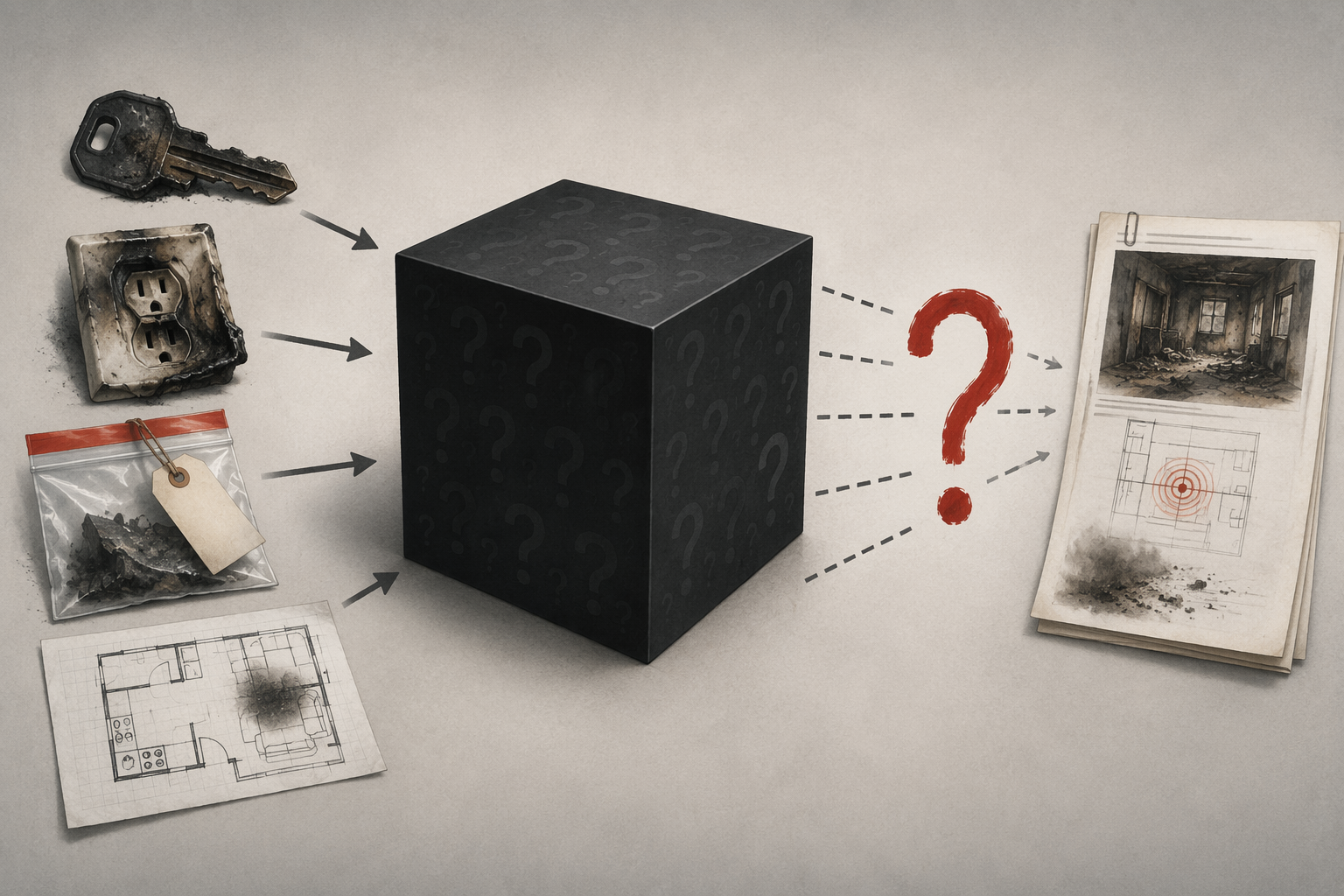
That problem is easy to miss in a polished apartment fire report. The report may describe burn patterns, electrical damage, witness statements, and appliance locations in ordinary expert language. But if the origin area was first identified by AI pattern recognition, counsel needs to know what the model saw, what data it was trained or configured on if that information is available, what alternatives it considered, what uncertainty it registered, and how the human investigator tested the result.
An expert can disagree with another expert. An expert can explain why a hypothesis was eliminated. A black-box tool may not be able to do either in a way that satisfies Daubert scrutiny. That does not mean AI pattern recognition can never be useful to an investigator. It means the report should not ask the court to admit a causation opinion whose decisive reasoning cannot be examined.
This is where the clerical-versus-cognitive distinction stops being academic. If AI sorted photographs by room, the investigator can still testify from the photographs. If AI inferred that the fire began in the kitchen based on visual pattern matching, the attorney has to confront the reliability of that inference. The evidentiary fight shifts from “Was the report typed accurately?” to “Was the method that produced the origin opinion reliable?”
The Tools Attorneys May See Are Not All Doing The Same Work
The current tool landscape makes loose labels especially unhelpful. Blazestack’s 2026 overview of AI tools for fire investigators identifies products and platforms attorneys may encounter, including Dragon, Microsoft Copilot, CaseGuard, and ChatGPT Enterprise.[5] The list is useful as context, not as an endorsement and not as proof that any particular tool was used properly in a case.
| Tool Example | Typical Role Counsel May Encounter | Admissibility Point |
|---|---|---|
| Dragon | Dictation and transcription | Usually raises accuracy and review questions, not origin methodology by itself. |
| Microsoft Copilot | Organizing, summarizing, or drafting from office materials | Requires clarity about what materials were processed and whether conclusions were generated. |
| CaseGuard | Evidence handling, redaction, or media-related workflows | Raises chain-of-custody, alteration, and authentication questions depending on use. |
| ChatGPT Enterprise | Drafting, summarization, or structured text generation under enterprise controls | Enterprise controls do not make the model’s reasoning independently admissible. |
A product name does not answer the legal question. The same platform can be used to clean up a paragraph, summarize interviews, or suggest the wording of an expert conclusion. Counsel should ask for the function performed in the case, not just the software named on an invoice or in a lab protocol.
CJIS Matters, But Not In Every Apartment Fire Case
CJIS compliance deserves a narrow treatment. Blazestack’s report-drafting guidance warns that tools handling investigative case data may need to satisfy CJIS requirements and that public-facing LLMs or free-tier tools should not be treated as CJIS-compliant.[1] That matters when the fire investigation materials include criminal justice information, law enforcement investigative data, or records governed by CJIS security requirements.
A civil-only apartment fire case may not always trigger CJIS. A subrogation dispute over appliance failure and a municipal arson investigation do not present the same data-governance problem. Still, counsel should not wait until expert discovery to find out that scene photos, incident reports, or witness information were uploaded into a public tool that the investigator was not authorized to use for that category of data.
What To Ask For In Discovery Or Expert Preparation
The discovery path should move from broad identification to precise function. The goal is not to make every AI mention sound sinister. The goal is to find out whether the expert can authenticate the report, defend the method, and explain the opinion without outsourcing reasoning to an opaque system.
- Ask whether any AI, automated transcription, generative drafting, summarization, image-analysis, or pattern-recognition tool was used in preparing the report.
- Request identification of each tool, the date range of use, the user, and the task performed.
- Request prompts, outputs, summaries, draft text, logs, or other retained records, subject to privilege and work-product disputes.
- Ask which conclusions were generated, suggested, organized, or revised with AI assistance.
- Ask the investigator to identify the independent evidence supporting each origin-and-cause conclusion.
- Ask what quality-control review was performed before the report was signed or served.
For the proponent, the same questions should be answered before the report leaves the expert’s office. If the answer is that AI was used only for transcription or formatting, the expert file should make that easy to prove. If AI touched causal analysis, counsel needs a deliberate admissibility strategy, not a footnote.
Deposition Questions Should Track The Legal Elements
A useful deposition does not stop at “Did you use AI?” It follows the report’s chain of reasoning. The examiner should move through facts or data, methodology, application, verification, and final adoption. If the expert can answer those questions from personal work and documented review, the AI issue may shrink. If the expert repeatedly returns to what the software “found,” the Daubert issue grows.
- What materials did you personally review before forming your origin opinion?
- What, if anything, did an AI tool review that you did not independently review?
- Did any AI output identify, rank, or suggest a fire origin area?
- How did you test and eliminate alternative hypotheses under NFPA 921 methodology?
- Which sentences in the report contain your final opinions, and how did you verify each one?
- Could you reach and explain the same origin-and-cause opinion without relying on the AI output?
The Current Litigation Posture Is Anticipatory
The available fire-investigation materials do not identify a known U.S. case that has excluded a fire investigation report specifically because AI was used. That boundary matters. The risk is not that courts have already adopted a special anti-AI fire-report rule. The risk is that ordinary expert-admissibility rules already give courts enough tools to exclude an opinion when the proponent cannot show reliable methods, sufficient facts, reliable application, and authentic evidence.
Analogous forensic disputes are likely to shape the questions even before a fire-specific AI exclusion appears. Nondisclosure, unverifiable automated reasoning, and weak expert supervision are familiar themes in challenges to technical evidence. Fire reports add their own pressure point because the origin-and-cause opinion often drives liability, settlement value, and expert credibility.
The practical admissibility judgment is straightforward. AI-assisted fire reports are safest when AI is limited to transcription, formatting, or summarization and the investigator can testify to independent verification of every factual statement and every origin-and-cause conclusion. Reports that rely on AI pattern recognition or generative reasoning for the origin-and-cause opinion carry a material exclusion risk unless the proponent can explain and validate the method under FRE 702, Daubert, FRE 901, and NFPA 921.
References
- How to Create a Fire Investigation Report with AI, Blazestack
- Navigating Daubert Challenges in Fire Investigations, Blazestack
- The Importance of NFPA 921 in Fire Litigation, American Bar Association
- AI and Fire Investigation: Navigating The Reliability And Legal Considerations, Origin & Cause
- 10 Best AI Tools for Fire Investigators in 2026, Blazestack
Comments
Join the discussion with an anonymous comment.