
The legally interesting moment in AI-assisted cancer detection is not the moment a machine produces a score. It is the later reconstruction: a radiologist missed a suspected cancer, the patient was harmed, and the record shows that an AI system had flagged the abnormality. At that point, the case no longer sounds like a familiar diagnostic miss. To a juror, it can start to sound like ignored assistance.
That shift is now measurable. In a Brown University study published in July 2025 and described in the New England Journal of Medicine AI, more than 1,300 online participants evaluated two hypothetical radiology malpractice cases across five randomized conditions. When no AI was involved, participants found the radiologist negligent 56% of the time. When AI had flagged the abnormality and the radiologist missed it, that figure rose to 75%.[1]
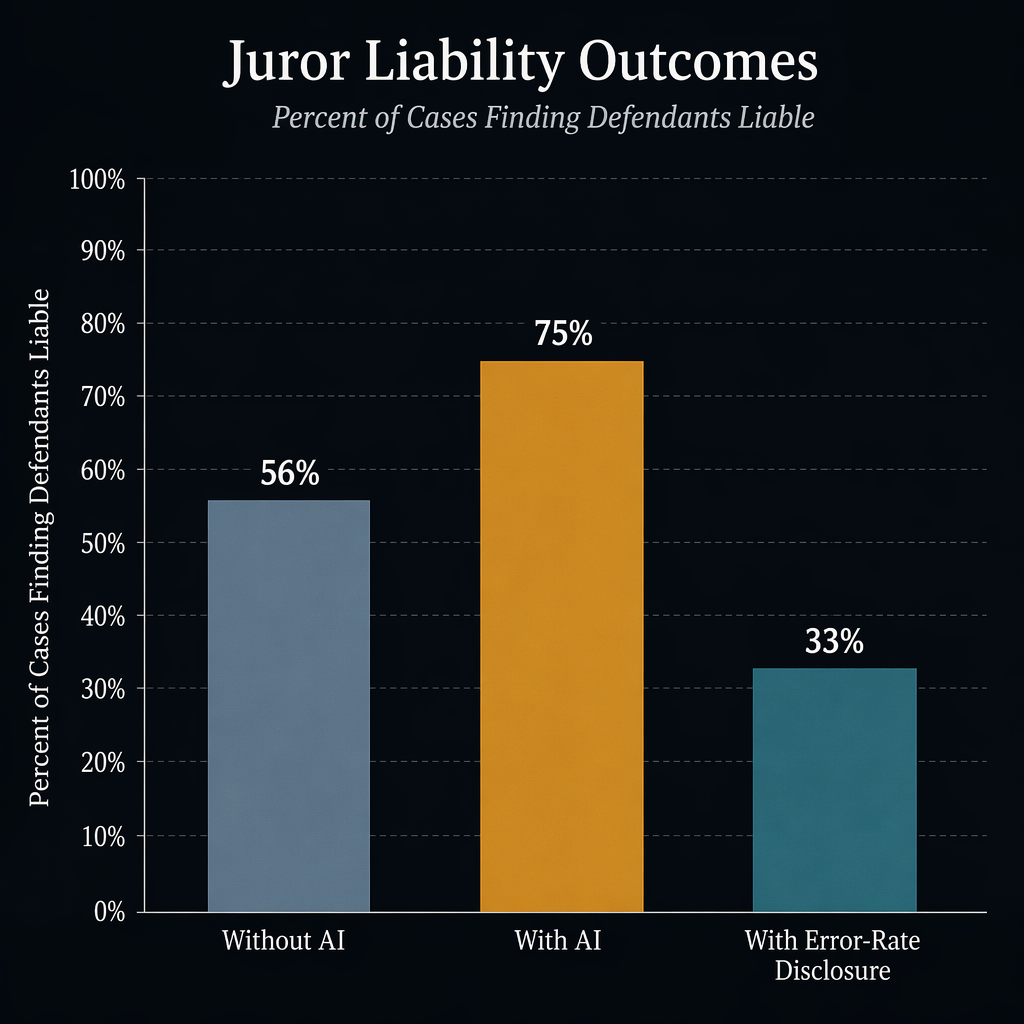
The study does not prove how an actual jury would decide a litigated cancer case. These were online mock jurors reading hypothetical vignettes, not jurors hearing expert testimony, cross-examination, jury instructions, and a full damages record. But malpractice defense is often shaped long before a verdict. Settlement posture, expert strategy, disclosure practice, and insurer appetite all respond to what a plausible jury story looks like. The Brown finding gives that story a number.
The AI flag changes the negligence story
A traditional missed-diagnosis defense often asks jurors to accept that medicine involves uncertainty. Images can be subtle. Cancer can be hard to detect. Reasonable physicians can disagree. A defense expert can explain why a finding was not apparent at the time, even if it looks clearer in hindsight.
An AI flag makes that defense harder to keep clean. The plaintiff does not have to persuade jurors that the lesion was obvious to everyone. The plaintiff can ask a simpler question: if the institution deployed a tool to catch suspicious findings, and that tool surfaced this one, why did the human expert miss it?
That does not mean the radiologist was careless. It means the presence of the AI output supplies jurors with a concrete counterfactual. The record contains something that appears to have done the very thing the physician allegedly failed to do. In a negligence case, that is not a technical detail. It is narrative evidence.

The Brown study tested this intuition directly. Its cases involved radiology malpractice scenarios, not abstract attitudes toward automation. The increase from 56% to 75% appeared when AI detected an abnormality the radiologist did not act on, and the effect persisted across the study vignettes.[1] For defense counsel, the important point is not that AI always hurts the defense. It is that an unexplained AI flag can become a focal point around which jurors organize responsibility.
The practical hinge: explaining what the AI misses
The same study also found something more useful than the headline liability increase. When participants were told the AI system’s false omission rate, perceived liability fell to approximately one-third.[1] That is the finding risk managers should linger over.
A false omission rate tells users how often the system fails to flag a disease or abnormality that is actually present. In litigation terms, it helps answer a question jurors will otherwise answer for themselves: what should the physician have understood this AI signal to mean?
Without that explanation, the AI output can be treated as a kind of clean warning light. The abnormality was flagged; the warning was missed; the harm followed. Disclosure of limitations complicates that chain. It lets the defense say the tool was not an oracle, not a replacement radiologist, and not a system whose output carried the same meaning in every clinical setting. More importantly, it lets the institution show that users were told what the system could and could not reliably do before the bad outcome.
This is not merely a consent issue, and it is not solved by burying a performance statistic in procurement paperwork. The courtroom question is whether a hospital can offer a juror-readable account of the tool’s role: who saw the output, what the output meant, how often the system misses relevant findings, what workflow governed review, and what the radiologist was expected to do when the AI and human read did not align.
| Record issue | Why it matters in a malpractice file |
|---|---|
| AI output visibility | Shows whether the radiologist actually had access to the flag at the relevant time |
| Known false omission rate | Helps prevent jurors from treating the AI system as an infallible warning device |
| Workflow policy | Shows whether the institution defined how AI findings should be reviewed or escalated |
| Training and disclosure | Supports an argument that clinicians understood the tool’s limits before using it |
| Audit trail | Allows counsel to explain what happened without relying on after-the-fact reconstruction |
The Brown results should make vague deployment language look expensive. If an institution adopts AI as a quality improvement signal, markets it internally as an added safety layer, and later cannot explain its known error profile, the plaintiff gets to supply the meaning of the tool. The disclosure finding suggests that jurors are not simply punishing AI use. They appear to react differently when the system’s limitations are made explicit.
Why this is no longer a niche question
This liability question is becoming a live operating problem because clinical AI is no longer rare in the settings where missed-diagnosis claims arise. Through the end of 2025, the FDA had authorized 1,451 AI/ML-enabled medical devices. Radiology accounted for 1,104 of those authorizations, or 76%, up from 950 in August 2024.[2][3]
Those figures should not be overstated. The FDA list covers AI/ML-enabled medical devices generally, not only cancer detection tools. Radiology’s large share includes many non-oncology uses. Still, the concentration matters for malpractice exposure because radiology is already a field where delayed or missed diagnosis can produce high-stakes claims, and AI tools are most densely authorized in that same clinical neighborhood.
There are early claims-market signals as well, though they deserve caution. Enjuris reports that AI-related medical malpractice claims rose approximately 14% from 2022 to 2024.[4] Because Enjuris is a plaintiff-oriented directory and the methodology behind that figure is not fully transparent, the number should be treated as directional rather than as a reliable market-wide measurement. It is enough to say that plaintiff-side attention is increasing, not that the claims environment has been precisely quantified.
The courts have not yet supplied a stable allocation rule
The legal doctrine is still behind the deployment curve. No U.S. appellate court has established binding precedent for AI-involved cancer detection liability. That leaves hospitals, radiologists, vendors, insurers, and lawyers borrowing from adjacent bodies of law while waiting for actual appellate guidance.
A Stanford HAI policy brief reviewing 51 software liability cases points to the closest analogs, including Mracek v. Bryn Mawr Hospital, involving surgical robots, and Singh v. Edwards Lifesciences, involving software-guided ablation.[5] These analogs are useful, but they do not answer the cancer-detection problem cleanly. A radiology AI flag sits inside a diagnostic workflow where the human physician remains visibly responsible for interpretation, communication, and follow-up.
The Milbank Quarterly has described possible liability allocation models for medical AI: traditional tort allocation, contractual indemnification and insurance, and legislative no-fault compensation.[6] Those categories help map the future fight, but they do not spare today’s defense team from the immediate file question. If the medical record shows an AI flag, who was supposed to respond to it, and what was the jury told the AI could miss?
What a defensible AI record needs to show
For risk management, the lesson is narrower and more practical than many AI liability debates. The question is not whether AI is good or bad for cancer detection. Nor is it whether a vendor, physician, or hospital will always be the primary defendant. The immediate question is whether the institution can explain the clinical meaning of the AI output before a plaintiff lawyer explains it first.
A defensible record starts before litigation. It should preserve the system version in use, the performance information available to the institution, the false omission rate disclosed to clinicians when available, the workflow for reviewing AI flags, and the documentation showing whether the AI output was seen, ignored, overridden, or unavailable at the time of interpretation.
Radiologists also need something better than informal reassurance. If the tool is presented as a second reader, triage aid, quality signal, or concurrent detection system, that choice should be reflected in policy and training. Otherwise, the same AI output can be characterized one way during adoption and another way during litigation.
Vendors have a related problem. Promotional performance language may help adoption, but malpractice files ask different questions. What population was used to measure performance? What clinical use was authorized? What kinds of misses are known? What warnings were provided? What limits were communicated to users? If those answers are not available in plain enough terms for a jury, the defense may be left translating technical uncertainty after harm has already occurred.
The risk is manageable, not imaginary
The Brown study does not justify a blanket warning that AI makes doctors careless or that every AI-assisted miss will produce higher liability. Its more disciplined message is more useful: when AI appears to have caught what the physician missed, mock jurors were more willing to find negligence; when the AI system’s false omission rate was disclosed, that perceived liability dropped substantially.[1]
That makes transparency a liability control, not just an ethics preference. AI may increase exposure when it creates what looks like an ignored warning. Transparent communication of system limitations may materially reduce that exposure by giving jurors a more accurate account of what the tool was designed to do, what it could miss, and how clinicians were expected to use it.
This is news and analysis for legal, insurance, and healthcare risk professionals, not legal advice and not a prediction of how any court will allocate responsibility in a particular case. The safer conclusion is also the more immediate one: AI-assisted cancer detection changes the malpractice story, and institutions that cannot explain their AI systems’ limitations may find that jurors are willing to do the explaining for them.
References
- AI in radiology may increase malpractice risk, but disclosure could reduce it, Brown University, July 28, 2025.
- Artificial Intelligence and Machine Learning (AI/ML)-Enabled Medical Devices, U.S. Food and Drug Administration.
- Numbers from the FDA Show Radiology Is Maintaining Its Lead, The Imaging Wire, March 11, 2026.
- AI Medical Malpractice Lawsuits, Enjuris.
- Policy Brief: Understanding Liability Risk from Healthcare AI, Stanford HAI.
- Artificial Intelligence and Liability in Medicine: Balancing Safety and Innovation, The Milbank Quarterly.
Comments
Join the discussion with an anonymous comment.