
The June 2026 AI-chip selloff was dramatic enough to change the way people talk about AI exposure, but the market move itself is not the legal event. SOXL’s 537% year-to-date return and 44% drawdown, alongside a 10% single-session drop in the Philadelphia Semi Index that erased $1.4 trillion in sector value, matter because they create the valuation backdrop in which plaintiffs can argue that directors and officers were selling an AI story the market did not fully understand. The crash did not automatically produce a clean wave of securities cases. What it did do was make AI disclosure disputes more expensive to ignore.
The market shock is the backdrop, not the claim
That distinction matters for anyone pricing D&O risk. A sudden drop in chip valuations can sharpen plaintiff attention, but a sector drawdown does not by itself create a viable shareholder claim. What gives the litigation theory traction is the later argument that management said too much about AI upside, too little about AI limits, and even less about the legal exposure sitting underneath the technology story.
SOXL is useful evidence of a highly stressed valuation environment, not a proxy for every semiconductor issuer’s litigation risk. The recent derivative filings are more useful than the market tape because they show how the legal theory is actually being built: not around the fact of volatility, but around the allegation that investors were led to believe the AI strategy was stronger, cleaner, or less risky than it really was.
Microsoft is the clearest version of the new theory
The Microsoft derivative suit, filed June 30, 2026 in the U.S. District Court for the Western District of Washington, names 14 current and former directors and officers and alleges false statements about AI strategy along with concealment of copyright infringement exposure. That is the cleanest example so far of how AI business optimism can turn into a D&O problem: the alleged wrong is not simply that the company used AI, but that it allegedly told the market one thing about the strategic and legal profile of that use while another risk was developing underneath it. [1]
The suit is still an early filing, not a merits ruling. That restraint matters. It would be a mistake to read one derivative complaint as proof of a broad liability regime. But for boards and insurers, the filing itself is already information. It shows that plaintiffs are willing to translate AI copyright exposure into a shareholder governance claim against individual fiduciaries, which is a very different risk posture from the original IP dispute.
Adobe shows the follow-on pattern is not isolated
Adobe provides the confirming case, and it does not need to be the lead story to matter. Its derivative suit was filed April 24, 2026, after copyright class actions had already been filed and after the stock had fallen more than 25%. The CEO also stepped down on March 12, 2026, which adds governance texture to the file without changing the basic pattern: AI-related copyright exposure can move from an operating issue into a shareholder claim that targets the boardroom response. [2]
Again, the point is not that every copyright case becomes a derivative case. It is that once the company is forced to absorb that legal risk in public, the plaintiffs’ bar has a much easier time alleging that earlier disclosures about AI capability or AI strategy were incomplete.
The filing counts show a real plaintiff pipeline
The broader litigation environment is no longer speculative. Cornerstone Research counted 38 AI-related securities class action filings since 2020, including 13 in 2024 alone. That is not a flood, but it is enough to show that AI disclosure claims have become a recognizable plaintiff category rather than an oddity. [3]
Alston & Bird separately noted six new AI class actions in the first half of 2025, which points in the same direction: shareholders are scrutinizing AI statements more aggressively, and not just where a company calls itself an AI company. The litigation test is increasingly whether the market was given a fair picture of capability, dependence on AI, training data problems, or the legal risks tied to all three. [5]
Bloomberg Law reported on July 17, 2026 that three AI-related shareholder derivative suits had been filed in recent months, and law professors described them as feelers for broader litigation. That is the right level of caution. These cases are still exploratory, but exploratory filings often tell underwriters more than the final merits opinions will, because they reveal where plaintiffs think the pressure points are. [4]
Why “Silent AI” is the most useful risk label
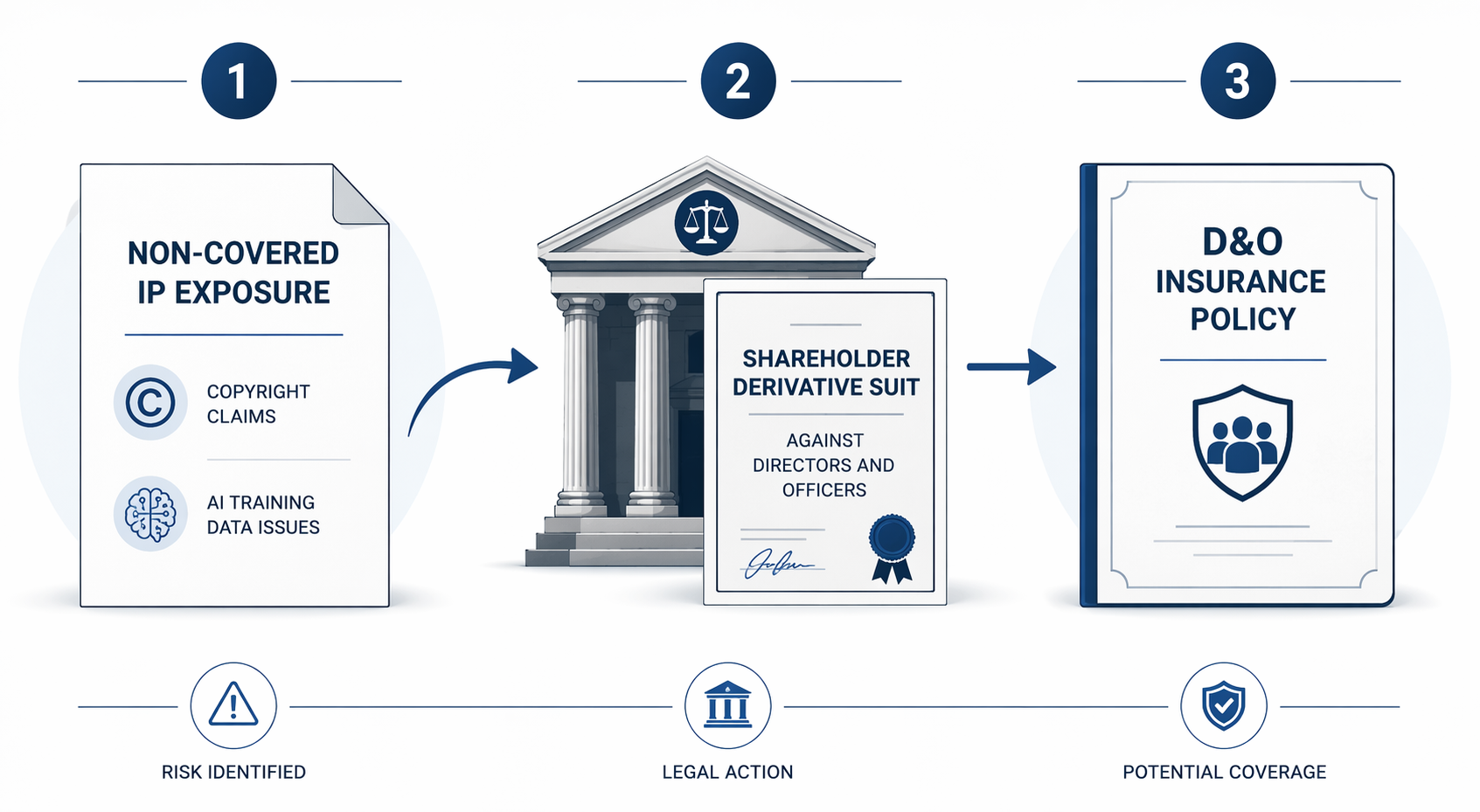
The most useful part of the current discussion is the “Silent AI” idea: non-covered IP exposure, especially copyright risk, does not stay confined to the original dispute. It can become the factual basis for a follow-on derivative suit that alleges directors and officers misled the market about the company’s AI strategy, capability, or legal exposure. That conversion is what matters for D&O programs. The original IP loss may not be insured the way a classic securities claim is, but the shareholder follow-on can land squarely in D&O territory. [1][2]
That is also why the usual market shorthand is too blunt. A chip-stock selloff is not the same thing as securities fraud. But when the selloff sits next to an AI narrative that later proves too polished, it supplies the price movement, the timing, and the hindsight story plaintiffs need to plead a fiduciary-duty case with some force.
The underwriting question is now narrower and more practical
The practical question for boards, brokers, and carriers is no longer whether AI creates some abstract future risk. It is whether the company has described AI upside expansively while leaving the legal and operational downside too vague for investors to assess. Once that gap is visible, a valuation shock can become the setting for a derivative filing, and the derivative filing can become the event that tests the D&O tower.
Carriers have noticed. Some are developing AI exclusions and specialized products, but the soft D&O market limits how aggressively they can impose restrictive terms. That leaves underwriters with a more familiar, and less tidy, task: deciding whether the company’s AI story and its disclosed legal risks actually match.
AI-chip volatility has changed the litigation economics around AI disclosures. The actionable D&O risk is not that stocks went down; it is that plaintiffs now have a market backdrop, early derivative suits, and an emerging theory for arguing that AI legal exposure was misdescribed, minimized, or concealed.
References
- “New Microsoft Derivative Lawsuit, Silent AI, and D&O Exposure” — The D&O Diary — July 2026
- “AI-Related IP Litigation Triggers Follow-On D&O Lawsuit” — The D&O Diary — April 2026
- “The Increase in Artificial Intelligence-Related Securities Class Actions” — The Legal Intelligencer / Troutman Pepper — November 26, 2024
- “Big Tech’s AI Copyright Woes Spur New Wave of Shareholder Suits” — Bloomberg Law — July 17, 2026
- “Shareholders Sharpen Focus on AI-Related Securities Disclosures” — Alston & Bird
Comments
Join the discussion with an anonymous comment.