
AI Compliance in 2026: The Enforcement Shift — How Regulators Are Moving From Guidance to Penalties
This article analyzes the decisive shift in AI regulation from voluntary guidance to concrete enforcement actions in 2026, covering EU AI Act penalties, U.S. state attorney general settlements, FTC consent orders, SEC examination priorities, and the growing role of cyber insurance. It is written for risk officers, compliance leaders, and in-house counsel who need to understand the real-world consequences of non-compliance.
- Hallucination rate
- Not measured / undisclosed
The Enforcement Landscape: From Guidance to Penalties
For the better part of three years, AI regulation was a landscape of white papers, voluntary frameworks, and principles. The EU AI Act was a text under negotiation. The FTC issued blog posts warning about AI hype. State legislatures introduced bills that mostly died in committee. Compliance teams could treat AI governance as a watching brief — something to monitor, not something that demanded immediate action.
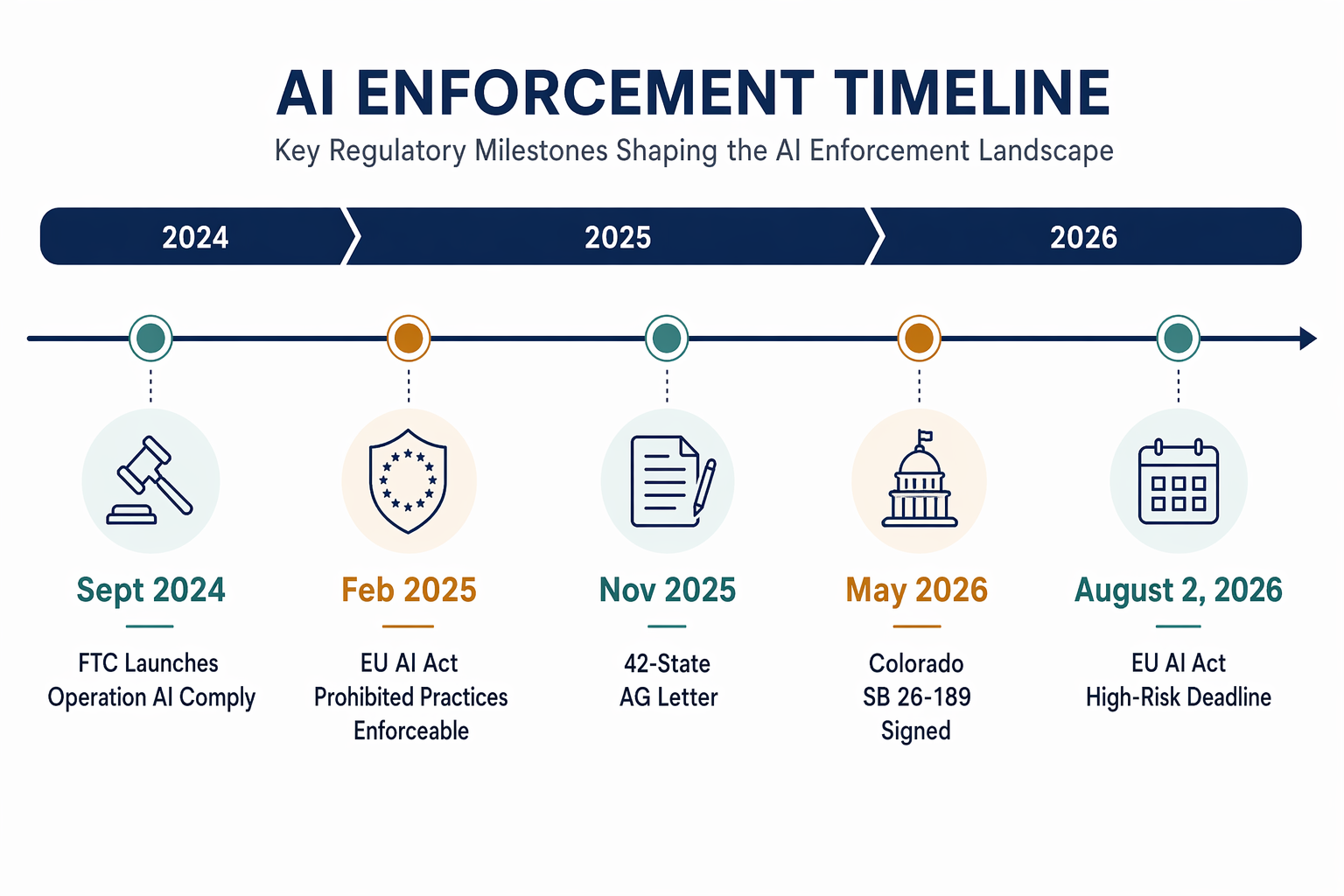
That period is over. 2026 is the year the enforcement machinery engages across multiple fronts simultaneously. The EU AI Act's prohibited practices have been enforceable since February 2, 2025. The FTC's Operation AI Comply has produced consent orders with concrete financial consequences. A bipartisan coalition of 42 state attorneys general is actively pursuing AI-related enforcement actions. The SEC has made AI-driven threats to data integrity a formal examination priority for FY2026. And cyber insurance carriers — a regulatory force that operates outside government — are conditioning coverage on documented AI risk management practices.
The shift is structural, not anecdotal. Each enforcement body operates independently, but together they create a compliance environment where inaction carries concrete financial and reputational consequences. The question for risk officers and in-house counsel is no longer whether AI regulation will be enforced — it is which regulator will arrive first.
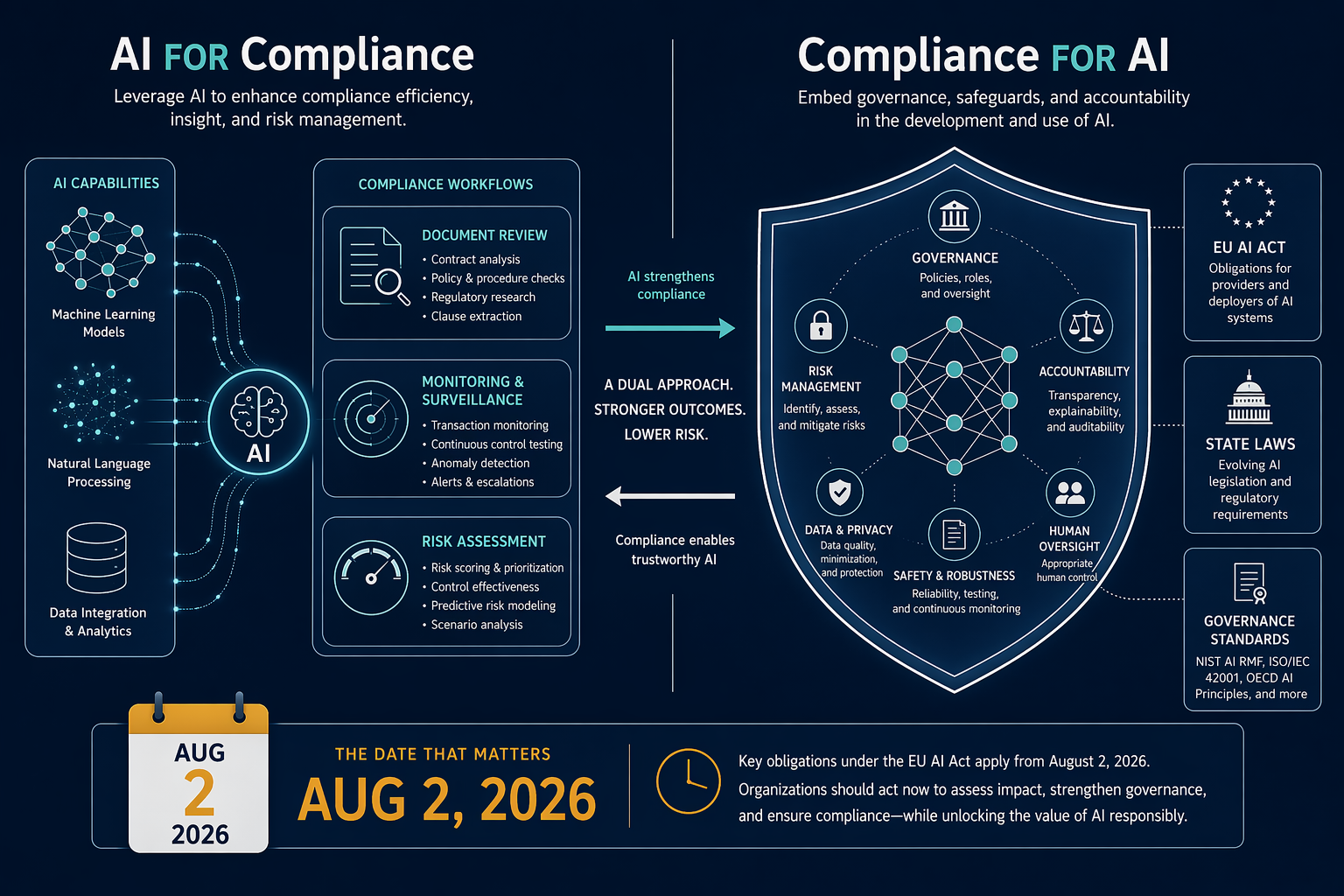
EU Enforcement: The AI Office, Live Penalties, and the August 2026 Deadline
The European Union remains the most advanced jurisdiction in terms of both regulatory architecture and enforcement infrastructure. The AI Office is operational. Member states are designating national supervisory authorities. And the penalty provisions are not theoretical — they are live.
The EU AI Act's prohibited practices — including social scoring, untargeted facial scraping from the internet or CCTV footage, and emotion recognition in workplaces and educational institutions — have been directly enforceable since February 2, 2025. Violations of these prohibitions carry penalties of up to €35 million or 7% of global annual turnover, whichever is higher.
The next major milestone is August 2, 2026, the deadline for high-risk AI systems to complete conformity assessments and comply with the Act's obligations. This date applies to standalone high-risk AI systems — those not embedded in regulated products — and represents the first major compliance deadline for most legal AI tools used in compliance monitoring, document review, and risk assessment.
For legal professionals deploying AI in compliance functions, the EU AI Act creates obligations under both the provider and deployer frameworks. A law firm or legal department that uses a high-risk AI system — for example, an AI tool that evaluates creditworthiness or makes employment-related decisions — is a deployer and must comply with obligations including human oversight, transparency, and record-keeping, regardless of whether the tool was developed in-house or procured from a third party.
For a detailed breakdown of these obligations, see our EU AI Act High-Risk AI Obligations for Legal Services: A Deployer's Guide and our analysis of the EU AI Act August 2026 Deadline: What Legal Professionals Must Know After the Digital Omnibus.
U.S. State Attorneys General: The New Front Line of AI Enforcement
While federal AI legislation remains stalled, state attorneys general have emerged as the most active enforcement front in the United States. Their actions target not just AI developers but any business that deploys AI in ways that produce harmful outcomes — including traditional businesses using third-party AI tools.
In November 2025, a coalition of 42 state attorneys general sent a joint letter to AI companies demanding safeguards for children. A bipartisan task force led by the attorneys general of North Carolina and Utah is developing new standards for AI developers. These are not symbolic gestures — they signal coordinated enforcement capacity.
Two settlements illustrate the pattern:
- Massachusetts extracted a $2.5 million settlement from a student loan company over allegations that its AI-driven lending system discriminated against borrowers in protected classes.
- Pennsylvania's attorney general settled with a property management company whose AI-assisted operations allegedly contributed to systematic maintenance delays affecting tenants.
Both cases share a critical feature: the target was not an AI developer but a business using AI as part of its operations. This is the enforcement model that compliance teams must internalize. State AGs are not waiting for federal guidance. They are using existing consumer protection and anti-discrimination statutes to police AI outcomes.
The December 2025 executive order instructs the Department of Justice to challenge state AI laws, creating legal uncertainty around state enforcement authority. However, executive orders do not automatically void state statutes. State laws remain fully enforceable until courts resolve preemption disputes — a process that will take years.
For a comprehensive jurisdictional map, see our AI Compliance Framework in 2026: A Jurisdiction-by-Jurisdiction Guide.
FTC Enforcement: Operation AI Comply in Practice
The Federal Trade Commission's Operation AI Comply, launched in September 2024, has moved from warning to enforcement with a series of consent orders that establish clear patterns for what the agency considers actionable AI misconduct.
The FTC's enforcement theory is not primarily about AI safety failures. It is about deceptive claims regarding AI capabilities and inadequate testing. The agency is using its Section 5 authority over unfair and deceptive acts — the same authority it uses for general consumer protection — and applying it to AI-specific representations.
Key cases illustrate the pattern:
| Case | Claim | Reality | Outcome |
|---|---|---|---|
| Workado | AI content detection tool advertised as 98% accurate | Independent testing found accuracy of approximately 53% | Consent order with ongoing monitoring |
| DoNotPay | AI chatbot marketed as 'the world's first robot lawyer' | Inadequate testing and substantiation of legal AI claims | Settlement in January 2025 |
| Growth Cave | AI-driven business coaching with unsubstantiated earnings claims | Deceptive use of AI-generated testimonials and performance data | Consent order with financial remedies |
Chronological incident history
No sanction cases have named this tool in the tracked record set to date. This does not imply the tool is safe — see Risk Digest for ongoing monitoring.
← Compare peer toolsReport a correction or tip
Spotted an outdated figure, a misstated fact, or a ruling this tool profile should reflect? Public comments are disabled for this content given the professional cost of a misreported case outcome, penalty amount, or rule text — use the structured correction channel instead.
Report a correction or tip for this record →