
EU AI Act August 2026 Deadline: What Legal Professionals Must Know After the Digital Omnibus
- Effective date
- Aug 2, 2026
As of June 14, 2026, the countdown to August 2, 2026 — the most consequential compliance deadline yet under the EU AI Act — stands at roughly seven weeks. For in-house counsel, compliance officers, and legal operations professionals at organizations that develop or deploy AI systems affecting EU persons, the window for preparation is closing fast.
The regulatory picture has shifted since the European Parliament voted in May 2026 on the so-called Digital Omnibus package, which proposes deferring enforcement of Annex III high-risk obligations from August 2, 2026 to December 2, 2027. That political agreement, however, is not yet formally adopted by the Council, and — critically — it does not touch several core obligations that remain binding on the original timeline. Organizations that pause compliance work assuming a blanket delay risk significant exposure.
This guide is not a general overview of the AI Act. It is a focused compliance reference for legal professionals who need to understand what the August 2, 2026 deadline actually requires, which provisions the Omnibus leaves untouched, how extraterritorial scope catches US and other non-EU organizations, what the penalty structure looks like, and what concrete steps to take now.
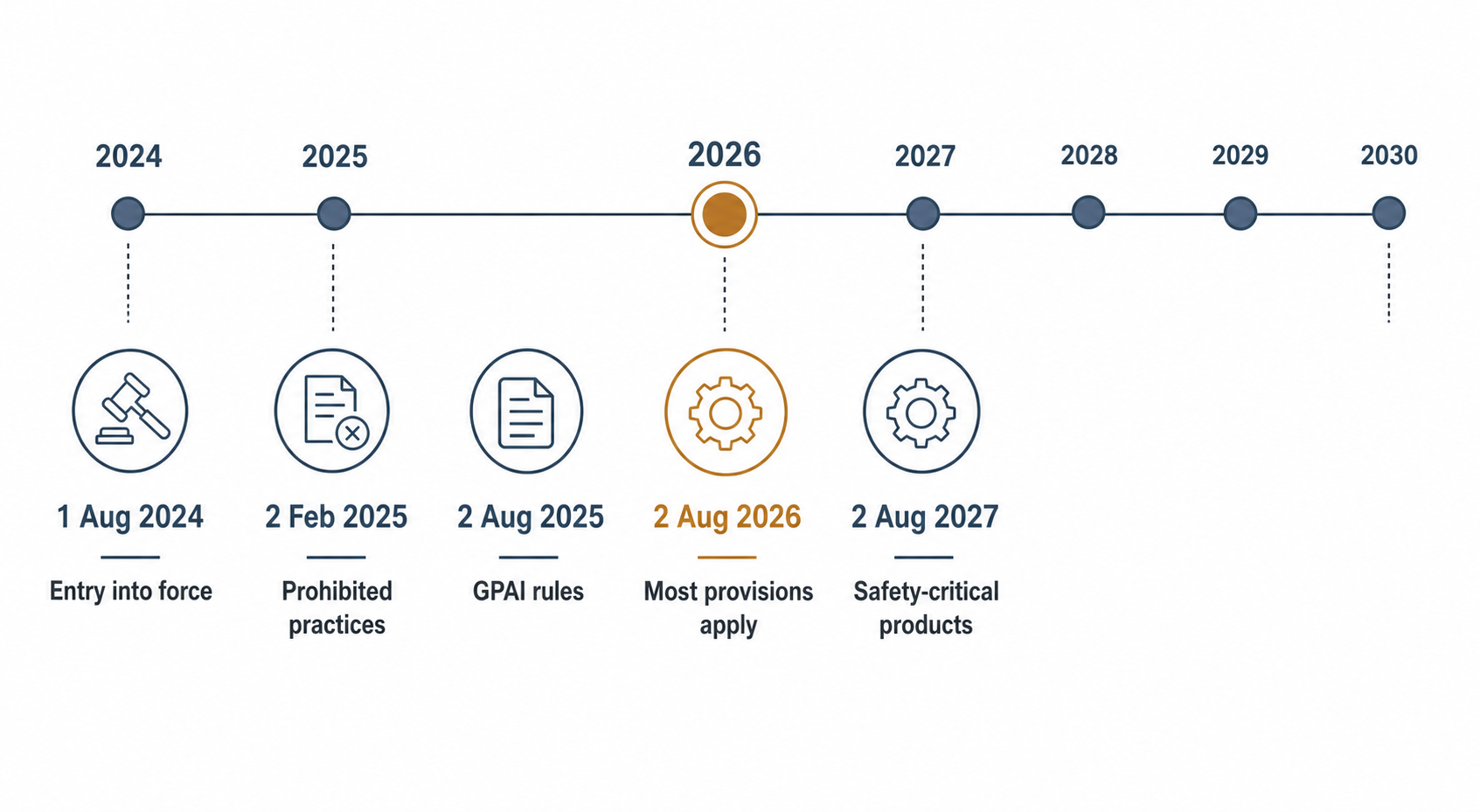
The August 2, 2026 Deadline: Why It Still Matters
The Digital Omnibus proposal has created confusion in the market. Some organizations have interpreted it as a blanket delay of all AI Act obligations. That reading is incorrect. The Omnibus — a political agreement between the European Parliament, Council, and Commission — would defer only the obligations tied to Article 6(1) and Annex III high-risk systems. Every other provision that was scheduled to take effect on August 2, 2026 remains binding unless and until the Omnibus is formally adopted and published in the Official Journal.
The following obligations are already in force or become enforceable on August 2, 2026 regardless of the Omnibus outcome:
- Prohibited AI practices (Article 5): In effect since February 2, 2025. These include social scoring, untargeted scraping of facial images, emotion inference in workplace and education settings, and certain predictive policing applications. Non-compliance carries the highest penalty tier.
- AI literacy (Article 4): Also in force since February 2, 2025. All staff who deploy or operate AI systems must receive sufficient AI literacy training. This obligation applies across risk tiers and has no Omnibus-related deferral.
- Transparency obligations (Article 50): Binding on August 2, 2026. Deployers of AI systems that interact with natural persons, generate deepfakes, or provide emotion recognition or biometric categorization must disclose the AI nature of the interaction.
- GPAI rules (Chapter V): In effect since August 2, 2025. Providers of general-purpose AI models must maintain technical documentation, comply with the Copyright Directive, and publish training-data summaries. Systemic-risk GPAI models face additional evaluation and incident-reporting requirements.
- Governance and penalties (Chapters VII and IX): The AI Office, national competent authorities, and the full penalty structure under Article 99 have been operational since August 2, 2025.
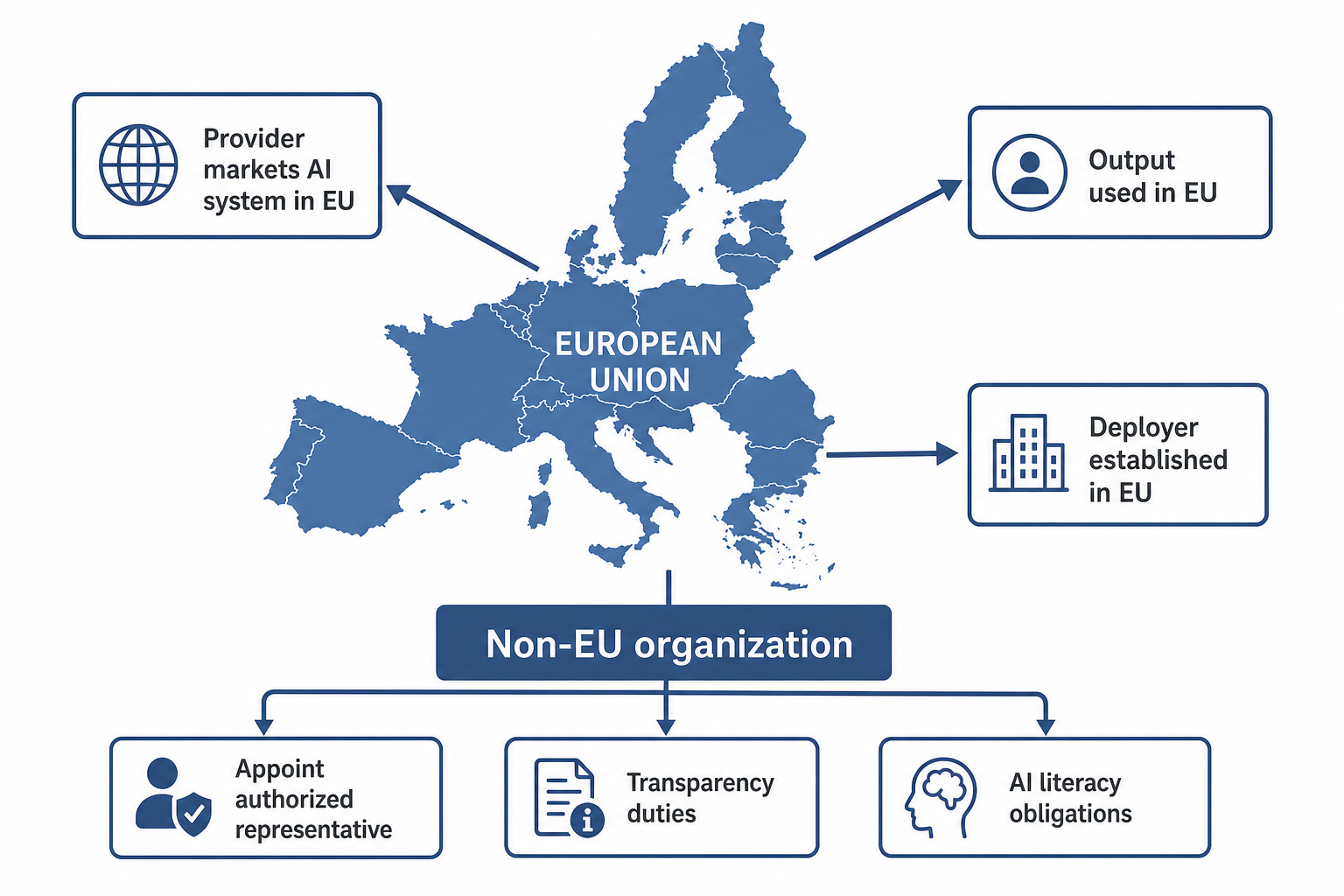
- Extraterritorial scope (Article 2): The Act applies to providers and deployers regardless of establishment if the AI system is placed on the EU market, its output is used in the EU, or the deployer is established in the EU. This provision is not affected by the Omnibus.
What Applies on August 2, 2026: Binding vs. Deferred Provisions
The table below provides a clear separation of obligations that remain binding on August 2, 2026 versus those the Digital Omnibus proposes to defer. Organizations should use this as a reference when prioritizing compliance work.
| Provision | Status on Aug 2, 2026 | Key Obligations | Penalty Tier |
|---|---|---|---|
| Art. 5 — Prohibited practices | In force since Feb 2, 2025 | No social scoring, manipulative AI, untargeted facial scraping, emotion inference in work/education, certain biometric categorization, real-time RBI (limited exceptions) | €35M or 7% global turnover |
| Art. 4 — AI literacy | In force since Feb 2, 2025 | All staff deploying AI must receive sufficient AI literacy training | €15M or 3% global turnover |
| Art. 50 — Transparency | Binding Aug 2, 2026 | Disclose AI interaction, deepfake generation, emotion recognition, biometric categorization | €15M or 3% global turnover |
| Chapter V — GPAI rules | In force since Aug 2, 2025 | Technical documentation, Copyright Directive compliance, training-data summary; systemic-risk models require evaluations, adversarial testing, incident reporting | €15M or 3% global turnover |
| Chapters VII, IX — Governance & penalties | In force since Aug 2, 2025 | AI Office, national competent authorities, penalty structure under Art. 99 | Varies by tier |
| Art. 2 — Extraterritorial scope | Binding Aug 2, 2026 | Applies to providers/deployers placing systems in EU market, using output in EU, or established in EU | Varies by tier |
| Art. 6(1) & Annex III — High-risk classification | Deferred to Dec 2, 2027 (Omnibus proposal) | Risk management, data governance, technical documentation, record-keeping, human oversight, accuracy/robustness/cybersecurity for Annex III systems | €15M or 3% global turnover |
| Art. 27 — Fundamental Rights Impact Assessment | Deferred with Annex III obligations | FRIA required for high-risk systems | €15M or 3% global turnover |
Extraterritorial Reach: Why US and Non-EU Organizations Are in Scope
A common misconception among US-based organizations is that the EU AI Act only applies to companies with a physical presence in the European Union. The Act's extraterritorial scope, defined in Article 2, reaches significantly further. As Holland & Knight explains, the Act applies to any organization that:
- Places an AI system on the EU market or puts it into service in the EU, regardless of where the provider is established
- Uses the output of an AI system within the EU — a clause that captures, for example, a US-based SaaS platform whose AI features assist EU users, a non-EU employer screening EU job candidates, or a financial institution processing credit or insurance data for EU residents
- Is established as a deployer within the EU
This extraterritorial reach means that a US company with no EU office, no EU subsidiary, and no EU employees may still be subject to the AI Act if, for instance, it offers an AI-powered recruitment tool that processes applications from EU candidates, or if it deploys an AI system for credit scoring that evaluates EU residents. The output used in the Union trigger is particularly broad and has no direct analogue in the GDPR's territorial scope.
For non-EU providers of high-risk AI systems, the Act requires appointment of an EU authorized representative by written mandate. The authorized representative must maintain records for 10 years, cooperate with market surveillance authorities, and terminate the mandate if the provider violates the AI Act. This obligation is not deferred by the Omnibus.
Penalty Exposure: The Three Tiers and What They Mean
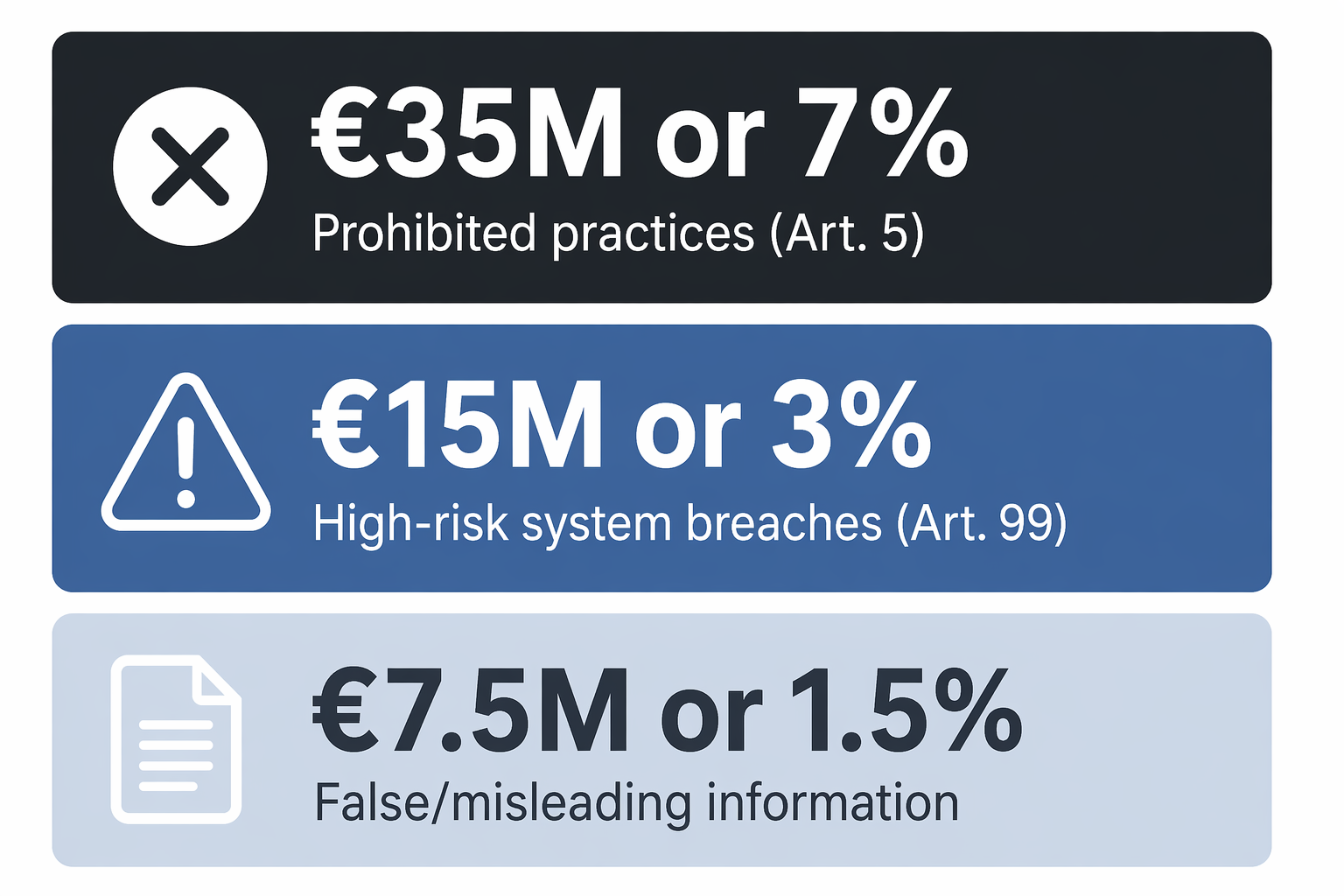
The EU AI Act's penalty structure under Article 99 is designed to create meaningful deterrence. The Digital Omnibus does not reduce these penalties. Organizations that fail to comply with binding obligations face exposure at three tiers:
| Violation Type | Maximum Fine | Alternative Cap | Effective Since |
|---|---|---|---|
| Non-compliance with prohibited practices (Art. 5) | €35,000,000 | 7% of total worldwide annual turnover | Feb 2, 2025 |
| Non-compliance with provider, deployer, transparency, and most other obligations | €15,000,000 | 3% of total worldwide annual turnover | Aug 2, 2025 |
| Supplying incorrect, incomplete, or misleading information to authorities | €7,500,000 | 1.5% of total worldwide annual turnover | Aug 2, 2025 |
Ten penalty factors. Article 99(7) enumerates factors that national supervisory authorities must consider when determining fines: the nature, gravity, duration, and consequences of the infringement; the number of affected persons and the level of damage suffered; prior fines by other market surveillance authorities; prior infringements of other Union or national law arising from the same activity; the size, turnover, and market share of the organization; financial benefits gained or losses avoided; the degree of cooperation with authorities; the degree of responsibility and the technical and organizational measures in place; whether the infringement was notified by the organization or discovered by authorities; and whether the infringement was intentional or negligent.
No one-stop-shop. Unlike the GDPR's one-stop-shop mechanism under Chapter VI, the AI Act decentralizes enforcement. Organizations face potential parallel enforcement actions in multiple EU member states. Each member state's market surveillance authority can investigate, impose fines, and — critically — withdraw noncompliant AI systems from its national market entirely.
Practical Compliance Roadmap: What to Do Now
With approximately seven weeks until the August 2, 2026 deadline, organizations should take the following steps immediately. This roadmap is adapted from guidance published by Skadden and Holland & Knight, supplemented by the official AI Act text.
- Inventory all AI systems in use or development. Catalog every AI system your organization deploys, develops, or procures — including SaaS tools, internal models, and embedded AI features. Document the system's purpose, data inputs, outputs, and the geographic location of affected persons.
- Classify each system by risk tier. Determine whether each system falls into the prohibited (Art. 5), high-risk (Annex III), limited-risk (transparency obligations), or minimal-risk category. For high-risk systems, assess whether they fall under Annex III categories that the Omnibus proposes to defer or under safety-component high-risk categories that remain on the August 2, 2026 timeline.
- Determine your organizational role. The AI Act distinguishes between providers (developers), deployers (users), importers, and distributors. Each role carries different obligations. Note that if a deployer substantially modifies a system or places its trademark on it, the deployer becomes a provider with full provider obligations.
- Prepare technical documentation and conformity assessment. For high-risk systems that are not deferred, providers must complete a conformity assessment under Article 43, self-certify (unless the system involves biometrics, which requires third-party assessment), issue a declaration of conformity, and register the system in the EU database before market placement. Technical documentation under Article 11 must describe the system's design, development methodology, training data, performance metrics, and risk management measures.
- Conduct a Fundamental Rights Impact Assessment (FRIA). Article 27 requires deployers of high-risk systems to conduct a FRIA before deployment. While the Omnibus proposes deferring this requirement for Annex III systems, organizations deploying high-risk systems in safety-critical product contexts (medical devices, aviation, vehicles) should proceed with the FRIA on the original timeline.
- Appoint an EU authorized representative. Non-EU providers must appoint an EU authorized representative by written mandate. The representative must maintain records for 10 years, cooperate with market surveillance authorities, and terminate the mandate if the provider violates the AI Act. This obligation is not deferred.
Intersection with Existing Duties: GDPR, Professional Responsibility, and AI Literacy
The EU AI Act does not operate in a regulatory vacuum. Organizations subject to the Act will also need to navigate its interplay with existing legal frameworks, particularly the GDPR. The IAPP's April 2026 mapping identifies several key intersections:
| AI Act Provision | GDPR Analogue | Key Interplay |
|---|---|---|
| Art. 27 — Fundamental Rights Impact Assessment (FRIA) | Art. 35 — Data Protection Impact Assessment (DPIA) | FRIA complements but does not replace DPIA. Organizations may need to conduct both for high-risk AI systems processing personal data. |
| Art. 10(5) — Special category data for bias monitoring | Art. 9(2)(g) — Substantial public interest derogation | AI Act permits processing of special category data 'strictly necessary' for bias monitoring in high-risk systems. The GDPR's substantial public interest derogation applies. |
| Art. 14 — Human oversight | Art. 22 — Automated individual decision-making | Human oversight obligations under the AI Act complement the GDPR's right not to be subject to solely automated decisions. |
| Art. 26(11) — Deployer transparency to affected persons | Arts. 13-14, 15(1)(h) — Information obligations | Deployers must inform individuals when they are subject to a high-risk AI system decision, complementing GDPR transparency requirements. |
| Art. 12, 26(6) — Recordkeeping | Art. 30 — Records of processing activities | AI Act recordkeeping obligations mirror and extend GDPR recordkeeping requirements. |
| Art. 15(5) — Robustness, accuracy, cybersecurity | Art. 32 — Security of processing | AI Act accuracy and cybersecurity requirements align with GDPR security obligations. |
AI literacy is already in effect. Article 4 of the AI Act, which requires organizations to ensure that all staff who deploy or operate AI systems have sufficient AI literacy, has been in force since February 2, 2025. This obligation applies across all risk tiers and to all organizational roles — providers, deployers, importers, and distributors. AI literacy training should cover the system's capabilities and limitations, appropriate human oversight, and the professional responsibility implications of relying on AI-generated outputs.
Enforcement fragmentation. Unlike the GDPR's one-stop-shop mechanism, the AI Act does not provide a single lead supervisory authority. Enforcement is distributed among member state market surveillance authorities, with the AI Office overseeing GPAI models. Data protection authorities may be involved in certain circumstances, particularly where AI Act obligations intersect with GDPR requirements. Organizations should be prepared for parallel inquiries from multiple national authorities.
Immediate Action Items for Legal Professionals
The following action items are prioritized by urgency and should be addressed within the next seven weeks:
- Verify scope. Determine whether your organization — or your clients' organizations — falls within the AI Act's extraterritorial scope under Article 2. If your organization markets AI systems in the EU, uses AI output in the EU, or is established in the EU, you are in scope regardless of the Omnibus.
- Begin AI system inventory and classification immediately. Without a complete inventory, you cannot assess which obligations apply. Classify each system by risk tier and determine your organizational role (provider, deployer, importer, distributor) for each system.
- Appoint an EU authorized representative. If your organization is a non-EU provider of AI systems that fall within scope, appoint an EU authorized representative by written mandate. This obligation is not deferred.
- Ensure AI literacy training is underway. Article 4 has been in force since February 2025. If your organization has not yet implemented AI literacy training for all relevant staff, this should be addressed immediately.
- Monitor the Digital Omnibus adoption process. The Omnibus is a political agreement that has not yet been formally adopted by the Council. Monitor the adoption process and adjust compliance timelines accordingly. Do not assume the deferral is final until the Omnibus is published in the Official Journal.
- Consult the structured compliance reference. For ongoing guidance, refer to the EU AI Act Compliance Obligations for Legal Professionals: A Structured Reference, which provides a maintained, source-cited overview of obligations by role and risk tier.
The August 2, 2026 deadline is not a distant regulatory event — it is seven weeks away. Organizations that treat the Digital Omnibus as a reason to pause compliance work risk significant penalty exposure, market access restrictions, and reputational damage. The obligations that remain binding — transparency, AI literacy, prohibited practices, GPAI rules, and extraterritorial scope — are substantial and enforceable now. Legal professionals who act decisively in the coming weeks will be best positioned to navigate the AI Act's evolving landscape.
Operationalizing workflow
No workflow has been explicitly linked to this obligation yet. See Workflows generally.
Illustrative cases
No illustrative case is currently tracked for this obligation. See Risk Digest for documented incidents generally.
← Back to RegulationReport a correction or tip
Spotted an outdated figure, a misstated fact, or a ruling this regulation entry should reflect? Public comments are disabled for this content given the professional cost of a misreported case outcome, penalty amount, or rule text — use the structured correction channel instead.
Report a correction or tip for this record →