
AI Compliance Software in 2026: A Buyer’s Guide to the Two-Market Split
This guide helps compliance officers, legal ops leaders, and IT security managers navigate the 2026 AI compliance software market by introducing a two-market split — AI for compliance vs. compliance for AI — and providing a role-based evaluation framework, tool-by-tool comparison, and industry-specific considerations.
- Hallucination rate
- Not measured / undisclosed
Market Context: The AI Compliance Software Landscape in 2026
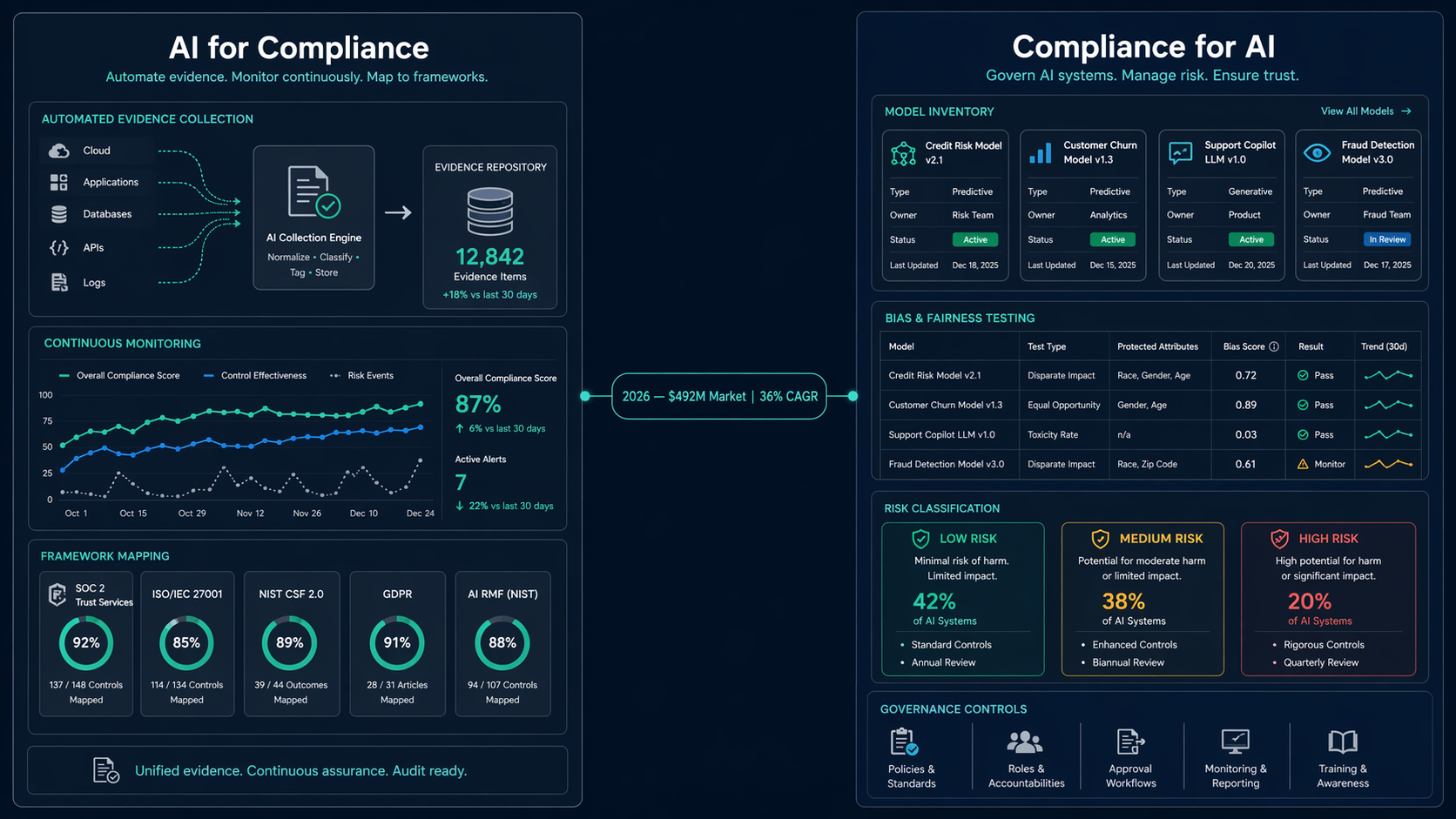
The market for AI compliance software is expanding rapidly, driven by converging pressures: new regulatory mandates, growing adoption of AI within enterprise operations, and a documented shortage of governance infrastructure. Research firms project the AI governance market at $419 million to $492 million in 2026, with compound annual growth rates ranging from 36% to 38.5% depending on methodology. Prefactor estimates $492 million in 2026, while Grand View Research and Persistence Market Research arrive at $417.8 million and $429.8 million respectively. The variance reflects different scope definitions — some analysts include only dedicated AI governance platforms, while others incorporate AI-enabled modules within broader GRC suites.
Adoption drivers are well documented. A Thomson Reuters and Deloitte survey, cited by Centraleyes, found that 73% of organizations cite time savings and 71% cite cost savings as primary reasons for adopting AI in compliance workflows. More than one-third of organizations already use AI in compliance functions, according to the same research. These figures suggest the market is past the early-adopter phase and entering mainstream procurement.
Regulatory urgency is the other major accelerant. The EU AI Act's high-risk system obligations take effect August 2, 2026, with penalties up to €35 million or 7% of global annual turnover. In the United States, the Colorado AI Act (SB 24-205) becomes enforceable on June 30, 2026, imposing a duty of care against algorithmic discrimination with penalties up to $20,000 per violation. California's SB 53 and AB 2013 took effect January 1, 2026, and Texas HB 149 followed on the same date. The result is a compliance environment where organizations face simultaneous obligations from multiple jurisdictions, making manual approaches increasingly untenable.
Yet readiness lags behind regulatory timelines. Prefactor reports that only 35.7% of managers feel adequately prepared for EU AI Act compliance, while 19.4% describe themselves as poorly prepared. Over 50% of organizations lack systematic inventories of their AI systems. This gap between regulatory deadlines and organizational readiness is the primary market driver for compliance software in 2026.
The Two-Market Split: AI for Compliance vs. Compliance for AI
The most useful way to understand the 2026 AI compliance software market is not through a four-category taxonomy of technical capabilities, but through a simpler, procurement-oriented split: AI for compliance versus compliance for AI. These two categories serve different buyers, solve different problems, and require different evaluation criteria.
AI for Compliance
These tools use artificial intelligence to automate and accelerate traditional governance, risk, and compliance (GRC) workflows. They are the direct descendants of legacy GRC platforms, enhanced with AI capabilities for evidence collection, control testing, policy management, and predictive analytics. The buyer is typically a compliance officer or legal ops leader who needs to manage existing regulatory obligations more efficiently.
- AI-powered risk assessment and scoring
- Automated control testing and continuous monitoring
- Intelligent document analysis and policy management
- Predictive compliance analytics and forecasting
- Multi-framework mapping (SOC 2, ISO 27001, NIST, HIPAA, etc.)
Representative platforms in this category include Drata, Vanta, Centraleyes, AuditBoard, Sprinto, Hyperproof, and LogicGate. These tools are mature, widely adopted, and well-documented in user reviews.
Compliance for AI
These tools govern the AI systems themselves. They address a newer set of requirements: model inventory management, bias testing, risk classification under the EU AI Act, documentation for high-risk system conformity assessments, and ongoing monitoring of deployed models. The buyer is often an AI governance officer, a model risk manager, or a chief data officer.
- AI system inventory and cataloging
- Risk tier classification (e.g., prohibited, high-risk, limited, minimal under the EU AI Act)
- Bias and fairness testing
- Model documentation and conformity assessment support
- Post-deployment monitoring and incident logging
Representative platforms include Credo AI, Holistic AI, IBM watsonx.governance, and Microsoft Purview. This category is less mature than AI for compliance, with fewer established products and more variation in capability depth.
A Role-Based Evaluation Framework for 2026
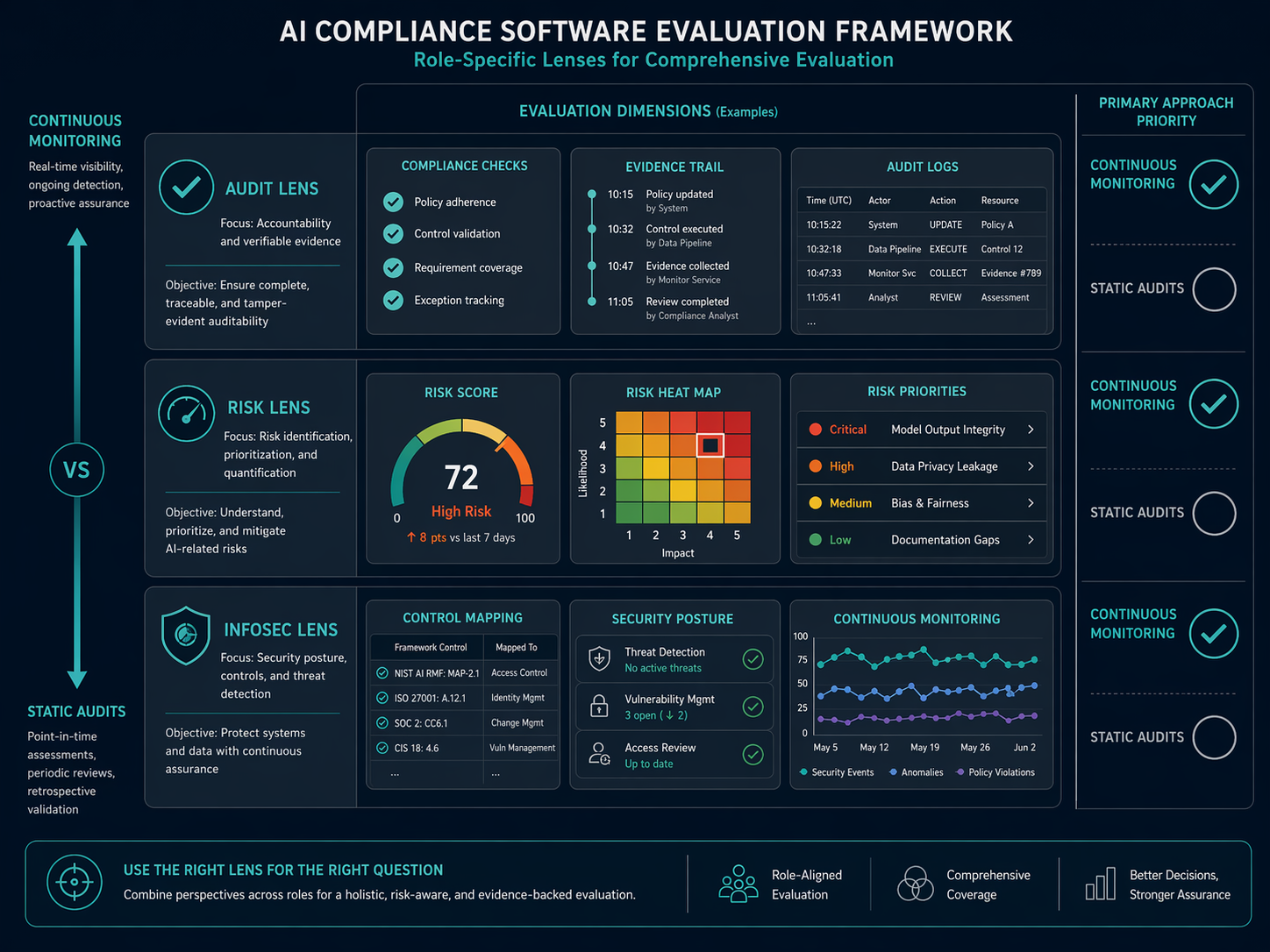
Generic feature checklists are insufficient for the 2026 market. Different stakeholders within an organization have fundamentally different priorities when evaluating AI compliance software. The framework below organizes evaluation criteria by role, with a key decision axis running through all three: continuous monitoring versus static audits.
| Role | Primary Concern | Key Criteria | Preferred Monitoring Mode |
|---|---|---|---|
| Audit / Compliance | Evidence automation, framework coverage, audit readiness | Multi-framework mapping, automated evidence collection, policy management, audit trail completeness | Continuous monitoring preferred; static audits acceptable for smaller programs |
| Risk Management | Risk scoring, heat maps, regulatory change intelligence | Real-time risk dashboards, predictive analytics, multi-framework risk aggregation, regulatory update feeds | Continuous monitoring strongly preferred |
| Infosec / IT Security | Control testing, data privacy, integration with existing security stack | Automated control testing, data retention and privacy posture, API integrations (SIEM, SOAR), vulnerability management | Continuous monitoring expected as baseline |
The continuous monitoring versus static audit axis is critical because it determines whether the tool provides ongoing assurance or periodic snapshots. For organizations subject to the EU AI Act's high-risk obligations, continuous monitoring is effectively mandatory — Article 14 requires ongoing human oversight, and Article 72 mandates post-market monitoring. For organizations managing SOC 2 or ISO 27001 compliance, static audits may still suffice, though the market is shifting toward continuous approaches.
Tool-by-Tool Comparison: Leading Platforms Reviewed
The following comparison covers nine platforms commonly evaluated by compliance officers and legal ops leaders in 2026. Each entry identifies the tool's best-fit scenario, key AI features, and limitations. Ratings are drawn from G2 user reviews as of early 2026, cited by Drata's comparison guide. All platforms fall primarily into the AI for compliance category, though some are expanding toward compliance for AI.
| Platform | G2 Rating | Best For | Key AI Features | Notable Limitations |
|---|---|---|---|---|
| Drata | 4.8/5 | Fast-growing cloud-native companies focusing on SOC 2 and ISO 27001 | Automated evidence collection, continuous control monitoring, AI-driven risk assessment | Limited support for non-cloud deployments; less mature for EU AI Act compliance-for-AI use cases |
| Vanta | 4.6/5 | SMBs and scaling teams needing quick SOC 2 or ISO certification | Automated evidence collection, vendor risk management, AI-powered policy generation | Less suitable for enterprises with complex multi-framework requirements; limited risk analytics depth |
| Centraleyes | 4.3/5 | Organizations needing multi-framework mapping and regulatory intelligence | AI-powered framework mapping, regulatory change monitoring, risk heat maps | Smaller user community than Drata or Vanta; some AI features still in development |
| AuditBoard | 4.6/5 | Enterprise audit and risk teams managing recurring audits across multiple frameworks | AI-driven audit automation, risk assessment, issue tracking, SOX compliance | Higher cost; steeper learning curve; less suited for small teams |
| Compliance.ai / Archer | Not rated on G2 (enterprise) | Large enterprises needing regulatory change intelligence and AI governance | Regulatory change monitoring, AI model risk management, policy management | Enterprise-only pricing; implementation complexity; limited public user reviews |
| Sprinto | 4.8/5 | Cloud-native companies seeking automated SOC 2, ISO, HIPAA compliance | Automated evidence collection, continuous monitoring, AI-driven control mapping | Limited support for on-premises environments; less mature for non-cloud frameworks |
| Hyperproof | Not rated on G2 (niche) | Teams managing recurring audits across multiple frameworks with custom workflows | AI-powered risk assessment, automated evidence collection, custom framework builder | Smaller user base; less automated than Drata or Vanta for initial setup |
| LogicGate | Not rated on G2 (enterprise) | Custom compliance and AI governance workflows for large enterprises | AI governance workflow automation, risk scoring, custom control testing | Requires significant configuration; higher total cost of ownership |
| Optro | Not rated on G2 (newer) | Mature teams across compliance, audit, and risk seeking unified platform | AI-powered evidence automation, continuous monitoring, multi-framework mapping, AI governance module | Newer entrant with smaller reference base; some features still in roadmap |
Industry-Specific Considerations for Compliance Software
Compliance requirements vary significantly by sector, and the two-market split applies differently in each. A tool that works for a SaaS company pursuing SOC 2 certification may be inadequate for a healthcare organization subject to HIPAA and FDA oversight, or a financial institution managing model risk under SR 11-7.
| Industry | Primary Frameworks | AI for Compliance Priority | Compliance for AI Priority | Key Consideration |
|---|---|---|---|---|
| Healthcare | HIPAA, FDA SaMD, EU MDR/IVDR | Automated evidence collection for HIPAA controls, policy management | Bias testing for diagnostic AI, model documentation for SaMD | FDA oversight of AI/ML-enabled medical devices adds pre-market conformity assessment requirements |
| Financial Services | SOX, SR 11-7, EU AI Act (credit/risk tools), FCRA, MiFID II | SOX control automation, audit trail management, regulatory change monitoring | Model risk management, bias testing for credit and insurance algorithms, EU AI Act high-risk documentation | Model risk management discipline is more mature in finance than any other sector; tools must integrate with existing MRM frameworks |
| Government / Defense | NIST AI RMF, EO 14110, FedRAMP, EU AI Act (law enforcement categories) | Authorization-first deployment workflows, continuous monitoring for FedRAMP | AI system inventory, risk classification, bias testing for law enforcement AI | Authorization-first deployment models require tools that can operate in air-gapped or classified environments |
| Energy / Critical Infrastructure | NERC CIP, ISO 42001, NIST CSF | Control testing for OT/IT convergence, evidence collection for NERC CIP | AI system inventory for AI near operational technology, incident logging | AI deployed near OT systems introduces unique safety and reliability requirements |
For financial services, the EU AI Act's classification of creditworthiness and risk assessment tools as high-risk means that compliance-for-AI capabilities — model documentation, bias testing, post-deployment monitoring — are not optional. The Glean analysis notes that these tools require pre-deployment evidence, data governance, and post-release oversight that go beyond traditional model risk management.
For healthcare organizations, the intersection of HIPAA, FDA oversight of software as a medical device (SaMD), and the EU AI Act's health-related high-risk categories creates a multi-layered compliance burden. Tools must support both traditional HIPAA controls and the emerging requirements for AI-specific documentation and bias testing.
Pricing Models and ROI Metrics
Pricing structures across the AI compliance software market vary considerably, reflecting differences in target audience, deployment model, and feature depth. Understanding the pricing model is essential for accurate budgeting and ROI calculation.
| Pricing Model | Typical Range | Common Platforms | Best For |
|---|---|---|---|
| Per-user / per-seat | $15–$100 per user/month | Drata, Vanta, Sprinto | Small to mid-size teams with clear user counts |
| Per-framework | $5,000–$50,000 per framework/year | Hyperproof, LogicGate | Organizations managing multiple frameworks with different scopes |
| Enterprise / custom | $50,000–$500,000+/year | AuditBoard, Compliance.ai/Archer, Optro | Large enterprises with complex, multi-jurisdiction requirements |
| Freemium / free tier | Limited features at no cost | Vanta (limited), Drata (limited) | Small teams evaluating tools before committing |
ROI measurement for AI compliance software typically focuses on four categories:
- Hours saved: Automated evidence collection and control testing can reduce manual audit preparation time by 60–80%, based on vendor-reported benchmarks.
- Audit cost reductions: Fewer external auditor hours needed when evidence is continuously collected and organized.
- Contracts earned: SOC 2 or ISO 27001 certification is increasingly a prerequisite for enterprise sales; faster certification directly impacts revenue.
- Risk mitigation value: The most difficult to quantify but potentially the largest. Prefactor reports that 63% of organizations that experienced AI-related breaches have no AI governance policy or are still developing one. The cost of a single AI-related compliance failure — regulatory fines, legal liability, reputational damage — can far exceed the annual cost of a compliance platform.
Emerging Platforms to Watch
Several newer entrants are worth monitoring for organizations planning their 2027–2028 compliance technology roadmap. These platforms are less mature than the established players but address gaps in the current market.
- Bretton AI: Focuses on AI governance and model risk management, with particular emphasis on EU AI Act compliance documentation. Targets enterprises that need dedicated compliance-for-AI capabilities rather than general GRC automation.
- Hybridity: Positions itself at the intersection of AI for compliance and compliance for AI, offering both automated evidence collection and AI system inventory management. Its hybrid approach may appeal to organizations that want a single platform for both categories.
- Vendict: Specializes in vendor AI risk assessment, helping organizations evaluate the AI compliance posture of their third-party vendors. As supply chain AI risk becomes a regulatory focus, this niche may expand rapidly.
These platforms have limited public user reviews and smaller customer bases compared to Drata, Vanta, or AuditBoard. Organizations considering them should request detailed product demonstrations, customer references, and evidence of third-party security certifications.
How to Choose: A Decision Framework for Your Organization
The following decision framework synthesizes the analysis above into actionable steps. It is designed to be used by a cross-functional evaluation team that includes compliance, risk, and infosec stakeholders.
- Assess your primary need. Are you trying to automate existing compliance workflows (AI for compliance) or govern AI systems themselves (compliance for AI)? Most organizations need both, but one category is usually the primary driver for the initial procurement.
- Identify your role-based lens. Which stakeholder group has the strongest business case? Audit teams prioritize evidence automation and framework coverage. Risk teams prioritize real-time dashboards and predictive analytics. Infosec teams prioritize control testing and integrations. Let the group with the most urgent need drive the evaluation criteria.
- Evaluate against the framework. Use the role-based criteria table in Section 3 to score each candidate. Weight criteria according to your organization's priorities. Do not compare tools on features that are irrelevant to your primary use case.
- Consider industry-specific requirements. Healthcare, financial services, government, and energy organizations have additional compliance obligations that may disqualify tools lacking specific framework support or deployment flexibility.
- Pilot with a shortlist of 2–3 tools. Request sandbox access or trial instances. Test the most critical workflows — evidence collection, control testing, risk reporting — with your own data. Measure time to first audit-ready output.
- Evaluate total cost of ownership. Include implementation costs, training time, ongoing configuration, and the cost of any additional modules needed for compliance-for-AI capabilities. A lower per-user price may not translate to lower total cost if the tool requires extensive customization.
| Decision Factor | Question to Ask | Red Flag |
|---|---|---|
| Primary need | Are we solving for compliance automation or AI governance? | Vendor claims to do both equally well but cannot demonstrate production customers for one category |
| Role alignment | Which stakeholder group will drive adoption? | Tool excels for one role but is unusable for another critical stakeholder |
| Monitoring mode | Do we need continuous monitoring or periodic audits? | Tool only supports static audits but regulatory obligations require continuous monitoring |
| Industry fit | Does the tool support our specific regulatory frameworks? | Tool lacks support for industry-specific frameworks (HIPAA, SOX, NERC CIP) |
| Total cost | What is the three-year total cost of ownership? | Per-user price is low but implementation and customization costs are undisclosed |
Chronological incident history
No sanction cases have named this tool in the tracked record set to date. This does not imply the tool is safe — see Risk Digest for ongoing monitoring.
← Compare peer toolsReport a correction or tip
Spotted an outdated figure, a misstated fact, or a ruling this tool profile should reflect? Public comments are disabled for this content given the professional cost of a misreported case outcome, penalty amount, or rule text — use the structured correction channel instead.
Report a correction or tip for this record →