
Which Laws Apply to AI-Generated Election Fraud Claims?
As the 2026 midterm elections approach, legal professionals face a fragmented landscape of state and federal laws addressing AI-generated content that falsely claims election fraud. This article analyzes which statutes are most defensible against First Amendment challenge and how campaigns and platforms can operationalize compliance.
- Hallucination rate
- Not measured / undisclosed
A synthetic video that appears to show ballot stuffing is not just another ugly campaign clip. By the time a lawyer sees it, a media buyer may already have placed it, a county official may be getting calls, a platform trust team may have a takedown queue, and someone may be asking whether the answer is a disclaimer, a complaint, a criminal referral, or silence. For the 2026 midterms, the hard part of election fraud claims and AI false statements law is that there is no single federal rule that answers all of those questions.
Federal law supplies a baseline, but not a campaign-ad code for synthetic media. The Federal Election Commission voted on September 19, 2024, not to open a formal AI rulemaking, while issuing an interpretive rule confirming that existing fraudulent-misrepresentation restrictions apply regardless of whether the deception is created by a camera, editing software, or generative AI.[1] That distinction matters. The FEC did not enact a new AI-specific regime. It also did not do nothing.
The result is an operating map that starts with old federal statutes, then immediately becomes state-specific. A campaign or PAC reviewing an AI-generated claim that an election was rigged has to separate at least five questions: whether the speaker is fraudulently speaking as or on behalf of a candidate or party; whether the content is intended to prevent voting; whether state synthetic-media disclosure or prohibition rules apply; whether the content impersonates a real person or misuses likeness rights; and whether a platform has an independent removal obligation under its own rules or another statute.
The Federal Baseline Is Narrower Than the Problem
The most relevant federal campaign-finance provision is 52 U.S.C. § 30124. It prohibits a person from fraudulently misrepresenting that the person is speaking, writing, or otherwise acting for or on behalf of a candidate or political party, or an employee or agent of either, in a way that is damaging to another candidate or party.[2] In the AI context, the useful point is not that the statute mentions deepfakes; it does not. The useful point is that the FEC reads the statute as technology-neutral.
That helps with one familiar category: a synthetic robocall, video, or audio clip that purports to be an official campaign communication when it is not. It is less helpful for a different category: an outside speaker who uses AI to claim, falsely, that unnamed poll workers dumped ballots or that voting machines were compromised, while not pretending to be any candidate, party, employee, or agent. Section 30124 is a fraudulent-misrepresentation law, not a general false-election-rumor law.
A separate federal statute, 52 U.S.C. § 20511, makes it unlawful in certain circumstances to communicate false election information with intent to prevent another person from voting.[3] That is a better fit for synthetic media that tells voters their polling place has changed, falsely announces that an election has been canceled, or uses fabricated claims of fraud to persuade a targeted group that voting is pointless or unsafe. It still requires attention to intent and voting interference. It does not turn every false AI-generated allegation about ballot fraud into a federal offense.
Congress has considered broader election-AI legislation. The Padilla-Merkley FAIR Elections Act, introduced in 2025, would create federal prohibitions on certain false AI-generated election content intended to suppress voters and target election workers, but its prospects remain uncertain.[4] The failed federal preemption fight points the other way. A proposed 10-year moratorium on state AI laws was stripped from the One Big Beautiful Bill by a 99-1 Senate vote on July 4, 2025, after opposition from 40 state attorneys general and 17 Republican governors.[5] Whatever one thinks of state experimentation, it has not been displaced by a uniform federal AI-election standard.
The State Map Is the Main Compliance Burden
By mid-2026, the state picture is broad enough that national answers are usually wrong. Public Citizen’s tracker reported that 46 states had enacted some form of deepfake legislation as of May 2026, and StackCyber’s May 14, 2026 tracker counted more than 30 states with laws specifically targeting election-related deepfakes.[6][7] MultiState’s February 2026 analysis shows how quickly the landscape changed across the 2024 and 2026 legislative sessions.[8]
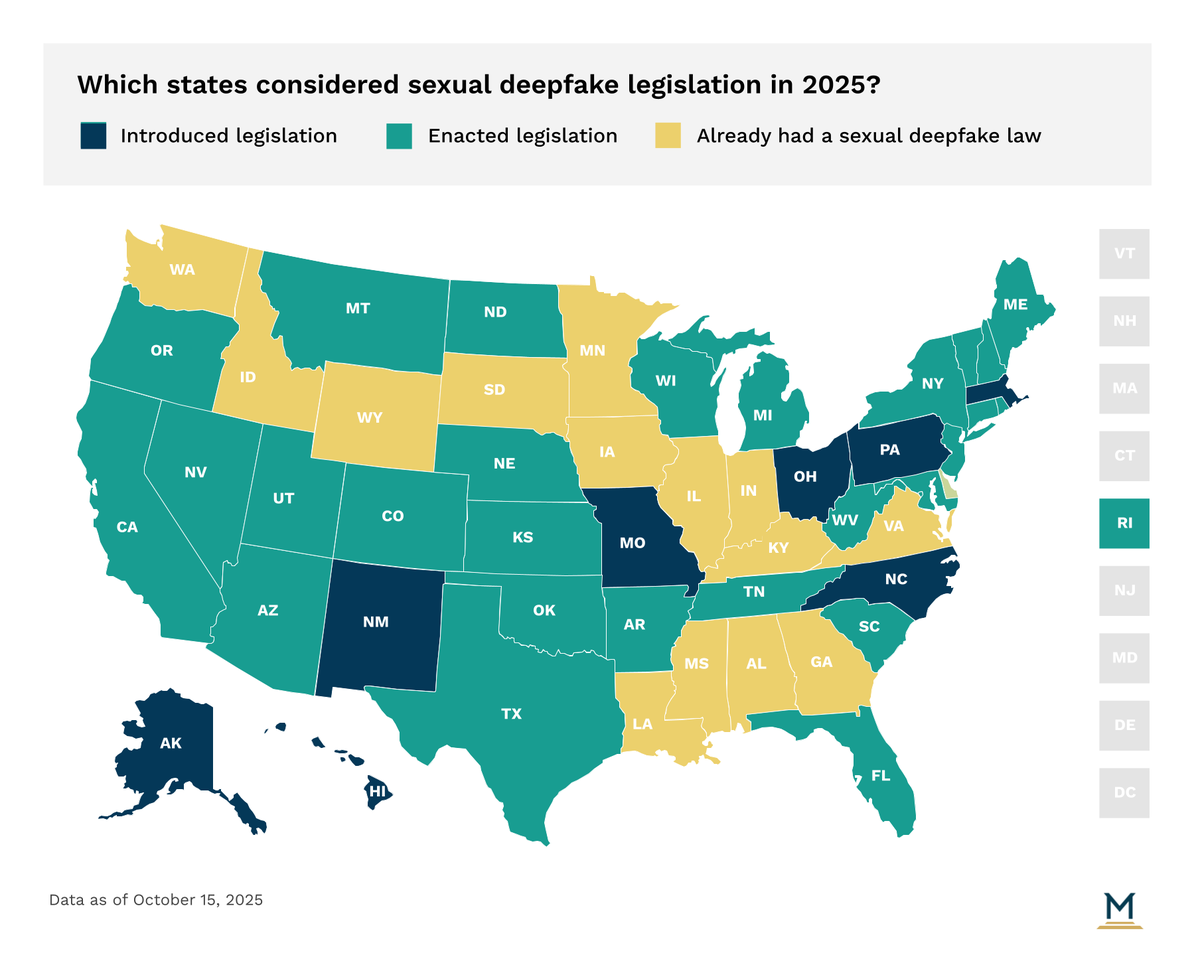
The statutes do not all regulate the same thing. Wiley Rein’s June 30, 2026 alert usefully groups the recurring approaches into disclaimer requirements, prohibitions on materially deceptive AI-generated election media, and quasi-property or right-of-publicity protections.[9] That taxonomy is more useful than simply asking whether a state has an “AI deepfake law,” because the compliance task changes depending on which model a state chose.
| State-law approach | What the reviewer has to decide | Typical pressure point |
|---|---|---|
| Disclosure or disclaimer requirement | Does the communication use synthetic media covered by the statute, and does the required label appear in the required form? | Operational fit: can the rule be added to ad review, creative trafficking, and platform labeling workflows? |
| Materially deceptive media prohibition | Does the content falsely depict speech, conduct, or events in a way the statute covers, within the relevant election window? | First Amendment exposure: the broader the ban, the more it has to survive scrutiny under political-speech doctrine. |
| Likeness, impersonation, or publicity-style protection | Does the content use a real person’s identity, voice, image, or likeness without authorization? | Scope: the issue may be impersonation or misappropriation, not the truth or falsity of an election-fraud claim itself. |
For a lawyer clearing a national ad buy, the first category is usually the cleanest to operationalize. If a statute requires a visible or audible statement that content was generated or materially altered by AI, that can be added to a script, supers, audio tags, trafficking instructions, and vendor certification. It does not mean the communication is immune from challenge. It does mean the compliance question can be turned into a checklist item.
The second category is harder because “materially deceptive” election media can reach protected political expression, parody, satire, and contested factual claims. A fake video of a county clerk confessing to adding ballots is not the same as a satirical image of a candidate wearing a crown and declaring victory. A statute that treats those close to the same way may be easy to explain in a press release and difficult to defend in court.
Alvarez Is the Constitutional Hinge
The First Amendment problem is not that falsehoods are good for elections. The problem is that U.S. v. Alvarez does not permit the government to punish false statements about public matters merely because they are false, absent fraud, defamation, or another established legally cognizable harm.[10] Any deepfake-election statute that reaches AI-generated claims of ballot fraud has to be drafted around that constraint, not around the intuitive proposition that fabricated election-fraud claims are dangerous.
That is why disclosure-based regimes are generally more defensible than blanket prohibitions. A disclosure rule aimed at provenance tells the viewer something about how the content was made. It does not require the state to decide, in the middle of a campaign, whether a political claim is true, exaggerated, satirical, or maliciously false. A prohibition, by contrast, often forces an enforcement official or court to decide whether the synthetic content is materially deceptive, whether the deception matters to voting, and whether an exception for satire, parody, news, or commentary saves the law.
The difference matters most in election-fraud scenarios because the fact pattern can be genuinely harmful without being easy to draft around. A synthetic clip of an election official saying “we changed the totals” may involve impersonation, false speech, voter interference, reputational harm, and threats to election administration. A fabricated meme implying that a candidate benefits from “stolen votes” may be crude campaign speech. A statute broad enough to catch both has to carry a heavy constitutional load.
Narrow prohibitions are not off the table. Laws aimed at fraud, intimidation, impersonation, or intentional voter suppression sit closer to recognized exceptions and established election-administration interests. The drafting problem is the gap between “this synthetic election-fraud claim is dangerous” and “this statutory category is narrow enough, with enough scienter and harm requirements, to survive First Amendment review.”
Model Language Is Useful, But It Is Still Only Model Language
The American Bar Association Task Force for American Democracy’s working paper, “Deepfakes and American Elections,” is notable because it names the election-fraud problem directly. Its model legislation targets deepfakes that “create a false impression of voter fraud, falsely claim or imply that an election has been stolen, [or] falsely impugn the integrity or security of an election or balloting system,” and it uses a 90-day pre-election and 180-day post-election window.[11]
That language is a drafting reference, not an enacted rule. It is useful because it avoids treating all synthetic political media as the same problem and focuses on claims that can destabilize voting and certification. But a campaign cannot comply with ABA model legislation in the abstract. It has to ask whether a particular state adopted comparable language, changed it, added exceptions, limited it to candidates, extended it to ballot measures, created a private right of action, or tied enforcement to an election window.
The ABA proposal also illustrates why post-election windows matter. False AI-generated admissions of rigged results may surface after polls close, when recounts, canvasses, certification meetings, and litigation are underway. But post-election regulation can collide with core political speech about the legitimacy of an election. A 180-day window is not self-justifying; it is a policy choice that would still need to be defended under the First Amendment if enacted.
California and Minnesota Show the Fragility of Broad Laws
California’s 2024 package became the obvious test case because it tried to move aggressively on synthetic election content. In Kohls v. Bonta, a federal judge partially struck down AB 2839 and AB 2655 in August 2025, calling the law “a blunt tool that hinders humorous expression” and holding that key provisions conflicted with Section 230.[12] The exact enforceable scope should be checked against the current docket before any late-cycle California decision, but the warning is already clear: broad content-based controls on political deepfakes can fail both constitutional and platform-liability tests.
California is not proof that every state synthetic-media law is doomed. It is proof that courts will look past the label “AI” and ask familiar questions about protected speech, statutory breadth, exceptions, and who is being compelled or punished. A law that requires a clear disclosure on synthetic political media is in a different posture from a law that suppresses a wide range of altered political expression.
Minnesota’s laws are also under active challenge. X Corp. v. Ellison targets HF 1370 and HF 4772, and the litigation drew unusual attention after the state’s expert submission contained AI-hallucinated citations generated by ChatGPT-4.0.[13] That episode should not distract from the legal issues, but it is a useful caution for election-law emergency work: when the subject is synthetic evidence and false provenance, sloppy support materials can become part of the case.
The California and Minnesota challenges do not settle the 2026 map. They do, however, make it harder to advise clients as if enactment equals enforceability. For each state, the live question is not only what the statute says, but whether a preliminary injunction, severability ruling, platform-liability holding, or pending appeal changes the practical risk before the ad runs.
What This Means for 2026 Review Workflows
A usable 2026 workflow should not begin with the question, “Is this an AI election fraud claim?” That category is too blunt. The better first screen is what legal theory would make the content actionable.
- Provenance disclosure: Does the jurisdiction require a label because the content is AI-generated or materially altered?
- Fraudulent misrepresentation: Does the communication falsely claim to be from, authorized by, or acting on behalf of a candidate, party, or agent?
- Voter interference: Is the false statement intended to prevent voting or mislead voters about election procedures?
- Impersonation or likeness: Does the synthetic media use a real person’s voice, image, or identity in a covered way?
- Platform removal and preservation: Does a platform policy, state rule, court order, or federal obligation require removal, labeling, escalation, or record preservation?
That separation prevents two common mistakes. The first is overcalling the FEC rule, as if it created a comprehensive synthetic-media code for campaign advertising. It did not. The second is undercalling it, as if the FEC declined to recognize any federal role. It confirmed that fraudulent misrepresentation law applies irrespective of the technology used to create the communication.[1]
Platforms have a different timing problem. A campaign lawyer may have hours to clear a revised spot; a platform trust team may have minutes to decide whether a synthetic video alleging ballot fraud should be labeled, downranked, removed, preserved for law enforcement, or left up as political speech. The TAKE IT DOWN Act, signed in May 2025, created separate platform-compliance obligations in the nonconsensual intimate imagery context, with a May 19, 2026 compliance deadline and FTC warning letters to major platforms before that date.[14] That statute is not the election-fraud rule, but it is part of the broader federal environment in which platforms are being pushed toward faster synthetic-media response systems.
There is also a boundary worth keeping clean. The focus here is AI-generated content that makes false election-fraud claims. The related “liar’s dividend” problem—someone falsely insisting that real evidence is AI-generated—raises different evidentiary and communications issues. It may appear in the same controversy, but it does not trigger the same statutory analysis.
For now, the laws most likely to endure are the ones that ask narrower questions: Was the media synthetic? Was that fact disclosed? Did the speaker impersonate a campaign or official? Was the falsehood used to suppress voting? Did the content invade a protected likeness interest? The broader the law becomes—especially when it tries to ban materially deceptive political speech as a class—the more it has to answer Alvarez, satire, Section 230, and the ordinary roughness of campaign advocacy.
That leaves campaigns, PACs, platforms, and prosecutors with a fragmented 2026 compliance reality. No federal preemption rule or uniform AI-election standard has displaced state experimentation. Current litigation and late-cycle legislative activity may change enforceability before particular ads, posts, or referrals are reviewed, so the safest operating assumption is jurisdiction-specific review rather than a clean national answer.
References
- Artificial Intelligence in Campaign Ads, Federal Election Commission, September 19, 2024.
- 52 U.S.C. § 30124 - Fraudulent misrepresentation of campaign authority, U.S. Code.
- 52 U.S.C. § 20511 - Criminal penalties, U.S. Code.
- FAIR Elections Act, Congress.gov, 2025.
- One Big Beautiful Bill Act, Congress.gov, July 2025.
- AI Deepfakes and Elections Legislation Tracker, Public Citizen, updated June 15, 2026.
- Election Deepfake Legislation Tracker, StackCyber, updated May 14, 2026.
- State Laws Targeting AI-Generated Election Content, MultiState, February 12, 2026.
- States Continue to Regulate AI-Generated Election Content, Wiley Rein, June 30, 2026.
- United States v. Alvarez, U.S. Supreme Court, 2012.
- Deepfakes and American Elections, ABA Task Force for American Democracy, 2024–2025.
- Kohls v. Bonta, U.S. District Court, August 2025.
- X Corp. v. Ellison, U.S. District Court.
- TAKE IT DOWN Act, Congress.gov, May 2025.
Chronological incident history
No sanction cases have named this tool in the tracked record set to date. This does not imply the tool is safe — see Risk Digest for ongoing monitoring.
← Compare peer toolsReport a correction or tip
Spotted an outdated figure, a misstated fact, or a ruling this tool profile should reflect? Public comments are disabled for this content given the professional cost of a misreported case outcome, penalty amount, or rule text — use the structured correction channel instead.
Report a correction or tip for this record →