
A consumer searching “how to choose car accident attorney hit and run” is usually asking a practical question: who can help when the at-fault driver disappeared? Inside a plaintiff firm, the harder question lands earlier. Can the intake team recognize, within the first call, that this file may not behave like an ordinary auto-liability claim at all?
That distinction matters because many hit-and-run evaluations begin with an absent defendant, uncertain insurance, and evidence that may be gone before a lawyer reviews the file. A Salvi Law analysis of Chicago police and transportation data reported roughly 30,000 hit-and-run collisions annually, 306 arrests from more than 37,000 crashes in the most recent audited year, and a 9.4% clearance rate for serious-injury or fatal hit-and-run crashes in Chicago compared with 34.7% in New York City; the same analysis should be read as a firm-commissioned, local study rather than a national clearance benchmark.[1]
The coverage problem is not theoretical. The Insurance Information Institute reports that 15.4% of U.S. drivers were uninsured in 2023, with state variation ranging from 28.2% in Mississippi to 5.7% in Maine.[2] The Insurance Research Council also reported that the uninsured-driver rate rose from 12.4% in 2017 to 15.4% in 2023.[3] For a hit-and-run intake desk, those numbers move uninsured and underinsured motorist analysis from a later coverage question to an opening case-evaluation issue.

Why a hit-and-run file breaks a generic auto-accident workflow
Standard auto-accident intake often assumes a known adverse driver, an exchange of insurance information, and a liability path that can be developed through police reports, photos, medical records, and insurer correspondence. A hit-and-run file may have none of that. The first evaluation has to ask whether the client’s own UM/UIM coverage is the real recovery path, whether state law or policy language requires prompt notice, whether the incident qualifies when there was no physical contact, and whether independent corroboration exists for a phantom vehicle.
AI can help here, but not if the system is configured as a generic car-crash sorter. A model that extracts “rear-end collision,” “neck pain,” and “ER visit” from a form may still miss the coverage trigger that decides whether the claim is viable. A demand generator can produce a polished liability narrative and still value the matter against a nonexistent bodily-injury carrier. The first improvement is not better prose. It is forcing the right missing facts into the file before they become unrecoverable.
National fatality data provides only a broad road-safety backdrop. NHTSA estimated 36,640 traffic fatalities in 2025, a 6.7% decrease from 2024, and reported the second-lowest fatality rate in recorded history at 1.10 fatalities per 100 million vehicle miles traveled.[4] Those figures do not answer how often a given hit-and-run claimant will recover. The claim-level question remains more operational: what can the firm prove, preserve, and collect against?
The workflow should be built around the first hour, not the final demand
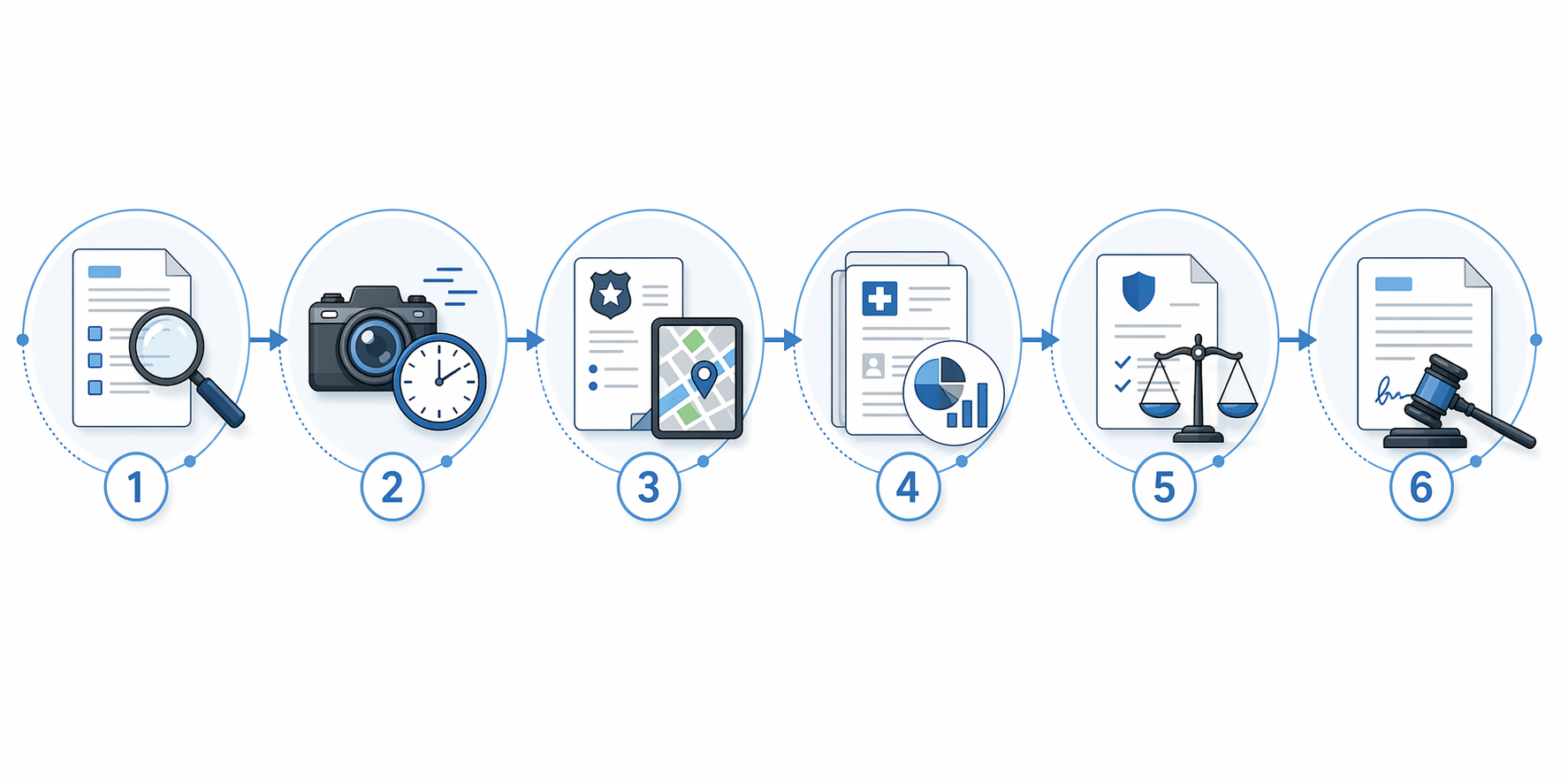
A useful AI workflow for hit-and-run matters does not start with document drafting. It starts with triage pressure. The system should identify the claim type, collect coverage facts, flag evidence that may disappear, and route the file to someone authorized to send preservation requests or assign an investigator.
| Evaluation point | What the AI workflow should force into the file | Why it matters |
|---|---|---|
| Intake triage | Physical contact, phantom vehicle facts, police report status, notice timing, client UM/UIM coverage, available witnesses | The case may turn on coverage and corroboration before liability can be developed |
| Rapid evidence preservation | Intersection cameras, nearby businesses, residential cameras, dashcam leads, vehicle debris, scene photos, tow or repair records | Video and other third-party evidence may be overwritten or lost quickly |
| Investigation support | Crash location mapping, vehicle description extraction, camera canvass planning, reconstruction inputs | The missing driver problem requires organized search work, not just claim documentation |
| Medical-record analysis | Injury chronology, causation flags, prior-condition issues, treatment gaps, permanency indicators | UM/UIM carriers still test causation and damages even when the tortfeasor is unknown |
| Coverage and valuation | Policy limits, stacking issues, offsets, state-specific UM/UIM triggers, available med-pay or health liens | The practical value of the case may be constrained by first-party coverage |
| Demand generation | Evidence index, damages narrative, policy-limit framing, unresolved proof gaps, attorney verification checklist | A polished demand is useful only if it matches the recoverable coverage theory |
Intake triage has to identify the claim as a coverage problem
The first call should not simply ask whether the client was hurt and whether the police came. In a hit-and-run matter, the AI intake layer should treat the absent driver as a fork in the case. Did the vehicles make contact? Did another vehicle force the client off the road without contact? Is there a witness who can corroborate that vehicle? Was a police report made? Has the client notified their own insurer? Does the declarations page show UM/UIM coverage? Is the vehicle owned by the client, a household member, an employer, or a rideshare or delivery platform?
Those questions should be structured, not buried in free-text notes. An intake platform can prompt the caller for policy documents, photos of the insurance card, the crash location, the exact time window, the reporting agency, witness names, and any camera sources the client noticed at the scene. If the client says, “I think the store had cameras,” that should not sit as a sentence in a call summary. It should become a task with a location, deadline, owner, and preservation status.
This is also where AI should classify uncertainty. “Unknown driver” is not enough. The file needs to distinguish a driver who fled after impact, a phantom vehicle that caused evasive action, a parked-car hit-and-run with no bodily injury, a pedestrian or cyclist strike, and a commercial vehicle that may be identifiable through route, camera, or plate-reader evidence. These categories are not labels for marketing. They change what the attorney must verify.
Some PI AI vendors describe intake automation as a way to capture more complete facts, route leads, and reduce manual intake burden.[5] That is helpful, but a hit-and-run configuration should go further than general lead scoring. The system should create an exception path when the defendant is unidentified: request the client’s policy documents, flag possible UM/UIM notice issues, ask whether the client has already spoken with their insurer, and prevent the file from being valued as if an adverse bodily-injury carrier has been identified.
A practical intake prompt set
- Identify the crash mechanism: direct contact, no-contact phantom vehicle, sideswipe, rear impact, pedestrian or cyclist strike, or property-damage-only event.
- Capture reporting facts: police agency, report number if available, date and time reported, insurer notice date, and any pending statement request.
- Collect coverage documents: declarations page, UM/UIM limits, household policies, employer or platform coverage, med-pay, and health insurance.
- Record corroboration sources: passengers, independent witnesses, scene video, dashcam footage, 911 calls, nearby businesses, and vehicle debris.
- Create urgent tasks: evidence preservation, police report follow-up, client insurer notice review, and attorney review of state-specific UM/UIM requirements.
Evidence preservation is the place to be least impressed by automation theater
In a normal PI office, a file can move from intake to attorney review to investigator assignment over several business days and still feel efficient. In a hit-and-run file, that same pace can be fatal to proof. Practitioner sources identify a common 72-hour overwrite problem for surveillance footage at many intersections and businesses, often before a dedicated investigator is assigned.[1][6] The point is not that every camera deletes footage on the same schedule. The point is that the workflow has to assume the evidence clock started before the client called.
AI should convert location facts into preservation work immediately. If the intake notes include an intersection, nearby store, gas station, apartment complex, school, transit stop, parking garage, or construction site, the system can generate a canvass list and a preservation queue. A human still has to decide what to send, where to send it, and whether the request is legally and factually appropriate. But the software can stop the file from waiting quietly while footage cycles out.
The same logic applies to client-controlled evidence. The intake workflow should ask for dashcam files, phone photos, repair estimates, tow records, rideshare receipts, location history, messages sent immediately after the crash, and photos of bruising or vehicle damage. None of these items proves the case alone. Together, they can corroborate timing, mechanism, impact severity, and injury onset when there is no identified adverse driver to depose.
AI investigation tools may also support later reconstruction work. Plaintiff-side discussions of investigation technology describe photogrammetry, LiDAR-supported crash reconstruction, dashcam and traffic-camera analysis, and research tools for identifying commercial or corporate defendants.[7] Those tools are most useful when the intake layer has preserved the raw material they need. A reconstruction platform cannot analyze video that the firm never requested.
Attorney review remains the control point. Generated camera lists can include irrelevant locations. A model may overread a vague client statement as proof of physical contact. An automated preservation letter may need jurisdiction-specific language or a narrower request. The defensible workflow is not “AI found the evidence.” It is “AI surfaced the evidence sources early enough for a responsible person to act.”
Investigation support should be tied to the missing-defendant theory
After the first preservation push, the investigation plan should branch. If the driver may be identifiable, the workflow can organize plate fragments, vehicle color, make, model, direction of travel, paint transfer, debris, repair-shop leads, and camera sequences. If the driver is unlikely to be found, the same facts still matter, but for a different audience: the UM/UIM carrier evaluating whether the crash occurred as described and whether the unknown motorist caused the injury.
This is where a case-management system should avoid treating “liability” as a single field. A hit-and-run liability memo may need separate entries for collision occurrence, unknown-driver involvement, client comparative fault, corroboration, police documentation, scene consistency, and coverage trigger. One field marked “clear” does not tell the attorney whether the proof is strong enough for a UM demand, arbitration, or suit.
General AI case-evaluation tools are often described as helping assess liability, damages, medical records, and case value across personal injury matters.[8] In hit-and-run work, the useful adaptation is narrower: separate what would prove negligence against an identified tortfeasor from what will satisfy the client’s own policy and state UM/UIM requirements. The same crash facts can look adequate under one theory and thin under another.
Medical chronology still matters, but it does not solve the coverage problem
Medical-record AI is a natural fit for hit-and-run files once the case survives the first coverage and evidence screens. The system can extract emergency-room visits, diagnostic imaging, referrals, treatment gaps, prior similar complaints, work restrictions, impairment ratings, and future-care references. It can also help align the injury timeline with the crash timeline, which matters when the insurer cannot cross-check the story against an adverse driver’s account.
The danger is overvaluing a clean damages package before the firm has a collectability path. Severe injuries do not create UM/UIM coverage where policy language, statute, notice, or corroboration requirements fail. The medical chronology should therefore feed two different evaluations: whether the injuries were caused by the crash and whether the available coverage can realistically compensate them.
A useful AI summary will not merely say “client sustained cervical and lumbar injuries.” It will identify the first report of pain, objective findings, missed-work evidence, treatment consistency, prior conditions that need attorney attention, and any facts that strengthen or weaken causation. Those outputs should then be checked against the evidence file: police report, witness statements, scene video, vehicle damage, and photographs.
UM/UIM analysis should shape valuation before the demand is drafted
Hit-and-run valuation is often policy-limit valuation. That does not mean every claim is worth limits. It means the first meaningful damages discussion must identify the available coverage, the applicable trigger, offsets, stacking possibilities, and any procedural requirements. Law-firm resources discussing hit-and-run and UM/UIM claims commonly frame the victim’s own uninsured motorist coverage as the route for recovery when the at-fault driver is unknown or uninsured.[9][10] Before a firm relies on a rule in a live legal workflow, the specific statutory and policy requirements should be verified against primary law and the actual policy forms.
An AI coverage screen should therefore collect more than the carrier name. It should request the declarations page, policy period, named insureds, covered vehicles, UM/UIM limits, med-pay, household exclusions, business-use issues, other household policies, employer coverage, and any correspondence from the insurer. It should also flag whether the claim involves physical contact, a no-contact phantom vehicle, delayed reporting, or disputed occupancy status.
For valuation, the demand system should know when policy limits are the ceiling, when damages appear to exceed limits, and when proof problems make a limits demand premature. A catastrophic injury with a thin phantom-vehicle record is not the same file as a moderate injury with clear video of an unknown driver striking the client and fleeing. Both may be UM claims. They do not deserve the same demand strategy.
Vendor demand tools can be useful at this stage if they are constrained by the correct coverage theory. EvenUp describes AI tools for auto-accident claims that assist with demand generation and policy-limit framing, and reports that firms using its platform see a 69% higher likelihood of policy-limit tender; that figure is a vendor-reported platform metric, not an independent finding.[11] The safer lesson is operational: a demand tool should not produce a general negligence demand until the attorney has confirmed what coverage is actually being demanded against.
What the demand package should show
- The unknown-driver theory: direct impact, phantom vehicle, or other hit-and-run mechanism, with citations to the evidence in the claim file.
- The coverage basis: policy, insured status, UM/UIM limits, notice history, and any unresolved coverage issues requiring attorney analysis.
- The preservation record: camera requests, witness contacts, police-report follow-up, dashcam collection, and scene documentation.
- The causation proof: treatment chronology, objective findings, vehicle or scene evidence, prior-condition analysis, and treatment-gap explanation.
- The valuation rationale: medical expenses, wage loss, permanency, pain and suffering evidence, liens, offsets, and why the demand fits the available limits.
The attorney verification layer is not optional
The more specialized the workflow becomes, the more important verification becomes. AI can extract a policy limit incorrectly, miss an exclusion, confuse UIM with UM, treat a no-contact event as a direct-impact crash, or summarize a medical record without preserving the ambiguity that a carrier will later exploit. Those are not small formatting errors. In a hit-and-run matter, they can distort case acceptance, client counseling, and settlement authority.
A plaintiff firm using AI for hit-and-run evaluation should assign review points, not just software permissions. Intake managers can verify that the right documents were requested. Investigators can confirm that preservation tasks were sent and logged. Paralegals can check that medical summaries match source records. Attorneys can decide coverage triggers, state-law requirements, demand posture, and litigation strategy. The workflow should make those handoffs visible.
The best use of AI in this setting is not replacing legal judgment. It is reducing the number of files where legal judgment arrives too late: after the video is overwritten, after the reporting window is disputed, after the client’s policy was never requested, or after a demand was drafted against the wrong practical source of recovery.
A measured standard for AI in hit-and-run evaluation
Plaintiff attorneys do not need hit-and-run AI because the final demand letter needs prettier language. They need it because these files punish delay and false assumptions. The unknown defendant changes liability investigation. UM/UIM rules change coverage analysis. Short evidence windows change intake urgency. Policy limits change valuation before the medical narrative is complete.
Configured well, AI can help a firm evaluate hit-and-run claims more systematically: flag the missing-defendant problem, preserve evidence faster, separate liability proof from coverage triggers, organize medical causation, and generate demands tied to actual UM/UIM limits. Configured like ordinary auto-claim automation, it can miss the very facts that decide whether the case is recoverable.
References
- Chicago Hit-and-Run Justice Gap: 2026 Data Analysis — Salvi Law
- Facts + Statistics: Uninsured Motorists — Insurance Information Institute
- Uninsured Motorists 2017-2023 — Insurance Research Council
- 2025 Traffic Death Estimates & 2024 FARS — NHTSA
- How AI Enables Personal Injury Intake Optimization — EvenUp
- Strategies for Handling Hit-and-Run Car Accident Cases — Gauthier & Maier
- AI Investigation Tools in Personal Injury Cases — Sam Aguiar Injury Lawyers
- How AI is Revolutionizing Personal Injury Case Evaluation — Anytime AI
- How Uninsured and Underinsured Motorist Coverage Protects You After a Hit-and-Run Crash — Cory Watson Attorneys
- Hit and Run vs. Uninsured Motorist Claims: Key Differences — Brumley Law Firm
- Best Legal AI Tools for Auto Accident Claims — EvenUp
Comments
Join the discussion with an anonymous comment.