
AI Evidence and Criminal Charges for Fatal Reckless Driving
As prosecutors increasingly use AI-powered crash reconstruction, EDR data, and bodycam transcription in fatal reckless driving cases, defense attorneys face new professional obligations to understand and challenge this evidence under Daubert and existing ethics rules — even as proposed FRE 707 remains pending.
- Hallucination rate
- Not measured / undisclosed
The discovery arrives as a stack of ordinary-looking files: a crash reconstruction report, an event data recorder extraction, a GPS-derived timeline, bodycam video, an automated transcript, and a polished animation showing two vehicles meeting at the point of impact. In a case involving criminal charges after a fatal reckless-driving accident, that package can feel less like raw evidence than a finished story. The danger is not that the files are digital. The danger is that everyone in the room may start treating the output as if it were the scene itself.
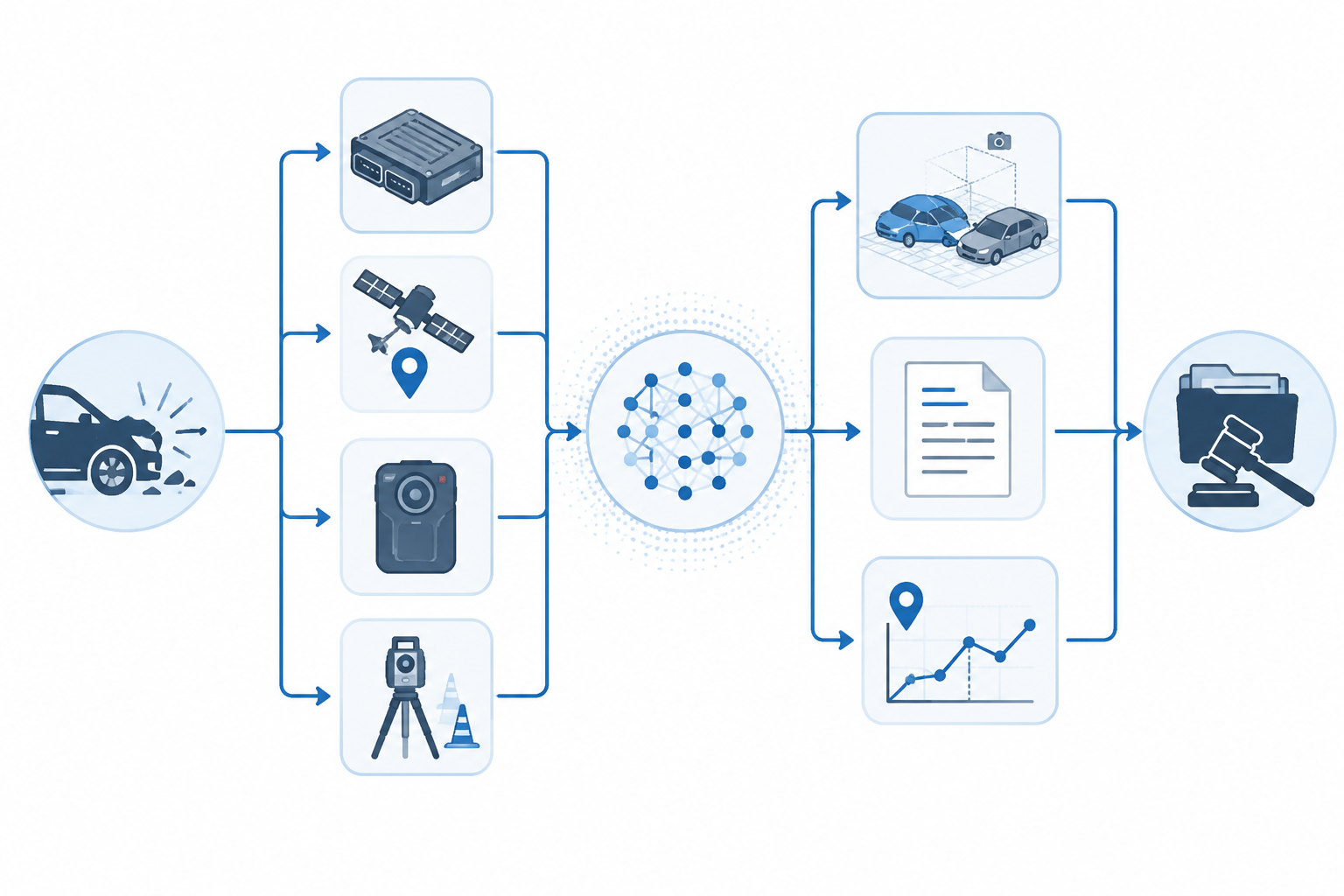
Fatal crash prosecutions have always depended on reconstruction when a surviving witness is unavailable or unreliable. What has changed is the density of the evidence stack. Current digital reconstruction discussions describe event data recorders, LiDAR, GPS data, crash-scene measurements, and multi-source AI modeling being combined to infer speed, trajectory, braking, lane position, and impact sequence in fatal collisions where no witness survived to describe what happened.[1]

That makes the first defense task practical, not philosophical. Before arguing about artificial intelligence in the abstract, counsel has to identify what each file is, who created it, what tool processed it, what assumptions were used, and which human being is prepared to explain it under oath.
Why the Evidence Stack Keeps Getting Heavier
The attraction of digital reconstruction is easy to understand. NHTSA’s early estimate placed 2025 U.S. traffic fatalities at 36,640, a 6.7% decrease from 2024, while its 2024 FARS context remains the national baseline for fatal-crash data analysis.[2] Those figures do not isolate deaths attributable to reckless driving, and they should not be used as if they did. They do explain why police, prosecutors, insurers, and reconstruction experts keep looking for more information in the vehicle, the roadway, the phone, and the video record.
The statutory label also changes from state to state. A 50-state survey updated in December 2025 shows that reckless driving laws vary in wording, penalties, and relationship to other offenses.[3] But the evidentiary pressure travels well across jurisdictions: when death follows dangerous driving, the prosecution has to convert motion, timing, perception, and causation into proof. Digital tools promise to make that conversion cleaner.
Clean is not the same as reliable. A reconstruction animation can make a disputed speed estimate look inevitable. A transcript can turn a chaotic roadside exchange into searchable text. A GPS timeline can imply precision beyond the source data. Each output may help the factfinder; each can also conceal the choices that produced it.
From Crash Scene to Prosecution Theory
In a fatal reckless-driving case, the workflow usually begins before anyone says the word AI. Investigators document the scene, photograph vehicle positions, mark gouge marks or debris fields, collect measurements, and preserve vehicles. The vehicle’s event data recorder may be imaged for pre-crash speed, throttle, braking, seatbelt, steering, or other recorded parameters, depending on the vehicle and the data available. Phone location data, infotainment data, surveillance footage, dashcam clips, and body-worn camera recordings may join the same evidence file.
Once those sources are merged, the theory begins to harden. A timeline is built. A speed range becomes a number used in charging and plea discussions. A vehicle path becomes a graphic. A model fills gaps between known points. If the case involves no surviving eyewitness, the reconstruction may become the prosecution’s most persuasive witness even though it is not a witness at all.
| Evidence source | What it may add | Defense question |
|---|---|---|
| Crash-scene measurements | Roadway geometry, debris field, impact indicators, post-impact positions | Were the measurements complete, repeatable, and tied to documented physical observations? |
| EDR or telematics data | Recorded vehicle data such as speed, braking, throttle, or other parameters when available | Who extracted the data, with what tool, and what limitations apply to this vehicle and event? |
| GPS or location data | Movement timeline, route, possible speed estimates between points | What is the location accuracy, sampling interval, and gap between recorded points? |
| Video and audio | Pre-crash movement, post-crash statements, officer observations, witness interviews | Was the video reviewed in full, and does the transcript preserve uncertainty, overlap, and inaudible portions? |
| AI-generated outputs | Reconstruction animation, indexed video, searchable transcript, data-fusion model, timeline chart | What inputs, assumptions, confidence information, and human review produced the output? |
This is where a defense lawyer’s Monday morning problem begins. The objection cannot be, simply, that technology was used. The stronger objection may be that the government has disclosed the polished output but not enough about the toolchain: extraction logs, software version, validation materials, operator training, excluded data, alternative runs, confidence values, or the assumptions that made one scenario appear more probable than another.
The Animation Is Usually the End of the Chain
A jury may remember the animation better than the equations. That is why the defense has to work backward. If the display shows braking too late, counsel needs to know whether that came from EDR data, a model assumption, a witness statement, a road-friction estimate, or a reconstructionist’s judgment. If the car appears centered in a lane, counsel needs to know whether the lane position was measured, inferred, or chosen for visual clarity.
Reports on current reconstruction technology describe AI-assisted systems claiming 85% to 90% accuracy, but that figure should be treated as a claim from vendors or practitioners rather than an independently audited courtroom fact.[1] For admissibility and cross-examination, the important question is not whether the percentage sounds impressive. It is what the percentage measured, on what dataset, under what conditions, against what ground truth, and whether those conditions resemble the crash being prosecuted.
The Transcript Can Be Evidence Processing, Not Evidence
Video and audio review is one of the few places where defense-side AI tools can be plainly useful. The UC Berkeley Law catalog identifies tools such as JusticeText and Reduct.Video as products used to review, transcribe, search, and organize video evidence; it also notes implementations involving Kentucky DPA, Santa Cruz PD, and Colorado State PD, with reported reductions of hours per case.[4] That is adoption and workflow impact, not proof that every transcript is accurate.
In a fatal crash case, a transcript can affect far more than convenience. It may shape how counsel reads a defendant’s roadside statement, how an officer’s observation is summarized, or how a witness’s uncertainty is preserved. Automated transcription should therefore be treated as an index and review aid unless its accuracy, limitations, and human correction process are established. The original audio and video still matter.
Defense Tools Deserve the Same Skepticism
There is no virtue in pretending the defense should stay analog. Berkeley’s catalog lists defense-relevant tools including SentencingStats, JusticeText, CoCounsel, Paxton AI, and other products aimed at research, review, sentencing analysis, and evidence management.[4] It also describes a Clearview AI-related exonerative example in a Florida vehicular homicide case, where facial recognition was used to identify another person connected to the facts of the case.[4]
That kind of use matters because it cuts against a lazy story in which AI belongs only to the state. A tool that helps an under-resourced defense team find a missed video lead or organize hours of footage can protect a client. But the same professional discipline applies: preserve confidentiality, verify outputs, document human review, and avoid allowing a vendor interface to become the lawyer’s judgment.
The Current Rules Already Reach the Problem
It is tempting to wait for a special AI evidence rule before building a practice around these issues. That is a mistake. Daubert-style reliability challenges already require attention to whether a method can be tested, whether it has known or knowable error rates, whether standards control its operation, whether it has been subjected to scrutiny, and whether the expert has reliably applied the method to the facts. Machine-generated evidence does not escape those questions just because the software is new.
Professional responsibility rules also do not wait. NACDL’s Jan./Feb. 2026 guidance frames AI in criminal defense around five obligations: competence, confidentiality, candor, supervision, and the duty to challenge government AI.[5] The last item is the one fatal crash lawyers cannot ignore. If the government’s reconstruction depends on AI-assisted processing, the defense lawyer must know enough to ask competent questions or find someone who does.
Competence does not mean becoming a software engineer. It means recognizing when a reconstructionist’s testimony rests on a model, when a transcript is machine-generated, when a GPS timeline is interpolated, when a confidence score is absent, and when the government has produced conclusions without the materials needed to test them.
What Proposed FRE 707 Would Change
Proposed Federal Rule of Evidence 707 is important, but it is not yet law. Reuters/Westlaw Today reported in April 2026 that the proposal would bring machine-generated evidence under reliability gatekeeping, with the public comment period closed in February 2026 and possible Supreme Court promulgation projected for May 2027 if the rulemaking process proceeds as expected.[6] The proposal may also be revised during the post-comment process, so counsel should check the current rules committee materials before relying on any specific text.
The value of proposed Rule 707 is not that it suddenly makes AI evidence questionable. The value is that it names a category courts are already struggling to handle: output generated by a process that may not fit comfortably into old habits of treating exhibits as either human testimony or ordinary business records. For defense lawyers, the rule is a warning marker. The duty to investigate and challenge the output exists before the rule arrives.
A Practice-Ready Competency Plan
A workable defense plan starts with the discovery demand. Counsel should ask not only for the final reconstruction, transcript, or timeline, but also for the underlying data, extraction logs, software and version information, operator notes, validation or training materials, error-rate information if available, excluded or rejected data, and communications showing how the output was interpreted. If the government claims a tool is proprietary, that is not the end of the inquiry; it is the beginning of a protective-order and reliability fight.
- Identify every machine-generated or machine-assisted output in the discovery package.
- Separate raw data from processed data, visualizations, summaries, and expert conclusions.
- Ask what assumptions were entered manually and what defaults the software supplied.
- Determine whether the tool’s claimed accuracy applies to the same conditions as the charged crash.
- Preserve the right to inspect native files, metadata, audit logs, and alternative model runs.
- Use an expert early enough to shape motions, not merely to react before trial.
The expert question deserves early attention because a fatal crash case can move from arraignment to negotiation quickly. If the prosecution’s animation drives the plea posture, a late challenge may come after the client has already absorbed the practical consequences of the output. The defense expert may need to evaluate whether the model omitted roadway conditions, used an unsupported friction coefficient, assumed perception-reaction timing, smoothed a GPS track, or treated missing EDR data as if it were neutral.
For transcripts and video-indexing tools, the competency plan should look different. Counsel should preserve the original media, compare important transcript segments against the recording, mark inaudible or uncertain passages, and avoid quoting automated text as if it had been certified by a court reporter. If the defense uses its own AI tools, supervision and confidentiality controls matter: who has access to uploaded discovery, whether the vendor uses data for training, how files are retained, and whether protected information leaves the defense environment.
Candor also cuts both ways. If the defense generates a demonstrative reconstruction or AI-assisted transcript, counsel should be prepared to explain what it is and what it is not. A useful internal tool does not automatically become admissible evidence. A demonstrative aid should not smuggle in untested assumptions just because the government’s animation did the same.
The Questions That Should Follow the File
The most reliable habit is to attach questions to the evidence as soon as it arrives. A crash reconstruction asks: What data points anchor the model, and which parts are inferred? An EDR extraction asks: Was the module imaged correctly, and what does this vehicle actually record? A GPS timeline asks: Are the intervals close enough to support the claimed speed or path? A transcript asks: Has a human reviewed the important statements against the recording? A facial-recognition lead asks: Was it treated as an investigative lead rather than a conclusive identification?
Those questions do not make technology the enemy. They make the courtroom slow down long enough to distinguish observation from inference, data from display, and assistance from proof. In fatal reckless-driving prosecutions, that distinction can decide whether a client is confronted with a testable theory or a beautiful exhibit that no one has been forced to explain.
The defense bar’s problem is not whether AI evidence will become admissible someday. It is already appearing in the workflow, sometimes as reconstruction, sometimes as transcription, sometimes as search, indexing, identification, or litigation support. Proposed FRE 707 may eventually give courts a clearer gatekeeping vocabulary. Until then, Daubert, competence, confidentiality, supervision, candor, and the duty to challenge government evidence are enough to require preparation now.
References
- Using 2026 Digital Reconstruction Technology to Prove Liability in Fatal Collisions Where No Witnesses Survived, OCNJ Daily, April 28, 2026
- Traffic Deaths Decreased in 2025, Early Estimates Show; 2024 Annual Fatality Data Released, NHTSA
- Reckless Driving, ConsumerShield, December 2025
- Existing AI Tools for Criminal Defense, UC Berkeley Law
- From the President: Navigating the Ethical Edge — AI in Criminal Defense Practice, NACDL, Jan./Feb. 2026
- Proposed AI evidence rule highlights new challenges for federal practitioners, Reuters/Westlaw Today, April 23, 2026
Chronological incident history
No sanction cases have named this tool in the tracked record set to date. This does not imply the tool is safe — see Risk Digest for ongoing monitoring.
← Compare peer toolsReport a correction or tip
Spotted an outdated figure, a misstated fact, or a ruling this tool profile should reflect? Public comments are disabled for this content given the professional cost of a misreported case outcome, penalty amount, or rule text — use the structured correction channel instead.
Report a correction or tip for this record →