
The legal fact that matters first is not that Jonathan Rinaldi allegedly used AI. It is that Queens prosecutors say a former New York City Council candidate disseminated altered political endorsements and phony news reports that appeared to come from other identifiable speakers: a Jewish civic organization, media outlets, a police precinct, and a school. The Queens District Attorney’s Office announced in June 2026 that Rinaldi had been charged with forgery-related offenses after allegedly circulating fabricated campaign materials during a 2025 City Council race in Queens.[1]
That distinction is doing most of the work. A campaign ad can be harsh, selective, misleading, or theatrically unfair without becoming a forged instrument. The Rinaldi allegations, if proved, sit somewhere else: not merely persuasion, but attribution. Prosecutors are not describing a candidate who exaggerated his own record or attacked an opponent with an ugly edit. They are alleging the manufacture of documents and media presented as if third parties had said things they had not said.
What prosecutors say was forged
The Queens DA release identifies several categories of alleged material. Rinaldi allegedly disseminated a fabricated endorsement from the Queens Jewish Alliance, altered or created campaign materials purporting to show support from the 104th Precinct and P.S. 128, and circulated phony news reports, including a fake New York Post article, fake CNN and Amsterdam News articles, and an AI-generated Sora video falsely suggesting that his opponent had dropped out of the race.[1]
Those alleged items do not all create the same legal problem. A fake withdrawal video aimed at voters raises one kind of election-integrity concern: whether voters are misled about a candidate’s continued participation. A fabricated endorsement raises another: whether an organization’s name and institutional credibility have been conscripted into campaign speech. A phony article adds still another: whether the apparent source of the assertion is part of the deception.
That is why the case is more useful than the standard “deepfake candidate video” hypothetical. Election law already has a familiar vocabulary for lies about candidates. It has a rougher time when the alleged lie is embedded in the identity of the speaker. If a voter sees “Organization X endorses Candidate Y,” the message is not just that Candidate Y is favored. It is that Organization X has made a choice, lent its name, and accepted the reputational consequences. If Organization X did no such thing, the injury is not exhausted by saying the voter was deceived.
The same point applies to fake news articles. The persuasive force of a news-style item comes partly from the asserted facts and partly from the masthead or outlet identity attached to them. A fabricated article can mislead voters about the campaign, but it also borrows the credibility of the publication it imitates. That is a narrower, more chargeable theory than a generalized complaint that AI made politics worse.
Rinaldi is presumed innocent, and the government still must prove its charges. But the charging theory is already important because it treats AI as an instrument used in a familiar legal wrong. The allegation is not “AI deception” standing alone. It is forgery, with AI allegedly making the impersonation cheaper, faster, or more convincing.
Why political endorsements are different from ordinary campaign spin
Campaign lawyers are accustomed to overclaiming. A candidate says she “led the fight” when she attended three meetings. A mailer crops a photograph to make an opponent look isolated. A consultant writes “community leaders agree” when the support is thin. Election law does not, and constitutionally could not, convert every abusive campaign claim into a criminal case.
An endorsement is different because it depends on a speaker relationship. The political value comes from the named third party: a union, civic group, newspaper, public safety organization, school community, or local association. A false statement that “Candidate A is best for Queens” may be campaign advocacy. A false document that appears to say “Queens Jewish Alliance endorses Candidate A” presents a distinct attribution problem.
That is also why the Rinaldi matter is more than a loose debate about synthetic media. The harder issue is not whether AI-generated content can be unattractive or manipulative. It plainly can be. The harder issue is whether traditional criminal statutes can reach a campaign communication when the alleged falsity lies in the identity of the speaker, the existence of a source, or the authenticity of a document.
| Alleged material | Primary legal concern |
|---|---|
| Fabricated third-party endorsement | False attribution of institutional support |
| Phony news article | False source authentication and borrowed media credibility |
| AI-generated withdrawal video | False information about candidate status |
| Altered school or precinct material | Misuse of identifiable public-facing institutional identity |
The table is not a charging chart. It is a way to separate harms that are too often collapsed into one category. “Misinformation” is a poor legal noun. It can mean a false factual claim, a misleading implication, a parody that some viewers miss, a forged document, a synthetic image, or an unauthorized use of a name. The statute that fits one may be a terrible fit for another.
The federal analogue: technology-neutral fraud
The Federal Election Commission took a notably technology-neutral path in 2024 when it declined to open a new AI-specific rulemaking and instead approved an interpretive rule explaining that the federal fraudulent misrepresentation statute, 52 U.S.C. § 30124, applies regardless of the technology used. The Commission said the provision is “technology neutral,” meaning AI does not place otherwise covered fraudulent misrepresentation outside the statute.[2]
That federal move matters less because it dictates the Queens prosecution—it does not—and more because it shows a regulatory instinct. One can regulate the conduct before regulating the tool. If the legal wrong is impersonating a campaign, committee, or other covered actor, the use of generative AI may change evidence, scale, and remedies. It does not necessarily change the legal category.
The Rinaldi case makes the same move under state criminal law. Prosecutors appear to be asking whether New York’s general forgery framework can do the necessary work without waiting for a legislature to draft an AI-campaign statute calibrated to the facts of one race. That approach is cleaner than much of the public debate, but it has its own risk. The farther a forgery theory moves into expressive campaign material, the more defense counsel will argue that the government is criminalizing political speech under another name.
The AI election-law patchwork was built around a different model
State lawmakers entered the 2026 cycle with considerable attention on AI in political ads. By 2026, trackers and legal alerts described a patchwork of more than 30 state laws addressing AI-generated or synthetic political content, especially deepfakes, disclaimers, and pre-election restrictions.[3][4]
But the most visible AI-specific laws tend to assume a particular deception model: a synthetic depiction of a candidate, often close to Election Day, that makes the candidate appear to say or do something he or she did not say or do. Texas has been identified with a 30-day pre-election ban model, Minnesota with a 90-day model, and California’s AB 2839 became a high-profile example of a broader prohibition before being struck down in court.[3][4]
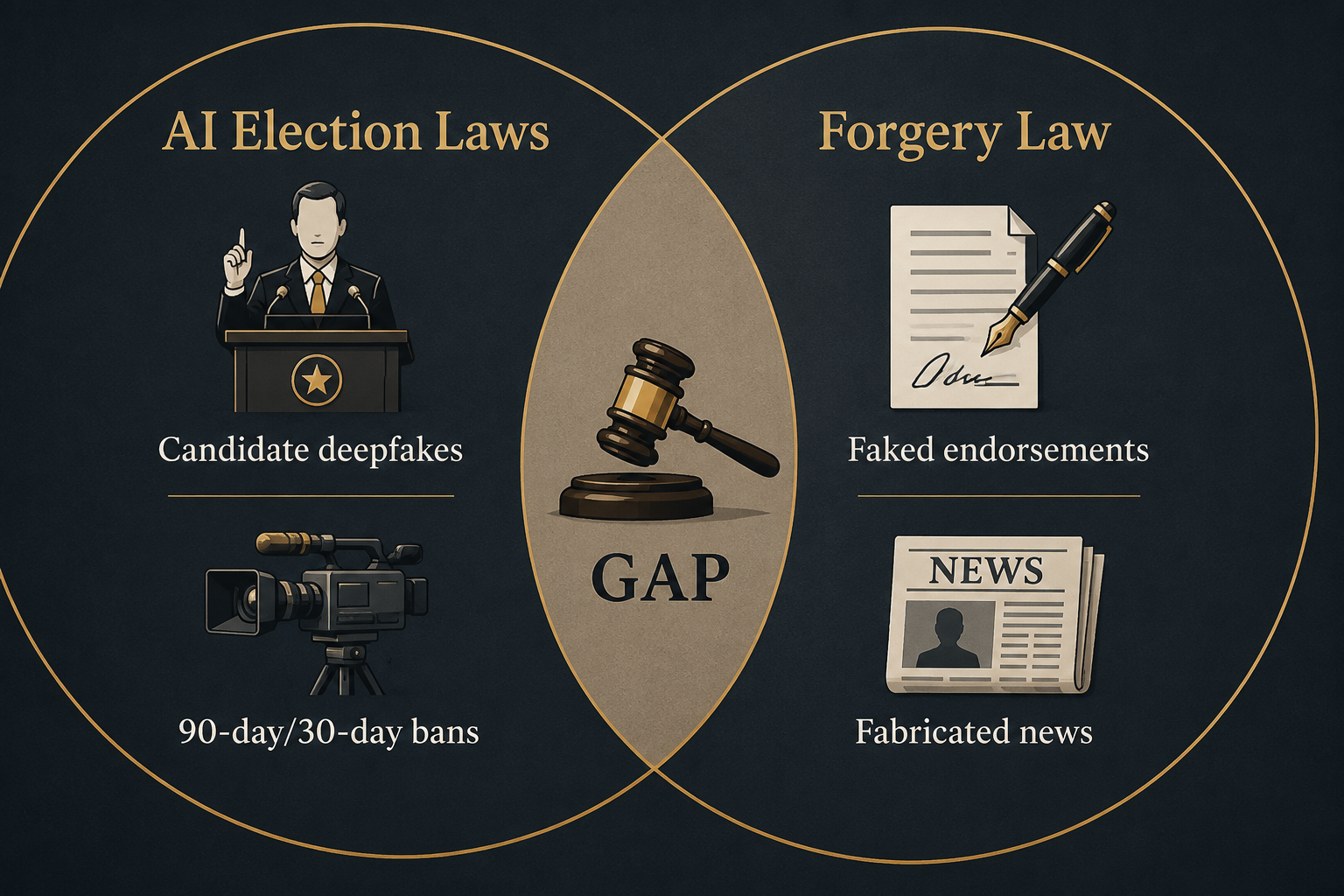
Those laws respond to a real concern, but not necessarily to the one presented by the Queens allegations. A fake video of an opponent withdrawing from a race fits the candidate-deepfake anxiety comfortably. A fake endorsement from a Jewish civic organization does not. Nor does a fabricated article, unless the statute is written broadly enough to cover source impersonation or synthetic media that misrepresents something beyond the candidate’s own speech or conduct.
That is the gap worth naming carefully. It is not that fabricated endorsements are immune from law. The Queens prosecution exists precisely because general criminal law may apply. The gap is that much of the AI-specific election-law wave was drafted for candidate deepfakes, not for false third-party attribution. If the next abuse looks like a forged endorsement letter, a phony newspaper page, or a fake civic-group statement, the newer AI statutes may be beside the point.
| Legal approach | What it is best positioned to address | Where the Rinaldi allegations test it |
|---|---|---|
| General forgery law | False instruments, altered documents, and misattributed materials | Fabricated endorsements and phony articles allegedly presented as authentic |
| Federal fraudulent misrepresentation rule | Covered impersonation or misrepresentation under campaign-finance law regardless of technology | Useful analogue, but not the direct charging vehicle in Queens |
| State AI deepfake bans | Synthetic depictions of candidates, often near Election Day | May miss fake third-party endorsements and fabricated media sources |
| Disclosure requirements | Informing viewers that content is synthetic or materially altered | Potentially easier to defend, but may not remedy a forged source identity |
Rinaldi’s own framing will matter, but it does not answer the forgery question
Rinaldi has reportedly defended the tactics in political terms. In a Guardian interview published July 8, 2026, he described the conduct as “asymmetrical warfare” and said, “it’s politics.”[5] That is a familiar campaign defense, and it should not be waved away merely because the alleged tools are new.
American campaign law leaves room for a great deal of rough conduct. Political speakers receive broad First Amendment protection, and courts have long been wary of giving the state a roving power to punish false political claims. A candidate’s lawyer will naturally characterize disputed material as advocacy, parody, hyperbole, or opposition research, not as a criminal instrument.
That defense becomes harder, though not impossible, when the government’s theory is not simply that a statement was false. If the state can show that a document or media item was made to appear as the authentic speech of an organization or outlet that did not authorize it, the case moves away from punishing a campaign viewpoint and toward policing false authentication. That distinction will likely do much of the constitutional labor if the charges are challenged.
Still, prosecutors should not expect the word “forgery” to make the First Amendment disappear. In an election setting, the charged material is almost certainly bound up with campaign advocacy. The question is whether the state can isolate the forged attribution from the political message closely enough to justify criminal punishment. That is a more serious question than either side’s slogans allow.
Disclosure rules are easier than bans, but they do not solve every forged-source problem
The constitutional literature around AI election regulation has tended to treat disclosure as the safer path. Brennan Center analysis has emphasized that rules requiring labels or disclaimers for synthetic political media are generally less speech-restrictive than outright bans, while still giving voters information about authenticity.[6] R Street’s coverage of 2025 state legislation likewise notes the pressure courts have placed on prohibitory approaches, including decisions striking down broader restrictions in California and Hawaii.[7]
That preference makes sense when the problem is synthetic production. A disclaimer can tell a viewer that an image, audio clip, or video has been materially altered. It is a more modest remedy than suppression, and it better respects the constitutional suspicion that follows government attempts to decide which political claims are too false to circulate.
But disclosure is less satisfying when the alleged deception is a forged source. A label saying “AI-generated” would not necessarily cure a fabricated endorsement if the communication still presents an organization as having endorsed a candidate. The injury to the impersonated group is not merely that voters failed to learn how the image was made. It is that the group’s name was allegedly used to make a political statement it did not make.
This is where compliance advice becomes concrete. A campaign can use generative tools to draft, translate, resize, caption, or test material without creating a forged endorsement. The line is crossed when staff make a third party appear to have spoken, approved, published, or authenticated something without authorization. That line existed before Sora, image generators, and automated design tools. AI just makes it easier to approach at speed.
The practical compliance lesson is source control
For campaign counsel, the Rinaldi allegations point to a review problem that is more specific than “check the AI.” The relevant questions are about authorization, provenance, and evidence of consent. Who approved the use of the organization’s name? Where is the endorsement letter? Did the outlet publish the article? Was the school, precinct, union, or civic group legally able to endorse at all? Who in the campaign verified the answer before distribution?
- Treat every claimed endorsement as a rights-and-authentication item, not merely as ad copy.
- Keep the original authorization, including the approving person, date, scope, and permitted wording.
- Do not recreate a newspaper page, civic-group letterhead, precinct-style notice, or school-branded item unless the source is authentic and permission is documented.
- Separate AI-production review from source-authentication review; the same item may pass one and fail the other.
- Escalate any material that says or implies a candidate withdrew, was endorsed, was disqualified, or was supported by an identifiable institution.
That kind of review is not glamorous, but it is where campaigns actually avoid criminal and civil exposure. A synthetic image policy will not catch a forged endorsement if the policy is written only for candidate deepfakes. A disclaimer checklist will not catch a phony article if no one asks whether the article exists.
Why the case matters in the 2026 cycle
The public anxiety around AI election content is real, even if anxiety is not a legal element. A PBS News/NPR/Marist poll released in March 2026 found that 85% of Americans expected AI-generated content to spread misinformation in the 2026 elections.[8] Among the professionals making campaign communications, AI use is no longer exotic: Campaigns & Elections reported AAPC survey data indicating that 83% of political consultants use AI weekly, while 67% want more regulation.[9]
Those numbers prove adoption and concern, not illegality. They do, however, explain why a local prosecution can have national significance. If ordinary campaign workflows now include AI tools, then the important legal question is not whether a campaign touched AI. It is whether AI was used to create a false source, a false authorization, or a false instrument.
That is why the Rinaldi prosecution is a more useful test than another abstract debate over election deepfakes. It asks whether old law can still identify old misconduct when the artifact is new. It also exposes the limits of statutes drafted around synthetic candidates rather than fabricated third-party speech.
If Queens prosecutors prevail, the lesson will not be that every deceptive AI campaign communication is criminal. It will be narrower and more durable: campaigns may not be able to escape forgery law by using generative tools to manufacture another entity’s supposed speech. If the prosecution falters, lawmakers may discover that the AI election statutes they built for the last feared scenario do not reach the next one.
References
- Former City Council Candidate Charged with Forgery for Disseminating Altered Political Endorsements and Phony News Reports, Queens District Attorney, June 2026.
- Commission approves notification of disposition, interpretive rule on artificial intelligence in campaign ads, Federal Election Commission, September 2024.
- AI Restrictions in Political Ads: What to Know About Deepfake Disclaimers and Bans, Wiley Law.
- AI Deepfake Laws, StackCyber.
- AI ads and political campaigns, The Guardian, July 8, 2026.
- Regulating AI Deepfakes and Synthetic Media in the Political Arena, Brennan Center for Justice.
- Update on 2025 State Legislation to Regulate Election Deepfakes, R Street Institute.
- Americans are increasingly worried about voting, new poll shows, PBS NewsHour, March 2026.
- AI Use Among Political Consultants Is Booming, Campaigns & Elections.
Comments
Join the discussion with an anonymous comment.