
The AI Lawyer Jobs Landscape in 2026: 8 New Roles That Didn't Exist Three Years Ago — With Salary Ranges and Entry Paths
This article provides attorneys, law students, and career-changing legal professionals with a detailed inventory of eight newly-emerged AI-focused legal roles, including concrete salary ranges, hiring demand signals, and actionable entry paths — built on the thesis that AI has created premium-priced hybrid roles rather than eliminated jobs.
- Hallucination rate
- Not measured / undisclosed
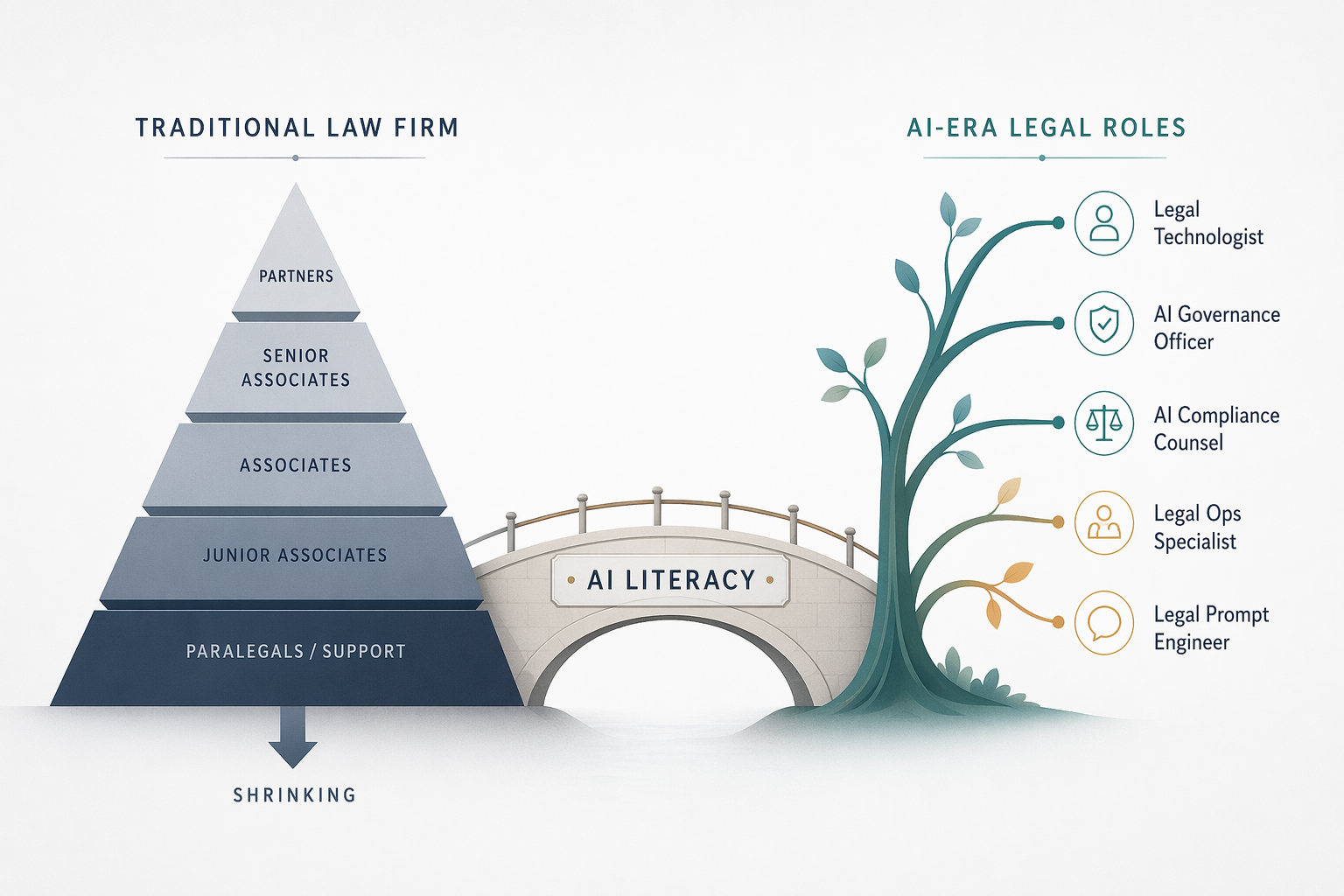
Introduction: The Bifurcation of the Legal Job Market
The dominant narrative around AI and legal employment has been one of displacement: robots replacing associates, algorithms swallowing document review, and a profession in existential retreat. That framing misses what is actually happening on the ground. Between January 2024 and January 2026, LinkedIn postings for legal AI jobs increased by 340%, according to data aggregated by AI Vortex. The Thomson Reuters Institute's 2025 State of the Legal Market report found that 78% of Am Law 200 firms have created at least one AI-focused position. Legal employment in the U.S. hit a ten-year high of 1.24 million jobs in January 2026, per Bureau of Labor Statistics data cited by The Agency Recruiting. The profession is not shrinking. It is bifurcating.
On one side of the divide, lawyers who treat AI as someone else's problem are competing for a slowly compressing pool of traditional roles. On the other side, a new tier of hybrid positions — legal technologist, AI governance officer, AI compliance counsel, legal operations AI specialist, legal prompt engineer — has emerged at salaries that match or exceed their conventional counterparts. These roles did not exist in any meaningful numbers three years ago. They are not theoretical. They are being staffed today, at firms like Covington, DLA Piper, Morrison Foerster, and Baker McKenzie, all of which expanded their AI advisory teams in 2025 and 2026.
This article inventories eight of those roles with concrete salary ranges, hiring demand signals, and actionable entry paths. It is not a practice-area taxonomy — our earlier piece, What Does an 'AI Lawyer' Actually Do?, covers that ground. This is a role-inventory with salary data and career strategy, built on the thesis that AI has created premium-priced hybrid roles rather than eliminated jobs. For readers new to the fundamentals, the AI and the Legal Profession glossary provides the necessary technical and professional responsibility context.
Role 1: Legal Technologist ($120K–$200K)
The legal technologist is the bridge between legal practice and AI tool implementation. These professionals evaluate, deploy, and manage AI systems within law firms and legal departments. They are not IT support — they understand both the legal workflow and the technology stack, and they translate between the two.
According to AI Vortex's market analysis, legal technologist roles at Am Law 200 firms command a salary range of $120,000 to $200,000, and a JD commands a 20–30% premium over candidates with only a technical background. This premium reflects a simple market reality: a technologist who can read a contract, understand a privilege log, and configure a retrieval-augmented generation pipeline is more valuable than someone who can do only one of those things.
The role often determines whether a firm's AI investment produces results. A firm spending $300,000 annually on a tool like Harvey AI — see our Harvey AI pricing analysis for mid-market total cost of ownership — needs someone who can train associates on prompt construction, audit output for hallucination risk, and integrate the tool into existing document management workflows. Without that human bridge, the tool underperforms.
Entry Paths
- Internal firm rotation: Several Am Law 200 firms now run formal AI rotation programs for mid-level associates interested in legal technology. These typically last 6–12 months and lead to permanent roles.
- Legal tech vendor roles: Product management, customer success, and solutions engineering positions at companies like Harvey, LexisNexis, and Thomson Reuters provide hands-on experience with legal AI systems.
- Post-JD certificate programs: Law schools including Georgetown, Stanford, and Duke offer AI and law certificates that combine doctrinal coursework with technical modules on natural language processing, data privacy, and AI governance.
Role 2: AI Governance Officer ($150K–$280K)
The AI governance officer role is a direct consequence of the regulatory environment. The EU AI Act's phased compliance deadlines and the Colorado AI Act, effective June 2026, have created demand for professionals who can classify AI systems by risk tier, draft governance policies, monitor compliance, and interface with regulators.
Salary ranges for this role span $150,000 to $280,000, per AI Vortex, with the upper end typically found in large corporate legal departments and financial institutions. The role exists in both law firms and in-house legal departments, but the highest concentrations are in regulated industries — healthcare, financial services, and technology — where AI deployment carries material compliance risk.
For a deeper look at what this role entails operationally, see our guide on Building AI Compliance Governance Infrastructure. The EU AI Act's August 2026 deadline for high-risk system obligations is a primary driver of current hiring — our EU AI Act compliance guide details the specific obligations that governance officers must operationalize.
Role 3: AI Compliance Counsel ($180K–$350K)
AI compliance counsel is an in-house role focused specifically on regulatory compliance for AI systems. Unlike the governance officer, who builds the framework, the compliance counsel interprets the regulations, advises product teams on risk classification, and manages regulatory filings and investigations.
The salary range of $180,000 to $350,000 reflects a significant premium over traditional compliance counsel roles. For context, Robert Half's 2026 Salary Guide reports that general counsel roles range from $222,750 to $270,500, and attorneys with 10+ years of experience range from $140,250 to $197,750. The AI compliance counsel premium is driven by scarcity: the pool of lawyers who understand both AI technical architecture and regulatory frameworks like the EU AI Act, Colorado AI Act, and emerging U.S. federal frameworks is extremely small.
A Major, Lindsey & Africa report from May 2026 confirms that employers increasingly seek lawyers who combine legal expertise with AI fluency, and that true AI expertise among lawyers remains rare. Companies are prioritizing adaptability and willingness to learn over existing AI credentials, which creates an opening for mid-career attorneys who invest in regulatory AI literacy.
Role 4: Legal Operations AI Specialist ($100K–$250K)
Legal operations has been one of the fastest-growing functions in the legal profession for several years. The AI sub-specialty within legal ops is now the fastest-growing segment of that field. Robert Half identifies the legal operations specialist as "one of the fastest-growing roles in the field", and The Agency Recruiting reports that firms with strong legal ops are "measurably more efficient."
The salary structure bifurcates by seniority. AI Vortex reports mid-level roles at $100,000–$180,000 and director-level roles at large corporations at $180,000–$250,000. Robert Half's baseline for a legal operations specialist (without the AI specialization) is $74,750–$99,500, so the AI premium is substantial — roughly 35–150% above base, depending on seniority and organization size.
This role does not always require a JD. Many legal ops AI specialists come from project management, data analytics, or legal technology backgrounds. However, legal domain knowledge — understanding eDiscovery workflows, contract lifecycle management, and billing compliance — significantly increases candidacy strength.
Role 5: Legal Prompt Engineer ($130K+)
The legal prompt engineer designs and optimizes prompts for legal AI tools — crafting the inputs that determine whether a model produces a usable contract clause, a correct citation, or a hallucinated case. AI Vortex reports a salary floor of $130,000+ for this role, though the title is still rare enough that reliable market data is thin.
A note of caution: "prompt engineer" may be a transient title. As AI models improve and interfaces become more sophisticated, the need for dedicated prompt specialists may diminish. However, the underlying skill — the ability to communicate with AI systems in a way that produces reliable, verifiable legal output — is durable. The smart career move is not to chase the title but to build prompt-engineering competence into an existing legal role. An associate who can consistently get useful first drafts from an AI tool while catching its errors is more valuable than one who cannot.
The 8am 2026 Legal Industry Report, cited by the ABA, found that 69% of legal professionals now use generative AI tools for work, up from roughly 31% in 2025. Yet 54% of respondents said their firm has provided no training on responsible AI use and has no plans to do so. That gap between adoption and training is precisely where prompt engineering skill becomes a differentiator.
Roles 6–8: AI Ethics & Policy Counsel, Legal Data Scientist, AI Practice Group Attorney
Three additional roles are emerging, though they are less established than the first five and have thinner salary data. They are worth tracking for professionals who want to position themselves ahead of the curve.
- AI Ethics & Policy Counsel: An advisory role focused on ethical AI deployment — bias auditing, fairness assessments, transparency reporting, and stakeholder engagement. These positions are most common in large technology companies and civil society organizations. The role draws heavily on professional responsibility frameworks, including ABA Model Rules on competence (Rule 1.1) and confidentiality (Rule 1.6).
- Legal Data Scientist: Combines legal analysis with data science — building predictive models for case outcomes, analyzing litigation trends, and constructing training datasets for legal AI systems. This role typically requires a graduate degree in a quantitative field (statistics, computer science) plus legal domain knowledge. It is the most technically demanding of the eight roles and the least likely to be filled by a traditional JD path.
- AI Practice Group Attorney: A specialist who handles AI-related litigation, regulatory defense, and transactional work — advising clients on AI liability, intellectual property for AI-generated content, and AI-related contract disputes. Major firms including Covington, DLA Piper, Morrison Foerster, and Baker McKenzie have expanded these practice groups significantly in 2025–2026. This role is the closest to traditional law practice among the eight, but it requires deep technical literacy about how AI systems actually work.
How to Break Into AI Legal Roles: The 'Become the AI Person' Path
The most common entry path into AI legal roles does not involve a formal job search for a specific title. It involves becoming "the AI person" in your current organization — the colleague who understands how the tools work, who can evaluate a vendor demo critically, who knows the difference between a large language model and a retrieval-augmented generation pipeline, and who can explain both to partners and clients.
The data supports this approach. The National Jurist, citing Major, Lindsey & Africa, reports that employers struggle to find candidates with experience in AI, cybersecurity, data privacy, and compliance. The 8am Legal Industry Report found that 54% of firms provide no AI training and have no plans to start. A lawyer who self-teaches AI literacy is filling a gap that most employers have not yet addressed.
Actionable Steps
- Build AI literacy: Start with the AI and the Legal Profession glossary to understand foundational concepts: RAG, hallucination, fine-tuning, token limits, and the difference between generative AI and predictive AI. Then read the AI Adoption in the Legal Sector market guide for context on where adoption stands.
- Get hands-on with tools: Most legal AI vendors offer free trials or demo environments. Use them. Run a contract review, test a legal research query, and — critically — verify the output against primary sources. Document what the tool gets wrong. That error analysis is the most valuable skill you can develop.
- Read the regulations: The EU AI Act, Colorado AI Act, and emerging state bar ethics opinions are the primary drivers of AI governance and compliance hiring. Our EU AI Act compliance guide provides a structured overview of the obligations that matter most to legal professionals.
- Take on an internal project: Propose an AI pilot within your current firm or department. Offer to evaluate a tool, draft an AI use policy, or train colleagues on prompt construction. Internal projects create portfolio pieces that demonstrate initiative and competence better than any certification.
- Consider a lateral move: NALP data shows overall lateral hiring increased 16.4% from 2024 to 2025, with associate hiring up 17.1% and partner hiring up 17.8%. Smaller firms (250 or fewer lawyers) saw the largest gains — overall lateral hiring up 62%, partner hiring up 88.7%. If your current firm has no AI trajectory, a lateral move to a firm that does may be the fastest path.
Summary Table: 8 AI Legal Roles at a Glance
| Role Title | Salary Range | Typical Employer | Required Background | Hiring Demand Signal |
|---|---|---|---|---|
| Legal Technologist | $120K–$200K | Am Law 200 firms, legal tech vendors | JD (20–30% premium) or technical degree + legal domain knowledge | 78% of Am Law 200 have created AI-focused positions |
| AI Governance Officer | $150K–$280K | Large corporate legal depts, regulated industries | JD + regulatory expertise (EU AI Act, Colorado AI Act) | Driven by EU AI Act deadlines and Colorado AI Act (June 2026) |
| AI Compliance Counsel | $180K–$350K | In-house legal depts (tech, finance, healthcare) | JD + AI regulatory experience | Premium over traditional compliance counsel; scarcity of qualified candidates |
| Legal Ops AI Specialist | $100K–$250K | Law firms, corporate legal depts | Legal ops experience; JD optional | Fastest-growing legal ops sub-specialty; 68,200 paralegal/legal ops postings in 2025 |
| Legal Prompt Engineer | $130K+ | Law firms, legal tech companies | Legal domain knowledge + prompt design skill | 69% of legal professionals now use GenAI tools; 54% of firms provide no training |
| AI Ethics & Policy Counsel | Not yet standardized | Tech companies, civil society, large firms | JD + ethics/professional responsibility expertise | Growing demand from corporate AI ethics commitments |
| Legal Data Scientist | Not yet standardized | Legal tech vendors, large litigation departments | Quantitative graduate degree + legal domain knowledge | Thin but growing; most technically demanding role |
| AI Practice Group Attorney | Varies by firm (partner-level comp) | Large law firms with AI practices | JD + AI litigation/regulatory experience | Covington, DLA Piper, Morrison Foerster, Baker McKenzie expanded teams in 2025–2026 |
Caveats and the 5-Year Outlook
The salary ranges in this article come primarily from two sources: AI Vortex (a single-source aggregator of market data) and Robert Half (a staffing firm). They may not capture full compensation including bonuses, origination credits, or equity at Am Law 100 firms. The 340% LinkedIn posting increase is directional, not precise — LinkedIn's job posting data can be noisy and may double-count or include non-attorney roles.
The Baker McKenzie reduction of 600–1,000 business services roles, attributed in part to AI integration, illustrates the other side of the bifurcation: AI eliminates some roles even as it creates others. The net employment effect, based on current data, appears positive — legal employment hit a ten-year high in January 2026 — but the distribution of gains is uneven. Professionals in roles that are purely administrative, repetitive, and non-advisory face the highest displacement risk.
Looking five years out, some of the titles in this article will likely evolve or disappear. "Legal prompt engineer" may merge into the legal technologist role. "AI governance officer" may become a standard component of the general counsel's portfolio rather than a standalone position. But the underlying skills — AI literacy, regulatory fluency, data analysis, prompt design, and the ability to bridge legal and technical domains — will remain in demand regardless of what the roles are called.
Chronological incident history
No sanction cases have named this tool in the tracked record set to date. This does not imply the tool is safe — see Risk Digest for ongoing monitoring.
← Compare peer toolsReport a correction or tip
Spotted an outdated figure, a misstated fact, or a ruling this tool profile should reflect? Public comments are disabled for this content given the professional cost of a misreported case outcome, penalty amount, or rule text — use the structured correction channel instead.
Report a correction or tip for this record →