
The Headline: AI Adoption Has More Than Doubled — But Governance Hasn't Kept Up
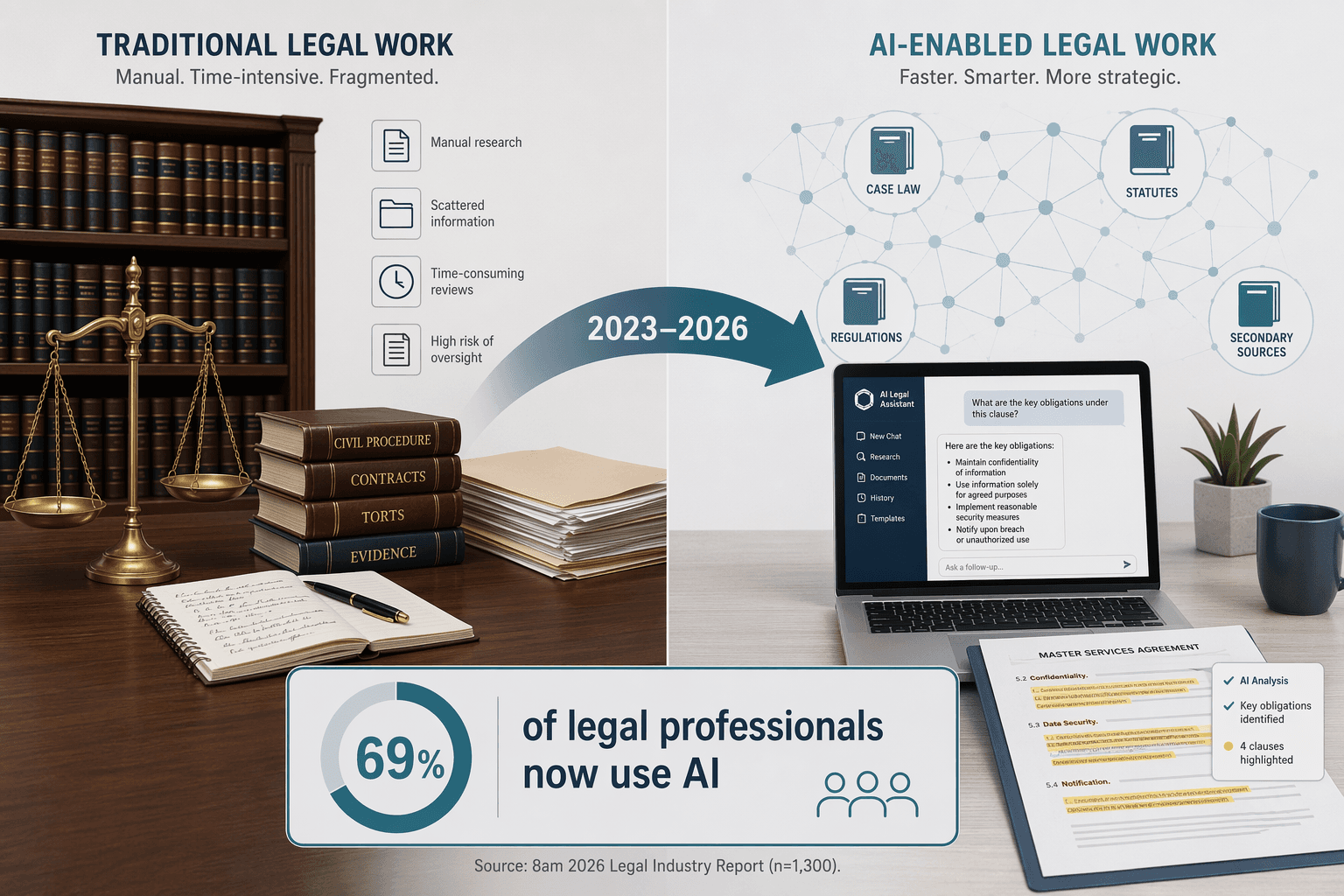
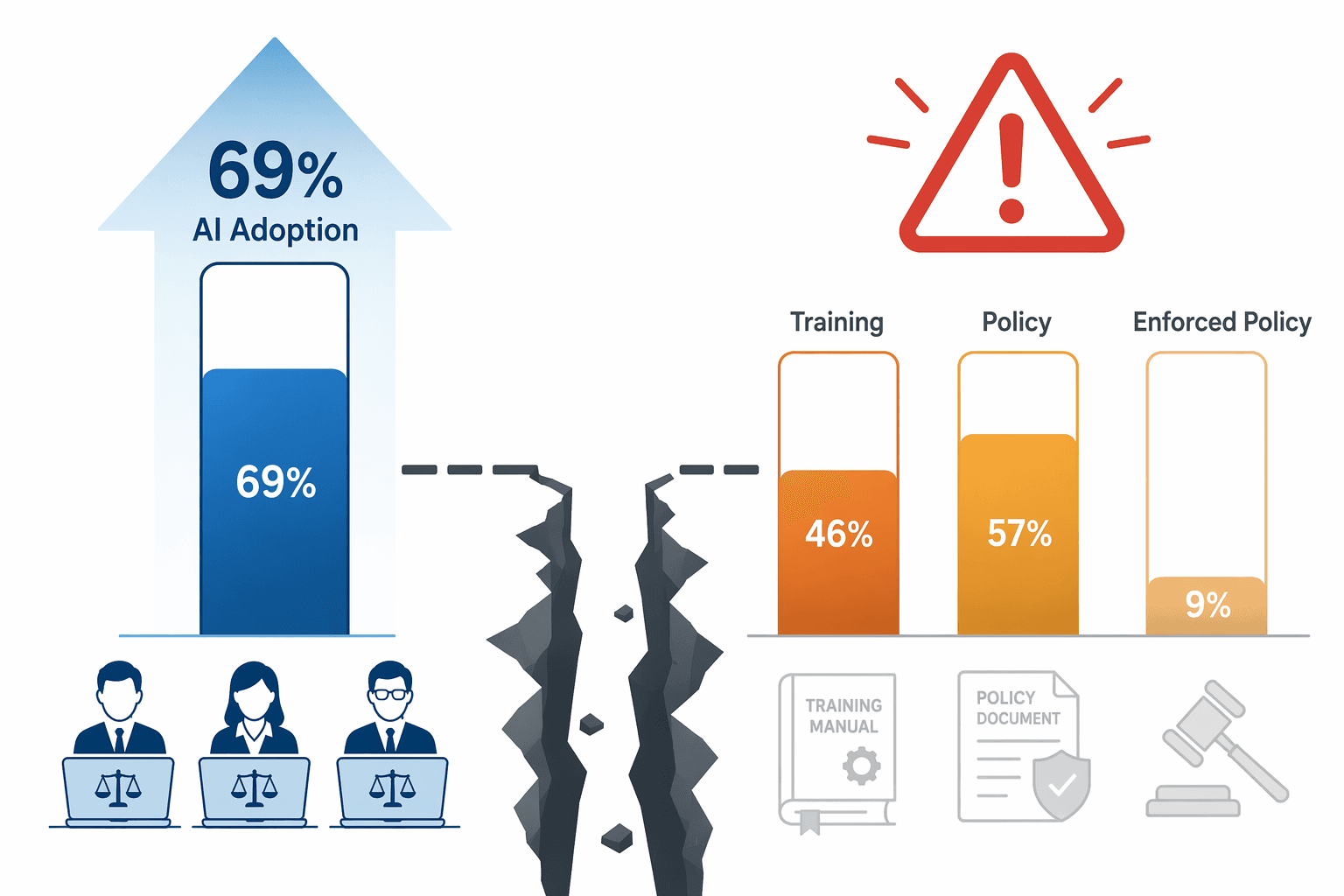
The headline figure from the 8am 2026 Legal Industry Report is striking: 69% of legal professionals now use general-purpose generative AI tools for work. That is more than double the 31% reported in the same survey just one year earlier. The survey, which polled more than 1,300 legal professionals between September and October 2025, captures a profession that has crossed a clear adoption threshold in a very short period.
But the same data set reveals a less comfortable truth. While individual practitioners have raced ahead, firm-level infrastructure has not kept pace. 54% of law firms offer no AI training to their attorneys and staff. 43% have no AI governance policy of any kind — and according to the 8am report, a substantial portion of that group has no plans to create one. Only 9% of firms report having an actively enforced AI policy.
The 8am report also found that 42% of legal professionals now use legal-specific AI tools — products built explicitly for legal workflows rather than general-purpose chatbots. And 46% of firms have implemented general-purpose AI tools, a figure that rises to 58% among firms with 20 or more lawyers. Yet only 19% of respondents described their firm as "very prepared" for AI's impact on their practice.
This article synthesizes data from three independent 2026 surveys — the 8am Legal Industry Report, Clio's 2026 survey of U.S. legal professionals, and the Thomson Reuters 2026 AI in Professional Services Report — to give law firm leaders and legal ops professionals a clear, evidence-based picture of where the profession actually stands. The picture is one of rapid adoption, uneven readiness, and a growing gap that demands attention.
Adoption by Firm Size: Solos and Small Firms Are Leading, Not Lagging
A common assumption in legal industry commentary is that AI adoption is primarily a large-firm phenomenon — that Am Law 200 firms with dedicated innovation budgets are the ones driving the numbers. The 2026 data challenges that assumption directly.
According to Clio's 2026 survey of U.S. legal professionals, 71% of solo practitioners and 75% of small firms report using AI in their practice. Among mid-sized firms, the figure rises to 86%. These are not marginal numbers — they represent a majority of practitioners in every firm-size category.
| Firm Size | AI Adoption Rate (Clio 2026) | Key Context |
|---|---|---|
| Solo practitioners | 71% | Highest adoption growth rate; lowest governance infrastructure |
| Small firms | 75% | Driven by embedded tools in existing practice management software |
| Mid-sized firms | 86% | Highest overall adoption; more likely to have dedicated IT/ops support |
| Firms with 20+ lawyers | 58% (general-purpose AI) | 8am data; higher formal adoption but also higher policy development activity |
Several factors explain why smaller firms are adopting at rates comparable to or exceeding larger ones. First, the barrier to entry for general-purpose AI tools is essentially zero — any attorney with an internet connection can use ChatGPT, Claude, or Gemini without a procurement process, IT approval, or budget allocation. Second, many of the tools that small firms already rely on — practice management platforms, legal research databases, document automation software — have been embedding AI features directly into their existing interfaces, making adoption frictionless.
For law firm leaders, this pattern carries an important implication: adoption is happening whether or not the firm has a strategy for it. Attorneys are not waiting for permission or for a formal rollout plan. They are experimenting with tools they already have access to, often without informing IT, risk management, or firm leadership. The governance gap described in the next section is not a failure of planning — it is a structural consequence of adoption that has outpaced organizational processes.
The Governance Gap: Training, Policies, and Enforcement Are Trailing Far Behind
The governance data from the 2026 surveys is the most important — and most concerning — finding for law firm leaders. It reveals a profession that has adopted a powerful and imperfect technology without building the organizational infrastructure to manage its risks.
| Governance Metric | 8am 2026 Report | Clio 2026 Survey | Implication |
|---|---|---|---|
| Firms with no AI training | 54% | Not separately reported | Majority of attorneys receive no guidance on appropriate use |
| Firms with no AI policy | 43% | 57% of solos; 55% of small firms | Most practitioners operate without any formal guardrails |
| Firms with an enforced written policy | 9% | Not separately reported | Even where policies exist, enforcement is rare |
| Firms with a policy in progress | 24% | Not separately reported | Some awareness of the gap, but action is slow |
| Organizations collecting ROI metrics on AI | 18% (Thomson Reuters 2026) | Not separately reported | Most firms cannot measure whether AI investments are paying off |
The 54% no-training figure is particularly significant because it represents a direct professional responsibility exposure. Under ABA Model Rule 1.1, attorneys have a duty to maintain competence in the technology they use. Multiple state bar ethics opinions — including those from California, Florida, New York, and Pennsylvania — have explicitly stated that this duty includes understanding the capabilities and limitations of AI tools. When a majority of firms provide no training, they are effectively leaving individual attorneys to determine their own competence standards.
The policy gap is equally stark. 43% of firms have no AI policy at all, and the Clio data shows that the situation is worse among smaller firms: 57% of solo practitioners and 55% of small firms operate without any formal AI governance. Even among the minority of firms that have policies, enforcement is rare — only 9% of firms report having an actively enforced written policy. Another 24% say a policy is in progress, which suggests that awareness of the gap is growing but that action remains slow.
For law firm leaders, the governance gap should be the primary strategic concern — not whether to adopt AI, but how to ensure that adoption happens within a framework of professional responsibility, risk management, and quality control. The technology is already in the building. The question is whether the firm has the infrastructure to use it responsibly.
The Pricing Disconnect: Efficiency Gains Aren't Reaching Clients — Yet
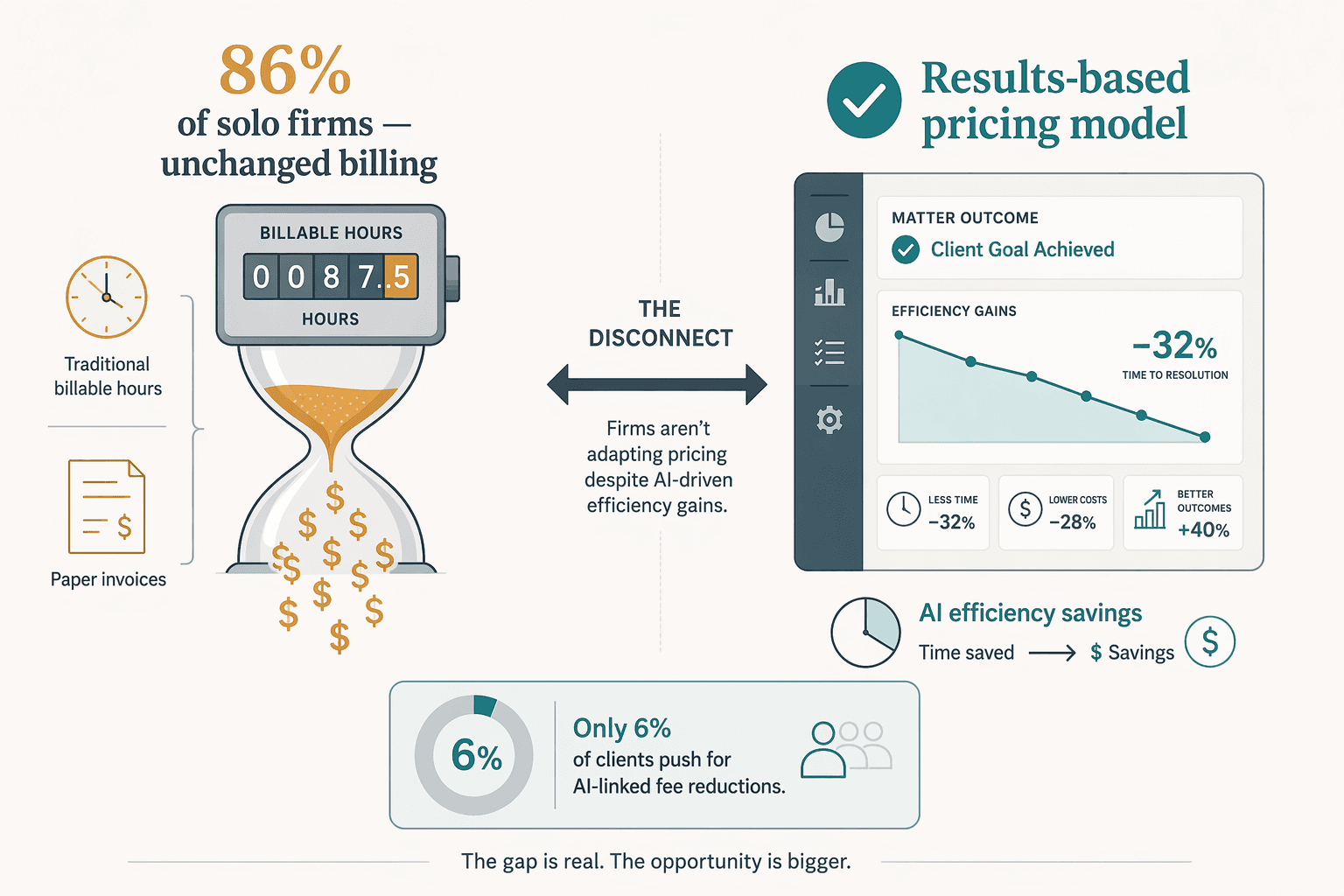
One of the most striking findings in the 2026 data is the disconnect between AI-driven efficiency gains and law firm pricing models. According to Clio's survey, 86% of solo firms have not adjusted their pricing models to account for AI-driven efficiency. The same pattern likely holds across larger firms, though the Clio data focused specifically on solos.
This is not because clients are indifferent. The 8am report found that only 6% of respondents said clients are explicitly pushing for AI-linked cost reductions. But that low figure is likely a lagging indicator, not a permanent state. As corporate legal departments become more sophisticated about AI's capabilities — and as they adopt AI tools themselves — the expectation that outside counsel's efficiency gains should be reflected in fees will almost certainly grow.
The pricing disconnect creates a strategic vulnerability for firms that are not preparing for this shift. A firm that captures AI-driven efficiency as additional margin today may find itself forced to justify those margins to clients tomorrow — without having built the data infrastructure to demonstrate what the work actually costs and how AI has changed the cost structure.
For law firm leaders, the pricing question is not urgent today — but it will become urgent within the next 12 to 24 months. The firms that will be best positioned are those that start now to measure the actual time and cost impact of AI on their workflows, so that when clients begin asking for AI-linked adjustments, they have data to support their pricing decisions rather than having to react defensively.
Productivity Gains Are Real: What Practitioners Report Saving Time On
Amid the governance concerns and pricing tensions, one finding is unambiguously positive: AI is delivering measurable productivity gains for the majority of legal professionals who use it. The 8am report found that 38% of AI users save between 1 and 5 hours per week. Only 6% report no productivity gains at all.
These time savings are concentrated in specific task categories where current-generation AI tools perform most reliably:
- Legal research and case law summarization — AI tools can surface relevant authorities and generate concise summaries of complex opinions, reducing the time attorneys spend reading and synthesizing.
- Document drafting and revision — First drafts of routine pleadings, correspondence, and contract clauses can be generated in minutes rather than hours, though careful human review remains essential.
- Contract review and analysis — AI tools can identify key terms, flag deviations from standard language, and compare multiple versions of a document far faster than manual review.
- Due diligence and document review — For large document sets, AI-assisted review can reduce the time spent on initial categorization and keyword identification.
The fact that only 6% of users report no productivity gains is a strong signal that the technology is delivering real value across practice areas and firm sizes. But the 38% figure also means that 62% of users are saving less than 1 hour per week or are uncertain about their time savings — suggesting that many practitioners have not yet integrated AI into their workflows in a systematic way.
For law firm leaders, the productivity data supports a clear strategic conclusion: AI is not a future possibility — it is a current competitive factor. Firms that help their attorneys use AI effectively will capture efficiency gains; firms that leave adoption to individual initiative will see uneven results and may miss the opportunity to build systematic advantages.
Embedded Tools Are Winning: Why 52% of Firms Prefer AI in Software They Already Use
The 8am report's finding that 52% of firms using legal-specific AI chose features embedded in software their firm already uses has significant implications for procurement strategy and the competitive dynamics of the legal AI market.
This embedded-adoption pattern means that the major legal technology platforms — Clio, Westlaw, LexisNexis, iManage, NetDocuments — are becoming the primary distribution channels for legal AI. When a firm's existing practice management system or legal research database adds an AI feature, the adoption decision shifts from "should we buy an AI tool?" to "should we try this new feature in software we already pay for?" The latter is a much lower-friction decision.
For standalone AI vendors — companies like Harvey, Spellbook, and Luminance that sell AI as a separate product — this trend creates a structural challenge. They must demonstrate enough incremental value over embedded alternatives to justify a separate procurement process, security review, and budget line item. For platform vendors, the opportunity is to deepen their existing relationships by making AI features sticky and valuable enough that firms would not consider switching.
For law firm leaders, the embedded-tools trend suggests a practical starting point for AI adoption: look first at the AI features already available in the software your firm uses. Before evaluating standalone products, understand what your existing platforms offer and whether those features meet your needs. This approach reduces procurement complexity, leverages existing data security and privacy agreements, and lowers the training burden on attorneys who already know the interface.
What Law Firm Leaders Should Do Now: Closing the Readiness Gap
The data in this article paints a clear picture: AI adoption among legal professionals has crossed a critical threshold, but firm-level readiness has not kept pace. The gap between individual use and organizational governance is the defining risk — and the defining opportunity — for law firm leaders in 2026.
The window to build organizational readiness is narrowing. Adoption continues to accelerate, and the professional responsibility, client expectation, and competitive pressures will only intensify. Here are the four priority actions for managing partners and legal ops leaders:
- Implement AI training programs immediately. With 54% of firms offering no training, this is the lowest-cost, highest-impact intervention available. Training should cover both basic AI literacy (how the technology works, what it can and cannot do) and professional responsibility considerations (confidentiality, competence, supervision, billing). The ABA and multiple state bars have published guidance that can serve as a curriculum foundation.
- Develop and enforce an AI governance policy. The 43% of firms with no policy — and the 91% without an enforced one — are operating without guardrails. A policy does not need to be complex. It should address: which AI tools are approved for firm use; what data can and cannot be entered into AI systems (particularly client confidential information); whether AI-generated work product requires human review and sign-off; and how AI use should be disclosed to clients.
- Start measuring ROI. The Thomson Reuters finding that only 18% of organizations collect AI ROI metrics means that most firms are making decisions about a significant technology investment without data. Begin with simple time-tracking comparisons on specific tasks (legal research, document drafting, contract review) to understand where AI is actually delivering value and where it is not.
- Prepare for pricing model evolution. The 86% of solos who have not adjusted pricing for AI efficiency will not be able to maintain that position indefinitely. Start the internal conversation now about how AI-driven efficiency should affect billing rates, flat fees, and value-based pricing. The firms that have thought through this question before clients start asking will have a significant advantage.
The firms that close the readiness gap will not only reduce their risk exposure — they will build a competitive advantage. They will have attorneys who use AI more effectively because they have been trained to do so. They will have policies that protect client confidentiality and firm reputation. They will have data that supports smart investment decisions. And they will have pricing models that reflect the real economics of AI-augmented legal work.
The data is clear. The gap is real. The time to act is now.
Comments
Join the discussion with an anonymous comment.