
The first legal problem with AI shipwreck treasure valuation is not the algorithm. It is the filing table.
A recovered coin is photographed, an AI tool suggests an identification, another system assigns a grade or provenance label, and the result begins to look like a number that can be dropped into a salved-value schedule. In an ordinary collection-management setting, that may be a useful shortcut. In a salvage case, the same number can become part of the calculation that influences how much the salvor is awarded.
That is where AI shipwreck treasure valuation stops being a trend line and becomes an evidentiary problem. Salvage awards commonly turn on the value of the property saved, along with factors such as the salvor’s labor, skill, risk, promptitude, and the degree of danger faced by the property. The Blackwall factors and Article 13 of the 1989 Salvage Convention both place salved value near the center of the award analysis, even though the award is not a simple percentage of the treasure recovered.[1]
No source reviewed for this article documents an admiralty salvage proceeding in which an AI-generated treasure valuation was actually admitted, excluded, or tested on the merits. That absence matters. The issue is anticipatory, not reported case history. But the pressure points are already visible: maritime operators are adopting AI in adjacent workflows, numismatic AI has shown concrete hallucination failures, and courts in 2025 and 2026 are asking sharper questions about machine-generated evidence, prompts, verification, and expert reliance.
Why Salved Value Is the Number Everyone Will Fight Over
A salvor does not usually win an award because the recovered object is glamorous. The legal question is whether the service preserved maritime property from danger and, if so, what award is justified. Value does not answer that question alone, but it heavily shapes the stakes. A cargo appraisal that moves from six figures to seven figures can change the negotiating posture of owners, insurers, salvors, investors, and claimants before anyone reaches a final award.
That is why coin identification and grading are not clerical details in a treasure recovery. A recovered coin described as a common issue, a rare variety, or a culturally significant object may carry very different valuation assumptions. Provenance can also alter both market value and legal posture. A label suggesting a link to a known wreck, cargo manifest, or historical collection may be useful if it is documented. If it is inferred by a model and repeated as fact, it becomes a weak link in the valuation chain.
The legal system is not hostile to tools. Experts have always used instruments, databases, catalogs, imaging, and assistants. The harder question is whether the expert can explain what the tool did, what data it relied on, how the result was checked, and why the final valuation opinion remains the expert’s opinion rather than a machine output with a signature attached.
| AI-assisted task | Usefulness before litigation | Problem inside a salved-value record |
|---|---|---|
| Coin identification | Sorts large recovered lots and flags likely matches | A wrong type or mint attribution can distort rarity and market comparables |
| Coin grading | Creates a preliminary condition range for expert review | A grade stated without human verification can overstate or understate value |
| Provenance matching | Connects images, registry entries, and claimed wreck histories | A label can be mistaken for proof of origin or chain of custody |
| Cargo appraisal | Organizes values across mixed recovered property | Aggregated errors can become embedded in the award calculation |
Maritime AI Is Already Close Enough to Matter
The AI valuation issue is not arriving in a vacuum. TreasureCheck.ai presents itself as a commercial provenance registry for shipwreck coins, illustrating the type of infrastructure now being marketed around recovered objects and their histories.[2] That does not make the product defective or litigation-ready. It simply shows that digital provenance and coin-analysis systems are moving into the part of the market where salvage disputes can eventually form.
Adjacent maritime uses of AI are also no longer speculative. NOAA Ocean Exploration and the University of Michigan have described machine-learning work for automated detection of shipwreck sites, including an operational pipeline that moves from detection toward inspection.[3] Lloyd’s Register, in an April 2026 industry discussion, likewise framed marine AI as part of a broader transformation in shipping and maritime operations.[4]
Those examples should be kept in their lane. A model that helps find an anomaly on the seabed is not thereby competent to grade coins, authenticate provenance, or price a recovered cargo for a court. Detection accuracy, registry design, and valuation reliability are different evidentiary questions. The fact that AI is becoming ordinary in maritime operations only makes it more likely that someone will try to carry an output from the operational side into the legal side before the verification work is complete.
The Numismatic Failure Mode Is Not Theoretical
CoinsWeekly’s July 2024 audit is the kind of small, concrete test that should make a valuation expert slow down. In that review, ChatGPT fabricated 7 of 16 German coin identifications, including a nonexistent coin.[5] The sample was not a salvage proceeding, and it should not be inflated into a universal error rate for every coin-recognition or grading system. Its importance is narrower and more practical: a general AI system produced confident numismatic identifications that were false.
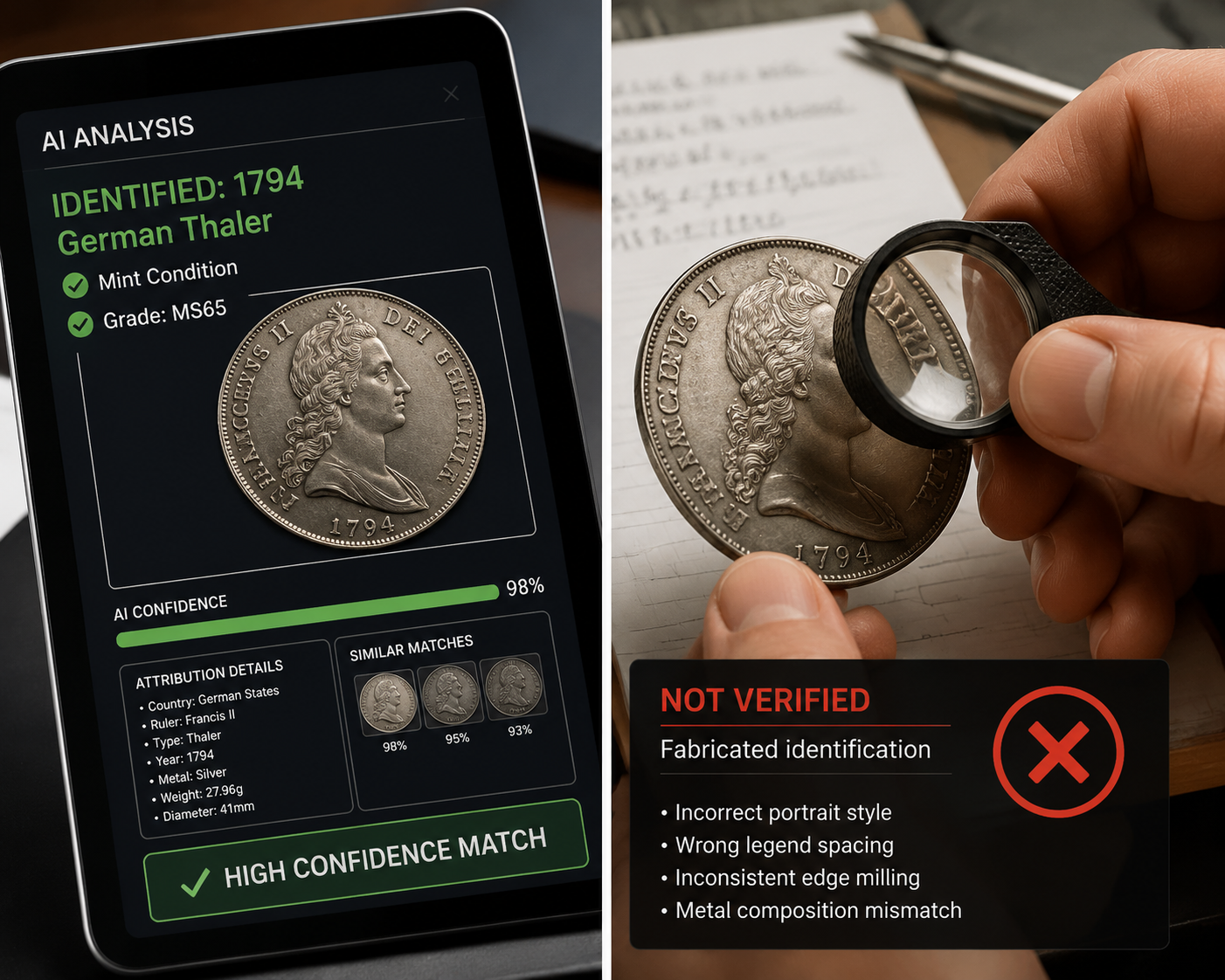
That is a particularly bad failure mode for salved value. A fabricated identification is not like a blurry photograph or a missing catalog page. It can look complete. It can carry a date, mint, ruler, denomination, or rarity implication. Once it enters a spreadsheet, the next reviewer may see only a tidy row with a value attached. By the time counsel notices the problem, the false premise may already have affected the appraisal report, settlement position, expert disclosure, or damages-style demonstrative used to explain the award request.
The risk is not limited to large language models. Purpose-built coin apps and image classifiers can be useful for triage, especially when a recovery produces hundreds or thousands of objects that must be sorted before a specialist can review them. But usefulness at triage is not the same as admissible valuation support. A classifier can narrow the expert’s work queue without becoming the authority for the final salved-value figure.
A defensible workflow treats AI output as a lead. The expert still verifies the physical object, image quality, catalog match, condition, conservation effects, provenance assumptions, market comparables, and valuation date. If the tool cannot preserve enough information to let that review happen, it may be efficient in the back office and fragile in court.
The 2025–2026 AI Evidence Cases Change the Cost of Being Casual
Recent AI evidence rulings make the salvage valuation problem more than a quality-control concern. Homestead Experts’ July 2026 synthesis of AI expert-witness decisions describes courts scrutinizing or excluding unverified AI-assisted material in cases including Kohls v. Ellison, Matter of Weber, Ferlito v. County of San Diego, and Conservation Law Foundation v. Shell.[6]
The lesson is not that every AI-assisted opinion fails. The lesson is that good-faith use of AI does not cure an unverified output. If an expert relies on a generated identification, valuation assumption, or synthesized authority, the court may ask how the output was produced, what was checked, whether the expert independently reached the opinion, and whether the method is reliable enough for the purpose offered.
That scrutiny maps cleanly onto shipwreck treasure valuation. Suppose an expert report values a recovered coin group using AI-assisted identifications and grades. The opposing party does not need to prove that AI is bad in the abstract. It can ask targeted questions: Which tool was used? What version? What images? What prompts? What confidence score? Was the output preserved? Did a qualified numismatist inspect the coins? Were market comparables selected by the tool or by the expert? Were any generated citations, catalog references, or provenance claims checked against primary materials?
Conservation Law Foundation v. Shell is especially uncomfortable for casual workflows because Homestead Experts reports that the May 2026 ruling recognized AI prompts as potentially discoverable.[6] In a salvage dispute, that can turn a private drafting shortcut into a discovery record. Prompts asking a model to “estimate the value of Spanish colonial silver recovered from a wreck” or “support provenance to a named vessel” may be examined not only for accuracy but for bias, missing assumptions, and whether the expert steered the tool toward a desired conclusion.
Homestead Experts also cites Damien Charlotin’s database for the proposition that more than 1,700 court decisions worldwide have addressed AI-hallucinated material.[6] That figure is useful as a warning signal, but it should be handled carefully because the research reviewed here did not independently verify the database count. Even with that caveat, the direction of travel is plain enough for litigation planning: courts are no longer treating hallucinated AI material as an amusing drafting mishap. They are treating it as a reliability, candor, and process problem.
Proposed Rule 707 Is a Warning Even Before Adoption
The proposed Federal Rule of Evidence 707 would subject machine-generated evidence to reliability standards comparable to expert testimony, according to Homestead Experts’ July 2026 discussion. The public comment period closed in February 2026, and the materials reviewed for this article do not show that the rule has been adopted as of July 20, 2026.[6]
For admiralty practitioners, the proposal is still worth watching because it captures the question courts are already asking without waiting for a new rule number: when a machine produces evidence, who can explain it, validate it, and accept responsibility for using it? A treasure valuation built from AI-generated coin labels will not become reliable merely because the output is placed inside an expert report. The report has to show the work that turns a tool suggestion into an expert conclusion.
What Verification Has to Cover
The necessary verification is broader than checking whether the AI named the right object. Salved value is a constructed litigation number. It can depend on identification, grade, quantity, conservation status, authenticity, provenance, legal restrictions, market comparables, valuation date, and the distinction between retail asking prices and realized sale prices. An expert who verifies only the first label may still leave the valuation exposed.
- Identification: the coin, artifact, or cargo item should be matched to recognized catalogs, physical inspection, and adequate imaging rather than accepted from a generated label.
- Condition and grade: corrosion, cleaning, marine encrustation, conservation treatment, and post-recovery handling can affect value in ways a surface image may not capture.
- Provenance: a wreck association should be supported by recovery records, chain-of-custody materials, manifests, archaeological context, or other evidence, not by resemblance alone.
- Market method: the expert should be able to explain the comparable sales, discounts, premiums, and assumptions used to move from object description to salved value.
- AI process record: tool name, version, inputs, prompts, outputs, confidence indicators, and human review steps should be preserved if the output influenced the opinion.
This does not require pretending that experts work without software. It requires drawing a clean line between software that helps the expert work and software that silently supplies a material premise. If AI reduces the time needed to group images for review, that is one thing. If it supplies the rare-variety identification that drives the valuation, the expert needs to be ready to defend that identification without leaning on the model’s confidence display.
The Cultural-Property Layer Should Not Be Smuggled Into Price
Shipwreck protection technology adds another caution. The International Bar Association has discussed new technology in the context of shipwreck protection and maritime law, a reminder that recovered objects can sit at the intersection of salvage, archaeology, ownership, preservation, and cultural-property concerns.[7] Those concerns may influence what can be recovered, transferred, sold, or valued, depending on the governing law and facts.
AI provenance systems can be useful here if they organize records and make inconsistencies easier to spot. They become dangerous when a provenance label is treated as a market premium without resolving the underlying legal and factual questions. In a salved-value dispute, “associated with a famous wreck” is not just colorful description. It may be a valuation assumption, an ownership signal, and a discovery target.
The Sensible Role for AI in Salvage Valuation
AI coin grading, cargo appraisal, and provenance tools may become valuable preparatory aids in shipwreck treasure cases. They can sort images, flag likely duplicates, cluster similar objects, compare visible features, and help experts decide where to spend scarce review time. None of that requires a court to accept the machine’s output as the salved-value opinion.
The more consequential the number, the less tolerable the black box. A salvor asking the court to consider a high-value recovery should expect the opposing side to test each valuation premise. An owner or insurer challenging the award should expect the same if it uses AI to minimize value. Either way, the person on the stand cannot outsource the hard parts to a system that fabricates, forgets its sources, or cannot reproduce its path.
The professional risk is not that AI makes a bad guess in private. The risk is that the guess enters a sworn admiralty record, becomes discoverable, and then has to survive reliability scrutiny it was never built to meet. In salvage proceedings, AI-generated valuations are unlikely to carry salved-value calculations unless a qualified human expert independently verifies the identification, grading, provenance assumptions, and valuation method. This article is editorial analysis, not legal advice.
References
- Salvage Claims & Awards Under Admiralty Law, Law Office of Nicholas H. Walsh
- TreasureCheck.ai, TreasureCheck.ai
- Machine Learning for Automated Detection of Shipwreck Sites, NOAA Ocean Exploration / University of Michigan
- Understanding the potential for marine AI transformation, Lloyd's Register, April 2026
- How AI Is Transforming Numismatics, CoinsWeekly, July 2024
- AI in Expert Witness Reports: What Courts Are Ruling in 2026, Homestead Experts, July 2026
- Maritime law: new technology heralds the future of shipwreck protection, International Bar Association
Comments
Join the discussion with an anonymous comment.