
A lawyer looking at one AI sports prediction product in 2026 may have to write three different risk paragraphs for the same basic contract. In one forum, the product is framed as a federally regulated event contract under the Commodity Exchange Act. In another, a state regulator treats the same sports outcome market as illegal or unlicensed gambling. In a third, the case is paused while the courts decide whether anyone has to move first.
That is the practical problem at the intersection of sports betting laws and AI predictions. The AI layer may change speed, liquidity, user targeting, pricing, or personalization. It does not by itself answer the threshold legal question: is the sports event contract a CEA-regulated swap subject to exclusive federal oversight, or a wagering product that states may prohibit, license, tax, and police?
As of a February 2026 snapshot, Holland & Knight described nearly 50 active cases involving prediction market oversight across federal and state courts, with conflicting outcomes on whether sports event contracts belong under the CEA or state gambling law.[1] That number should not be treated as a live docket count in Q3 2026, but it captures the scale of the fight: this is no longer a niche interpretive dispute between one platform and one regulator.
The Collision Is Federal Exclusivity Against State Police Power
The CFTC’s position, as reported in 2026 sports and gaming law updates, is that sports event contracts listed on federally regulated prediction markets fall within the agency’s exclusive jurisdiction. Chair Selig formally committed the agency to defending that position, including through amicus briefs and lawsuits seeking to block state enforcement. More than 36 states, meanwhile, filed amicus briefs asserting their authority to regulate sports wagering.[2]
Those are not merely different policy preferences. They are different theories of legal power. The CFTC theory depends on the CEA’s treatment of event contracts as swaps and on federal preemption where a state attempts to regulate or prohibit the same instrument. The state theory starts from police power over gambling, consumer protection, licensing, integrity controls, and local enforcement.
The post-Loper Bright environment makes that collision harder to paper over. Courts are now engaging in de novo statutory interpretation of the CEA’s swap definition rather than relying on the old Chevron pathway for agency deference.[1][2] That does not mean the CFTC loses. It means the statutory text has to do more work, and different courts may read the same structure differently before appellate courts impose order.
For a platform using AI to price, surface, or scale sports prediction contracts, this matters more than branding. Calling a product a prediction market, an exchange, an AI forecast tool, or a sports engagement layer does not decide whether a state cease-and-desist order is preempted. The controlling question is still jurisdictional.
Tennessee Gives Kalshi the Clearest Preemption Win
The Tennessee ruling is the strongest current judicial endorsement of Kalshi’s federal preemption theory. The federal district court ruled that Kalshi’s sports event contracts are likely “swaps” under the CEA and that federal law likely preempts state regulation, according to the American Gaming Association’s summary of sports event contract litigation.[3]
For operators and counsel, the important word is likely. The Tennessee court did not create a national license for every AI-enabled sports prediction product. It did, however, give the federal theory a concrete judicial foothold: if the contract is a CEA swap, and if the state action interferes with federally regulated listing or trading, then state enforcement may have to yield.
That is why Tennessee carries more weight than a platform press release or a regulator’s warning letter. It gives compliance teams a court-tested argument to cite. It also gives state regulators a target: they can distinguish the product, the procedural posture, the statutory record, or the court’s reading of the CEA in later cases.
The result is useful, but not portable in the casual way that some market commentary suggests. A risk memo can say Tennessee supports the swap/preemption theory. It should not say Tennessee settles the legality of AI sports prediction markets nationwide.
Nevada and Massachusetts Show Why the Answer Does Not Travel Cleanly
Nevada points in the other direction. Holland & Knight’s February 2026 alert describes a Nevada ruling upholding state authority, while Massachusetts entered a stay, producing conflicting procedural and substantive outcomes across jurisdictions.[1] The details matter because they prevent the easy sentence every client wants: “federal law controls, so state law is irrelevant.”
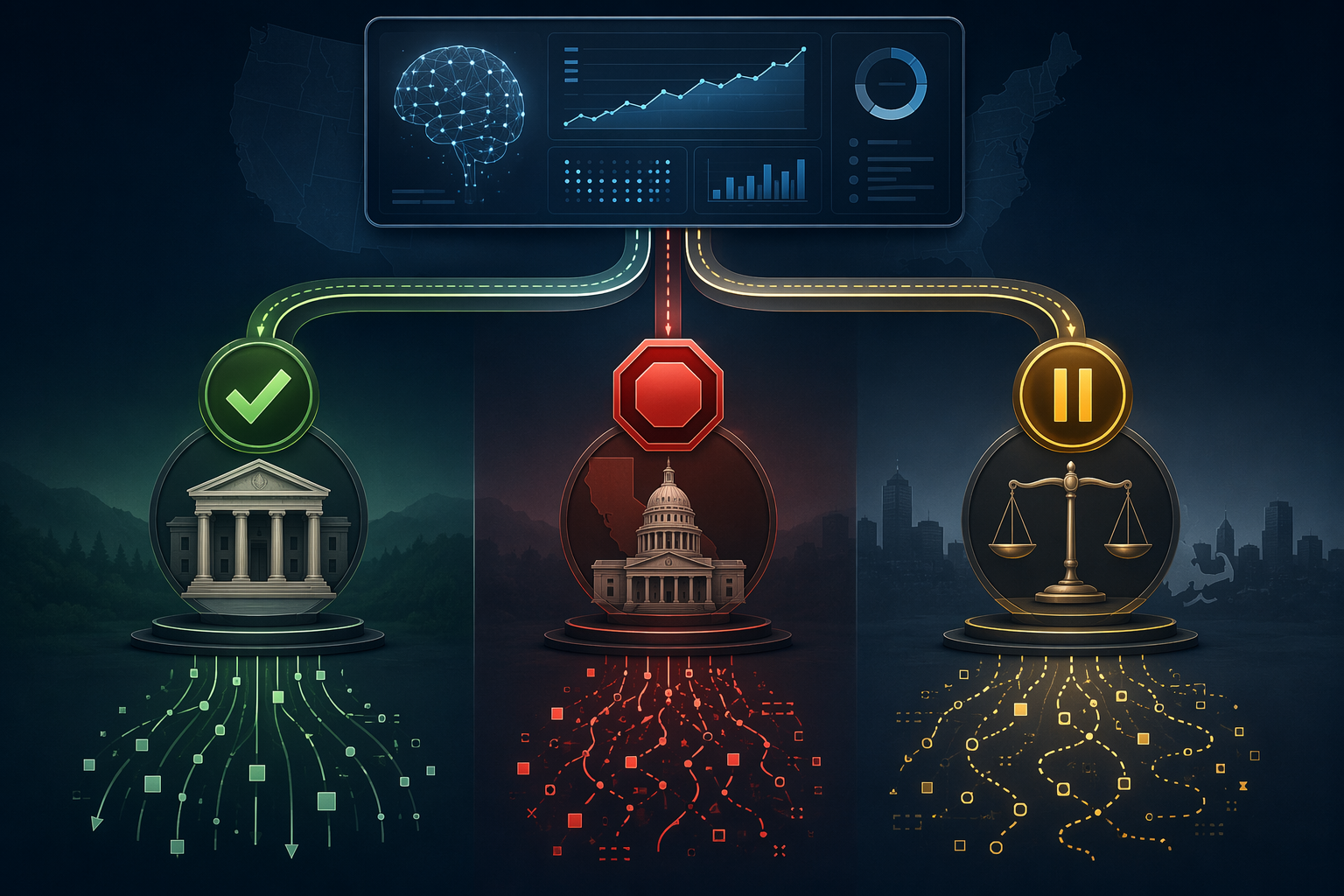
Nevada is not just another state on a map. It is one of the jurisdictions most invested in the distinction between regulated sports wagering and unlicensed sports betting. If a court accepts that state authority can reach a sports event contract notwithstanding the CFTC’s federal role, then an AI prediction platform faces a very different operational problem: geofencing, licensing exposure, advertising restrictions, payment risk, and enforcement posture all become state-specific again.
Massachusetts adds a different kind of uncertainty. A stay is not a final merits ruling, but it is still operationally significant. It can freeze conduct, delay enforcement, preserve a status quo, or leave counterparties waiting for a court to decide which regulator gets to act. For a compliance department, a paused case is not a green light. It is a calendar item attached to legal uncertainty.
| Jurisdictional pressure point | What it supports | Operational consequence |
|---|---|---|
| Tennessee | Kalshi’s argument that sports event contracts are likely CEA swaps and that federal law likely preempts state regulation | Stronger basis for a federal preemption memo, but not a national answer |
| Nevada | State authority to regulate or block sports wagering activity | Higher state enforcement and licensing risk for similar products |
| Massachusetts | A paused posture rather than a clean merits answer | Uncertainty over timing, status quo obligations, and next procedural move |
The emerging split makes high-court resolution plausible, but not inevitable on any particular timetable. Until an appellate path produces a controlling rule, counsel are left with a patchwork of district court reasoning, agency litigation positions, state briefs, and product-specific facts.
AI Makes the Market Larger, Faster, and Harder to Treat as a Side Issue
AI is not the doctrinal key that unlocks the CEA. It is the force that changes how quickly the legal question becomes urgent. A manually listed, thinly traded event contract can look like a specialist financial product. An AI-enabled sports prediction layer that recommends markets, updates probabilities, segments users, and scales liquidity begins to look much closer to mass-market sports wagering from the state regulator’s point of view.
The World Cup volume figure explains why lawmakers and regulators stopped treating this as a theoretical boundary dispute. During the 2026 World Cup, Kalshi reportedly processed about $40 billion in wagers, compared with roughly $4 billion at traditional sportsbooks, according to third-party analytics cited in this site’s earlier coverage.[4] The legal meaning of those transactions remains disputed, but the scale changes enforcement incentives.
That volume does not prove consumer harm, and it does not prove statutory illegality. It does show why state gaming regulators, incumbent sportsbooks, federal lawmakers, and the CFTC are no longer arguing over an edge case. If federally regulated event contracts can absorb sports betting demand at that scale, the state licensing model is not merely inconvenienced. It is structurally bypassed.
For readers who need the baseline distinction between a CEA event contract and a sportsbook wager, the more useful starting point is the framework in What Legal Framework Applies to Kalshi vs. Sportsbooks. The short version for this dispute is that the same sports outcome can be described through two regulatory vocabularies, and neither vocabulary disappears because the interface uses AI.
Polymarket, MLB, and the Congressional Backlash
The Polymarket flashpoint sharpened the politics around the legal theory. The MLB-Polymarket sponsorship deal, together with a CFTC memorandum of understanding, triggered bipartisan backlash in Congress. Reporting by The Hill, republished by AOL, described criticism from lawmakers including Representative Alexandria Ocasio-Cortez and the introduction of the Schiff-Curtis bill, the Prediction Markets Are Gambling Act, which would ban sports event contracts on prediction markets.[5]
The significance is not that congressional criticism resolves the CEA question. It does not. The significance is that lawmakers are treating sports prediction markets as part of the gambling perimeter, not simply as neutral derivatives infrastructure. That framing matters for appropriations pressure, oversight hearings, agency priorities, and the odds that Congress tries to write a more explicit rule.
The proposed Schiff-Curtis bill would be a direct statutory intervention if enacted. Until then, it is evidence of political resistance and legislative appetite, not binding law. A compliance analysis that treats the bill as already changing the status of event contracts is getting ahead of the record.
The Legislative Background Is Active but Unsettled
The SAFE Bet Act belongs in the same category of unresolved background. Available sources describe uncertain prospects and political headwinds. That makes it relevant to monitoring and scenario planning, but too uncertain to serve as the legal basis for a current product launch, shutdown, or enforcement conclusion.
Trump’s December 2025 AI executive order adds another layer, because it attempted to preempt state AI laws and has been flagged by law firms as creating preemption concerns. Its practical effect on state sports betting regulation remains unclear. The order may matter where a state targets the AI component of a prediction product, but it does not automatically displace state gambling authority or answer the CEA swap question.
That distinction is easy to lose in public commentary. An AI preemption fight is not the same as a sports wagering preemption fight. A platform may face one, both, or neither depending on how the product is structured and how the regulator frames the alleged violation.
What Compliance Teams Can Safely Take From the Current Record
The cleanest professional takeaway is narrow. As of Q3 2026, AI-powered sports prediction platforms operate in a legally fractured environment. The CFTC has committed to defending exclusive federal jurisdiction. States have organized around gambling-law authority. Courts have not delivered one national answer. The post-Loper Bright interpretive environment gives judges more visible responsibility for reading the CEA themselves.
For an operator, vendor, affiliate, data provider, league partner, or payments intermediary, the risk questions should stay tied to source and jurisdiction. Which court order applies? Which state has threatened enforcement? Is the contract listed through a federally regulated venue? Does the AI system merely provide analytics, or does it help create, recommend, route, or execute event contracts? Who touches the customer relationship? Who receives consideration? Who can be named in an enforcement action?
None of those questions has a universal answer simply because the product uses AI. The technology can intensify the facts that regulators care about: scale, access, personalization, inducement, market integrity, and consumer exposure. It does not erase the older conflict between federal derivatives law and state gambling law.
Teams tracking state-by-state exposure will need a live jurisdictional map rather than a national conclusion. The companion Kalshi World Cup Sports Contracts Legal Status by State can help separate state posture from broader federal theory. The central point remains the same: the most dangerous memo in this area is the one that treats one favorable ruling, one agency statement, or one AI label as a settled national rule.
References
- Prediction Markets at a Crossroads: The Continued Jurisdictional Battle Over Event Contracts, Holland & Knight, Feb. 2026.
- Sports and Gaming Law 2025 Year in Review: Top Five Developments, WilmerHale, Feb. 17, 2026.
- Sports Event Contracts, American Gaming Association.
- Kalshi World Cup Sports Betting Faces Legal Reckoning, July 20, 2026.
- Lawmakers ramp up fight against sports betting on prediction markets, The Hill/AOL.
Comments
Join the discussion with an anonymous comment.