
By July 2026, AI-industry spending in elections is no longer a speculative campaign finance compliance topic. AI-industry super PAC networks have raised or deployed sums large enough to matter in live races, while the legal theories around disclosure, coordination, and paid online persuasion are still being tested. CNBC reported that Leading the Future had raised more than $125 million, Public First Action had $80 million, and AI-aligned spending had already put $44 million into more than 40 races through the end of June.[1] That is not just a scale story. It is a structure story.

The familiar post-Citizens United frame still explains part of the architecture: independent-expenditure committees, large donors, aggressive race targeting, and policy interests dressed in candidate-support language. But the AI cycle is not merely repeating an old super PAC script with a newer industry label. The pressure points this year sit in the routing: corporate money through opaque entities, influencer content that may not look like conventional election advertising, and canvassing arrangements that depend on a contested FEC advisory opinion.
The Two-Network Map
The public political fight is already organized around rival AI policy projects. Leading the Future is the deregulatory network, opposing state-level and federal safety restrictions it views as barriers to U.S. AI development. Public First Action is the safety-focused counterweight, supporting regulation and candidates aligned with AI oversight, including support for the AI Act as described in the available reporting.[1]
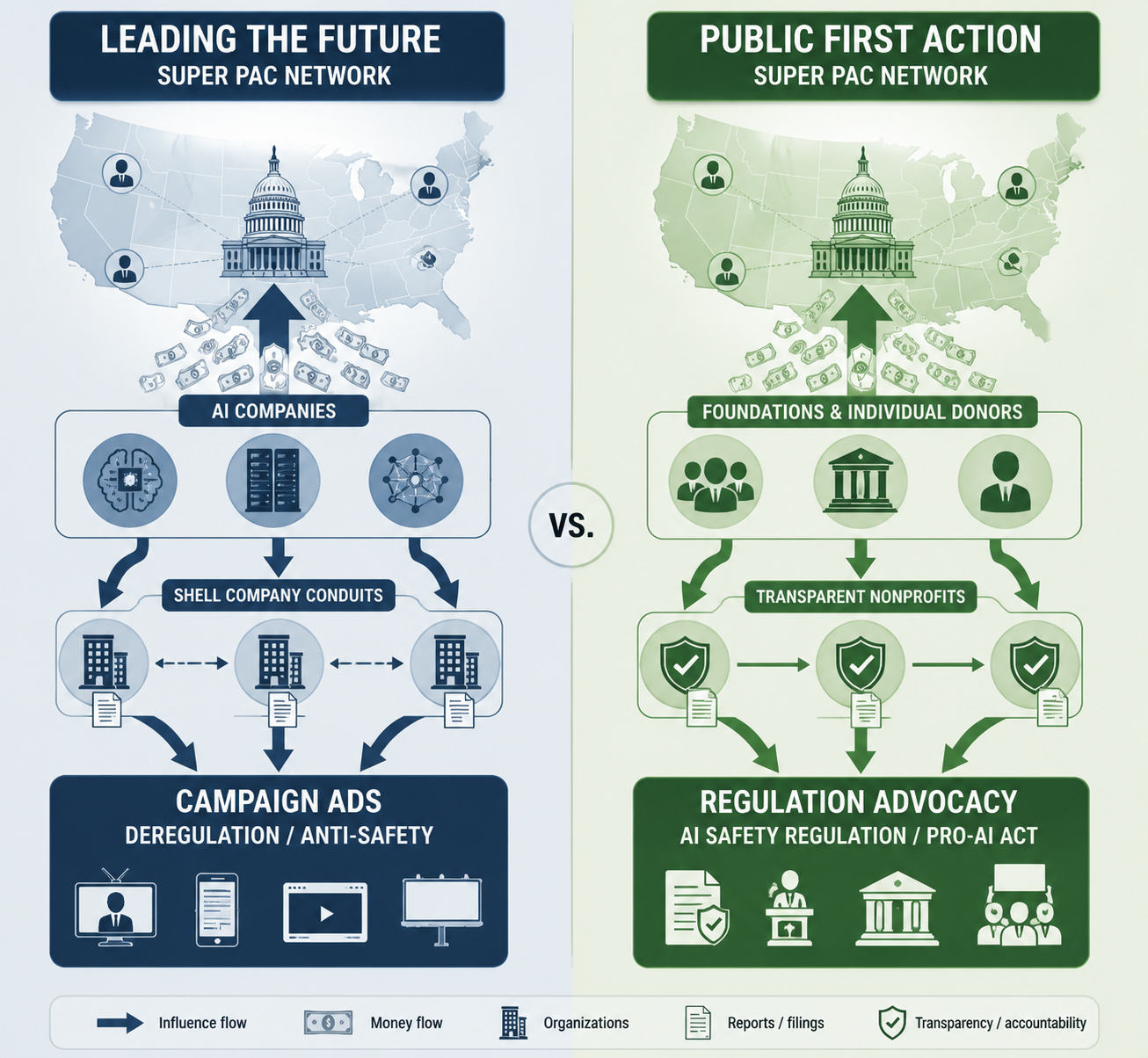
That alignment matters for lawyers because the spending is not floating above policy. It is aimed at races where federal and state choices about AI liability, safety regulation, national-security framing, and preemption may become legislative leverage. The candidate message may be about economic growth, China, innovation, or safety. The compliance file still has to answer a more prosaic question: who paid, through which entity, and under which disclosure rule?
Public Citizen’s separate analysis helps explain why this arrived so quickly. Looking at FEC data through the first quarter of 2026, the group reported $517 million in corporate midterm spending, a 12% increase over the entire 2024 cycle, with AI and Big Tech interests contributing $60 million, described as two-thirds of Leading the Future’s funding.[2] That number should not be collapsed into CNBC’s $44 million race-spending figure; they cover different reporting periods and measure different things. Taken together, they show the same practical problem from two angles: capital is entering the cycle early, and advisory answers are being demanded before enforcement answers exist.
The Crypto Comparison Only Gets You So Far
The obvious comparison is Fairshake in 2024: a technology industry, a concentrated set of donors, a policy agenda with high regulatory stakes, and a willingness to spend in primaries as well as general elections. That comparison is useful because it reminds practitioners not to treat AI spending as a novelty just because the industry’s product is novel. Sophisticated sectors use super PACs when legislation, enforcement, and agency authority threaten their business models.
But the AI spending wave becomes legally more interesting where it departs from that playbook. The contested conduct is not only large independent expenditures. It includes alleged conduit payments through shell companies, paid creator messaging that may sit outside ordinary ad-buy workflows, and a canvassing theory that could let a campaign and outside spender operate closer together than many lawyers would have advised before FEC Advisory Opinion 2024-01 was issued.
| Pressure point | Why it matters this cycle |
|---|---|
| Alleged shell-company conduits | Disclosure may identify an entity while obscuring the source or purpose of funds if the legal theory in the pending complaint is accepted. |
| Paid influencer videos | AI-policy persuasion can be routed through creators and national-security framing rather than conventional political ad inventory. |
| Coordinated canvassing | A contested advisory opinion may change how campaigns, super PACs, and canvassing vendors assess coordination risk. |
The Shell-Company Complaint Is About Naming the Transaction
The May 5 Campaign Legal Center complaint against American Mission and Think Big PAC is the cleanest example of why the AI spending story cannot be reduced to aggregate dollars. CLC alleged that AI industry-funded super PACs used shell companies to funnel payments and evade federal transparency obligations.[3] At this stage, that is an allegation in an FEC complaint, not an adjudicated violation. For advisory work, the difference matters.
The legal issue is not whether a political committee may hire vendors, consultants, or pass-through service providers. It is whether the reported payer/payee relationship accurately reflects the transaction federal law requires the public to see. If an entity exists mainly to intermediate a payment chain, the disclosure question becomes whether the committee has reported a vendor relationship or concealed the real source, recipient, or purpose of the spending.
That is a familiar problem in campaign finance enforcement, but AI-sector spending gives it a current-cycle urgency. The more money moves quickly through newly formed or lightly described entities, the harder it becomes for opponents, journalists, watchdogs, and even cautious counsel to understand the operational relationship before ballots are cast. A later enforcement decision may clarify the law. It may also arrive after the transaction has already achieved its political purpose.
For practitioners, the immediate question is not whether every intermediary is suspect. It is what contemporaneous file would support the structure if a complaint asks why a shell, affiliate, or vendor entity sat between the committee and the apparent political work. Engagement letters, scopes of work, payment approvals, beneficial ownership information where available, and explanations of business purpose become more than housekeeping. They are the difference between a defensible routing decision and a fact pattern that invites the word “conduit.”
Influencer Payments Move the Disclosure Problem Off the Rate Card
The influencer-payment network deserves separate treatment because it changes the surface form of political spending. CNBC reported that Build American AI offered $5,000 per video for creator content supporting AI deregulation, with messaging framed around Chinese AI as a national-security threat.[1] That is not the same thing as buying a television spot, placing a digital ad through a platform dashboard, or mailing a piece with a disclaimer box.
A paid creator video can be political persuasion, issue advocacy, industry branding, or some combination of all three. The legal classification may turn on words used, timing, targeting, payment source, candidate references, and whether the content is coordinated with a campaign or committee. The compliance risk is sharpened when the message is built around foreign competition or national security, because that framing may feel policy-oriented even when it also benefits candidates who oppose AI regulation.
Counsel advising a sponsor, creator network, or committee cannot stop at the platform’s advertising rules. The questions are federal election questions: whether the payment is an expenditure, whether a disclaimer is required, whether the communication is reportable, whether a conduit is involved, whether a vendor is acting for more than one political client, and whether nonpublic campaign information was used to shape the content. The fact that the public experiences the message as a creator’s opinion does not answer who financed it.
This is where industry arguments about “education” and watchdog arguments about “dark money” often talk past the compliance problem. A paid video may educate viewers about AI policy and still be a regulated communication in a campaign context. It may be funded by a lawful spender and still create inadequate disclosure if the payment chain or sponsorship presentation masks the relevant political actor. The legal file has to survive more than a public-relations description of the campaign.
The Coordinated-Canvassing Fight Is the Most Direct Practitioner Trap
The May 6 lawsuit by Campaign Legal Center and CREW challenging FEC Advisory Opinion 2024-01 goes to a different part of the machinery: ground activity and coordination. The groups sued the FEC to strike down an advisory opinion they describe as creating an unlawful coordinated-canvassing loophole.[4] The case matters because advisory opinions are often treated as safe operating terrain by actors whose facts look close enough to the requestor’s facts.
That instinct is understandable and dangerous. An advisory opinion binds the Commission as to the requestor and the specific facts presented; it is not a statute, and it is not a district court judgment. When an advisory opinion is immediately challenged, a lawyer advising a super PAC, campaign, nonprofit, or canvassing vendor has to decide how much reliance risk the client is willing to bear while litigation is pending.
The coordination issue is especially consequential for AI-industry networks because a race-targeting strategy can depend on more than paid media. Canvassing can generate voter contact, message testing, data feedback, and field intelligence. If outside groups may coordinate certain canvassing activity without creating prohibited in-kind contributions, the practical boundary between independent and campaign-aligned work becomes harder to police. If the challenged opinion falls, arrangements built around it may look different in hindsight.
The compliance answer cannot be a blanket “use” or “avoid” directive. Some clients will accept litigation risk for strategic field advantages; others will not want a test-case posture. The necessary work is narrower and more disciplined: identify whether the planned conduct fits the advisory opinion’s facts, document reliance assumptions, separate vendors and data flows where needed, and warn the client that a live lawsuit may change the risk analysis before the cycle is over.
AI Ad Rules Are Not the Same as AI Spending Rules
The FEC has addressed artificial intelligence in campaign ads, but that does not mean it has resolved the campaign finance questions raised by AI-industry spending. The Commission approved a Notification of Disposition and an interpretive rule concerning artificial intelligence in campaign ads, according to the FEC Record.[5] That development belongs in the file, but it should not be mistaken for a comprehensive rulebook for AI-backed super PAC networks.
Deepfakes, synthetic media, and deceptive AI content raise one set of questions. Donor routing, committee reporting, influencer compensation, and coordination raise another. A campaign may use no generative AI in its creative at all and still sit inside the legal uncertainties created by AI-industry money. Conversely, an AI-generated ad may trigger content and disclaimer questions without implicating the shell-company or canvassing theories now being litigated.
The Protect Elections from Deceptive AI Act remains relevant as legislative context, but its precise procedural status should be treated cautiously unless counsel has current bill-tracking confirmation. The more immediate risk for many clients is not whether Congress enacts a synthetic-media statute before November. It is whether existing contribution, expenditure, disclaimer, and coordination rules can be applied coherently to structures already operating in the field.
Enforcement May Not Arrive on a Useful Schedule
The FEC’s familiar structural problem is acute here: even when a complaint presents a concrete theory, the agency may not produce a timely, precedential answer. The current environment includes partisan deadlock at the Commission and broader constitutional challenges to independent-agency authority. Any confident prediction about how quickly the FEC will handle AI super PAC complaints should be treated as speculation.
That delay changes the compliance posture. In a fast election cycle, uncertain enforcement can function as permission for aggressive actors and as a tax on cautious ones. A client willing to absorb reputational and legal risk can act before the agency resolves the theory. A client seeking conservative advice has to account for possible complaints, later conciliation, donor disclosure consequences, and parallel litigation without a definitive agency map.
The June 30, 2026 NRSC v. FEC decision is adjacent structural context rather than part of the AI transparency story itself. It belongs in the background because challenges to campaign finance limits and agency authority can alter the enforcement environment in which super PAC disputes unfold. It should not be overread as answering whether an AI-funded payment chain, influencer program, or canvassing arrangement complies with federal law.
What Counsel Should Be Able to Answer in July 2026
The practical task this cycle is not to declare AI money lawful or unlawful as a category. It is to make sure each structure can be described in legal terms before a watchdog, reporter, opponent, or regulator describes it first. That means separating policy support from candidate intervention, spending from persuasion, issue advocacy from election activity, and vendor routing from alleged evasion.
- For donors: identify whether funds move directly to a committee, through a nonprofit, through a corporate affiliate, or through another intermediary, and document the stated purpose of each transfer.
- For super PACs: preserve vendor scopes, payment approvals, ownership information where available, and explanations for any pass-through entities in the chain.
- For influencer programs: treat creator briefs, compensation terms, approval rights, candidate references, targeting instructions, and disclosure language as campaign finance evidence.
- For canvassing arrangements: compare the planned facts to FEC Advisory Opinion 2024-01, then separately assess the litigation risk created by the pending CLC/CREW challenge.
- For campaigns: assume that nonpublic information, vendor overlap, data sharing, and field coordination remain the facts most likely to make a nominally independent program legally vulnerable.
None of those steps resolves the larger statutory mismatch. Federal campaign finance law was built around committees, contributions, expenditures, communications, and coordination. The 2026 AI spending surge is testing those categories through entities and distribution channels that can make the formal spender, the operational sponsor, and the public-facing messenger appear as different actors.
That is the legal significance of the surge. The amount of money matters, but the harder problem is the collision between new conduits, influencer networks, coordination theories, and an enforcement system that may not deliver usable guidance before lawyers have to advise clients and clients have to act.
References
- What AI companies want for the millions they're spending on elections, CNBC, July 9, 2026.
- Corporate Supremacist Super PACs Drive $500 Million Midterm Spending Surge, Public Citizen, 2026.
- AI Industry-Funded Super PACs Unlawfully Evaded Transparency Rules, CLC Alleges, Campaign Legal Center, May 5, 2026.
- CLC, CREW Sue Federal Election Commission to Strike Down Unlawful Advisory Opinion on Canvassing Coordination, Campaign Legal Center, May 6, 2026.
- Commission approves Notification of Disposition, Interpretive Rule on artificial intelligence in campaign ads, FEC Record.
Comments
Join the discussion with an anonymous comment.