
The bottleneck in witness impeachment is not usually the dramatic moment when a contradiction appears. It is the quieter work before that: reading the transcript, isolating the commitment, checking whether the prior statement is usable, deciding whether the inconsistency is material, and building a page-line trail clean enough that another lawyer can use it under pressure. That is where impeachment AI legal analysis has become genuinely useful, and also where it can become dangerous if treated as more than a first-pass engine.
The current claims are strong enough to deserve attention. Traditional manual transcript review is commonly framed at 4–6 hours per 100 pages, while esumry says its AI workflow can process a 400-page transcript in “several minutes.”[1] CaseMark says its Deposition Impeachment Builder can generate a Commit-Credit-Confront impeachment script, materiality assessment, and deployment memo in 10–12 minutes.[2] Those are vendor-reported timings, not independent audits. They also do not mean a usable impeachment is finished. They mean the first pass may no longer have to consume the better part of an evening.

The ceiling on automation is just as important as the speed claim. U.S. Legal Support cites the Vectara Hallucination Leaderboard’s March 2026 range of 1.8–6.4% hallucination rates for the top 25 general-purpose large language models.[3] That benchmark is not a legal-specific audit of every deposition tool, and retrieval-augmented or legal-tuned systems may perform differently. Still, for impeachment work, even a low single-digit error rate matters. One invented page reference, one flattened conditional answer, or one overstated contradiction can turn a helpful draft into a cross-examination problem.
Start With The Impeachment Job, Not The Tool
A deposition summary tells you what the witness said. An impeachment package tells you what can be done with what the witness said. The difference is structure.
Most serious deposition impeachment work still turns on the same basic sequence: lock the witness into the current testimony, establish the reliability of the prior statement or document, then confront the witness with the inconsistency. CaseMark describes this as the Commit-Credit-Confront framework, and it is the structured method its impeachment workflow automates.[2] AI.Law also markets deposition analysis around cross-referencing testimony and identifying impeachment material across transcripts and case files.[4]
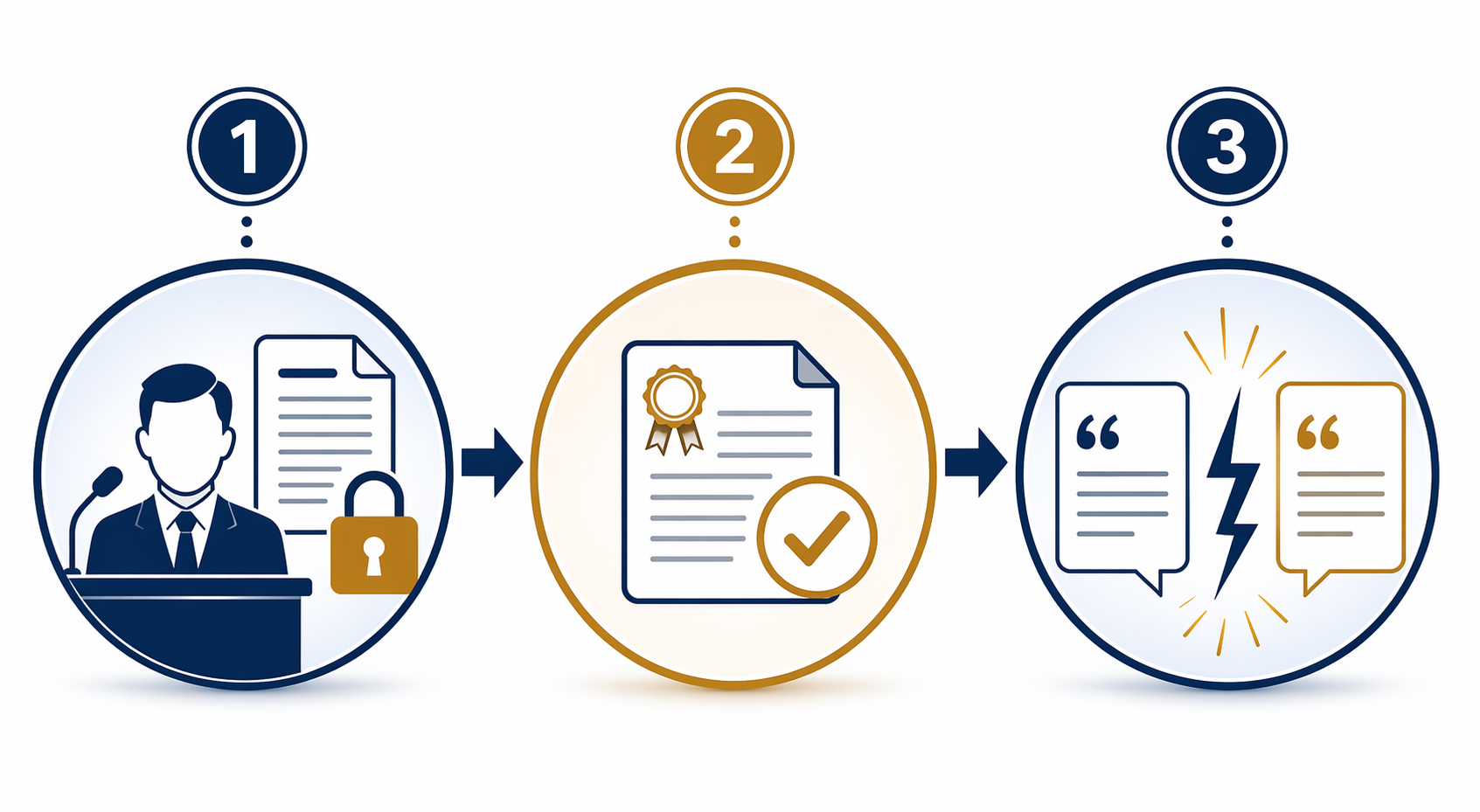
That matters because contradiction detection alone is not impeachment preparation. A tool can flag that a witness said “I reviewed the policy” in one place and “I did not review the policy” somewhere else. The lawyer still has to know whether the answers refer to the same policy, the same time period, the same decision, and the same level of personal knowledge. The useful AI workflow is the one that keeps those questions attached to the output instead of burying them under a confident label.
| Workflow Question | What AI Can Do | What Still Needs Human Judgment |
|---|---|---|
| What did the witness commit to? | Extract admissions, denials, dates, actors, and topic clusters from the transcript. | Decide whether the answer is clear enough to use and whether the setup limits its meaning. |
| What prior statement or record creates tension? | Cross-reference other transcripts, exhibits, pleadings, emails, or summaries where available. | Confirm authenticity, admissibility posture, and whether the source actually says what the tool claims. |
| Is the inconsistency material? | Draft a materiality note tying the contradiction to claims, defenses, damages, or credibility. | Decide whether using the point advances the case theory or merely scores a minor inconsistency. |
| How should the impeachment be asked? | Generate a CCC-style question sequence with page-line support. | Rewrite for tone, jurisdiction, witness control, and the specific deposition or trial objective. |
The Under-60-Minute Workflow That Is Plausible
The realistic target is not “AI prepares impeachment for you.” The defensible target is narrower: AI can compress the first organized pass for one witness into a bounded review window, often under 60 minutes, if the transcript and source materials are clean, the task is framed tightly, and a human verifies the output before it enters an outline.
In practice, that workflow looks less like a single command and more like a controlled handoff.
- Ingest the transcript and exhibits, preserving page-line references and source labels.
- Generate a first-pass summary by topic, witness commitment, and important factual assertion.
- Cross-reference those assertions against prior testimony, documents, pleadings, discovery responses, or other record materials.
- Separate mere differences in wording from candidate contradictions.
- Assess materiality against the case theory, not just semantic conflict.
- Draft a Commit-Credit-Confront sequence with source-linked support.
- Verify every quoted line, every cited page, and every contextual assumption before use.
esumry and CaseChat fit naturally near the front of that chain: rapid transcript summarization, issue spotting, and chat-based follow-up over deposition materials. The vendor’s own timing claim is “several minutes” for a 400-page transcript, which is best understood as processing speed, not finished attorney work.[1] That can still be valuable. A paralegal or associate who receives topic clusters, witness admissions, and candidate inconsistencies quickly can spend the next hour checking the right places instead of trying to find the first foothold.
CaseMark fits later in the chain because its stated output is more structured: a CCC script, materiality assessment, and deployment memo in 10–12 minutes.[2] That is the sort of package that looks deceptively close to usable. It should be treated as a draft impeachment worksheet, not a deposition outline. The question sequence may be helpful, but the value depends on whether the cited commitment, credit foundation, and confronting source all survive human review.
AI.Law’s advertised strength is cross-referencing deposition testimony and surfacing impeachment material across the record.[4] That is the step where many manual workflows slow down: the contradiction may be in another witness’s transcript, a complaint allegation, a discovery response, or an exhibit that nobody remembers by number. Tools that can preserve source trails while searching across materials are more useful than tools that simply announce that testimony is “inconsistent.”
Commit: Lock The Testimony Before Looking For The Contradiction
The first AI pass should extract commitments, not just themes. A theme is “safety training.” A commitment is “the witness testified that no one gave them the revised safety protocol before the incident,” with a page-line reference and the question that produced the answer. That question matters. A clean answer to a narrow question is very different from a qualified answer to a compound one.
This is where deposition summarization tools can help, but only if the user demands source-linked output. Clio’s discussion of AI deposition summaries emphasizes common capabilities such as summarizing transcripts, extracting key points, and organizing deposition information for review.[5] Steno Transcript Genius and similar transcript-management systems sit in the same practical neighborhood: they are most helpful when they keep the transcript, the summary, and the lawyer’s review path close together rather than forcing the team to reconcile separate documents later.
For impeachment, the instruction should avoid asking only for “contradictions.” A better first request asks the system to list material factual commitments by topic, include the full question-and-answer context, identify whether the answer is absolute or qualified, and preserve page-line support. BrassTranscripts’ deposition analysis guidance is useful here because it treats input design as a way to force structure onto transcript review rather than as a trick for producing polished prose.[6]
The review standard is simple: if the commitment cannot be pasted into a contradiction chart with page and line support, it is not ready to become an impeachment point.
Credit: Make The Prior Statement Carry Weight
The “Credit” step is where many AI-generated impeachment drafts look cleaner than they are. The tool may identify a prior email, interrogatory answer, document, or earlier deposition excerpt that appears to conflict with the witness’s testimony. But impeachment does not work merely because two strings of text diverge. The prior statement needs a reason to matter and, often, a foundation that allows the examiner to use it cleanly.
This is also the stage where cross-document systems can create the most leverage. AI.Law’s cross-reference positioning is relevant because impeachment sources often live outside the active transcript.[4] CaseMark’s CCC-oriented workflow also recognizes that the prior statement must be placed into a usable sequence, not just listed as a conflicting excerpt.[2]
A verification pass should ask four questions before the draft moves forward.
- Does the prior source actually say what the AI summary says it says?
- Is the prior statement tied to the same person, time period, transaction, document, or event?
- Can the examiner establish why the source is reliable enough to use in the deposition or at trial?
- Does the contradiction matter to liability, damages, causation, notice, credibility, or another case theory issue?
A tool can draft answers to those questions. It cannot be the final authority on them. That is not a philosophical objection to AI; it is the consequence of using software in a task where context and admissibility posture change the meaning of the excerpt.
Confront: Treat The Script As A Draft, Not A Performance Plan
The most tempting AI output is the polished impeachment script. It looks like the work is done because it has the familiar rhythm: commit the witness, credit the source, confront with the inconsistency. CaseMark expressly markets generation of a CCC impeachment script as part of its 10–12 minute workflow.[2] NexLaw AI, from a different angle, describes AI-assisted witness cross-examination strategy generation.[7]
That kind of output is worth having. It gives the reviewer a starting architecture: the lead-in questions, the foundation sequence, the confronting language, and sometimes a deployment note explaining why the point matters. But a generated script often lacks the discipline of a trial-ready cross. It may use too many words. It may ask one question too many before the contradiction. It may assume the witness will agree to a foundation point that the transcript does not actually support.
The lawyer’s edit should be ruthless. Remove adjectives. Split compound questions. Replace paraphrases with exact transcript or document language when precision matters. Mark the page-line support beside the question where it will be needed, not in a separate memo that nobody will find in the moment. If the script depends on the witness accepting a characterization, rewrite it so the document or transcript does the work.
There is also a materiality edit. Not every inconsistency belongs in the deposition outline. A witness who used “reviewed” loosely in one answer and “skimmed” in another may have given the AI a contradiction and the examiner a distraction. A contradiction that proves notice, control, reliance, timing, or credibility on a central issue deserves a different place in the outline than a wording mismatch that only shows the witness is human.
Where The Current Tools Fit
The tool landscape is better understood by workflow stage than by asking which platform “wins.” No source in the available material supports the claim that one product handles the entire impeachment process end to end better than the rest. The safer comparison is narrower: what each tool appears designed to do well, and where another review layer is still required.
| Tool | Best-Fit Stage | Useful Output | Review Risk |
|---|---|---|---|
| esumry / CaseChat | Transcript ingestion and first-pass review | Rapid summaries, topic extraction, chat-based follow-up over transcript content | Vendor timing describes processing speed, not verified impeachment readiness |
| CaseMark | CCC script generation and materiality memo | Commit-Credit-Confront script, materiality assessment, deployment memo | Generated scripts can look final before page-line and context checks are complete |
| AI.Law | Cross-transcript and cross-document impeachment search | Cross-referenced deposition analysis and impeachment issue spotting | Flagged contradictions still need source verification and materiality screening |
| Steno Transcript Genius | Transcript management with AI-assisted review | Integrated transcript organization and AI-supported review workflow | Transcript convenience should not be confused with impeachment judgment |
| Verbit Legal Visor | Real-time deposition support | Live or near-live deposition assistance and contradiction surfacing | Real-time flags need a confirmation protocol before use in questioning |
| Clio Work | Practice-management-adjacent deposition AI | Deposition summary and case workflow integration | Integrated summaries still require record-level review |
| NexLaw AI | Cross-examination strategy | AI-assisted witness cross-exam planning and strategic framing | Strategy output must be reconciled with the record and examiner style |
| Filevine Depo CoPilot | Real-time deposition support | Live deposition assistance and issue flagging in the current tool landscape | Independent long-form failure-mode reporting remains limited |
Verbit describes AI-supported deposition preparation and real-time capabilities that can help surface useful information while the deposition is still underway.[8] U.S. Legal Support also identifies real-time and AI witness-analysis tools as part of the emerging litigation workflow, while warning about hallucination and contextual limits.[3] If the witness gives an answer that conflicts with a prior statement, the examiner may be able to adjust before the witness leaves the room.
The operational problem is that real-time impeachment support compresses the review window to minutes or seconds. If the AI flag is wrong, if it pulls a prior statement from a different time period, or if it strips a qualification from the testimony, the examiner may chase a false inconsistency in front of the witness. Real-time tools need a designated reviewer, a source-preview habit, and a rule for when the flag is strong enough to use immediately versus parked for a break.
The Hallucination Problem Is Only Part Of The Verification Problem
The 1.8–6.4% hallucination benchmark range is a useful warning label, not a complete failure map.[3] In impeachment work, a system can damage the draft without inventing a fact. It can compress context. It can treat a conditional answer as unconditional. It can miss that the witness was answering about a different location, subsidiary, policy version, or date range. It can turn “I do not recall receiving it before the meeting” into “I did not receive it,” which is not the same testimony.
U.S. Legal Support’s discussion of AI witness analysis identifies both the benefits and the risks, including hallucination and the possibility that AI may miss subtler impeachment opportunities or mishandle contextual testimony.[3] That limitation should shape the workflow. The reviewer is not merely checking whether the quote exists. The reviewer is checking whether the AI’s proposed contradiction survives the surrounding transcript.
A safe verification pass should be physical enough to interrupt overconfidence. Open the transcript. Read at least the question before and the answer after the cited line. Open the prior source. Confirm the speaker, date, and document version. Then decide whether the contradiction is direct, contextual, or too soft to use. If the tool cannot expose the cited source quickly, it is poorly suited for impeachment work no matter how good the prose looks.
| AI Output | Minimum Verification Before Use |
|---|---|
| Witness admission | Read the full question and answer, including nearby qualifications. |
| Contradiction flag | Compare both passages in source, confirming same topic, time period, and actor. |
| Materiality assessment | Tie the point to an element, defense, damages theory, credibility theme, or discovery objective. |
| CCC script | Check each question against the transcript or document it depends on. |
| Real-time alert | Confirm source preview before asking, or hold for a break if the alert is not clean. |
A Practical Division Of Labor
The strongest use case is a disciplined division of labor. Let AI do the work it is good at: ingesting large transcripts, clustering testimony, surfacing candidate contradictions, drafting CCC sequences, and producing a memo that tells the reviewer where to look. Keep human lawyers and trained litigation staff responsible for the work that carries evidentiary consequence: source verification, context review, materiality judgment, and final question design.
That division changes staffing. The first reviewer no longer has to spend hours building a blank contradiction chart from scratch. Instead, the reviewer receives a populated chart and spends the time attacking it: Is this actually inconsistent? Is the page-line cite right? Is the prior statement reliable? Does this help the theory? What would the witness say if confronted? The work becomes less about finding every possible mismatch and more about deciding which mismatches deserve space in the deposition plan.
The cost comparison also points in that direction, though the available data is broad. The research materials identify traditional outsourcing at roughly $3–8 per page and AI subscriptions at roughly $30–100 per month per tool. That comparison should not be oversold. A subscription does not replace attorney review, and outsourced human review may include judgment that a summarization tool does not provide. The better conclusion is narrower: AI can reduce the amount of paid human time spent on first-pass organization, especially when the team already has a verification process.
How To Build The Review Packet
The end product should not be an AI-generated memo floating apart from the deposition outline. It should be a review packet that a partner, trial lawyer, or second-chair can test quickly.
- A witness commitment chart with transcript page-line support and the surrounding question context.
- A contradiction chart separating direct contradictions from softer tensions or memory gaps.
- A source packet with the prior testimony, exhibit, pleading, or discovery response behind each confrontation point.
- A materiality note explaining why each point matters to the case theory.
- A draft CCC script revised into short, controlled questions.
- A verification status field showing who checked the source and when.
That last field is not administrative clutter. It is the difference between a generated draft and a litigation work product someone can rely on. If a contradiction has not been verified, it should be marked as unverified. If context weakens it, the packet should say so. If the contradiction is real but not worth using, it should be preserved for the file without being promoted into the examination outline.
When Real-Time Flags Are Worth Using
Real-time deposition AI is the most exciting and least forgiving part of the workflow. Verbit Legal Visor and Filevine Depo CoPilot are examples of tools positioned around surfacing useful deposition information while testimony is still happening.[8][3] Used well, they can help the examination team catch a live tension before the witness leaves the room.
The practical rule should be conservative. Use real-time AI for navigation, reminders, and candidate follow-up. Use it immediately for impeachment only when the source is visible, the contradiction is direct, and the examiner can confirm the setup without derailing the deposition. If the flag requires interpretation, save it for a break or post-deposition analysis.
A real-time workflow also needs role assignment. The questioning lawyer cannot reliably examine the witness, read an AI alert, verify the source, and rewrite the outline at the same time. A second lawyer, paralegal, or litigation support person should monitor the feed, open the source, and pass forward only flags that meet the agreed threshold. Otherwise the tool adds noise at exactly the moment the examiner needs control.
The Standard For Safe Integration
AI is now credible as a first-draft impeachment engine. The better tools can reduce the time spent getting from raw transcript to organized candidate impeachment points, and the strongest workflows now resemble a junior review packet more than a generic summary. The under-60-minute claim is plausible when it means a bounded, AI-assisted first pass plus targeted verification for one witness. It is not plausible if it means complete, unsupervised impeachment preparation.
The integration standard is straightforward: use AI to surface, organize, cross-reference, and draft; use humans to verify, contextualize, and decide. A contradiction flag does not become impeachment until someone has checked the page lines, read the context, credited the source, and decided the point belongs in the theory of the case.
References
- What AI-Powered Transcript Review Looks Like in 2025, esumry, esumry.com/blog/what-ai-powered-transcript-review-looks-like-in-2025
- Deposition Impeachment Builder, CaseMark, casemark.com/workflows/deposition-impeachment-builder
- AI Witness Analysis, U.S. Legal Support, uslegalsupport.com/blog/ai-witness-analysis/
- Depo Analysis, AI.Law, ai.law/features/depo-analysis
- AI Deposition Summary: A Guide for Lawyers, Clio, clio.com/resources/ai-for-lawyers/ai-deposition-summary/
- Legal Professional AI Toolkit: Deposition Analysis Prompts, BrassTranscripts, brasstranscripts.com/blog/legal-professional-ai-toolkit-deposition-analysis-prompts
- AI Witness Cross Exam Strategy, NexLaw AI, nexlaw.ai/blog/ai-witness-cross-exam-strategy/
- Mastering Deposition Prep in the Digital Age: A Guide for Modern Law Firms, Verbit, verbit.ai/blog/ai-technology/mastering-deposition-prep-in-the-digital-age-a-guide-for-modern-law-firms/
Comments
Join the discussion with an anonymous comment.