
As of July 19, 2026, the Air Force One subpoenas sit inside a thin legal architecture: Branzburg sets the constitutional floor, DOJ media guidance is only internal policy, and there is still no federal shield law to fill the gap [1][2][3].
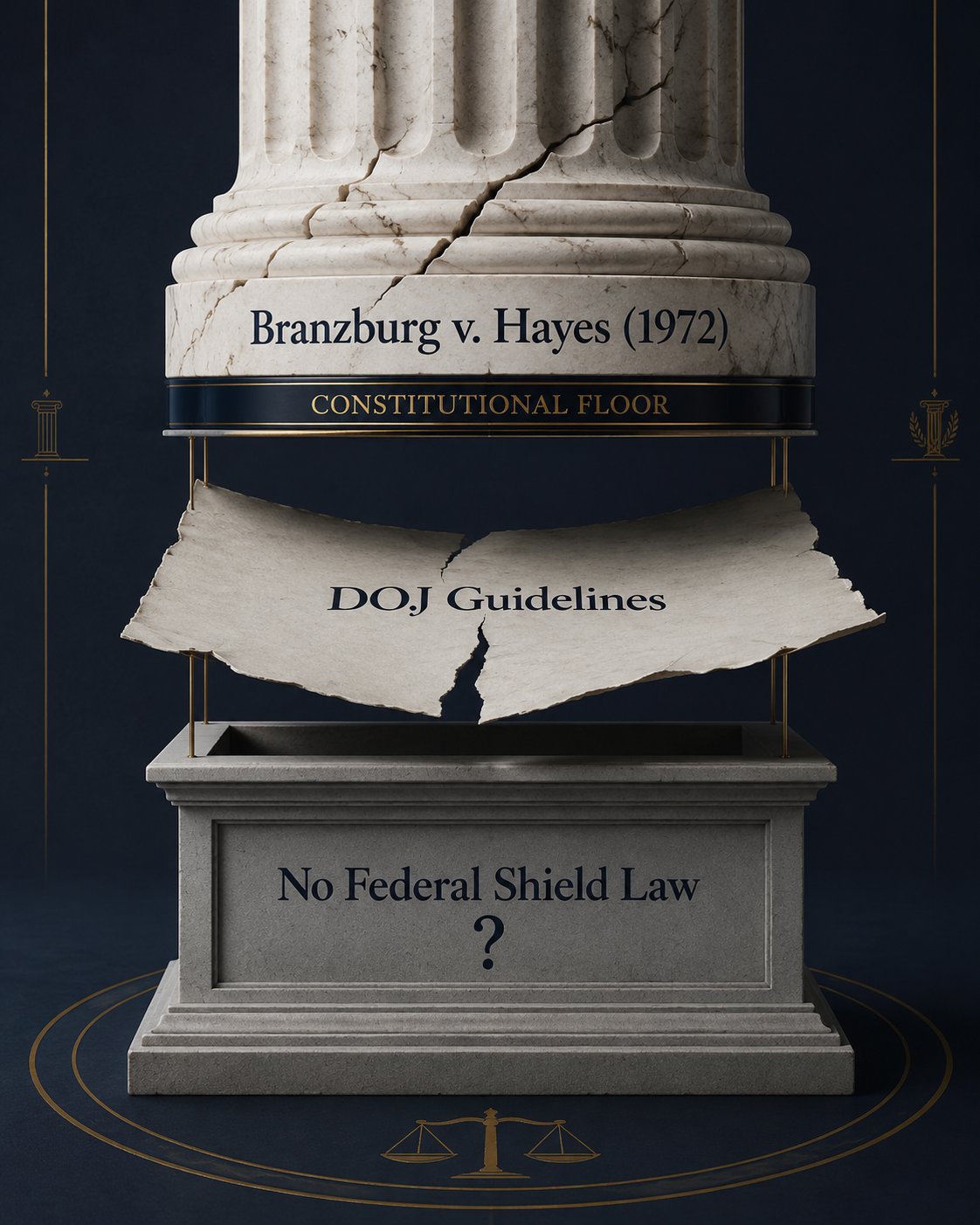
Branzburg Still Controls
Branzburg v. Hayes still does the hard work because the Supreme Court's 5-4 majority held that the First Amendment does not create a reporter privilege against grand jury subpoenas [1]. Justice White's opinion rejected any categorical exemption. Justice Powell's concurrence is the only crack the Times can realistically work inside, and it is narrow: case-specific arguments about bad faith, harassment, or overbreadth, not a general entitlement to refuse testimony.
That is why the legal question here is not whether journalists can ever be compelled. They can. The real question is whether this subpoena crossed one of the limited lines Branzburg leaves open, because once the request looks like ordinary grand jury process aimed at nonprivileged evidence, the First Amendment itself does very little.
DOJ Guidance Was Never A Shield
The rescinded DOJ media guidelines were never law in the first place. Under 28 C.F.R. § 50.10, the department's own rules can slow a subpoena, but they do not bind a future attorney general. The Bondi-era rescission in April 2025 moved the department back from Garland's bright-line bar to a Holder-era balancing test, deleted the "sole purpose" safeguard, introduced an undefined "lawful newsgathering" qualifier, and removed the DNI certification step [2].
That matters in practice even if it changes nothing constitutional. A guideline can create friction and force an internal review; it cannot create a privilege. Once the policy changed, one of the few administrative checks that made subpoenas harder to issue was gone.
The structural gap is wider still. Forty-nine states have some form of reporter-protection law, but the federal government does not, and the PRESS Act never became law [3]. That leaves reporters in federal leak cases with no statute to invoke against the subpoena itself. They can only work around the edges of Branzburg and whatever process objections a judge is willing to recognize.
What The Sealed Motion Can Still Argue
Because the motion to quash is under seal, every public account of it is second-hand. The reporting that is available points to a narrow attack: bad faith, retaliatory purpose, overbreadth, and failure to exhaust alternative sources [4]. Public reports also vary on the subpoena count — the Times expected five, while later accounts said three or four had actually been served — which is a reminder that the docket and the press coverage are not yet the same thing [4].
- Bad faith or retaliation, if the subpoenas were aimed at punishing the reporting rather than gathering evidence.
- Overbreadth, if the demands sweep farther than the investigation needs.
- Failure to exhaust alternatives, if prosecutors skipped less intrusive sources.
- Powell-style abuse of process, the narrow opening Branzburg still leaves.
If the Times succeeds, it will likely be because the subpoenas crossed one of those narrow lines, not because journalists hold a robust federal privilege. That is the legal reality check. In national security leak cases, the Air Force One subpoenas show how thin the protection really is unless Congress enacts a federal shield law or the Court revisits the terrain Branzburg left behind [1][2][3].
References
- Branzburg v. Hayes — Middle Tennessee State University
- DOJ rescinds news media guidelines: analysis — Reporters Committee for Freedom of the Press
- Reporter's Privilege — Middle Tennessee State University
- Subpoenas issued to New York Times reporters in Air Force One leak probe — Associated Press
Comments
Join the discussion with an anonymous comment.