
Once a civil aircraft violates restricted airspace badly enough to draw a NORAD intercept, the legally important moment is not the flare, the fighter's position off the wing, or the news clip that follows. It is the handoff after landing. NORAD's own public description of temporary flight restriction responses says its role can include visual contact, radio calls, wing-rocking, flare deployment, more aggressive visual maneuvers, and escorting the aircraft to land; after that, the pilot is turned over to the FAA and DOJ for possible legal consequences.[1]
That sequence matters because the legal consequences of an airspace violation that triggers a NORAD interception do not have a single answer. The intercept is the security event. The legal case begins sorting itself afterward, through a chain that can remain administrative, become civil and certificate-threatening, or, in the narrower and more serious category, become criminal.

The Intercept Is a Security Response, Not the Final Legal Judgment
A NORAD intercept changes the posture of a routine pilot error because it creates an official security response record before the FAA ever begins its ordinary enforcement analysis. The aircraft has entered restricted airspace tied to presidential movement, a major event, or another protected location. Fighters or other assets respond because the air-defense system has to resolve the aircraft's identity and intent in real time, not because a prosecutor has already decided what the pilot meant to do.
Domestic enforcement also sits inside an international-law boundary. Article 3 bis of the Chicago Convention prohibits the use of weapons against civil aircraft in flight, while preserving the obligations of states to protect safety and recognizing that other international-law rules, including self-defense, may still matter in an extreme case.[2] That does not eliminate intercept authority. It does keep the discussion from drifting into the idea that a civil aircraft becomes legally fair game merely by crossing a line on a TFR map.
For most legal purposes, the question after landing is more prosaic and more consequential: what did the pilot know, what should the pilot have known, what notices were available, what instructions were given, whether the operator has prior violations, and whether the incursion created a security response beyond the bare fact of unauthorized entry.
The Three-Tier Response Chain
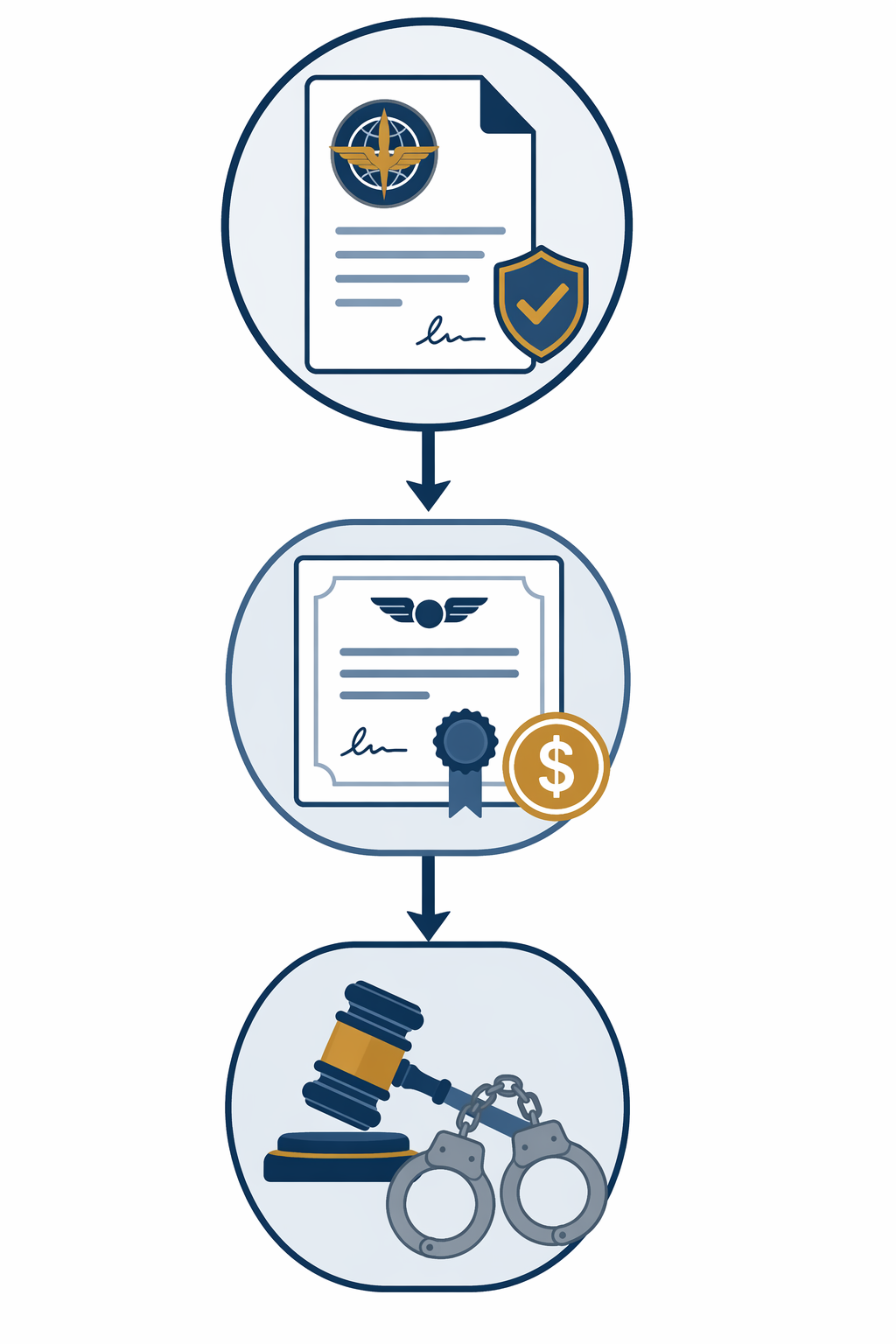
The post-intercept consequences generally sort into three tiers. They are not mutually exclusive in the abstract, but they mark different legal postures: correction, punishment and certificate risk, and criminal exposure.
| Tier | Primary forum | Typical legal character | What moves the matter upward |
|---|---|---|---|
| Administrative or compliance resolution | FAA | Corrective action, education, remedial measures, or other non-punitive handling where available | Facts suggesting more than inadvertence, a lack of cooperation, prior history, or a security-sensitive context |
| Civil penalty and certificate action | FAA | Monetary penalty, certificate suspension, or certificate revocation depending on facts and authority | Careless, reckless, repeated, or serious conduct; failure to meet regulatory duties; aggravating operational facts |
| Criminal prosecution | DOJ, usually after referral or coordination | Potential prosecution under federal criminal statutes, including 49 U.S.C. § 46307 where its elements are met | Evidence supporting knowing or willful violation, false statements, threatening conduct, or other criminal facts |
FAA enforcement authority includes civil penalties and certificate actions, and the agency describes enforcement as covering both monetary penalties and certificate suspension or revocation depending on the violation and the person or entity involved.[3] For temporary flight restriction cases, one aviation-law summary cites FAA internal guidance placing simple TFR certificate suspensions in the 30-to-90-day range, while also noting civil penalty exposure ranging from $1,100 to $75,000 per violation for individuals and broader statutory maximums that can reach $100,000 for individuals and $1,200,000 for non-individuals or small businesses.[4] Those figures are useful as exposure markers, not as a sentencing table.
The FAA Compliance Program is the principal reason not every incursion should be described as an enforcement march toward punishment. The program is designed for safety issues that can be corrected without legal enforcement, but FAA excludes intentional, reckless, or criminal conduct from that non-enforcement pathway.[5] That exclusion is where intent stops being a background fact and becomes the switch controlling the track.
At the criminal end, 49 U.S.C. § 46307 provides penalties for knowingly and willfully violating certain airspace restrictions. The statute carries up to one year of imprisonment and a $100,000 fine for a first offense, and a December 2025 amendment raised subsequent-offense exposure to up to five years.[6] That amendment is a serious change in statutory risk. It does not, by itself, prove that presidential TFR busts are now routinely prosecuted criminally.
Intent Does Most of the Sorting
A common mistake in coverage of NORAD interceptions is to let the military response substitute for the mental-state analysis. An intercept may be operationally justified even when the later legal record supports negligence rather than willfulness. Conversely, the absence of a dramatic cockpit confrontation does not make a violation harmless if the pilot ignored clear notices, repeated prior conduct, or refused instructions.
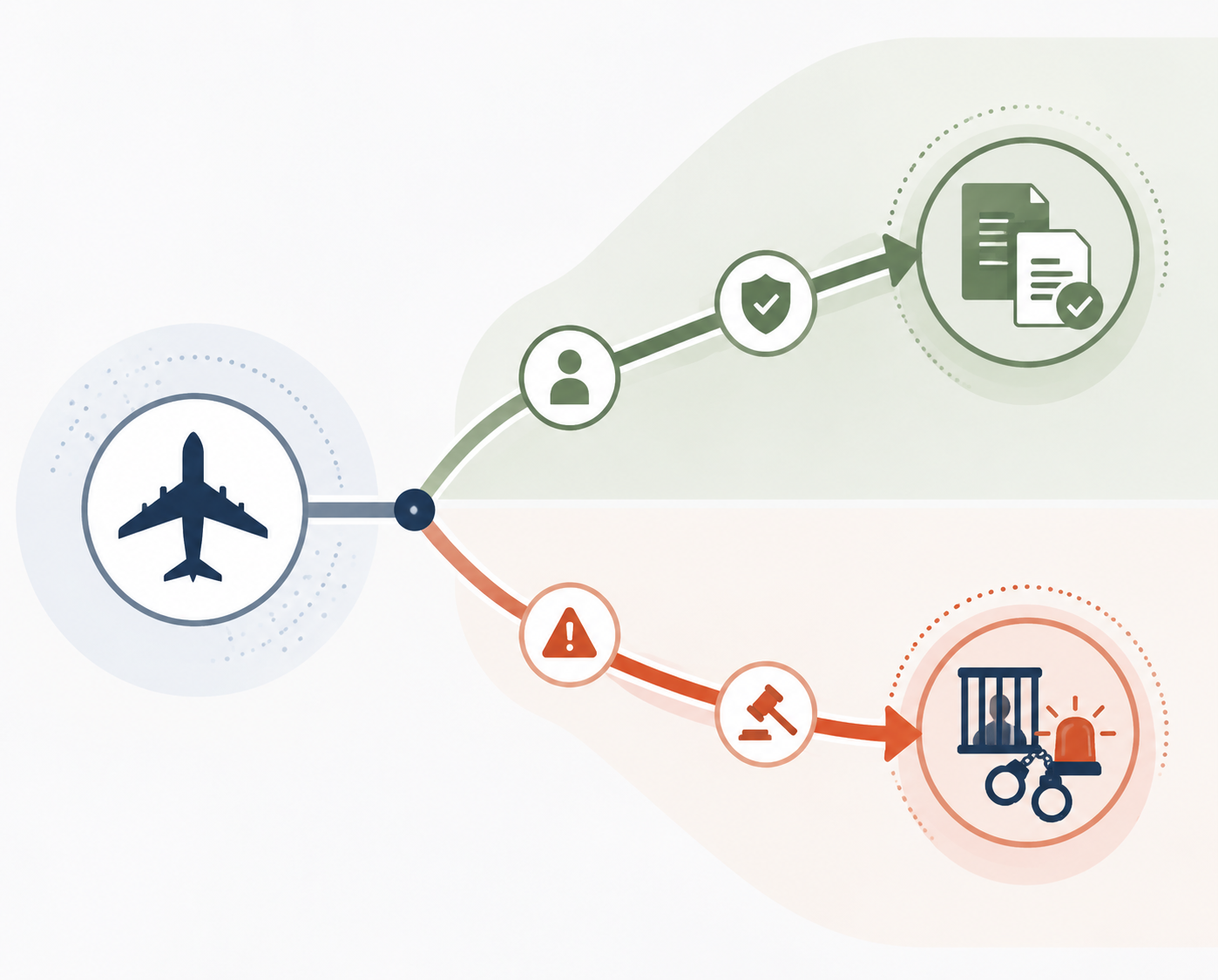
Inadvertent conduct is the most plausible route into administrative handling, assuming the pilot cooperates and the surrounding facts remain ordinary. A pilot who failed to review current NOTAMs before flying near a presidential location may have a serious compliance problem, but the failure does not automatically establish a criminal case. The FAA's own Compliance Program structure leaves room for corrective handling only when the conduct is not intentional, reckless, or criminal.[5]
Careless or reckless conduct sits in a harder middle category. It may not prove a knowing and willful criminal violation, but it can take the case out of compliance treatment and into civil penalty or certificate action. In practice, the facts that matter are not abstract labels. They include preflight planning, NOTAM availability, route choice, ATC communications, whether the aircraft had working radios or transponder equipment, whether instructions were followed, and whether the operator had relevant prior violations.
Knowing and willful conduct is the point at which § 46307 becomes more than a citation in a warning paragraph. A prosecutor would need evidence that the violation was not merely mistaken but knowing and willful within the statute's terms.[6] Publicly available research for this article did not identify actual federal prosecutions specifically under § 46307 for presidential TFR violations. That limitation should make lawyers cautious in both directions: criminal exposure is real, but a NORAD intercept is not a proxy for a criminal charging pattern.
NORAD's own publicly reported materials also complicate the instinct to treat nearly every intercept as hostile. AVweb reported NORAD data stating that 99.9% of intercepted pilots had simply failed to check NOTAMs.[7] That figure supports a narrower conclusion than some commentary gives it: most intercepted pilots may be non-malicious, but non-malicious is not the same as compliant, careful, or immune from enforcement.
Security Context Changes the Weight of the Same Error
A wrong turn in quiet uncontrolled airspace and a wrong turn into a presidential TFR are not treated the same way because the second mistake forces a security system to react. That difference is not sentimental. It appears in the agencies involved, the record created, and the government resources committed before the pilot lands.
The 2025–2026 numbers are pressure indicators. E3 Aviation reported more than 32 intercepts near presidential locations since January 2025, including 24 fighter deployments in Palm Beach County.[8] NBC Miami reported NORAD Vice Director Steven Armstrong's statement that each F-16 scramble costs a minimum of $50,000.[9] That cost estimate is not an audited damages number and should not be treated as a statutory penalty, but it explains why agencies and public officials frame repeated incursions as more than paperwork failures.
The pattern was not confined to one location. DVIDS reported that NORAD responded to 11 incursions in a single July 2025 weekend over the Bedminster, New Jersey, temporary flight restriction.[10] On July 19, 2026, the New York Post reported multiple NORAD fighter-jet intercepts of aircraft violating a restricted area in New Jersey near the World Cup Final.[11] Those incidents do not establish that any particular pilot acted willfully. They do show why the enforcement environment in mid-2026 is less forgiving than a one-off TFR violation would suggest.
Executive Order 14305 Raises Priority, Not Proof
Executive Order 14305, issued June 6, 2025, directed DOJ to ensure full enforcement of criminal laws related to airspace violations and to submit legislative proposals for revised criminal penalties.[12] In legal terms, that order matters as an enforcement-priority signal and as part of the path to penalty revision. It is not self-executing proof that a particular TFR violation meets a criminal statute's elements.
The later December 2025 amendment to § 46307 gives that policy environment more concrete force by raising subsequent-offense exposure to five years.[6] The combination is what changes counsel's risk assessment: more stated DOJ attention, a higher statutory ceiling for repeat offenses, and a visible series of presidential and event-related intercepts. None of those facts eliminates the need to prove knowing and willful conduct where § 46307 is the charging theory.
For operators, the practical consequence is that the first post-landing account can become unusually important. What the pilot says about preflight planning, whether records support that account, and whether the aircraft's path matches an inadvertent error or a conscious disregard of restrictions can affect whether the matter is framed as remediable noncompliance, a certificate case, or a criminal referral candidate.
What Counsel Should Look for After Landing
The useful file is not built from the intercept video alone. It is built from the materials that show notice, planning, communications, and response. A lawyer evaluating exposure after a NORAD intercept should separate the security facts from the culpability facts, even though agencies may consider both.
- Notice record: what NOTAMs and restrictions were active, when they were issued, and what sources the pilot or dispatcher actually reviewed.
- Flight-planning record: route, altitude, timing, fuel stops, navigation inputs, and whether the plan was changed after briefing.
- Communications record: ATC contact, guard frequency monitoring, intercept instructions, radio failures, and any delay in responding.
- Operational conduct: whether the aircraft continued toward the protected area, turned away promptly, landed as directed, or created additional risk.
- History and remedial posture: prior violations, training practices, company dispatch procedures, cooperation, and corrective measures.
Those categories are not a substitute for statutory analysis. They are the places where the statutory analysis usually finds its facts. A pilot who did not check NOTAMs may still be arguing about negligence, recklessness, or willfulness. A company that had procedures on paper but no effective dispatch control may be arguing about organizational compliance rather than a single cockpit mistake.
The Professional Risk in 2026
In 2026, a NORAD intercept following an airspace violation is not itself a criminal conviction, and it is not even proof of intent. It is, however, a documented entry into a heightened multi-agency enforcement environment. FAA compliance treatment may still be available for the right facts. Civil penalties and certificate action become realistic where the conduct is careless, reckless, repeated, or serious. DOJ prosecution under § 46307 remains tied to proof of knowing and willful violation, with higher exposure now attached to subsequent offenses.
The legal consequence therefore turns less on the spectacle of the intercept than on the record that follows the landing. That is the part ordinary aviation coverage often leaves undeveloped, and the part most likely to determine whether the incident ends as correction, enforcement, certificate loss, or criminal risk.
References
- Holding the Line: TFRs, NORAD and General Aviation, NORAD
- Article 3 bis, ICAO
- Enforcement Actions, FAA
- TFR Violation, Rupprecht Law
- Compliance Program, FAA
- 49 U.S. Code § 46307 - Violation of national defense airspace, Cornell Legal Information Institute
- TFR Busts On The Increase, AVweb
- Presidential TFR Violations: What GA Pilots Need to Know, E3 Aviation Association
- Temporary Flight Restrictions violations over Mar-a-Lago: What to know about restricted airspace, NBC Miami
- NORAD responds to airspace violation in Temporary Flight Restriction over Bedminster, New Jersey, DVIDS
- NORAD fighter jets intercept multiple aircraft violating restricted area in NJ near World Cup Final, New York Post
- Restoring American Airspace Sovereignty, The White House, June 6, 2025
Comments
Join the discussion with an anonymous comment.