
By Q3 2026, the legal question after the Alaska Airlines emergency landing is no longer whether a frightening in-flight failure occurred. It is how responsibility is being divided among Boeing, Spirit AeroSystems, and Alaska Airlines across passenger injury claims, cross-claims, regulatory enforcement, a criminal-investigation backdrop, and a separate pilot defamation suit.
That distinction matters because the public record does not point to one clean line of liability. The National Transportation Safety Board’s final report and docket materials supply findings about manufacturing quality, training, and door plug reinstallation. Court filings show Boeing and Alaska Airlines denying liability while attempting to place responsibility elsewhere. The FAA’s proposed penalty adds regulatory pressure, but it does not decide civil fault. The Department of Justice investigation remains a separate uncertainty. And the pilot defamation case, filed later, turns corporate messaging into its own legal problem.
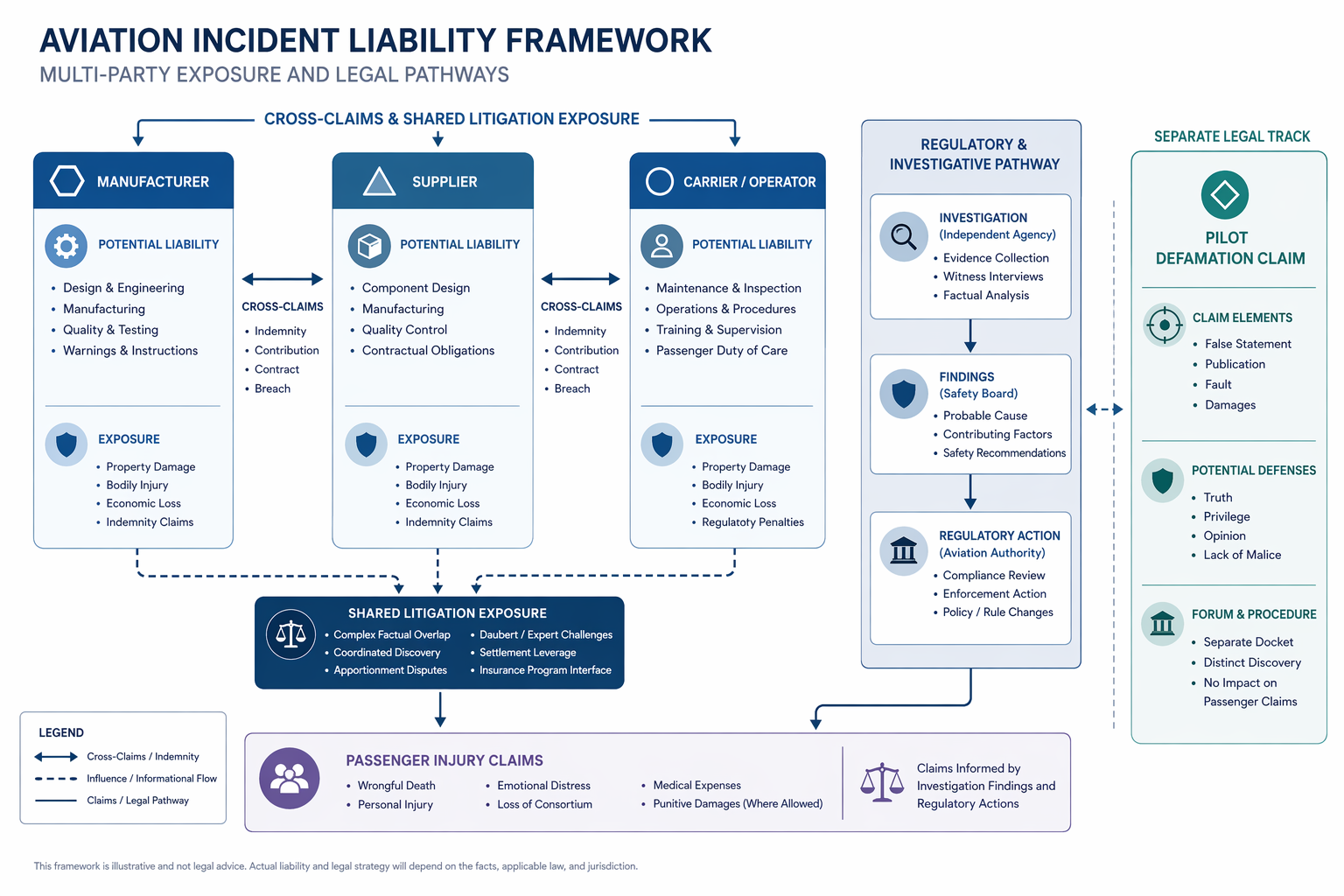
The Current Liability Map
The main civil exposure sits on three defendant tiers. Boeing is the aircraft manufacturer and the public-facing company most closely tied to the 737 MAX program. Spirit AeroSystems is implicated through manufacturing and quality-control facts concerning the fuselage and door plug work. Alaska Airlines is not positioned the same way, but it carried the passengers, owed carrier duties to them, and is named in litigation arising from the emergency landing.
| Front | Principal legal significance | Posture to keep separate |
|---|---|---|
| Passenger suits | Negligence, strict products liability, and common-carrier theories aimed at Boeing, Spirit AeroSystems, and Alaska Airlines | Complaint allegations and cross-claims are not findings |
| NTSB final report and docket | Findings on training, manufacturing quality, and reinstallation facts that plaintiffs can use as evidentiary support | Accident findings do not automatically allocate civil damages |
| FAA proposed fine | Regulatory enforcement pressure citing hundreds of quality-system violations and a proposed $3.1 million penalty | An agency penalty proposal is not a substitute for civil proof |
| Pilot defamation suit | A separate claim by pilot Brandon Fisher alleging Boeing falsely implicated him in public statements | Boeing had not filed a substantive response in the materials provided |
| DOJ criminal investigation | Potential criminal exposure and negotiation backdrop | Status as of Q3 2026 is unconfirmed in the provided record |
The passenger litigation is the center of gravity because it is where physical injury, emotional distress, product defect theories, and carrier obligations converge. But the litigation record is already adversarial in the ordinary, important sense: parties are not merely making public statements; they are pleading denials, defenses, and blame allocation.
What the NTSB Findings Change
The NTSB’s final report is not a damages award, and it is not a verdict. Its legal force is more practical: it turns technical failure into documented facts that lawyers can plead around, test in discovery, and use to frame expert opinions. The report contains 35 findings and 19 recommendations, giving plaintiffs and defendants a structured record rather than a loose narrative of a door plug blowout.[1]
The facts most likely to matter in civil litigation are procedural rather than cinematic. The research record identifies four door-team personnel with less than two years of experience and states that none were present at the plug reinstallation. Those facts are not just background color. They speak directly to negligent-training, supervision, quality-control, and handoff theories.[1]
For Boeing and Spirit AeroSystems, the report supplies plaintiffs with a way to move from “the aircraft failed” to “specific quality processes and training systems failed.” That is a different evidentiary posture. A product-liability case can survive on defect theories, but documented process lapses make the case easier to explain to a court and, eventually, to a jury.
For Alaska Airlines, the same report cuts differently. The strongest manufacturing-quality facts may point upstream, but passenger-facing liability does not require Alaska to have manufactured the part. Common-carrier and negligence claims can ask what the airline knew, what it should have known, how it responded to prior warnings or maintenance indications, and how its passengers were protected once the aircraft was placed into service.
Passenger Claims and the Formal Blame Allocation
The March 2024 filings are important because they show that denial and cross-blame were formalized early. Boeing and Alaska Airlines denied liability and pointed toward other parties in court papers, according to NBC News coverage of those filings.[2]
That matters more than another recounting of the cabin scene. Once a manufacturer, supplier, and carrier are all inside the same liability system, each party’s litigation position becomes a record of strategy. Boeing has incentives to contest defect, causation, notice, and damages, while also distinguishing its conduct from supplier work. Spirit AeroSystems has incentives to narrow any quality-control facts to particular workstreams, personnel, or inspection failures. Alaska Airlines has incentives to emphasize reliance on upstream manufacturers and regulators while defending its own operational decisions.
The passenger plaintiffs do not need every defendant to have committed the same wrong. A manufacturer-focused theory can live beside a carrier-duty theory. A strict products liability claim can sit beside negligence allegations. Trauma-related damages can be pleaded even where the physical mechanics of the failure are attributed upstream. The hard work is not inventing one master theory; it is proving which defendant’s conduct legally caused which injury.
Reporting in July 2025 described passenger suits ramping up after the NTSB report, which is the expected sequence when an accident docket gives lawyers more concrete allegations to attach to existing claims.[3]
The dismissed Oregon passenger class-action settlement should not be treated as a pricing guide. The research record states that the $1 billion Oregon passenger class action was dismissed with prejudice on July 7, 2025, with confidential terms. Confidentiality prevents any reliable public benchmark for valuation, and dismissal with prejudice does not by itself tell outsiders how comparable claims should settle.[3]
Why Alaska Airlines Is Still in the Frame
It is tempting to describe Alaska Airlines as the airline caught with a defective aircraft. That is too simple for civil liability. A passenger bought carriage from Alaska, boarded an Alaska-operated flight, and experienced the emergency landing inside Alaska’s service relationship. Even if the most severe quality-control facts remain upstream, Alaska’s own duties do not disappear.
The airline’s exposure is likely to turn on narrower questions: maintenance records, communications about prior conditions, reliance on Boeing or Spirit, internal escalation, passenger handling, and causation. Those questions are less dramatic than a missing or improperly secured plug, but they are exactly the kind of operational record that becomes central in discovery.
The FAA Fine Adds Pressure, Not a Verdict
The FAA’s proposed $3.1 million fine against Boeing is legally significant because the agency cited hundreds of quality-system violations. It is not significant because $3.1 million resolves the scale of harm, or because an enforcement proposal substitutes for a civil trial.[4]
In civil litigation, the proposed fine gives plaintiffs another official record to point to when arguing that the Alaska Airlines emergency landing was not an isolated operational surprise. It also gives defendants reasons to litigate admissibility, scope, causation, and whether regulatory allegations map cleanly onto the specific aircraft, work sequence, and injuries at issue.
For in-house counsel, the fine also changes the settlement atmosphere. It may affect board reporting, insurer communications, disclosure controls, and reserve analysis. But it should be read as regulatory context and evidentiary pressure, not as a public damages calculation.
The DOJ Investigation Remains a Separate Uncertainty
The Department of Justice criminal investigation is part of the legal environment, but the provided research record does not confirm its status as of Q3 2026. That limits what can responsibly be said. A criminal investigation can influence civil timing, discovery fights, privilege assertions, witness strategy, and settlement leverage. It does not, without a charging decision or public resolution, establish civil liability.
Civil plaintiffs may use the existence of government scrutiny to argue that the case belongs in a broader pattern of safety and quality failures. Defendants may argue that unresolved criminal inquiries should not be converted into adverse inferences. Courts will care about the actual record before them, not the gravitational pull of an investigation whose current posture is unconfirmed.
The Fisher Defamation Suit Widens the Risk Frame
The Brandon Fisher suit is legally distinct from the passenger claims. Fisher, identified in the research record as a pilot, filed a $10 million defamation suit against Boeing on December 30, 2025, in Multnomah County Circuit Court. The Hill reported on the case, which alleges that Boeing falsely implicated him in connection with the Alaska Airlines incident.[5]
The claim matters because it moves the dispute from product failure and passenger injury into corporate-disclosure conduct. In a product-liability crisis, a company’s explanation of what happened is not merely public relations. It can affect pilots, mechanics, suppliers, airlines, investors, regulators, and passengers. If a statement assigns blame or implies operational fault, the person named or identifiable may have reputational injury claims separate from the underlying accident litigation.
The procedural caution is essential. The research record states that Boeing had not filed a substantive response in the Fisher case. The allegations therefore remain allegations. The suit should not be folded into the passenger cases as proof of defect, nor should it be dismissed as a sideshow. It is a disclosure-risk case growing out of the same accident ecosystem.
How the Defendants Are Likely to Use the Record
Boeing’s public litigation problem is that the NTSB and FAA materials focus attention on quality systems and training at the manufacturing level. Its legal strategy is therefore likely to separate general quality criticism from the specific elements of each plaintiff’s claim: defect, causation, damages, notice, and recoverability.
Spirit AeroSystems faces a related but more specialized exposure. Plaintiffs can use manufacturing and door plug work facts to argue that supplier conduct was not remote from the emergency. Spirit can be expected to contest the boundaries of its work, the role of Boeing oversight, and whether any alleged lapse was a legal cause of passenger harm.
Alaska Airlines occupies the passenger-facing tier. Its strongest defense posture is likely reliance: it did not design or manufacture the aircraft component and may argue that upstream parties and regulatory processes controlled the relevant risk. Its vulnerability is that passengers do not experience the aviation supply chain as separate legal compartments. They experience the carrier.
Those positions explain why cross-claims matter. They are not procedural clutter. They are the mechanism by which defendants preserve the argument that, if passengers recover, some other party should bear all or part of the cost.
What Can Be Said Now
The strongest public evidence now supports a distributed-liability analysis. Boeing and Spirit AeroSystems remain central because the NTSB and FAA materials point toward manufacturing quality and training failures. Alaska Airlines remains in the case because passenger carriage carries its own legal duties and because injured passengers can pursue the airline that operated the flight. The passenger suits, cross-claims, and regulatory record are aligned enough to make the litigation serious, but not settled enough to assign final legal responsibility.
The open cautions are just as important. Complaint allegations are not findings. A proposed FAA fine is not a civil judgment. Confidential settlements are not valuation benchmarks. The DOJ investigation’s Q3 2026 status is unconfirmed in the provided record. Boeing’s substantive response in the Fisher defamation suit is not available in the materials provided. Anyone treating this as a single-defendant story is reading past the record.
References
- NTSB docket DCA24MA063 and final report, National Transportation Safety Board.
- Boeing, Alaska Airlines deny liability in March 2024 court filings, NBC News, March 2024.
- Coverage of passenger suits ramping up after NTSB report, Anchorage Daily News, July 17, 2025.
- FAA proposed $3.1M fine announcement citing hundreds of quality system violations, Federal Aviation Administration.
- Coverage of Brandon Fisher defamation suit against Boeing, The Hill.
Comments
Join the discussion with an anonymous comment.