
| Front | Current posture | Next known date |
|---|---|---|
| Baseline blame positions: in March 2024, Boeing and Alaska Airlines each filed formal denials, with each side pointing at the other and at Spirit AeroSystems. [1] | Those pleadings still matter because they set the initial fault map. | No specific hearing date is given in the brief. |
| DOJ criminal/regulatory track: the DOJ opened a criminal investigation in March 2024, FBI letters identified passengers as possible victims of a crime, DOJ later concluded Boeing breached its 2021 DPA, and Boeing later moved toward a new resolution path to avoid prosecution. [2][3] | This is the main criminal exposure track still shaping the wider liability picture. | Current docket terms should be verified against the latest filings. |
| NTSB factual record: the final report issued on June 24, 2025 and assigned probable cause to Boeing's inadequate training, guidance, and oversight, with ineffective FAA compliance surveillance as a contributing factor. [4][5] | This is the fixed factual anchor under the remaining claims. | No further investigative milestone is identified in the brief. |
| Remedial ledger: Boeing's payments to Alaska Airlines were described as $160 million initially and $443 million total to MAX 9 customers. [6] | These are compensation markers, not a final allocation of liability. | No additional payment milestone is specified in the brief. |
| Passenger civil tracks: one Oregon passenger case was settled confidentially and dismissed with prejudice on July 7, 2025, and three trial tracks were set for January 2026, March 2026, and September 2026. [7][8] | This remains the most visible civil docket. | September 2026: seven plaintiffs, including three children. [8] |
| Crew claims: four flight attendants filed separate negligence and product-liability suits against Boeing in King County Superior Court in August 2025. [9] | These claims extend the blame story beyond passenger injury valuation. | No public trial date is given in the brief. |
| Pilot defamation claim: Captain Brandon Fisher sued Boeing and Spirit AeroSystems on December 30, 2025, seeking $10 million and alleging defamation and scapegoating of the flight crew. [10] | This is the sharpest reputational claim in the docket. | Procedural posture beyond filing is not specified. |
This is litigation-status information, not legal advice. The useful divide is between facts that have hardened into official records and claims that still depend on docket movement.
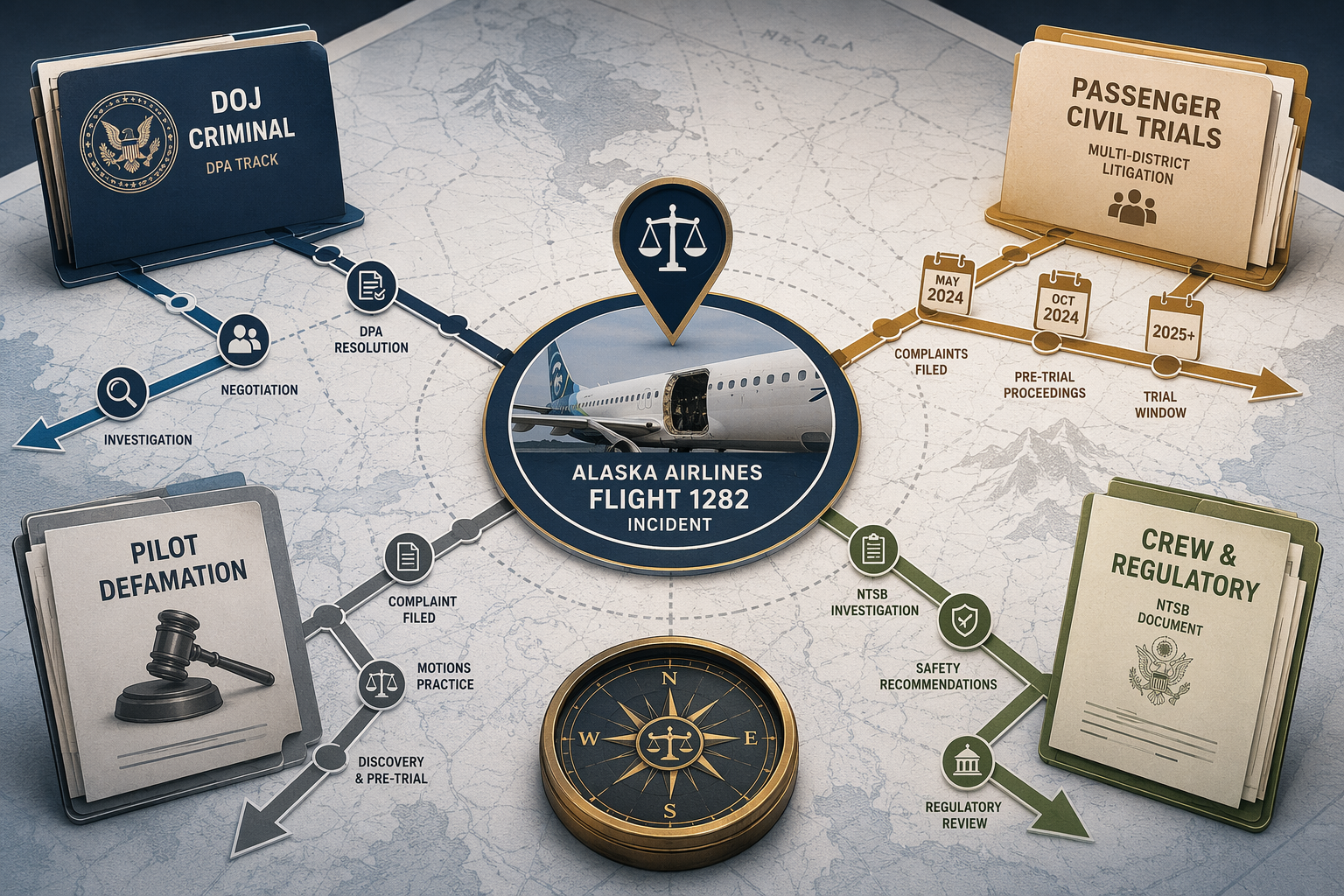
The first pleadings did not wait for the public narrative to settle. Boeing and Alaska Airlines each denied blame in March 2024, and the dispute immediately widened to Spirit AeroSystems as well. [1] Boeing's remedial payments later became another marker on the map: Alaska Airlines said the package reached $160 million initially and $443 million total to MAX 9 customers. [6] That is exposure on the ledger, not a final answer on fault.
What The Official Record Fixed
The NTSB final report does the heavy lifting for later blame arguments. It found Boeing failed to provide adequate training, guidance, and oversight for the door plug removal process, and it identified ineffective FAA compliance surveillance as a contributing factor. The report also noted that none of the 24 door-team members were trained for the task, that the plug had moved gradually over 154 prior flights, and that three pressurization warning lights had illuminated. The board placed the event at 14,830 feet and revised the casualty count to seven passengers and one flight attendant with minor injuries. [4][5]
That matters because it narrows the room left for narrative blame-shifting. The regulatory and investigative record now asks who controlled the process, who documented the process, and who was supposed to catch the failure before the airplane returned to service. The FAA's separate regulatory pressure, including an emergency airworthiness directive, a 38-per-month production cap, and a $3.1 million fine, keeps that same question alive on the compliance side. [4]
Passenger Civil Tracks
The civil passenger docket is where exposure becomes most legible. The Oregon case that had been billed as a $1 billion lawsuit was settled confidentially and dismissed with prejudice on July 7, 2025, but the amount is sealed, so it tells you only that one large claim left the board, not what that claim was worth. [7] The rest of the passenger litigation had already been split into three trial tracks: January 2026 with 51 plaintiffs, March 2026 with 35 plaintiffs, and September 2026 with seven plaintiffs, including three children. [8]
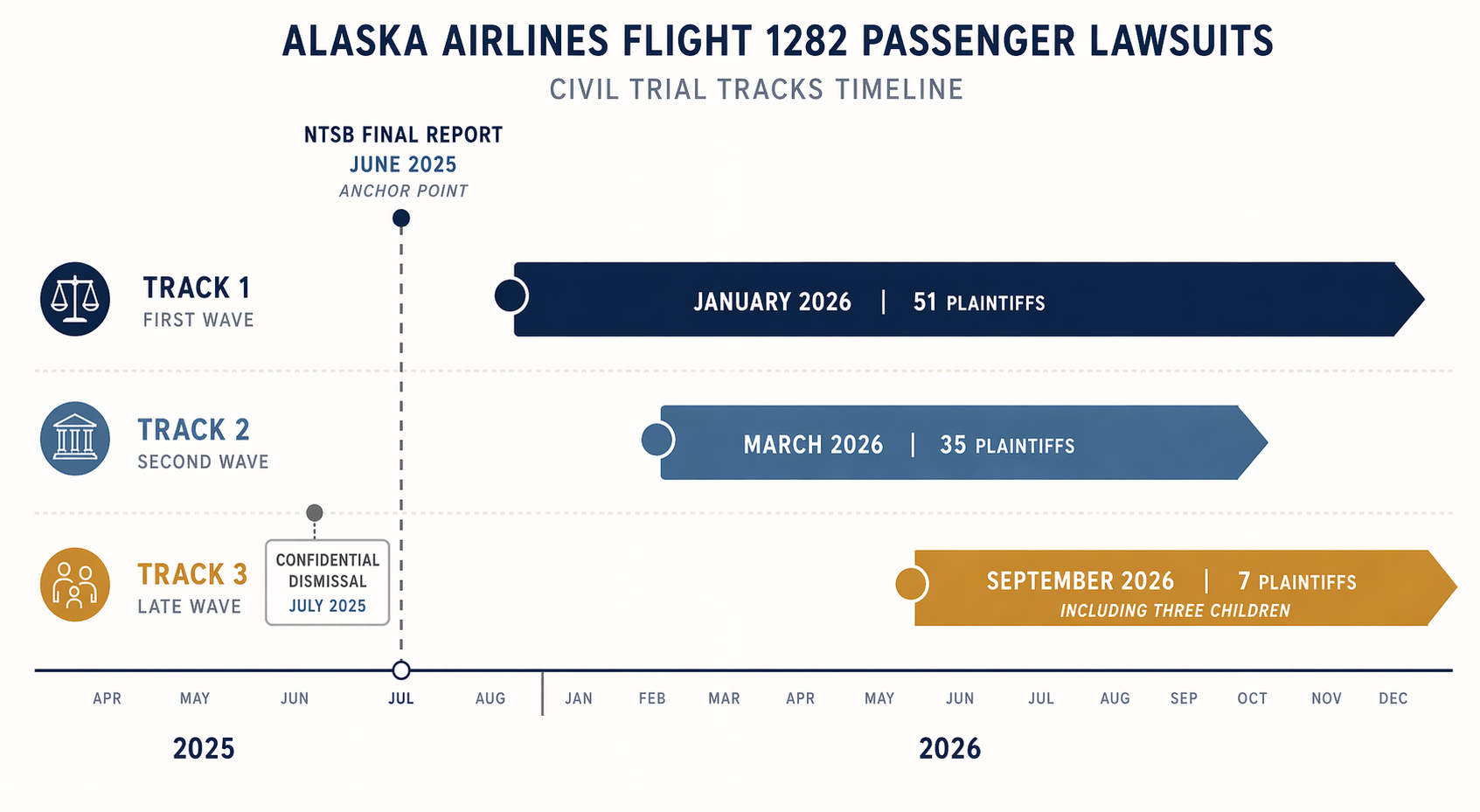
That sequencing matters more than the headline number attached to any one settlement. It tells you which claims are still being tested in open court and which ones have already been absorbed into private resolution. The September 2026 track is the next public date that clearly changes the exposure picture. [8]
Crew And Reputation Claims
The smaller claims show how the liability story has spread past the passenger injury docket. In August 2025, four flight attendants filed separate negligence and product-liability suits against Boeing in King County Superior Court. [9] On December 30, 2025, Captain Brandon Fisher sued Boeing and Spirit AeroSystems for $10 million, alleging defamation and scapegoating of the flight crew. [10] Those cases are narrower than the main passenger tracks, but they matter because they test whether public blame, internal reporting, and crew treatment can become independent liability theories rather than just commentary around the larger injury cases.
As of Q3 2026, the legal picture is still multi-track. The NTSB report sets the factual floor, the DOJ resolution path controls the criminal risk, the passenger docket is headed toward the September 2026 track, and the crew and defamation suits keep the blame story from stopping with the passenger cases. What remains open is which claims are resolved privately, which findings are fixed in the record, and which disputes are still set for trial.
References
- NBC News: Boeing and Alaska Airlines formal denials over Flight 1282; Mar. 13, 2024; https://www.nbcnews.com/
- NPR: DOJ opens criminal investigation into Boeing after Flight 1282; Mar. 22, 2024; https://www.npr.org/
- ABC7: DOJ says Boeing breached its 2021 DPA; May 2024; https://abc7ny.com/
- AP News: NTSB final report on Alaska Airlines Flight 1282; Jun. 24, 2025; https://apnews.com/
- National Transportation Safety Board: DCA24MA063 investigation page; https://www.ntsb.gov/investigations/Pages/DCA24MA063.aspx
- Alaska Airlines Newsroom: Boeing compensation and MAX 9 customer payments; Jan. 2025; https://news.alaskaair.com/
- FOX 13 Seattle: Oregon passenger lawsuit settled and dismissed with prejudice; Jul. 16, 2025; https://www.fox13seattle.com/
- Anchorage Daily News / Seattle Times: Flight 1282 civil trial schedule; Jul. 17, 2025; https://www.adn.com/
- Reuters: Four flight attendants sue Boeing over Flight 1282; Aug. 1, 2025; https://www.reuters.com/
- KATU: Captain Brandon Fisher defamation suit; Jan. 6, 2026; https://katu.com/
Comments
Join the discussion with an anonymous comment.