
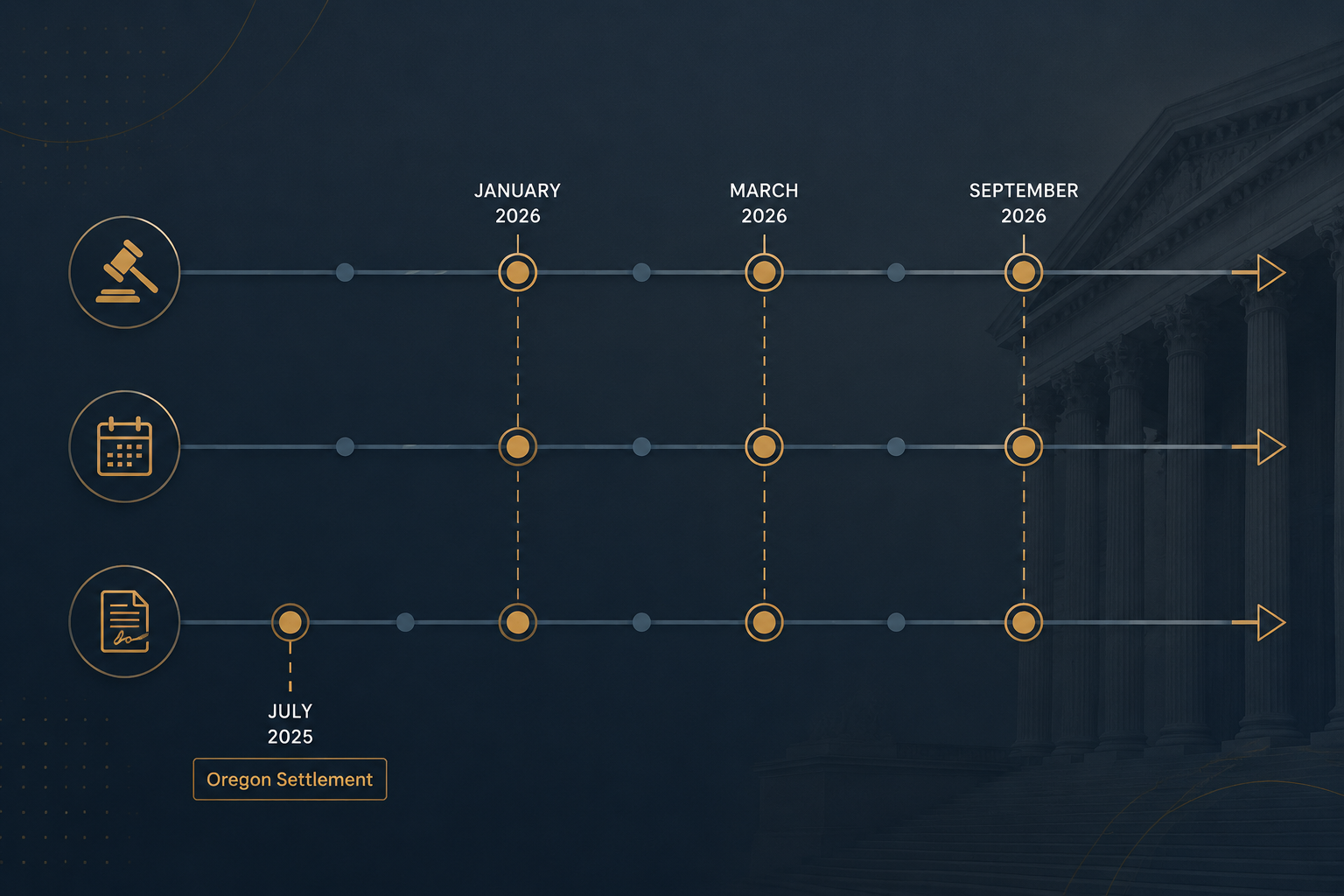
By July 2026, the legal implications of the Alaska Airlines emergency declaration are no longer captured by a single phrase like “door plug litigation.” The civil docket has split into several tracks: a class action, group trials originally reported for January, March, and September 2026, a concluded Oregon matter, crew injury suits, and Captain Brandon Fisher’s separate King County action. The trial calendar reported in July 2025 placed 51 plaintiffs in a January 2026 track, 35 plaintiffs in a March 2026 track, and seven plaintiffs, including three children, in a September 2026 track.[1]
That calendar matters because the January and March windows have now passed from a July 20, 2026 vantage point. Without current docket records, it would be careless to say those trials produced verdicts, were continued, or settled. What can be said from the sourced record is narrower and more useful: the litigation architecture had already forced Boeing, Alaska Airlines, and Spirit AeroSystems into a live blame-allocation fight, with a September 2026 group trial still standing in the reported schedule unless later displaced by orders, settlement, or continuance.[1]
The Incident, Kept To The Facts Needed For The Docket
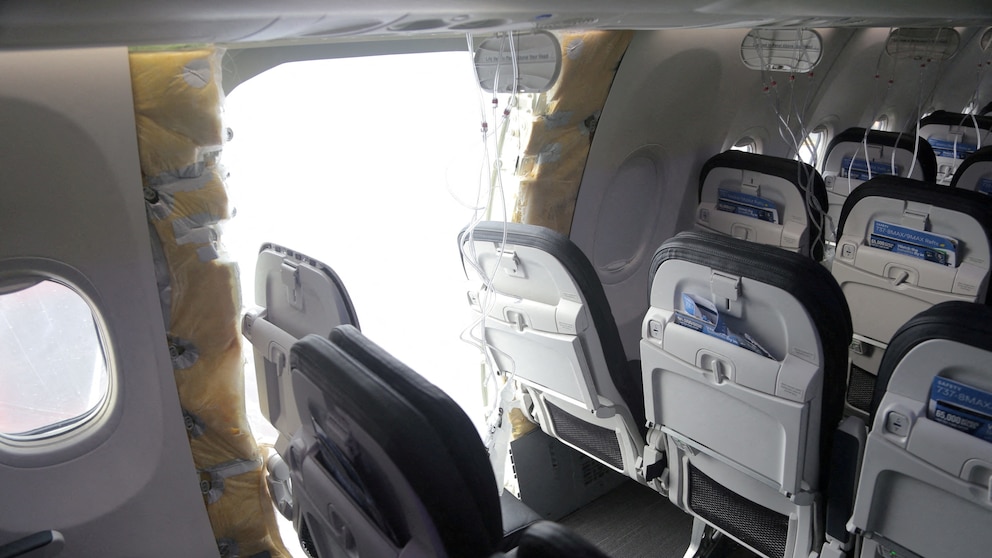
Alaska Airlines Flight 1282 departed Portland, Oregon, on January 5, 2024, aboard a Boeing 737 MAX 9. During the climb, a door plug blew out at about 16,000 feet, causing a rapid decompression and forcing the flight to return. There were no fatalities, and eight reported injuries were described as minor in the incident summaries, though that label does not decide the value or seriousness of later physical, emotional, or crew-related claims.[2]
For litigation purposes, the cabin scene is only the starting point. The harder questions now sit in pleadings and discovery: who had control over the plug installation and inspection, what warnings were available before the flight, what Alaska Airlines did or did not know, what Spirit AeroSystems supplied, and whether crew members were later blamed in a way that created a separate legal injury.
Current Case Map
| Track or case | Plaintiffs or parties | Reported status | Why it matters |
|---|---|---|---|
| January 2026 group trial | 51 plaintiffs represented by Stritmatter Law | Reported for January 2026; current post-window docket status must be verified | Large passenger group track and early pressure point |
| March 2026 group trial | 35 plaintiffs represented by Lindquist counsel | Reported for March 2026; current post-window docket status must be verified | Second passenger group track and possible settlement lever |
| September 2026 group trial | Seven plaintiffs, including three children | Reported for September 2026 unless later continued or resolved | Smaller group with child plaintiffs and a forward trial marker |
| Oregon case | Plaintiffs in a case described in reporting as a $1 billion matter | Confidential settlement; dismissed with prejudice on July 7, 2025 | First concluded civil matter, but not a public merits ruling |
| Captain Brandon Fisher suit | Flight 1282 captain against Boeing | Filed December 30, 2025, in King County Superior Court | Raises crew-blame and defamation issues in addition to product-liability theories |
| Flight attendant suits | Four flight attendants | Filed July 31, 2025 | Shows crew injury claims moving outside the passenger-only frame |
The tracker is doing real work here. A complaint can accuse broadly; a trial date forces parties to prepare narrowly. It sets expert deadlines, deposition priorities, document fights, settlement timing, and the order in which defendants may have to decide whether they want a jury to hear a manufacturer-supplier-airline blame story.
The First Concluded Matter: A Confidential Oregon Settlement
The Oregon case is important because it ended first, not because it answers the merits. Reporting described the matter as a $1 billion case; it settled on confidential terms and was dismissed with prejudice on July 7, 2025.[3]
Dismissal with prejudice means the plaintiffs cannot refile that same case. It does not, by itself, establish liability, set a public damages benchmark, or prove how Boeing, Alaska Airlines, or Spirit AeroSystems privately valued the risk. Confidential settlements are often treated too casually in aviation-disaster commentary. Here, the reliable inference is procedural: one major matter left the docket before trial, while the broader litigation continued.
The 2026 Trial Tracks Carry The Main Pressure
The reported January 2026 track, involving 51 plaintiffs represented by Stritmatter Law, appears to have been positioned as the largest early group trial.[1] For case managers, that kind of grouping can matter as much as the pleading labels. A 51-plaintiff trial track can make damages proof, plaintiff-specific medical evidence, emotional-distress claims, and common liability evidence collide on a schedule that is difficult to manage quietly.
The March 2026 track, reported for 35 plaintiffs represented by Lindquist counsel, created a second near-term trial window.[1] From the defense side, back-to-back group settings can compress settlement decision-making. From the plaintiffs’ side, they can test whether defendants intend to resolve groups serially, litigate liability globally, or divide claims by injury severity, age, seat location, medical proof, or other plaintiff-specific factors.
The September 2026 group trial is smaller, with seven plaintiffs including three children, but it should not be treated as minor for that reason.[1] Child plaintiffs change how damages presentation may be received, and a smaller group can sometimes make individualized testimony easier for a jury to absorb. The source record does not establish whether that trial date remains intact as of July 20, 2026; it establishes that September was the next major forward marker in the reported schedule.
Boeing, Alaska Airlines, And Spirit AeroSystems Are Not Aligned
The defense posture matters because the cases are not only about whether passengers and crew were harmed. They are also about which defendant, if any, bears responsibility for the failure. Boeing and Alaska Airlines both denied liability in early filings, with each pointing away from itself and toward other actors, including Spirit AeroSystems.[4]
Stritmatter Law’s public case materials describe filings in which Boeing denied responsibility and Alaska Airlines denied that it was negligent, while plaintiffs pursued claims tied to manufacturing, warning, and carrier obligations.[5] Those denials are not formal exonerations. They are litigation positions. But they define the discovery battlefield: what Boeing knew, what Alaska Airlines knew, what Spirit supplied or performed, and whether any warning signs should have changed the aircraft’s operation before Flight 1282.
That blame allocation is likely to shape settlement pressure more quickly than a merits ruling would. A manufacturer may want to show the airline ignored signals. An airline may want to show it relied on the aircraft’s design, certification, maintenance history, or supplier/manufacturer representations. A supplier may be pulled into a narrower but still consequential dispute over the manufacture or installation history of the fuselage component.
The Legal Theories Being Tested
The recurring civil theories are familiar, but the factual setting gives them weight. Plaintiffs have asserted negligence theories tied to manufacturing and inspection, failure-to-warn allegations, breach of common-carrier duty, and res ipsa loquitur arguments.[1][5] Across related suits, additional theories include strict product liability, breach of warranty, emotional distress, and, in Captain Fisher’s case, defamation.[6]
- Negligence in manufacturing asks whether the aircraft or component left a responsible party’s control in an unsafe condition because reasonable care was not used.
- Failure to warn focuses on whether known or knowable risks, warning lights, maintenance signals, or operating concerns should have been communicated differently.
- Common-carrier duty places attention on Alaska Airlines’ obligations to passengers, separate from Boeing’s and Spirit’s product-side responsibilities.
- Res ipsa loquitur gives plaintiffs a way to argue that a door plug blowout during ordinary commercial flight is the kind of event that ordinarily does not happen without negligence, while defendants may contest control, causation, and inference.
- Strict product liability and breach of warranty move the analysis toward product condition and representations rather than only fault-based conduct.
- Emotional-distress claims require attention to the experience of the decompression and its aftermath, including injuries that may not be cleanly measured by emergency-room summaries.
None of those theories wins because it appears in a complaint. They become meaningful through proof: documents, expert work, maintenance records, crew testimony, warnings evidence, and rulings on what the jury is allowed to hear.
Discovery Fights May Decide What The Jury Never Sees
Three discovery subjects deserve close attention: cabin pressure warning light evidence, NTSB evidentiary privilege, and Boeing safety-culture materials.[1][5] Each one could affect the story available at trial.
Cabin pressure warning evidence goes to notice. If plaintiffs can show warning signs existed and were mishandled, the common-carrier and failure-to-warn theories become more concrete. If defendants limit or contextualize that evidence, they may reduce the chance that a jury sees the incident as preceded by ignored red flags.
NTSB privilege issues are equally important, but for a different reason. Aviation accident investigations produce powerful factual material, yet not every investigative conclusion or record can simply be repurposed in civil litigation. The boundary between permissible factual evidence and protected investigative material can shape both summary-judgment practice and trial presentation.
Boeing safety-culture discovery raises the broadest risk of overreach and the broadest potential relevance. Plaintiffs may seek materials that show systemic knowledge, repeated warnings, or organizational incentives. Defendants can be expected to argue for limits based on relevance, burden, prejudice, and the danger of turning a component-failure case into a corporate-history trial.
Captain Fisher’s Suit Adds A Crew-Blame Track
Captain Brandon Fisher’s lawsuit, filed December 30, 2025, in King County Superior Court, is not just another passenger injury complaint. Fisher reportedly seeks $10 million and alleges negligence, strict product liability, breach of warranty, emotional distress, and defamation, including an allegation that Boeing scapegoated the flight crew in court filings.[6]
The defamation claim changes the frame. Passenger suits ask who caused or failed to prevent the decompression event. Fisher’s suit also asks whether post-incident litigation narratives injured a crew member’s reputation. That is a distinct theory with its own elements and defenses, and the sourced materials do not identify substantive rulings on it. It should be treated as an early-stage side track, not as a resolved finding that Boeing defamed anyone.
Still, the claim is worth watching because crew conduct often becomes a tempting defense theme in aviation cases. If a defendant implies or argues that crew decisions contributed to an emergency, those assertions can migrate from causation defense into reputational dispute. Fisher’s complaint puts that migration directly at issue.
The Flight Attendant Claims Keep Crew Injuries In The Main File
Four flight attendants filed suits on July 31, 2025, alleging permanent physical and emotional injuries from the decompression event.[7] Their claims are a reminder that Flight 1282 litigation is not only about passengers looking back at a frightening few minutes. Crew members were working inside the emergency, responsible for passengers while experiencing the same sudden cabin failure.
That distinction can matter in damages and duty analysis. A passenger’s claim may center on the carrier-passenger relationship and the product failure. A flight attendant’s claim may add workplace exposure, job consequences, continuing physical limitations, and emotional injury tied to performing safety duties during the event. The sourced record does not allow a ranking of those injuries, and the absence of fatalities does not make them incidental.
What The Schedule Signals, And What It Does Not
The Flight 1282 cases are significant because they put several aviation-liability questions on parallel tracks at once: product responsibility, supplier responsibility, airline common-carrier duty, warning evidence, emotional injury, and crew-blame narratives. That combination makes the litigation one of the most important civil aviation product-liability tests since the MAX 8 crash litigation, but the comparison should not be pushed past what the record supports. This is a near-catastrophic decompression case with no fatalities, a different injury profile, and its own docket structure.
The strongest signal is not that any one party will win. It is that Boeing, Alaska Airlines, and Spirit AeroSystems face overlapping incentives to assign responsibility before a jury hears a simplified version of the case. If the 2026 tracks produce rulings on discovery, admissibility, common-carrier duty, product-liability theories, or comparative fault, those decisions may matter well beyond these plaintiffs. If the cases settle, the public record may stay thinner, but the sequence and timing of settlements will still tell litigators something about perceived risk.
For now, the practical legal-monitoring judgment is restrained: the Alaska Airlines Flight 1282 litigation is important less because of the most dramatic complaint language than because the 2026 trial tracks may force rulings, settlements, or discovery decisions clarifying how courts handle manufacturer, supplier, airline, and crew narratives after a serious aviation failure. This is news-and-analysis coverage, not legal advice, and every trial-status statement should be refreshed against current docket records before publication.
References
- “With probe of fuselage blowout done, lawsuits take off against Boeing and Alaska Air,” Anchorage Daily News, July 17, 2025.
- “Alaska Airlines Flight 1282,” Wikipedia.
- “Settlement of $1B Oregon case,” The Independent.
- “Boeing and Alaska Airlines deny liability,” NBC News, March 2024.
- “Court filing details on class action and liability denials,” Stritmatter Law.
- “Captain Fisher's $10M lawsuit details,” The Hill, December 30, 2025.
- “Flight attendants' lawsuit filing,” ABC News, July 31, 2025.
Comments
Join the discussion with an anonymous comment.