
The Supreme Court’s July 20, 2026 certiorari grant in Jouppi v. Alaska puts a narrow but consequential forfeiture question back before the Court: when a state takes property as punishment, does proportionality turn on the defendant’s own misconduct, or may a court uphold the forfeiture by looking at the offense at a high level of legislative generality? The case arrives from Alaska after the state courts upheld forfeiture of Kenneth Jouppi’s Cessna 206 following a misdemeanor alcohol-importation conviction tied to a flight into a dry village.[1]
The facts matter because they are the point of the case, not decoration around it. Jouppi’s aircraft was valued at about $95,000. The maximum fine for the misdemeanor was $10,000. He was convicted of knowingly transporting a six-pack of beer; a passenger had packed three cases, or 72 cans, but the petition distinguishes that larger quantity from what Jouppi was found to have known.[2][3]

That distinction is not a sentimental one. It is the line between punishing a person for what he did and defending a forfeiture by invoking the full category of harms associated with illegal alcohol importation. Alaska has made a serious legislative judgment about alcohol-related injury in rural communities. The constitutional question is whether that judgment, standing at that level of abstraction, can carry a forfeiture many times larger than the statutory fine authorized for this defendant’s misdemeanor.
The constitutional issue is excessive fines, not a free-floating due process claim
The constitutional label matters here: this is principally an Eighth Amendment Excessive Fines Clause case, not a free-floating due process challenge. The due-process connection runs through the Fourteenth Amendment because Timbs v. Indiana held in 2019 that the Excessive Fines Clause applies to the states through that Amendment.[4]
Timbs unlocked the door for state forfeiture challenges, but it did not fully light the hallway. The Court held that the protection against excessive fines is incorporated against the states; it did not supply a complete, administrable proportionality rule for courts deciding how to compare a forfeiture with the gravity of a particular offense.[4]
The older federal anchor is United States v. Bajakajian. There, the Court treated forfeiture as subject to the Excessive Fines Clause when it functions as punishment and asked whether the forfeiture is “grossly disproportional” to the gravity of the offense.[5] That formulation does real work, but it also leaves room for disagreement over what “the offense” means in cases like Jouppi’s.
| Question | Why it matters in Jouppi |
|---|---|
| Is the forfeiture punishment? | If the property taking is punitive, the Excessive Fines Clause applies. |
| What is the gravity of the offense? | The parties dispute whether courts measure gravity by Jouppi’s own conduct or by the broader harms Alaska associates with alcohol importation into dry villages. |
| Is the forfeiture grossly disproportional? | The comparison pits a $95,000 aircraft forfeiture against a misdemeanor carrying a $10,000 maximum fine and a conviction based on knowledge of a six-pack. |
What the Alaska Supreme Court actually held
The Alaska Supreme Court unanimously upheld the forfeiture in an April 2025 opinion by Justice Jude Pate.[2] Its reasoning did not ignore proportionality. It framed the analysis around Alaska’s statutory treatment of aircraft used to import alcohol into dry communities, including a 2004 amendment making aircraft forfeiture mandatory in covered circumstances and legislative findings about alcohol-related harms in rural Alaska.[2]
That is the strongest version of the state-court judgment: Alaska did not simply announce that planes are expensive and dry-village laws are important. It looked to the legislature’s determination that aircraft are a particular instrument of the prohibited trade, and that alcohol importation into isolated communities creates harms not captured by an ordinary fine schedule.[2]
But the same move is what makes the case cert-worthy. By allowing the gravity inquiry to rest heavily on the general category of the offense and the legislature’s assessment of rural alcohol harms, the Alaska court accepted a more abstract proportionality analysis than Jouppi says the Eighth Amendment permits. His petition calls that move a “stratospheric level of abstraction,” arguing that courts must focus on the defendant’s own culpability and conduct rather than the worst or broadest version of the offense category.[3]
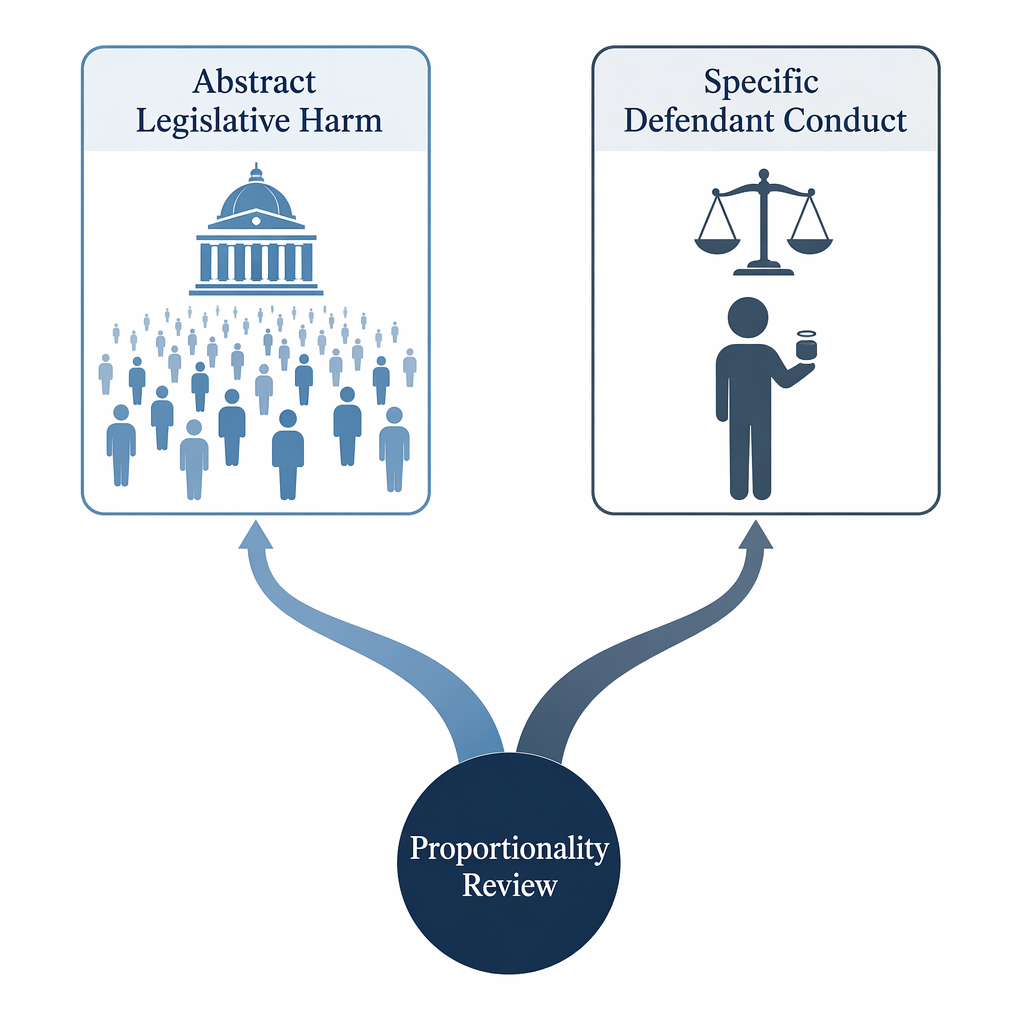
The split is about the unit of measurement
The dispute is easy to state and difficult to administer. One approach asks what this defendant did, what he knew, what role the property played, and what penalty the legislature authorized for that conduct. The other permits courts to weigh the offense by reference to the legislature’s broader judgment about the social harms the law targets.
The petition describes a lower-court conflict between the Ninth Circuit, which requires attention to the specific defendant’s conduct, and the Alaska and Eleventh Circuit approach, which allows a more abstract assessment of offense gravity.[3] That split matters because forfeiture cases rarely involve neat one-to-one comparisons. The property is often more valuable than the statutory fine, the offense category may be serious in the aggregate, and the individual defendant’s conduct may sit closer to the margins.
Jouppi sits exactly there. A plane can be an efficient tool for supplying contraband to remote communities; it can also be the livelihood-level asset of a person convicted of a misdemeanor based on knowledge of a six-pack. If the constitutional scale is calibrated to Alaska’s general alcohol-control interest, the forfeiture looks more defensible. If it is calibrated to Jouppi’s specific conviction and knowledge, the $95,000-to-$10,000 comparison becomes much harder to brush aside.
Alaska’s response: settled law, fact-bound application
Alaska’s opposition to certiorari resisted turning the case into a vehicle for broad doctrinal revision. The state characterized the dispute as a fact-bound disagreement over the application of settled excessive-fines principles, rather than a clean split requiring Supreme Court intervention.[6]
That argument is not frivolous. Excessive-fines cases are fact-sensitive by design, and Bajakajian’s gross-disproportionality test does not promise mechanical results. A state can reasonably argue that the legislature’s decision to mandate aircraft forfeiture reflects a considered judgment about how alcohol reaches dry villages and why ordinary fines may not deter that conduct.[2][6]
The cert grant, however, signals that at least four Justices saw more than a routine error-correction petition. It does not mean Jouppi will win. It means the Court agreed to review the first question presented: whether gravity can be assessed purely in the abstract or must be tied to the defendant’s specific wrongdoing.[1][3]
Why Timbs did not settle this
Timbs is the reason Jouppi can press this constitutional claim against a state forfeiture regime with national force. The Court in Timbs held that protection from excessive fines is fundamental to the American scheme of ordered liberty and deeply rooted in history and tradition, making it applicable to the states through the Fourteenth Amendment.[4]
But incorporation is not measurement. After Timbs, state courts still had to decide how to apply Bajakajian’s gross-disproportionality standard to civil and criminal forfeitures imposed under state law. That is where the abstract-versus-specific divide took shape. A right incorporated without a clear proportionality method leaves litigants arguing about the instrument before the court ever reaches the music.
For defense lawyers, the defendant-specific approach makes proportionality resemble sentencing: culpability, knowledge, authorized penalties, and actual conduct all matter. For states, an abstract legislative-harm approach preserves more room to defend categorical forfeiture rules, especially where lawmakers have documented serious community harms that are not easily priced in an individual misdemeanor fine.
Outside briefs widen the stakes, but the plane remains the hard fact
The amicus activity reflects why forfeiture practitioners are watching. The Cato Institute’s filing points to revenue incentives and cites forfeiture collections exceeding $82 billion since 2000, including more than $57 billion federally and roughly $25 billion at the state and local level.[7] Professor Beth A. Colgan’s amicus work focuses on the history and structure of proportionality review, while Tyson Timbs’s participation underscores the practical importance of a meaningful standard after incorporation.[8]
Those materials are useful because they explain why a small-plane forfeiture from Alaska is not only a local alcohol-control case. Still, national forfeiture totals do not answer the constitutional question by themselves. A revenue-incentive argument may explain why courts should be careful; it does not decide whether Alaska’s forfeiture of this aircraft is grossly disproportional to this offense.
The tighter issue remains the one the petition presents: whether a court may uphold a severe forfeiture by moving upward from the defendant’s conduct to the legislature’s broadest account of the offense’s dangers. The higher the abstraction, the less work the statutory maximum fine and the defendant’s actual knowledge do in the analysis.
What a ruling could change
A defendant-specific ruling would not abolish forfeiture. States could still seize and forfeit property used in crime, and legislatures could still identify serious harms. But courts would have to test the punishment against the offender’s actual conduct, culpability, and statutory exposure. In cases where the property is worth many times the maximum fine, the state would need a more concrete explanation for why the forfeiture is not excessive.
An abstract-harm ruling would give states more room to defend categorical forfeiture provisions. If the gravity of the offense can be measured by the legislature’s general findings about the problem the law targets, the individual defendant’s marginal role may matter less. That approach would make forfeitures easier to sustain in areas where lawmakers have built a record of public harms, including drug, alcohol, wildlife, customs, and licensing offenses.
There is also a middle possibility. The Court could reject purely abstract review without requiring a rigid formula, instructing lower courts to consider legislative judgments while still anchoring the proportionality inquiry in the defendant’s conduct. That kind of opinion would be less dramatic than either party’s preferred rule, but it would still constrain the easiest route to upholding high-value forfeitures: defining the offense at the level where the state’s interest is strongest and the defendant nearly disappears.
Pending posture
The Court has granted review, but it has not decided the merits. Oral argument has not been set; current reporting places argument as possible in fall 2026 or early 2027, with a decision expected by summer 2027 if the case follows ordinary Term timing.[1]
For now, Jouppi is not a Supreme Court ruling that Alaska violated the Constitution. It is a grant aimed at the standard courts use when property becomes punishment. If abstract legislative harm is enough, forfeitures like Alaska’s become easier to defend. If defendant-specific misconduct is required, states will have to justify the taking against what the person before the court actually did.
References
- Jouppi v. Alaska, SCOTUSblog
- Jouppi v. State, 566 P.3d 943, Alaska Supreme Court, April 2025
- Petition for a Writ of Certiorari, Jouppi v. Alaska, Supreme Court of the United States
- Timbs v. Indiana, Oyez, February 20, 2019
- United States v. Bajakajian, Oyez, June 22, 1998
- Brief of Respondent in Opposition, Jouppi v. Alaska, Supreme Court of the United States
- Brief of the Cato Institute as Amicus Curiae in Support of Petitioner, Jouppi v. Alaska, Supreme Court of the United States
- U.S. Supreme Court agrees to hear Alaska pilot’s excessive fines case, Institute for Justice, July 20, 2026
Comments
Join the discussion with an anonymous comment.