
The Amazon Prime settlement claim process is easy to mistake for a class action because it has familiar surface features: a large dollar figure, a claims website, notices, payment elections, and a filing deadline. For legal professionals, that shortcut is the first place to slow down. This is an FTC-administered consumer redress program arising from FTC v. Amazon.com, Inc., not a private Rule 23 settlement with opt-out rights, objections, a claims administrator answering to class counsel, or a negotiated per-class-member benefit.
The settlement, finalized on September 25, 2025, includes a $2.5 billion judgment: a $1 billion civil penalty, described by the FTC as the largest-ever civil penalty for an FTC rule violation, and $1.5 billion in consumer redress, described as the second-highest restitution award in FTC history. The underlying case alleged violations of ROSCA and Section 5 of the FTC Act tied to Prime enrollment and cancellation practices, but the immediate claims question is administrative: which consumers fall into the refund program, which ones must act, and by when? [1]
The Controlling Frame Is FTC Redress, Not Class Settlement Practice
A private class settlement usually asks lawyers to think in terms of class definition, release, opt-out rights, objections, claim-form sufficiency, administrator discretion, and court-approved distribution mechanics. The Amazon Prime process uses a different source of authority and a different workflow. The FTC identifies eligible recipients, uses available records where possible, determines a payment formula, sends refunds, updates contact information, considers additional distributions, and sends remaining funds to the U.S. Treasury when further consumer distribution is not feasible. [2]
That distinction changes the advice. An eligible consumer can decline to submit a claim, but the process does not offer a Rule 23-style opt-out that preserves a separate private claim by rejecting the government settlement. The FTC’s refund-program guidance also emphasizes practical safeguards that matter in client triage: the agency does not require consumers to pay a fee to receive a refund and does not require Social Security numbers or bank-account information for FTC refund eligibility. [3]
The government-redress frame also makes source hierarchy important. The FTC’s Amazon refund page and consumer alert should control over news summaries when they conflict. National coverage is useful for corroborating dates, payment timing, and claim mechanics, but it should not be treated as the source of legal entitlement.
The Two-Stage Distribution Structure
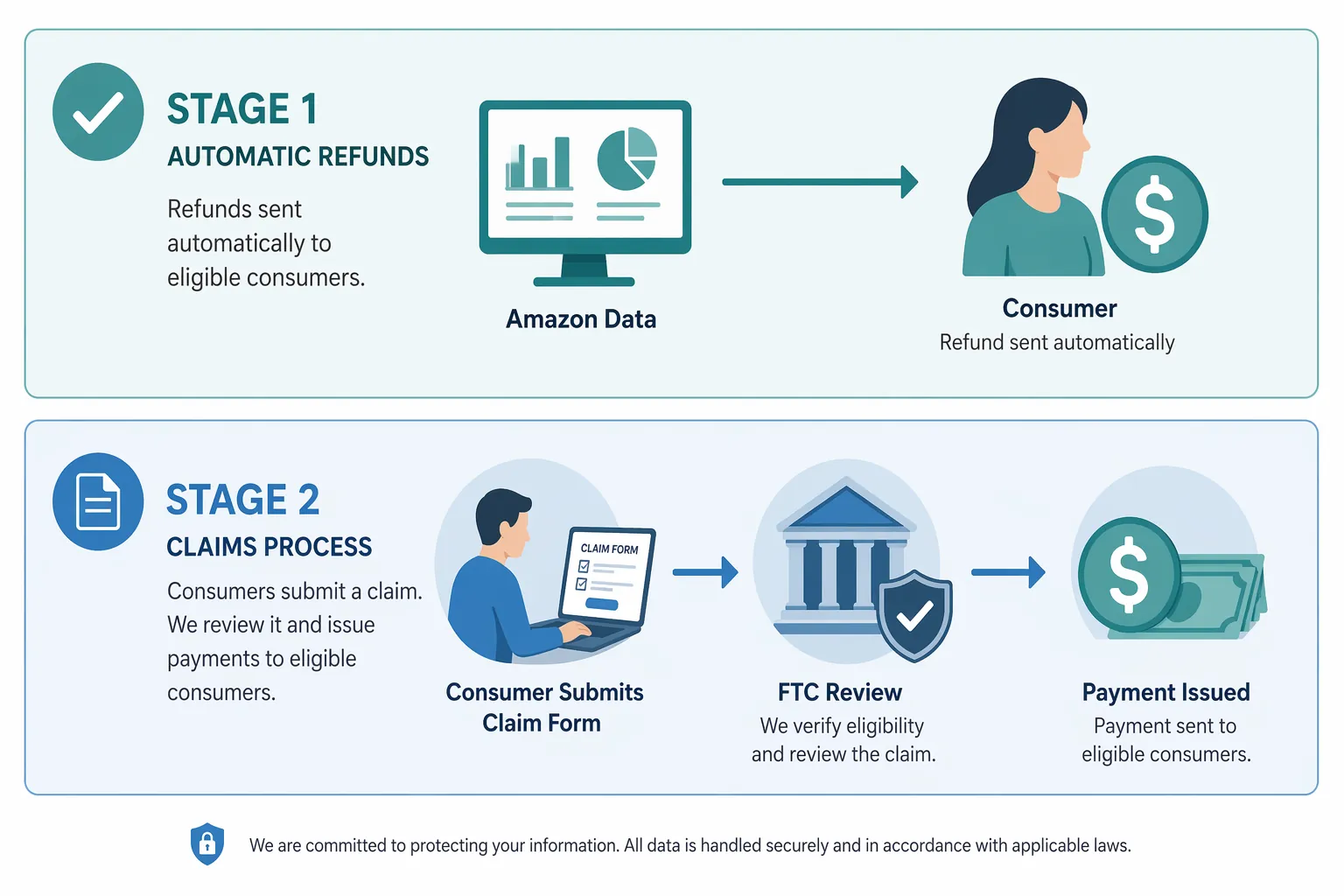
The settlement distribution is built around usage bands, which is why not every consumer who remembers an unwanted Prime subscription is in the same procedural position. The FTC describes a two-stage structure: automatic refunds for one group and a claims process for another. [4]
| Stage | Who It Covers | Action Required | Timing |
|---|---|---|---|
| Stage 1: Automatic refunds | Customers who used fewer than 3 Prime benefits in any 12-month period | No claim required | November-December 2025 |
| Stage 2: Claims process | Customers who used more than 3 but fewer than 10 Prime benefits in any 12-month period and meet the other eligibility conditions | Claim required | January 5-July 27, 2026 |
Stage 1 matters because it excludes a category of people from the later claims phase. Consumers who already received an automatic refund should not be treated as ordinary claimants with a second bite at the same redress program. In Stage 1, Amazon provided customer data for automatic payments to consumers who used fewer than 3 Prime benefits in a relevant 12-month period; those payments were scheduled for November and December 2025. [4]
Stage 2 is the live claims-administration problem in Q3 2026. It covers a narrower group: consumers who fall into the moderate-usage band and satisfy the remaining eligibility filters. The capped payment is up to $51 per claimant, with possible pro rata adjustment if funds are insufficient to pay all valid claims at that level. [4][5]
Eligibility Turns on Four Cumulative Conditions
The most common advisory error is likely to be treating any unwanted Prime enrollment as enough. The claims phase is narrower. To file successfully, a consumer must satisfy four cumulative conditions; missing any one of them changes the answer.
- The consumer signed up for Prime in the United States between June 23, 2019 and June 23, 2025. [4]
- The enrollment was allegedly unintentional through one of the challenged flows, such as a failed cancellation attempt or a misleading enrollment interface described in the FTC’s case materials. [1][4]
- The consumer used more than 3 but fewer than 10 Prime benefits in any 12-month period during the membership. [4]
- The consumer did not already receive an automatic refund in Stage 1. [4]
The third condition deserves particular care. The claims phase is not for the lowest-usage group, because that group was addressed through automatic refunds. It is also not framed as a general refund program for heavy Prime users. The operative band is more than 3 but fewer than 10 Prime benefits in any 12-month period. That is a usage filter, not a measure of how strongly the consumer feels about the enrollment or how much they paid over time. [4]
The available materials do not independently verify a precise number of current claims-phase participants. The broader FTC case involved a large affected-consumer universe over a six-year period, but that should not be collapsed into the number of consumers who can file in Stage 2. For client intake, the safer question is not “Were you affected by Amazon Prime practices?” but “Do you meet all four FTC claims-phase criteria?”
Filing Mechanics: Claim ID, PIN, Website or Paper Form
Eligible claimants were to receive notice with a claim ID and PIN. The notice mailing date reported in the available materials is January 23, 2026. Claimants may file through the settlement website, subscriptionmembershipsettlement.com, or by paper form. Payment method selection includes check, PayPal, or Venmo. [5]
Those details are mundane, but they are exactly where fraud and misdirection tend to enter mass-refund programs. A claimant should not have to pay a filing fee, provide a Social Security number, or surrender sensitive financial credentials to submit a claim. If a communication asks for those items, it should be treated as suspect unless verified against the official FTC refund page or the official settlement process. [3][5]
| Intake Question | Why It Matters |
|---|---|
| Did the person receive a claim ID and PIN? | The claims process is notice-driven, and those credentials support filing through the official process. |
| Was there already an automatic refund? | Stage 1 recipients are excluded from the claims phase. |
| Which Prime benefits were used, and how many in a 12-month period? | The claims phase applies to the more-than-3 and fewer-than-10 usage band. |
| Is the person being asked for a fee, SSN, or bank credentials? | FTC refund guidance says those items are not required for refund eligibility. |
For a paralegal or legal ops professional triaging inquiries, the claim form should not become a mini-litigation file. The practical task is to confirm whether the person fits the FTC’s criteria, help them locate the official notice if appropriate, and keep the filing channel clean. If the person lacks a notice but believes they qualify, the next step should be verification through the official settlement or FTC materials, not improvising a separate demand package.
Deadline: Treat July 27, 2026 as the Controlling Date
The claims window is reported as January 5 through July 27, 2026, and July 27 is the date to calendar as the filing deadline because it appears on the FTC refund page and is consistently reflected in national coverage of the claims process. [4][5]
There is a discrepancy worth naming rather than smoothing over. The Hill/Nexstar and some local affiliate reports cite July 21, 2026. Available reporting connects the deadline discussion to a 180-day window from the January 23 notice mailing, but the FTC page and more consistent national claims coverage point to July 27 as the hard deadline. For practice management, that means July 27 is the controlling external date, while July 21 is a conservative internal tickler if a team wants a buffer. [4][5][6]
Amazon has 30 days to review each claim after submission, and payments are expected in September 2026. Those dates should not be converted into a guaranteed receipt date for any individual claimant; they describe the expected administrative timeline. [5]
Why the $51 Cap Should Not Be Read Like a Class Benefit
The maximum $51 payment is a redress-program cap, not a privately negotiated class settlement benefit that maps neatly onto a release analysis. It sits inside a government enforcement resolution that also includes civil penalties and injunctive or compliance obligations reflected in the settlement order. The amount may be reduced pro rata if valid claims exceed available funds for that category. [1][5]
That matters when a client asks whether filing is “worth it.” The answer is not the same as evaluating a class action claim form, where the client may be weighing a release, an opt-out deadline, an objection, or separate litigation leverage. Here, the more useful analysis is narrower: if the consumer is eligible and wants the redress available under the FTC process, filing through the official channel is the route to payment. If the consumer is not eligible under the FTC filters, the claim process does not become broader because the underlying story feels similar.
Administrative Oversight and the FTC Refund Baseline
FTC refund programs have their own baseline practices. In claims-process cases, the FTC says it generally receives claims from 5% to 50% of potential claimants. The agency also reports that, over the five-year period from 2020 through 2024, more than 95% of money collected for FTC refunds was returned to consumers and less than 5% was sent to the U.S. Treasury. [2][3]
Those figures are not predictions for Amazon claim volume or individual payment timing. They are useful because they show why the FTC’s administrative design matters: notice quality, identity matching, payment selection, reminder strategy, and residual-funds handling are not incidental afterthoughts. They are the refund program.
The Amazon settlement order also places Amazon in the funding position and provides for an independent third-party supervisor to monitor the distribution process. That is another point where class-action instincts can mislead. The mechanics are not being driven by class counsel’s settlement administration vendor in the ordinary private-settlement sense; they operate under a government enforcement settlement and FTC refund framework. [7]
A Practical Advisory Posture
A legal professional asked “Can I file?” should start with classification and then move quickly to the four filters. The clean answer is not “Anyone affected by Prime can claim.” It is: this is an FTC redress process; a claim is available only for consumers who meet the claims-phase criteria; prior automatic-refund recipients are out; and the claim must be filed through the official process by the controlling deadline.
- Verify the client’s sign-up window against June 23, 2019 through June 23, 2025.
- Confirm that the alleged enrollment or cancellation issue matches the challenged Prime flows described by the FTC.
- Check the usage band: more than 3 but fewer than 10 Prime benefits in any 12-month period.
- Ask whether an automatic refund was already received in Stage 1.
- Use the official notice, claim ID, PIN, website, or paper form; do not respond to fee requests or unnecessary sensitive-information requests.
- Calendar July 27, 2026 as the external filing deadline, with an earlier internal reminder if desired.
That framing keeps the advice useful without turning a government refund program into something it is not. The legal professional’s role is to preserve the distinction between procedural guidance and legal advice, direct eligible consumers to the official FTC-administered process, and avoid importing private class action assumptions where they do not belong.
References
- FTC Secures Historic $2.5 Billion Settlement Against Amazon, Federal Trade Commission, September 2025.
- How the FTC Provides Refunds, Federal Trade Commission.
- Refund Programs: Frequently Asked Questions, Federal Trade Commission.
- Who's eligible for a refund from Amazon?, Federal Trade Commission, September 2025.
- Amazon refunds, Federal Trade Commission.
- $2.5B settlement over Amazon Prime: How to file a claim, The Hill/Nexstar.
- Amazon.com, Inc. (ROSCA) FTC v., Federal Trade Commission.
Comments
Join the discussion with an anonymous comment.