
The “2024 Deadline” Framing Is Out of Date
For anyone searching “amazon prime settlement deadline 2024 legal update,” the first correction is simple: the live deadline is not a 2024 event. The consumer-facing claim deadline identified by the FTC is July 27, 2026, and it concerns refund claims under the Amazon Prime settlement process.[1]
That deadline matters to consumers. For subscription counsel, compliance officers, and product teams, it is not the main event. The more durable legal update is that the FTC turned an allegedly confusing Prime enrollment and cancellation design into a $2.5 billion settlement and a detailed behavioral order that reads less like a press release and more like a product requirements document.
This is a news-and-analysis discussion, not legal advice. The professional question in Q3 2026 is what the Amazon order says about ROSCA enforcement after the FTC’s formal click-to-cancel rule was vacated, and how much room subscription businesses still have to defend friction-heavy cancellation and enrollment flows as merely “standard.”
The Settlement Is Expensive, but the Injunction Is the Point
The headline numbers were built to travel: a $1 billion civil penalty, described by the FTC as the largest ever for an FTC rule violation, plus $1.5 billion in consumer redress, described as the second-highest restitution award in FTC history.[2] The agency also characterized the matter as only the third ROSCA civil penalty it had obtained.[2]
Those numbers will make board decks. They should. But the settlement’s practical force sits in the injunctive provisions: how Prime enrollment must disclose material terms, how a consumer must be allowed to decline, how cancellation must work, and how compliance must be monitored. A large penalty tells a company the regulator is serious. A detailed injunction tells the product team what screens need to change.
The settlement also has a limit that matters. Amazon did not admit wrongdoing as part of the resolution, according to legal analyses of the settlement.[3] That makes it a poor shortcut for saying every challenged design element has now been adjudicated unlawful across the market. It is stronger, and more useful, as evidence of what the FTC is prepared to demand when it brings a ROSCA case to the point of trial pressure.

The Challenged Design Was Not a Single Bad Button
The Prime matter is easy to flatten into a dark-pattern story, but the compliance lesson is more exacting. The FTC’s theory did not depend on one stray phrase or one obscure link. The challenged design was a flow: an enrollment path that allegedly nudged users toward paid Prime membership and made the alternative harder to understand or select.
The most concrete example is the so-called Iliad Flow. As summarized in legal analysis of the FTC complaint, the process required consumers to move through 4 pages, 6 clicks, and 15 options, while the decline button read, “No, I don’t want Free Shipping.”[4] That wording did more than identify a choice. It framed refusal as giving up a benefit, not as declining enrollment in a recurring paid program.
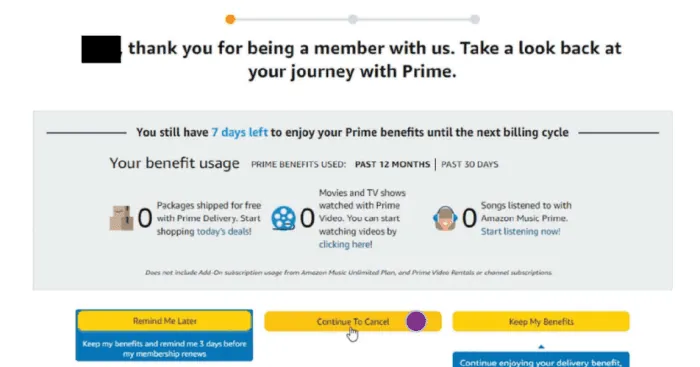
This is where many subscription review meetings go wrong. Teams ask whether a disclosure exists somewhere, whether a customer technically can cancel, or whether a competing service uses a similar pattern. The FTC’s case treated the complete interaction as the relevant unit: sequence, copy, visual emphasis, number of choices, and the emotional cost of saying no.
The internal evidence reportedly sharpened that point. Legal coverage of the trial described Amazon employees referring to Prime enrollment as “a bit of a shady world” and unwanted subscriptions as “an unspoken cancer,” with the settlement reached three days into trial after such evidence emerged.[5] Those phrases are not a substitute for the legal elements of a ROSCA claim, but they are a reminder that internal product language can turn design ambiguity into litigation leverage.
What the Order Turns Into Product Requirements
The order’s value for other subscription businesses is not that it creates a formal industry rule. It does not. Its value is that it shows how the FTC translates ROSCA’s consent and disclosure requirements into screen-level obligations.
| Order theme | Operational meaning for subscription flows |
|---|---|
| Clear decline choice | A consumer must be able to reject enrollment through a clear decline mechanism, rather than being steered through copy that makes refusal feel like rejecting a benefit. |
| Material terms before checkout | Recurring charges, renewal terms, cancellation terms, and other material conditions need to appear before the consumer completes the transaction, not after commitment. |
| Same-method cancellation | If a consumer can enroll online, the cancellation path cannot be pushed into a materially different or more burdensome channel. |
| Independent monitoring | Compliance is not left entirely to internal signoff; the order includes an independent third-party compliance monitor. |
| Future rulemaking preserved | Section VI preserves the FTC’s ability to supersede the injunctive terms with a future amended negative option rule. |
Legal analyses of the order identify these obligations as central settlement terms, including the clear decline requirement, pre-checkout disclosure of material terms, same-method cancellation, independent monitoring, and Section VI’s preservation of future rulemaking.[3][4]
For an in-house team, the first operational change is where legal review enters the process. If counsel sees only final disclosure language after the growth team has already optimized the funnel, the review is too late. The order points toward reviewing the path as a system: what is shown first, what is visually dominant, what the decline option says, how many decision points exist, and whether cancellation is meaningfully available in the same environment where enrollment occurred.
A subscription business can comply with the literal words of a disclosure checklist and still create risk if the surrounding interaction buries the practical choice. The Iliad Flow allegations matter because they show the FTC looking at cumulative friction. Four pages may be defensible in one context. Six clicks may be harmless in another. Fifteen options may be necessary for a complex account change. Together, in a cancellation or enrollment-avoidance path, they become evidence of design intent.
Clear decline is not just a copy edit
The decline button requirement is easy to underestimate because it looks like wording. It is really a consent control. “No, I don’t want Free Shipping” asks the customer to reject a positive benefit. A cleaner decline option identifies the actual decision: no Prime enrollment, no recurring charge, no continuation. That difference matters because ROSCA turns on informed consent, not on whether a user eventually found a way out.
Pre-checkout disclosure has to arrive before commitment
The order’s pre-checkout disclosure requirement moves material terms to the moment when the consumer can still use them. For product teams, that means disclosures cannot be treated as receipt language, post-enrollment account text, or a legal footer that appears after the user has already been channeled toward acceptance. The relevant test is practical: could a reasonable consumer understand the recurring bargain before completing the transaction?
Same-method cancellation changes channel strategy
Same-method cancellation is where the order most closely resembles the policy logic behind click-to-cancel. If enrollment is available in a few online steps, cancellation cannot be protected by a phone queue, a chat escalation, or an account maze that forces the consumer to prove resolve. The order does not say every cancellation path in the market must be identical to enrollment. It does show that the FTC views channel asymmetry as a ROSCA problem when the asymmetry interferes with a consumer’s ability to stop recurring charges.
The Click-to-Cancel Vacatur Did Not Create a Clean Safe Harbor
The Eighth Circuit vacated the FTC’s click-to-cancel rule in July 2025.[3] That changed the procedural terrain. It removed the formal rule as a direct source of generally applicable obligations, at least for now. It did not repeal ROSCA, erase the FTC’s enforcement authority, or bless cancellation friction by implication.
The Amazon settlement shows one way the agency can work around that gap. Without relying on the vacated rule as an industrywide mandate, the FTC obtained structural remedies that look click-to-cancel-adjacent in practice: clear decline, front-loaded material terms, cancellation through the same method, and outside monitoring.[3][4]
That distinction is not academic. A rule tells everyone the standard in advance. A case-specific injunction binds the settling defendant and reflects the facts, litigation posture, and negotiated terms of that matter. But a public order against a major subscription platform still changes the compliance conversation. It gives FTC staff, state regulators, plaintiffs’ lawyers, and corporate boards a concrete model for what a remediated subscription flow can be expected to contain.
There is also no reason to treat the Amazon case as isolated pressure. Legal analyses of 2025 FTC activity reported at least 4 publicly identified ROSCA enforcement actions, including Chegg and Amazon.[3] That is not proof that every subscription business faces imminent enforcement. It is enough to make “the rule was vacated” a weak answer when a product team asks to preserve avoidable friction.
How to Read the Order Without Overreading It
The Amazon order is not a statute. It is not the reinstated click-to-cancel rule. It does not automatically decide whether a smaller SaaS company, a gym membership platform, a streaming service, or a meal-kit provider has violated ROSCA because its cancellation path contains more steps than its signup path.
Still, compliance teams should be careful about minimizing it. Orders like this become templates because they are operational. They give counsel something more useful than broad language about deception: a set of design controls that can be tested before launch.
- Map every enrollment path, including checkout interstitials, trial offers, mobile flows, and account prompts.
- Identify the first screen where recurring-price, renewal, and cancellation terms are presented before the consumer commits.
- Compare the visual weight of accept and decline choices, not just the literal availability of both options.
- Count the cancellation steps, decision points, save offers, and channel transfers against the enrollment path.
- Review internal experiment names, Slack language, and product memos for evidence that the company knows friction is doing the work.
- Assign ownership for post-launch monitoring, because a clean design at launch can decay through A/B testing and retention experiments.
The last point is not cosmetic. The independent monitor term in the Amazon order signals that the FTC did not view compliance as a one-time redesign. Subscription interfaces change constantly. If the compliance control depends on one lawyer remembering one meeting six months earlier, it is not a control.
Section VI Keeps the Rulemaking Door Open
Section VI of the order matters because it preserves the FTC’s right to supersede the injunction’s terms with a future amended negative option rule.[4] That is not the same as saying a new rule is imminent. As of July 2026, the research record here does not identify a newly proposed replacement rule.
For compliance planning, the point is narrower and more practical. The FTC did not settle Amazon in a way that treats the vacatur as the end of the agency’s subscription agenda. It preserved room for future rulemaking while using existing ROSCA enforcement to obtain many of the design outcomes the vacated rule would have made easier to demand across the market.
The Compliance Judgment for July 2026
The Amazon Prime settlement should not be treated as binding industrywide law. It should be treated as the clearest current expression of what the FTC thinks a lawful, remediated subscription experience should look like after a challenged enrollment and cancellation design.
That is enough to change product review. A company that can enroll a customer online should be prepared to explain why cancellation is not equally direct. A company that asks for consent to recurring charges should be prepared to show where material terms appear before checkout. A company that offers a decline path should be prepared to defend the words, placement, and visual treatment of that choice.
The click-to-cancel vacatur remains important. It limits the FTC’s ability to rely on that specific rule as a ready-made, generally applicable mandate. But it does not make friction-heavy funnels safe. The Amazon settlement gives the FTC a visible playbook for demanding click-to-cancel-equivalent remedies through ROSCA enforcement, one challenged flow at a time.
References
- Amazon refunds, Federal Trade Commission, https://www.ftc.gov/enforcement/refunds/amazon-refunds
- FTC Secures Historic $2.5 Billion Settlement Against Amazon, Federal Trade Commission, September 2025, https://www.ftc.gov/news-events/news/press-releases/2025/09/ftc-secures-historic-25-billion-settlement-against-amazon
- FTC Settles Amazon ROSCA Litigation, Cobalt LLP, https://www.cobaltlaw.com/ftc-settles-amazon-rosca-litigation
- An Amazonian-Sized Settlement: FTC Secures $2.5 Billion Against Amazon for Use of Dark Patterns in Prime Enrollment Scheme, Davis+Gilbert LLP, https://www.dglaw.com/an-amazonian-sized-settlement-ftc-secures-2-5-billion-against-amazon-for-use-of-dark-patterns-in-prime-enrollment-scheme/
- FTC’s Landmark $2.5 Billion Amazon Settlement Highlights Ongoing Focus on Dark Patterns, The National Law Review, https://natlawreview.com/article/ftcs-landmark-25-billion-amazon-settlement-highlights-ongoing-focus-dark-patterns
Comments
Join the discussion with an anonymous comment.