
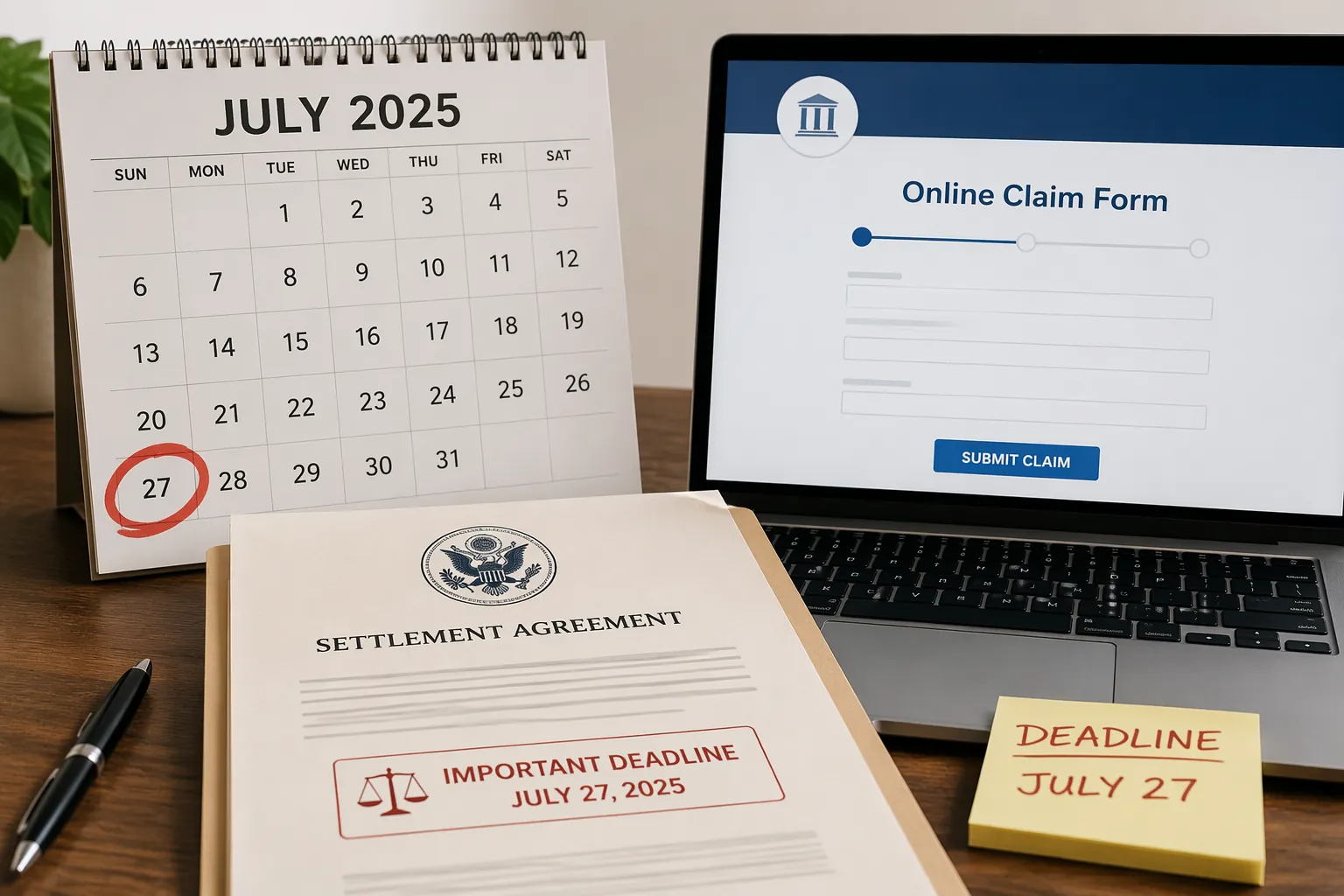
Published July 23, 2026. If you are checking the Amazon Prime settlement eligibility requirements now, the operative date is July 27, 2026: eligible claimants in the current claims phase have only days left to file for a payment reported at up to about $51.[1][2] The practical question is not whether Amazon agreed to a $2.5 billion settlement. It is whether your Prime account falls into the narrower claims group that must act before the cutoff.
This article provides general information about a consumer settlement and claim process. It is not legal advice, does not create an attorney-client relationship, and should not be used as a substitute for advice from counsel about any individual facts. Lex Machina Review is also not affiliated with Lex Machina, the legal analytics product from LexisNexis.
The Claim Phase Is For A Specific Middle Group
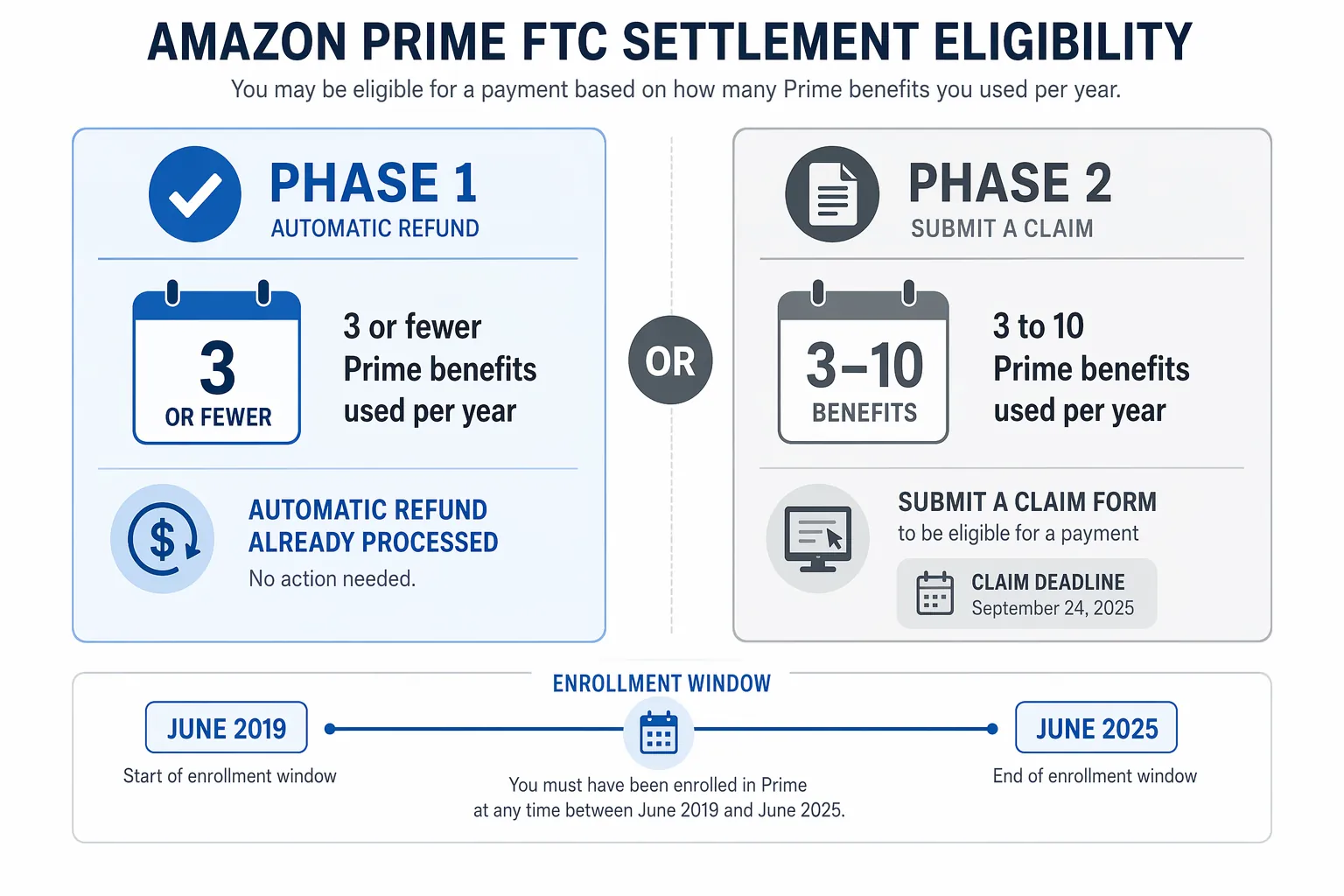
The cleanest way to read the settlement is in two phases. Phase 1 covered consumers who used three or fewer Prime benefits in a 12-month period; those consumers were slated for automatic refunds through their Amazon account payment methods in November and December 2025.[3] Phase 2 is the current claim process for consumers who used more than three but fewer than 10 Prime benefits in a 12-month period and who otherwise meet the settlement’s enrollment or cancellation criteria.[2][4]
That distinction matters because a subscriber who did not receive an automatic refund is not necessarily out of the settlement. The no-form-needed group and the file-a-claim group are separated by benefit use. Conversely, someone who already received an automatic refund should not assume that filing a second claim is the normal next step.
Who Appears To Meet The Amazon Prime Settlement Eligibility Requirements
For the current claims phase, the core eligibility framework has three moving parts: the subscriber must be in the United States; the relevant Prime enrollment or cancellation conduct must fall between June 23, 2019 and June 23, 2025; and the subscriber must fit the benefit-use band of more than three but fewer than 10 Prime benefits in a 12-month period.[2][4]
| Eligibility Element | What To Check |
|---|---|
| Location | Whether the relevant Prime subscription was held by a U.S. consumer. |
| Time window | Whether enrollment or an unsuccessful cancellation attempt occurred between June 23, 2019 and June 23, 2025. |
| Enrollment route | Whether enrollment occurred through one of the challenged Prime flows, including the Universal Prime Decision Page, Shipping Option Select Page, Single Page Checkout, or Prime Video enrollment flow. |
| Cancellation route | Whether the consumer made an unsuccessful attempt to cancel Prime during the covered period. |
| Benefit use | Whether the consumer used more than three but fewer than 10 Prime benefits in any 12-month period. |
| Claim timing | Whether the claim is submitted by July 27, 2026. |
The enrollment-route language is not decorative. FTC allegations and later reporting identify several challenged Prime sign-up flows, including the Universal Prime Decision Page, Shipping Option Select Page, Single Page Checkout, and Prime Video enrollment flow.[5] A claimant does not need a law-review article on each screen design, but the form’s logic depends on the premise that not every Prime sign-up in history is the same event for settlement purposes.
The cancellation side is equally important. A consumer who tried to cancel and did not successfully do so may fit the settlement framework even if the enrollment memory is fuzzy. That is why the claim analysis should not stop at “When did I join Prime?” It should also ask whether there was a failed cancellation attempt during the covered window.
The benefit-use threshold is the part most likely to trip up an otherwise careful reader. The current claims phase is not described as “anyone who had Prime.” It is aimed at consumers in the more-than-three and fewer-than-10 benefits range in a 12-month period.[2][4] That may require reconstructing enough account history to answer a practical question: did Prime feel mostly unused, lightly used, or used often enough that the settlement’s claim band may not fit?
The available materials do not establish that every subscriber can easily verify this threshold from a single Amazon account page. Treat the benefit count as something to review carefully, not as a label that outside commentary can assign for you.
How To File Before July 27
Claims are to be filed through the official settlement portal at subscriptionmembershipsettlement.com or through an emailed claim link, with a claim ID and PIN used to access the claim process.[2][4] If you received a settlement email, the safest habit is to navigate from the official FTC refund page or the official settlement domain rather than from an unsolicited message promising faster payment.
- Check whether you already received an automatic refund in late 2025 before filing a new claim.
- Confirm whether your Prime enrollment or failed cancellation attempt falls between June 23, 2019 and June 23, 2025.
- Review whether your Prime benefit use appears to fall above three and below 10 benefits in a 12-month period.
- Use the official settlement portal or the emailed claim link requiring your claim ID and PIN.
- Submit before July 27, 2026, using the FTC’s current timeline rather than older deadline references.
Some earlier coverage cited a July 21 deadline. For present filing purposes, the FTC refund page and recent consumer reporting point to July 27, 2026.[1][2] When deadlines conflict, a claimant should not play deadline archaeology; use the date appearing in the FTC’s current refund materials and file before that date.
Reported payment mechanics are straightforward enough but still worth reading precisely: eligible claimants may receive about $51, with payment options reported to include PayPal, Venmo, or check, and payments expected to begin in September 2026.[6][7] That is not a promise that every person who files receives the maximum amount, and it is not a share of the full $2.5 billion headline number.
Use The Official Channel, Not A Refund Solicitation
The FTC says it does not contact people asking for money to claim refunds.[3] That warning should be taken literally. A settlement administrator may need information to process payment, but anyone asking you to pay a fee to release an Amazon refund is describing a scam-shaped transaction, not a normal claims process.
The official settlement website FAQ could not be independently crawled for this article, so the filing details here are drawn from the FTC’s own refund and consumer-alert pages and cross-checked against recent reporting from CNBC, USA TODAY, Newsweek, and The Hill. That source hierarchy is intentional: the deadline and refund warning should come from the agency first, with press reports used to fill in process details where they align.
Why The Settlement Exists
The FTC settlement totals $2.5 billion, divided into a $1 billion civil penalty and $1.5 billion in consumer redress; the agency described the civil penalty as the largest ever for an FTC rule violation and the redress component as the second-highest in FTC history.[8] The agency and major outlets have described the affected consumer population at roughly 35 million.[8]
Those two buckets should not be collapsed. The $1 billion penalty is not a consumer claims pool, and the $1.5 billion redress figure is not divided equally among everyone who ever subscribed to Prime. For a claimant, the operative number is the reported individual payment cap of about $51, subject to the settlement process and eligibility determination.[6]
The underlying case challenged Amazon’s Prime enrollment and cancellation practices, including specific sign-up pages and what became known as the “Iliad Flow” cancellation process.[5] Reporting and legal commentary described that cancellation path as involving four pages, six clicks, and 15 options, and quoted internal Amazon emails referring to the cancellation environment as “a bit of a shady world.”[9]
For lawyers and legal operations readers, the ROSCA point is not just atmosphere. Commentary on the settlement has described it as only the third time the FTC obtained civil penalties under the Restore Online Shoppers’ Confidence Act, and as the largest civil penalty ever for an FTC rule violation.[10] That is why the case sits inside the broader dark-patterns enforcement conversation, even though the immediate task for a consumer is still filling out a form correctly.
Public reaction split in familiar directions. Former FTC Chair Lina Khan criticized the settlement as about 0.1% of Amazon’s market capitalization, while the Trump-Vance FTC framed the result as record-breaking consumer protection enforcement.[11][12] That debate may matter for agency strategy; it does not change the July 27 filing problem for a potentially eligible subscriber.
For a separate example of how consumer-protection litigation can turn on procedural posture and jurisdiction rather than headline conduct alone, see Lex Machina Review’s discussion of DraftKings consumer protection lawsuits. The Amazon Prime settlement is different in structure, but it poses the same editorial nuisance: the useful answer is usually in the eligibility mechanics, not the biggest number in the headline.
What To Do Now
The remaining risk for a potential claimant is less about understanding the FTC’s theory and more about misreading the threshold or missing the date. Verify whether you were in the covered Prime enrollment or cancellation window, check whether you already received an automatic refund, review your likely Prime benefit use, and use the official claim channel before July 27, 2026. Ignore anyone asking for money to release a refund.
References
- Amazon refunds, Federal Trade Commission.
- Amazon Prime settlement, CNBC Select.
- Who’s eligible for a refund from Amazon?, Federal Trade Commission, September 2025.
- Amazon FTC settlement claim deadline, USA TODAY, June 27, 2026.
- Amazon Will Pay $2.5 Billion for Tricking Prime Subscribers, WIRED.
- Amazon Prime Settlement Deadline: Claim Billions This Week, Newsweek.
- $2.5B settlement over Amazon Prime: How to file a claim, The Hill.
- FTC Secures Historic $2.5 Billion Settlement Against Amazon, Federal Trade Commission, September 2025.
- An Amazonian-Sized Settlement: FTC Secures $2.5 Billion Against Amazon for Use of Dark Patterns in Prime Enrollment Scheme, Davis+Gilbert.
- FTC’s Landmark $2.5 Billion Amazon Settlement Highlights Ongoing Focus on Dark Patterns, National Law Review / Katten.
- Amazon Agrees to Pay $2.5 Billion to Settle FTC Lawsuit Over Prime Memberships, TIME.
- Amazon agrees to $2.5 billion settlement with FTC over Prime subscriptions, NPR, September 25, 2025.
Comments
Join the discussion with an anonymous comment.