
Ronald Fischer’s July 2026 capture had the surface elements that make a fugitive story travel: an America’s Most Wanted profile, an online tip, an alias, a sailboat, and a Coast Guard interception about an hour offshore. The legally useful part begins immediately after that scene. A Rhode Island defendant, already convicted and sentenced in state court, was found in New Jersey-area U.S. territorial waters under the name “Richard Graydon” and taken into federal custody without incident after a tip connected to the broadcast was analyzed by FBI intelligence personnel over 48 hours.[1][2]
That posture matters more than the nautical setting. This was not a new arrest awaiting a first charging decision. It was an old state judgment, a federal unlawful-flight warrant, a maritime arrest inside U.S. jurisdiction, and a coming handoff between sovereigns. For anyone tracking the legal proceedings after an America's Most Wanted capture, Fischer’s case is useful because the legal machinery is visible at almost every joint.

The Rhode Island Judgment Was Already Waiting
The first controlling mechanism is not the 2026 arrest warrant. It is the Rhode Island conviction and sentence that survived Fischer’s flight from trial.
Fischer was convicted in absentia of first-degree sexual assault in Newport Superior Court after fleeing during his 2005 trial. The flight was not treated as a mysterious failure to appear. He emailed his attorney, Robert Mann, saying: “I have therefore decided not to take the risk and leave the U.S.” That email gave the court a concrete record for the waiver problem: whether a defendant who knowingly absents himself after trial has begun may be tried to verdict without being physically present.[3]
The result was a conviction and a life sentence with parole eligibility after 25 years.[3] State rules on in absentia proceedings vary, and Rhode Island’s trial court was not applying the federal criminal rule that governs presence in federal cases. But the practical consequence is straightforward: when Fischer was found in 2026, Rhode Island did not need to restart the original prosecution from arraignment. It had a judgment to execute.
That distinction shapes everything that follows. A fugitive captured before trial returns to face prosecution. A fugitive captured after conviction in absentia returns to face the sentence, subject to whatever post-conviction motions or challenges counsel may pursue. The public story may read as a cold case finally solved; the clerk’s-office version is closer to a long-delayed sentence calendar.
The Federal Warrant Did the Pursuit Work
The second controlling mechanism is the federal Unlawful Flight to Avoid Prosecution warrant. The U.S. Marshals Service said Fischer was arrested on a UFAP warrant under 18 U.S.C. § 1073, the statute that reaches a person who moves or travels in interstate or foreign commerce with intent to avoid prosecution, custody, confinement after conviction, or giving testimony in certain criminal proceedings.[1][4]
UFAP is often misunderstood as a substitute for the underlying state case. It is not. It federalizes the flight problem so federal agents can locate and apprehend a fugitive whose original case belongs to another jurisdiction. The statute also carries its own exposure: unlawful flight is punishable by up to five years, and prosecution requires written approval from the principal deputy of the Justice Department’s Criminal Division.[4]
That is why the agency list is not mere press-release ceremony. The operation involved the Rhode Island Violent Fugitive Task Force, FBI Boston Field Office, USMS New York/New Jersey Regional Fugitive Task Force, USMS Southern District of New York, U.S. Coast Guard, Rhode Island State Police, and Portsmouth Police.[1] Each name explains a piece of authority or logistics: the originating state case, federal fugitive authority, local intelligence, maritime interception, district custody, and eventual return.
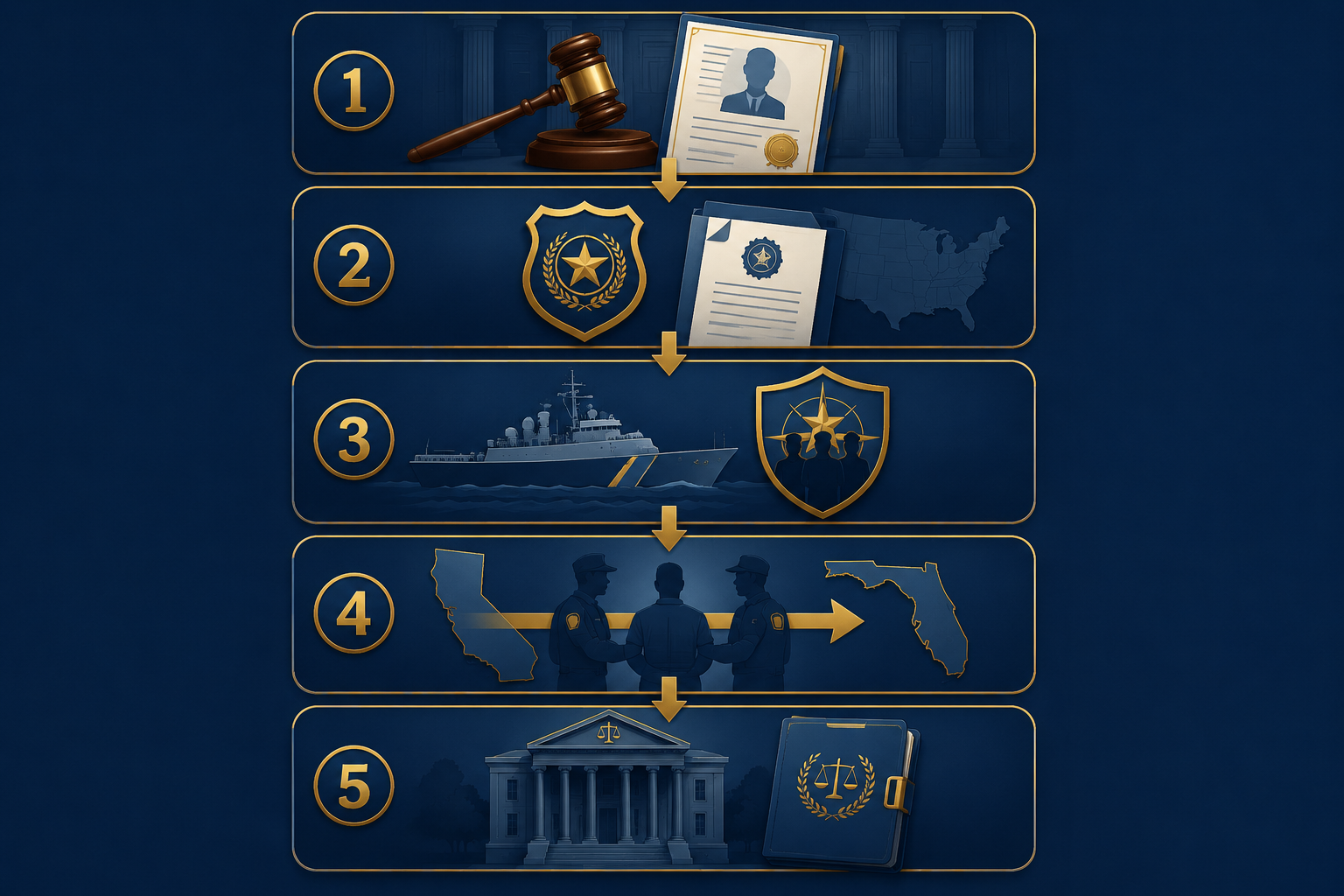
From Broadcast Tip to Arrestable Location
America’s Most Wanted matters here because the broadcast generated the tip that moved the case from long-term fugitive file to current operational target. Reports attribute the lead to an online sleuth after Fischer’s profile aired; the tipster’s identity and method have not been publicly established in the available record, so the safe conclusion is narrow. The broadcast did not arrest Fischer. It produced information that analysts and agents could test against location, identity, and warrant authority.[2]
Once agents connected Fischer to the alias “Richard Graydon” and the sailboat, the next question was not whether the story was dramatic. It was whether the location placed him within a jurisdiction where the existing warrant could be executed without opening an international extradition file. The answer, as reported, was yes: the Coast Guard intercepted the vessel in U.S. territorial waters, and Fischer was transferred to U.S. Marshals custody.[1][2]
| Point in the sequence | Legal mechanism controlling the next step |
|---|---|
| Fischer fled during trial | Rhode Island court proceeded to conviction in absentia after a knowing absence |
| Rhode Island judgment entered | Life sentence with parole eligibility after 25 years awaited execution |
| Fischer remained a long-term fugitive | UFAP warrant under 18 U.S.C. § 1073 supplied federal pursuit authority |
| Tip identified a current alias and vessel | Analysts and task force members converted public-facing information into an arrest plan |
| Coast Guard intercepted the sailboat in U.S. territorial waters | Federal custody could begin without international extradition |
| Fischer entered USMS custody | Initial federal appearance and interstate rendition became the next procedural steps |
The First Court After Capture Is Not Necessarily the Sentencing Court
A common narrative shortcut is to say the fugitive was “returned to face justice.” In practice, the first courthouse after capture is often dictated by custody and geography, not by the courthouse that entered the old judgment.
Fischer was transferred to U.S. Marshals custody in the Southern District of New York for an initial appearance.[1] That appearance does not erase Rhode Island’s judgment. It handles the fact that federal officers arrested him on a federal warrant and that a federal court must address the immediate custody, identity, counsel, detention, and transfer posture.
From there, the state sentence and the federal flight case run on related but distinct tracks. Rhode Island has the existing life sentence to execute. The federal government has the UFAP warrant and the option of prosecuting unlawful flight, subject to the statutory approval requirement. Reports also indicate Fischer faces failure-to-appear consequences in addition to the original sentence.[1][3]
Rendition Back to Rhode Island
Because Fischer was captured inside the United States, the return path is interstate rendition, not international extradition. Domestic fugitives are governed by the Extradition Clause and 18 U.S.C. § 3182, which require a person charged with crime who flees from one state and is found in another to be delivered up on proper demand by the executive authority of the demanding state.[5]
For a sentenced defendant, the practical objective is custody transfer to the state that owns the judgment. The paperwork still matters: identity, warrant validity, the demanding state’s authority, and the receiving state’s obligation all have to line up. But the core issue is not whether Rhode Island can try Fischer for the original offense. It already did.
Why Territorial Waters Kept This Out of Extradition
The vessel’s location is more than color. If Fischer had been arrested by a foreign sovereign, lawyers would be looking at treaty obligations, diplomatic channels, provisional arrest questions, and the Justice Department’s Office of International Affairs. DOJ guidance describes international extradition as a formal government-to-government process, and its Justice Manual materials treat extradition as a specialized procedure involving foreign authorities and treaty-based requirements.[6][7]
That is not the reported Fischer path. The Coast Guard interception in U.S. territorial waters allowed federal arrest and USMS custody without waiting for a foreign state to deport or extradite him.[1][2] It is the difference between executing a domestic warrant in the right place and asking another country to surrender a person under its own law.

The contrast shows up in other 2026 fugitive captures. Samuel Ramirez Jr. was captured in Mexico and deported to the United States after what DOJ described as the fastest capture in FBI Ten Most Wanted history, 73 minutes after being added to the list.[8] Alejandro Rosales Castillo, also captured in Mexico after years on the FBI list, faces formal extradition proceedings.[9] Ryan Wedding, a former Olympic snowboarder, was likewise arrested in Mexico, placing his case on an international custody path rather than a state-to-state rendition path.[9]
Those comparisons are useful only because they prevent category error. Deportation, extradition, and domestic rendition may all end with a fugitive in U.S. custody, but they do not ask the same court to do the same thing. Fischer’s reported location avoided the slowest and most treaty-dependent route.
The Capture Count Is Politics; the Case File Is Process
Officials have also framed recent fugitive captures as a performance metric. FBI Director Kash Patel said there had been “five captures under this administration since last year — more than the entire previous four years combined,” according to reporting on the Fischer arrest.[2] That claim may be checked against public capture records, but it is still an attributed political statement, not the legal explanation for Fischer’s next hearing.
The operational record is firmer. A tip came in, analysts worked it, a multi-agency team matched the fugitive to an alias and location, the Coast Guard reached the vessel, marshals took custody, and the case moved toward federal appearance and Rhode Island rendition. Those are the steps that survive changes in administration and press conference language.
Where the Law Stops for Now
As of July 19, 2026, Fischer’s post-capture proceedings are still unfolding. The known path is two-track: Rhode Island has an existing life sentence with parole eligibility after 25 years to execute, while federal authorities have a UFAP case that can carry up to five years if prosecuted under the statute and approved through the required Justice Department channel.[3][4]
The remaining steps are not improvised because the arrest was unusual. They are the ordinary work of custody and jurisdiction: federal initial appearance, confirmation of identity and warrant posture, interstate rendition, state sentence execution, and any separate federal unlawful-flight or failure-to-appear proceedings. The sailboat made the story memorable. The warrants, judgment, and handoffs are what make it legally operative.
References
- One of Rhode Island’s Longest Wanted Fugitive Captured After More Than 20 Years on the Run, U.S. Marshals Service
- Ronald Fischer, yachtsman doctor wanted in Rhode Island, arrested after America's Most Wanted tip, CBS News
- Ronald Fischer, R.I. fugitive convicted in absentia, captured after more than 20 years, Providence Journal
- 18 U.S. Code § 1073 - Flight to avoid prosecution or giving testimony, Legal Information Institute
- 18 U.S. Code § 3182 - Fugitives from State or Territory to State, District, or Territory, Legal Information Institute
- Justice Manual 9-15.000 - International Extradition and Related Matters, U.S. Department of Justice
- Frequently Asked Questions Regarding Extradition, U.S. Department of Justice
- FBI Ten Most Wanted Fugitive Charged in Double Homicide Apprehended in Mexico, U.S. Department of Justice
- FBI Charlotte Field Office fugitive capture release, FBI Charlotte Field Office
Comments
Join the discussion with an anonymous comment.