
As of July 20, 2026, Andrew Tate and Tristan Tate are in U.S. Marshals custody in Miami after their arrest on a sealed warrant tied to a United Kingdom extradition request.[1][2] The immediate question is no longer simply which allegations exist in which country. It is which court system can move first, what authority it is invoking, and which pending proceeding can delay or redirect the others.
The present posture is this: UK prosecutors have authorized 59 total charges, with 42 against Andrew Tate and 17 against Tristan Tate; Romania’s original case remains unable to proceed to trial after an evidence ruling in late 2024; a second Romanian investigation sits on a separate track; and Florida has announced an active criminal investigation.[3][4] None of those charges or allegations is proof. The brothers are presumed innocent unless and until a court determines otherwise.
This article reports on public criminal and civil proceedings and is not legal advice. It also treats procedural labels by jurisdiction: Romanian “judicial control,” UK charging authorization, and U.S. extradition custody do not perform the same legal work.
| Forum | Current posture as of July 20, 2026 | Why it matters procedurally |
|---|---|---|
| Romania | Original prosecution blocked from trial after a December 2024 evidence ruling; judicial controls lifted in April 2026 while investigation continues.[5] | The Romanian case created the first extradition bottleneck because UK surrender had been conditioned on Romanian proceedings concluding. |
| United Kingdom | CPS has authorized 59 charges: 42 against Andrew Tate and 17 against Tristan Tate.[3][4] | The UK is now the charging jurisdiction seeking extradition, and its warrant is the basis for the Miami arrest. |
| United States | The brothers are in U.S. Marshals custody in Miami under a sealed UK-linked warrant; Florida also has a separate active criminal investigation.[1][2] | U.S. courts now become the forum where custody, extradition process, and any competing domestic interests may have to be sorted. |
Romania: the case that first controlled the sequence
Romania is the place to start because it supplied the first hard procedural constraint. Romanian authorities detained the brothers in the original case, later moved them through house arrest and then judicial control, and brought allegations that included human trafficking and rape. Those custody statuses mattered because they affected where the defendants could be, whether they could travel, and whether another jurisdiction could obtain physical custody.
A court-approved trial path appeared to exist in 2024, when a Romanian court ruled that the case could proceed on charges including rape and human trafficking.[6] That was not a finding of guilt. It was a procedural ruling allowing the prosecution to move forward. The more consequential event came later.
In December 2024, the Bucharest Court of Appeals ruled that prosecutors’ evidence, including initial victim testimony, was inadmissible on procedural grounds and returned the case for amendment.[5] That ruling did not acquit the defendants, and it did not erase the investigation. But it stopped the existing trial route. For a cross-border case, that kind of ruling is not just a domestic evidentiary problem; it can alter another country’s timetable.
The common public shorthand that “Romanian restrictions were lifted” is also easy to overread. In April 2026, a Romanian court lifted judicial controls, including regular police check-ins, while the investigation remained pending.[5] That relieved the brothers of the last Romanian reporting and travel restrictions described in the cited reporting. It did not mean the Romanian file had been abandoned, and it did not transform allegations into resolved claims.
A separate Romanian investigation complicates the picture further. In August 2024, Romanian anti-organized-crime prosecutors opened another file involving allegations connected to 35 victims, including minors, and offenses reported to include trafficking of minors, money laundering, and witness tampering.[7] That second file should not be folded into the original prosecution as though it were the same case. It has a different procedural posture and may move differently.
Romania therefore remains both a charging forum and a source of delay. Its original case has not produced a trial judgment. Its evidence ruling blocked the prosecution’s existing path. Its later lifting of controls changed mobility, not merits. Its second investigation adds exposure without answering whether or when the first case can be amended, refiled, or otherwise revived.
The Romania-to-UK bottleneck
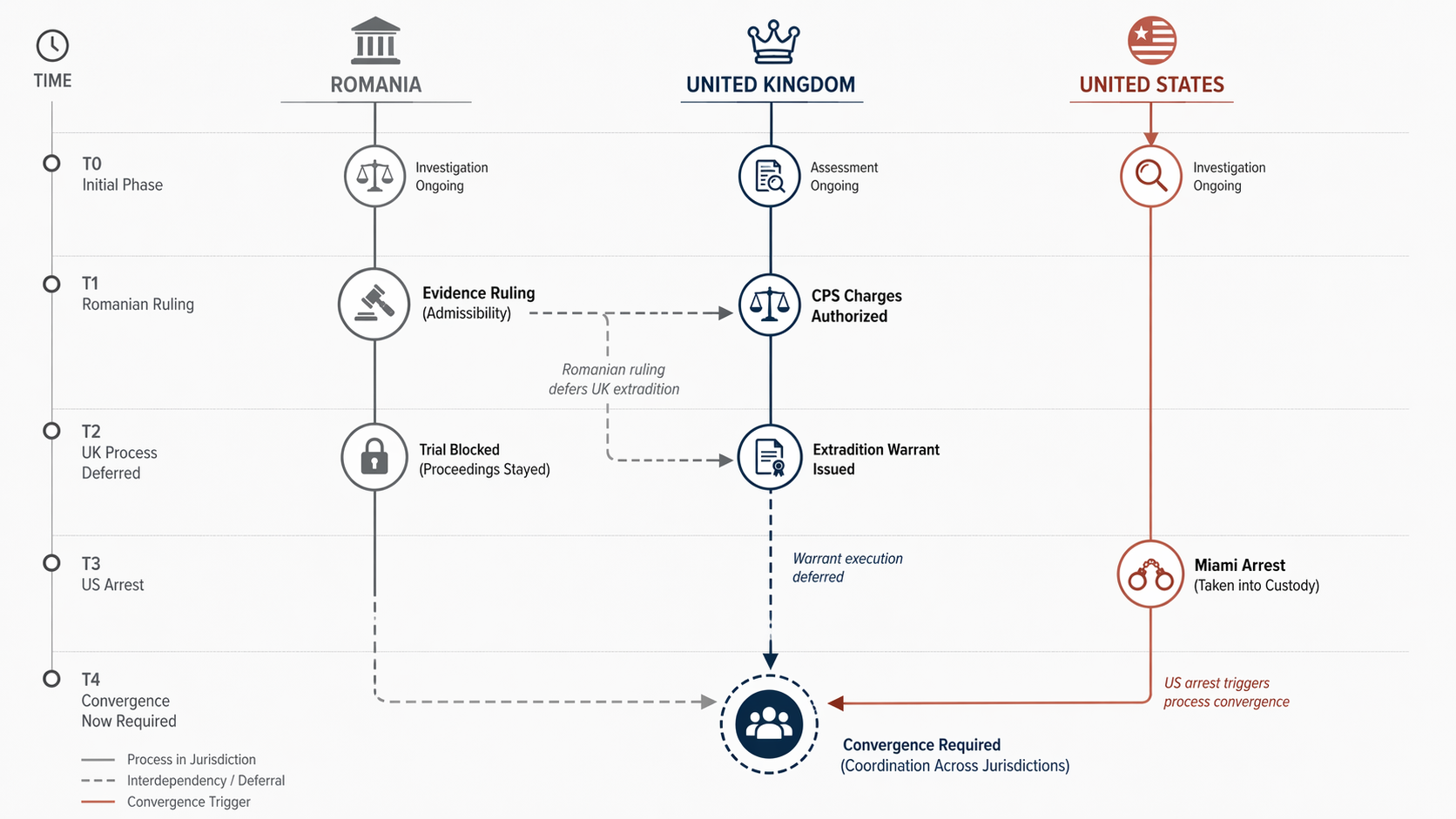
The UK track was not waiting in a vacuum. In March 2024, a Romanian court allowed extradition to the United Kingdom but conditioned surrender on the completion of Romanian proceedings.[7] That condition is the hinge. If Romania’s case moved efficiently to conclusion, the UK could wait its turn. If Romania’s case stalled, the UK’s authorized prosecution would remain ready on paper while custody stayed governed by a different forum’s timetable.
The December 2024 Romanian evidence ruling therefore had an effect beyond Bucharest. By blocking the trial path, it also made it harder to identify when the Romanian proceedings would be “complete” for purposes of the UK extradition condition. A domestic ruling on admissibility became a cross-border scheduling problem.
That is why the April 2026 lifting of judicial controls was procedurally significant but not self-executing. It reduced Romania’s immediate physical restraints. It did not itself deliver the defendants to the UK, resolve the Romanian evidence problem, or decide how a later U.S. custody event would be prioritized.
United Kingdom: charging authority, extradition demand, and accuser anonymity
The UK prosecution became materially larger in July 2026. The Crown Prosecution Service announced that it had authorized 38 additional charges against the brothers, bringing the total to 59 charges across allegations involving seven complainants.[3] The CPS breakdown attributes 42 charges to Andrew Tate, including 10 counts of rape, and 17 charges to Tristan Tate.[3] BBC reporting described the same expanded total in connection with the U.S. arrest.[4]
That expansion followed an earlier UK charging decision in May 2025, when prosecutors said the brothers would face 21 charges in the United Kingdom.[8] The July 2026 authorization did not merely add background allegations. It changed the scale of the UK proceeding and supplied the new extradition posture that, according to current reporting, led to the sealed warrant executed in Miami.[1][2][3]
The UK charges are still allegations. CPS authorization means prosecutors have decided the legal and evidentiary tests for charging are met under that system. It does not mean a jury has heard evidence, that defenses have been tested, or that the charged conduct has been proven.
One UK procedural fight has already clarified how the case will be managed before trial. In June 2026, Mr. Justice Chamberlain rejected a challenge by Andrew and Tristan Tate to the CPS decision withholding the identities of accusers before trial.[9] The judgment addressed the defendants’ request for names in the setting of what the court described through a “notorious defendant” analysis, including concern about the brothers’ public reach.[9]
That ruling matters for case administration, not because it proves the allegations. It affects pre-trial disclosure and witness protection in a prosecution where publicity is not incidental. For complainants, anonymity can be the condition that allows participation without immediate public exposure. For defendants, withheld names can become a litigation issue over preparation and fairness. The High Court’s ruling put that balance, at least at that stage, on the CPS side.[9]
The UK also has collateral proceedings around the broader history of complaints. In March 2026, the Independent Office for Police Conduct announced an investigation into Hertfordshire Constabulary over alleged misconduct and failures to investigate properly earlier rape complaints against Andrew Tate from 2014 and 2015.[7] That watchdog inquiry is not the same thing as the CPS prosecution. It concerns police handling of earlier complaints, not whether the current charges are proven.
A separate UK civil tax case sits even farther from the criminal-extradition spine. In December 2024, Andrew and Tristan Tate lost a civil case over unpaid tax, reported as involving about £2.5 million.[10] That case is relevant to a full legal-affairs map, but it should not be treated as evidence on the sexual-offense or trafficking allegations.
United States: custody in Miami and an unresolved Florida track
The United States entered the main procedural sequence because the brothers are now physically held there. On July 18, 2026, U.S. Marshals arrested Andrew and Tristan Tate in Miami under a sealed warrant tied to a UK extradition request.[1][2] The warrant being sealed matters. Until the filing is unsealed or described in court, the public record cannot confirm every asserted basis, condition, or requested relief.
For now, the reliable point is custody and forum. U.S. courts may have to determine the extradition process for a UK request while accounting for the fact that Romania has had pending criminal matters and Florida has its own announced criminal investigation. That does not mean the United States has charged the same case as the UK or Romania. It means U.S. judicial process now controls immediate physical custody.
Florida’s criminal investigation was announced by the state attorney general in March 2025.[7] The public materials in the research record do not establish a completed Florida charging decision, a filed indictment, or a trial schedule. Reporting has also referred to Homeland Security activity dating back to at least 2023, but the available source trail for that point runs through paywalled or secondary reporting. That claim should be treated as unresolved unless and until a primary filing or agency statement is available.
The Miami arrest is therefore not just another entry on a long timeline. It creates a custody forum in a third country at the moment when the UK has expanded charges and Romania has not closed its files. If extradition litigation proceeds in the United States, the court record may clarify whether the UK request is narrow, whether any U.S. authority asserts competing interests, and how prior Romanian conditions are being treated after the lifting of judicial controls.

How the tracks fit together
A clean chronology helps, but only if it preserves the dependencies:
| Date or period | Event | Procedural consequence |
|---|---|---|
| 2014-2015 | Earlier UK rape complaints later became the subject of police-watchdog scrutiny.[7] | Those complaints form part of the institutional-review background, not a finding on current charges. |
| March 2024 | Romanian court allowed UK extradition but conditioned surrender on completion of Romanian proceedings.[7] | UK prosecution was effectively placed behind the Romanian timetable. |
| August 2024 | Romanian prosecutors opened a second investigation involving allegations tied to 35 victims, including minors.[7] | A separate Romanian track emerged alongside the original case. |
| December 2024 | Romanian appeals court excluded key prosecution evidence and returned the case for amendment.[5] | The original Romanian trial route was blocked, making the UK wait harder to resolve. |
| May 2025 | UK prosecutors said the brothers would face 21 charges.[8] | The UK case became formally charged but still dependent on securing custody. |
| April 2026 | Romanian judicial controls were lifted while the investigation continued.[5] | Travel and reporting restrictions changed; the Romanian case did not end. |
| June 2026 | UK High Court upheld withholding accuser identities pre-trial.[9] | The court resolved an important disclosure and anonymity dispute before extradition or trial. |
| July 2026 | CPS authorized 38 additional charges, bringing the UK total to 59.[3][4] | The UK case expanded sharply and triggered the extradition posture now being litigated through U.S. custody. |
| July 18-19, 2026 | U.S. Marshals arrested the brothers in Miami on a sealed UK-linked warrant.[1][2] | The United States became the immediate custody forum. |
The sequence explains why the case is hard to summarize accurately. Romania did not simply finish and pass the matter to the UK. The UK did not merely add charges while waiting for a routine surrender. The United States did not open the timeline; it became the place where the latest UK request was executed.
Several variables remain open. The sealed Miami warrant may reveal more about the scope of the UK request. Extradition litigation may identify whether any U.S. proceeding can delay or complicate surrender. Romanian prosecutors may amend, refile, or pursue the separate investigation. Florida’s announced investigation may remain investigative or move into a charging posture. Each of those steps would change procedure before it changes proof.
The most accurate current overview is therefore restrained: the UK has authorized a large set of charges and is seeking extradition; Romania’s first case remains procedurally impaired but not erased; Romania has a second investigation; the brothers are in U.S. custody after a Miami arrest; and Florida’s investigation remains unresolved. Anything beyond that depends on records that are not yet public or proceedings that have not yet occurred.
References
- Andrew and Tristan Tate arrested in Miami as UK seeks extradition, Euronews
- Tate brothers arrested in Miami as UK seeks extradition on new charges, Fox News
- CPS decides to prosecute Tate brothers with additional sexual offences, Crown Prosecution Service
- Tate brothers arrested in US as further UK charges take total to 59, BBC News
- Romanian court lifts judicial controls against Andrew Tate, Reuters, April 6, 2026
- Andrew Tate's trial on charges of rape and human trafficking can start, AP News
- Legal affairs of the Tate brothers, Wikipedia
- Andrew and Tristan Tate to face 21 charges in UK, prosecutors say, BBC News
- Andrew Tate and Tristan Tate -v- Director of Public Prosecutions, Judiciary UK
- Andrew and Tristan Tate lose £2m court case over unpaid tax, The Guardian, December 18, 2024
Comments
Join the discussion with an anonymous comment.