
The July 18, 2026 arrest of Andrew Tate and Tristan Tate in Miami matters less because it added another scene to an already crowded public case than because it changed custody. U.S. Marshals executed a sealed warrant requested by the United Kingdom, and that single act moved the British case out of the queue it had occupied in Romania and into the UK-U.S. extradition channel.[1]
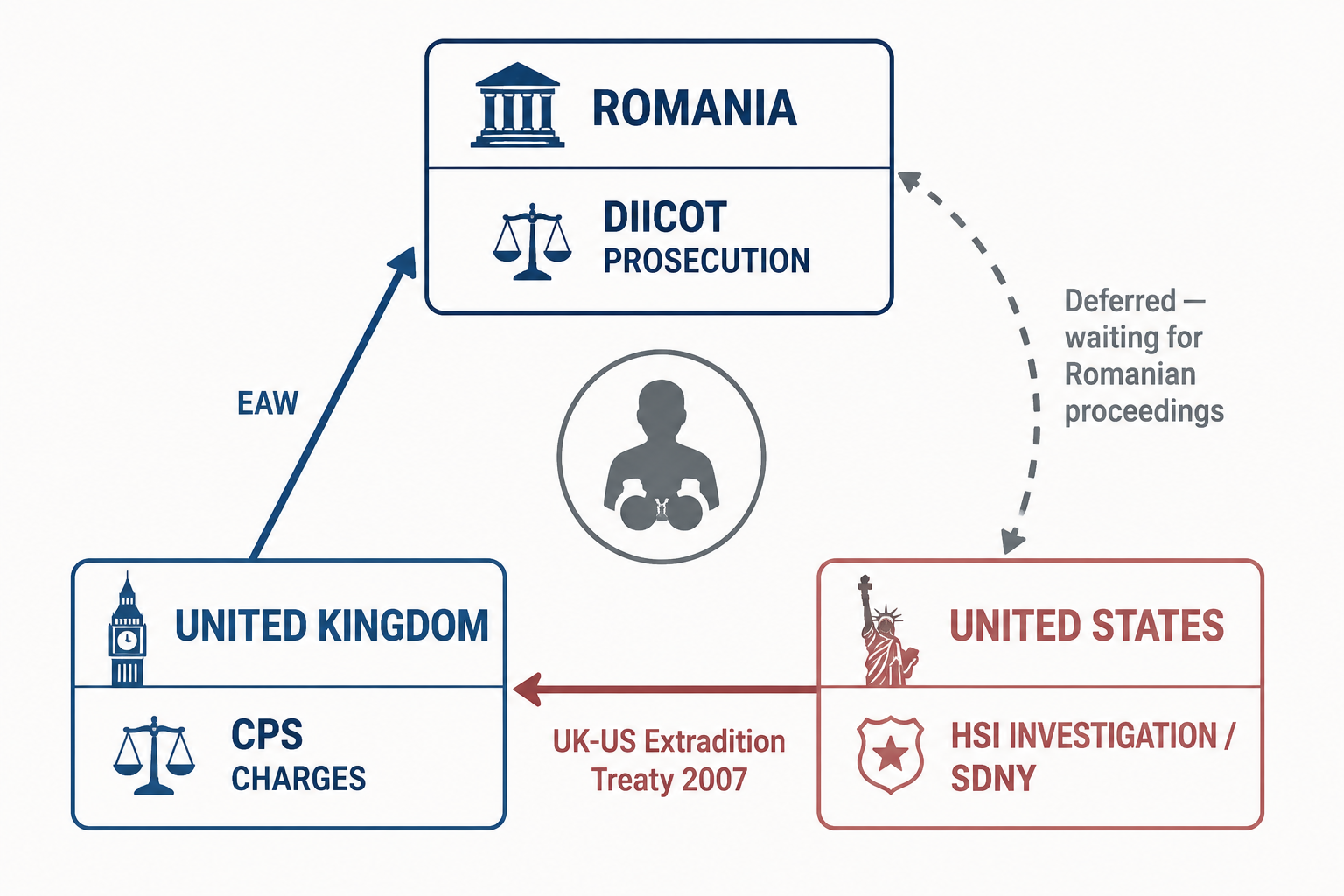
That is the procedural point at the center of the new charges against Andrew Tate. Until Miami, the United Kingdom had charges, complainants, and European Arrest Warrants, but it also had a Romanian court ruling that extradition to Britain would occur only after Romanian proceedings finished. Once the brothers were arrested in the United States, the live file was no longer only in Bucharest. The United Kingdom could seek surrender from the country that actually had custody.
The charge list is substantial, but the list alone does not answer the extradition question. British prosecutors have authorized 59 charges across seven complainants, including 42 charges against Andrew Tate and 17 against Tristan Tate, with alleged offending in Bedfordshire and Hertfordshire between July 2010 and August 2017.[1][2] The publicly reported charges include rape, actual bodily harm, human trafficking, controlling prostitution for gain, indecent images of a child, and extreme pornography.[1][2]
Those numbers explain why the British claim is not symbolic. They do not, by themselves, decide whether a U.S. court will certify extradition, whether the Secretary of State will order surrender, whether any U.S. investigation delays transfer, or whether every alleged offense maps cleanly onto an extraditable offense under the treaty. The sealed Miami warrant had not been publicly unsealed as of this writing, so the exact warrant charges should not be assumed to be identical to every CPS-authorized count.
Three live tracks, one immediate custody problem
Romania remains the oldest and most developed criminal track. Romanian anti-organized-crime prosecutors have pursued the brothers since December 2022, with allegations including human trafficking, rape, forming an organized criminal group, trafficking minors, sex with a minor, and money laundering; Reuters has reported more than 30 alleged victims in the Romanian human-trafficking allegations.[3] In May 2026, Romanian authorities also brought incitement-to-hatred charges relating to women.[3]
But the Romanian file has not moved cleanly into trial. In November 2024, a Romanian court found procedural irregularities and sent the indictment back to prosecutors, leaving the trial posture delayed and no trial date set in the available reporting.[4] That delay is not a minor scheduling footnote when another country is waiting to prosecute its own complainants.
The United Kingdom’s track began in practical extradition terms before the Miami arrest. British authorities issued European Arrest Warrants in March 2024, and a Romanian court accepted that the brothers could be extradited to the United Kingdom, but only after Romanian proceedings concluded.[1] That ruling gave Britain a route, not custody. It left the United Kingdom dependent on the Romanian calendar.
The United States is different. It is not merely a transit point if its own authorities are investigating. Reporting describes a Homeland Security Investigations probe dating to 2023, a Florida statewide prosecution investigation announced in March 2025, and possible federal interest in the Southern District of New York.[5][6] Those materials support caution, not certainty: public reporting shows U.S. investigative interest, but not a public U.S. indictment equivalent to the Romanian or British charge posture.
| Jurisdiction | Current posture described in public reporting | Why it matters after Miami |
|---|---|---|
| Romania | DIICOT prosecution track with serious charges, but a delayed trial posture after procedural irregularities | Previously controlled the practical queue because the brothers were in Romania and British extradition was deferred |
| United Kingdom | CPS-authorized charges and earlier European Arrest Warrants, now paired with a U.S. arrest on a UK-requested sealed warrant | Can seek extradition from the United States rather than waiting solely on Romanian proceedings |
| United States | Reported federal and Florida investigative activity, with no public U.S. indictment established in the materials | Has physical custody after the Miami arrest and may have interests that affect timing |
Why the treaty route matters more than the charge count
Extradition does not ask which prosecutor is most morally entitled to go first. It asks a colder set of questions: Who has custody? Which treaty applies? What paperwork has been filed? What threshold must the requesting state meet? Are the offenses extraditable? Does nationality matter? Are there pending domestic proceedings in the requested state? Which executive official has the final permission?
The Romania route and the United States route answer those questions differently. Under the earlier European Arrest Warrant path, the United Kingdom had a recognized claim but not immediate transfer. The Romanian court’s answer was sequencing: Britain could have extradition, but only after Romania was done.[1] That is the kind of order that looks firm until the defendants leave the jurisdiction that issued it.
The UK-U.S. route is governed by the 2003 extradition treaty between the two countries, which entered into force in 2007.[7] Under that treaty framework and implementing extradition practice, the United States does not categorically bar extradition of its own nationals to the United Kingdom.[7][8] That point matters because Andrew Tate is reported to hold U.S. citizenship; nationality alone is not the kind of shield it can be in some extradition systems.
The evidentiary threshold also changes. The European Arrest Warrant system was designed around mutual recognition among participating European states, while U.S. extradition proceedings require a judicial certification process but do not function as a full criminal trial. The requesting state must satisfy the treaty and U.S. extradition law; the defendant does not receive a mini-trial on guilt in the American extradition hearing.[8]
That does not mean extradition is automatic. Dual criminality still matters. Some British allegations, such as rape, assault, and trafficking-type conduct, are easier to understand in dual-criminality terms at a general level. Other reported categories, including indecent images of a child and extreme pornography, require more careful offense-by-offense mapping before anyone should claim confidence about how a U.S. court would treat them. Public reporting of a CPS charge label is not the same thing as a treaty analysis of the sealed warrant.
The rule of specialty adds another constraint. If the United States extradites a defendant to the United Kingdom, the United Kingdom is generally limited to prosecuting the offenses for which extradition was granted unless an exception or later consent applies. That is one reason the sealed warrant matters. The practical case may turn not on the full public charge universe, but on the subset packaged into the extradition request.
There is no central docket clerk for Romania, Britain, and the United States
Multi-jurisdiction cases often sound, from the outside, as if someone must be deciding the best forum. In practice, no single tribunal ranks Romania, the United Kingdom, and the United States by seriousness, readiness, complainant impact, or evidentiary strength. Each sovereign uses its own charging authority, treaty rights, and custody position. If two requests compete, the requested state’s law and executive discretion do much of the sorting.
That is why Miami changed the geometry. Romania’s earlier sequencing order controlled the British route only while Romania was the place from which Britain needed surrender. With the brothers in U.S. custody, the United Kingdom can ask a different requested state under a different treaty. Romania may still have a serious prosecution. It no longer necessarily controls the entire order of operations.
What Britain can seek from the United States now
The United Kingdom’s next practical task is to convert the Miami arrest into a sustainable extradition case. That ordinarily means transmitting the treaty materials through the diplomatic and legal channels required by U.S. practice, identifying the extraditable offenses, presenting the required evidence or charging materials, and securing judicial certification before any final surrender decision. The arrest is the opening move, not the handover.
The High Court proceedings in London shortly before the Miami arrest show that the British case was not dormant. On June 25, 2026, Mr. Justice Chamberlain rejected the brothers’ attempt to learn the names of accusers in related proceedings, accepted the CPS’s characterization of the brothers as “notorious,” and rejected proposed £20,000 undertakings.[9] That judgment did not decide extradition, but it shows British courts were already managing case-protection and procedural-risk issues around these defendants.
For British prosecutors, the Miami arrest reduces one delay and introduces another set of gates. They no longer have to wait only for Romania’s unresolved trial posture. They do have to satisfy the United States. That means U.S. courts and executive officials become the immediate audience for British charging decisions.
For complainants, the difference is not abstract. A deferred extradition order can leave a case waiting behind years of litigation in another forum. A live U.S. extradition request may move faster, or it may not; but it gives the United Kingdom a second procedural door. That can matter when the alleged offending period in the British case dates back to 2010 through 2017.[1]
How U.S. investigations could complicate priority
If the United States has no charges it wants to bring first, the British request can proceed as a bilateral extradition matter. If U.S. prosecutors decide they have a domestic case ready to charge, the question becomes more complicated. A requested state may choose not to surrender a person immediately when it wants to prosecute, investigate, or complete domestic proceedings first.
The available materials do not establish that the United States has reached that point. They describe investigative activity: Homeland Security Investigations interest since 2023, Florida officials announcing a statewide prosecution investigation in March 2025, and reported federal interest connected to the Southern District of New York.[5][6] Investigation is not prosecution. It can slow the corridor, but it is not the same as an indictment blocking the door.
That distinction is especially important because the defendants’ physical presence in the United States gives American authorities leverage even without a public charge. Devices, witnesses, immigration status, bail conditions, detention decisions, and federal investigative priorities can all affect the timeline. Extradition law supplies the formal path; custody supplies the practical pressure.
The political-pressure allegations belong in the file, but not at the center of it
ProPublica reported in 2026 that Paul Ingrassia, described as a former Tate attorney serving as a White House liaison to the Department of Homeland Security, directed DHS officials to return seized devices; the report relied on anonymous DHS officials, and Ingrassia and his attorney denied the account.[10] ProPublica also reported that Duke law professor Samuel Buell called the alleged conduct politicization.[10]
The same reporting and other accounts have discussed Richard Grenell raising the Tate matter with Romanian officials, with Romanian Foreign Minister Emil Hurezeanu confirming that Grenell raised the case at the Munich Security Conference.[10] That is relevant because political contact can affect urgency, diplomatic posture, and public confidence in ordinary sequencing. It is not, on the available record, a substitute for the sealed warrant, the treaty, or the custody transfer.
This is where overstatement would do real damage. The materials support saying that alleged political intervention is a pressure point around the U.S. track. They do not support treating it as the proven explanation for every movement in the case. The Miami arrest has a procedural explanation even without resolving the political allegations: the United Kingdom had a warrant request, the United States had custody, and a treaty route existed.
What the Miami arrest does not settle
The arrest does not erase Romania’s case. It does not prove that Britain will receive surrender. It does not establish which charges are in the sealed warrant. It does not resolve dual criminality for every CPS-authorized count. It does not tell us whether U.S. prosecutors will stand aside, pursue their own case, or use investigative needs to slow extradition.
It does, however, remove the simplest assumption that the British case must wait behind Romania until Romania is finished. That assumption depended on geography and custody as much as law. Once the brothers were arrested in Miami, the operative question became what the United States will do with a UK-requested warrant under the UK-U.S. treaty.
The case therefore does not reveal a neat hierarchy among Romania, the United Kingdom, and the United States. It shows the less satisfying machinery of international criminal procedure: timing, physical custody, treaty design, evidentiary thresholds, domestic prosecutorial interest, and alleged political pressure can determine which sovereign gets first crack before any court ever decides the underlying criminal allegations.
References
- Andrew Tate and Tristan Tate arrested in Miami on UK warrant, BBC, July 18, 2026.
- Andrew Tate faces additional UK charges after Miami arrest, CNN, July 18, 2026.
- Romanian prosecutors bring new incitement charges against Andrew Tate, Reuters, May 28, 2026.
- Romanian Tate case remains delayed after procedural irregularities, Reuters, April 6, 2026.
- What to Know About Andrew Tate, The New York Times.
- Andrew Tate investigation and U.S. federal interest, Searchlight Magazine, April 2026.
- Extradition Treaty Between the Government of the United States of America and the Government of the United Kingdom of Great Britain and Northern Ireland, Congress.gov, Treaty Doc. 108-23.
- Extradition processes and review, GOV.UK.
- High Court judgment of Mr Justice Chamberlain concerning Andrew Tate and Tristan Tate, Judiciary of England and Wales, June 25, 2026.
- White House intervention in Andrew Tate case reported by ProPublica, ProPublica, 2026.
Comments
Join the discussion with an anonymous comment.