
Anthea Hartig’s July 21 congressional hearing landed in an unusually compressed legal moment: one day after a major White House report attacking Smithsonian museum content, one day before her scheduled follow-up appearance before the House Administration Committee, and months into a confrontation that has already moved from exhibit criticism to funding threats and attempted personnel control. The hearing’s legal implications do not turn on whether a curator chose the best label or whether a committee member asked the sharpest question. They turn on a less satisfying but more consequential problem: which actor, using which legal instrument, can require the Smithsonian to change course?
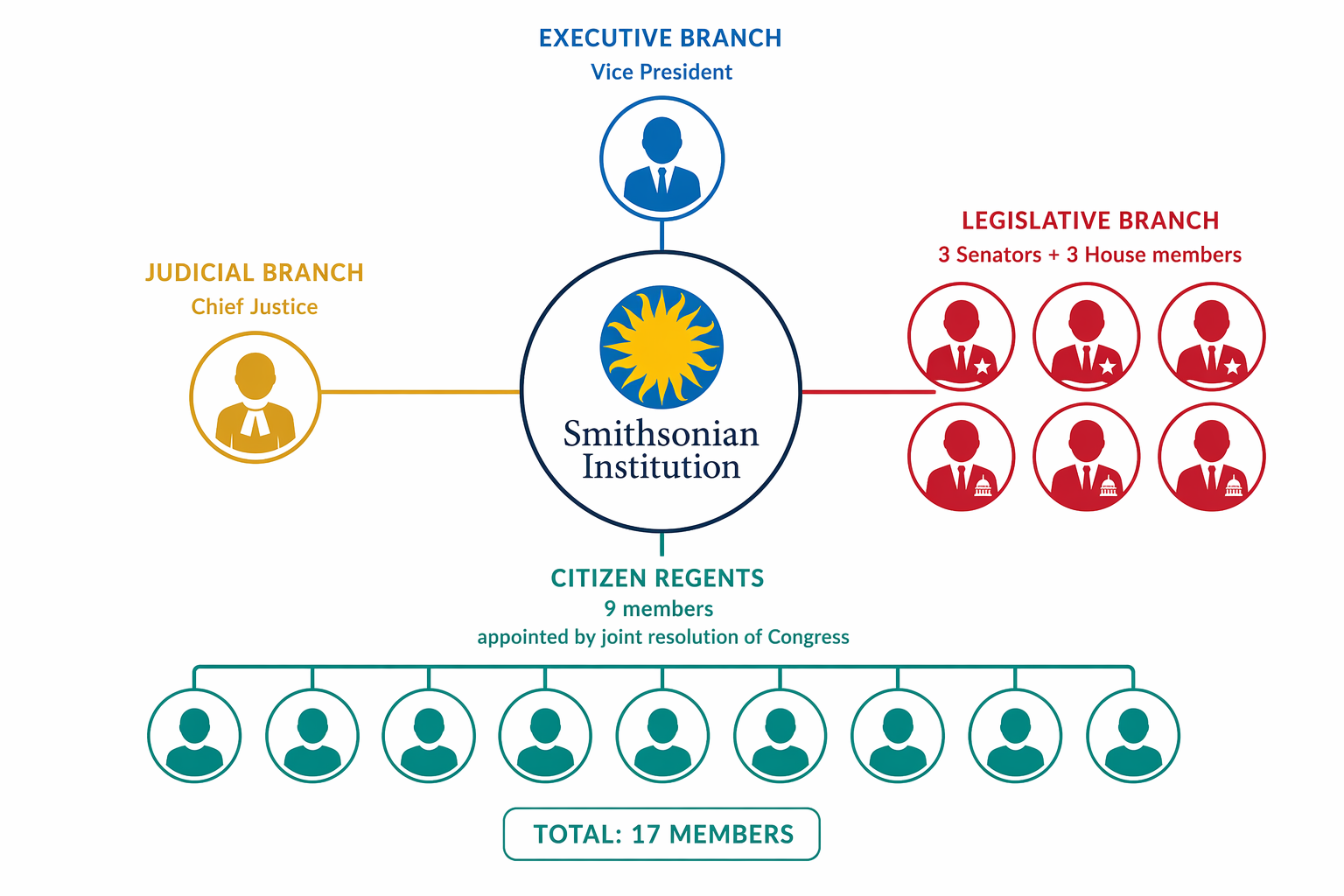
That question is harder here than it would be for an executive agency, a private museum, or a conventional federally funded nonprofit. The Smithsonian was created by Congress in 1846 as a “trust instrumentality of the United States,” not as a department in the executive branch. Its governing Board of Regents has 17 members: the Vice President, the Chief Justice, three Senators, three House members, and nine citizen regents appointed by joint resolution of Congress.[1] That design is not decorative. It is the reason familiar branch-control assumptions keep producing uncertain answers.
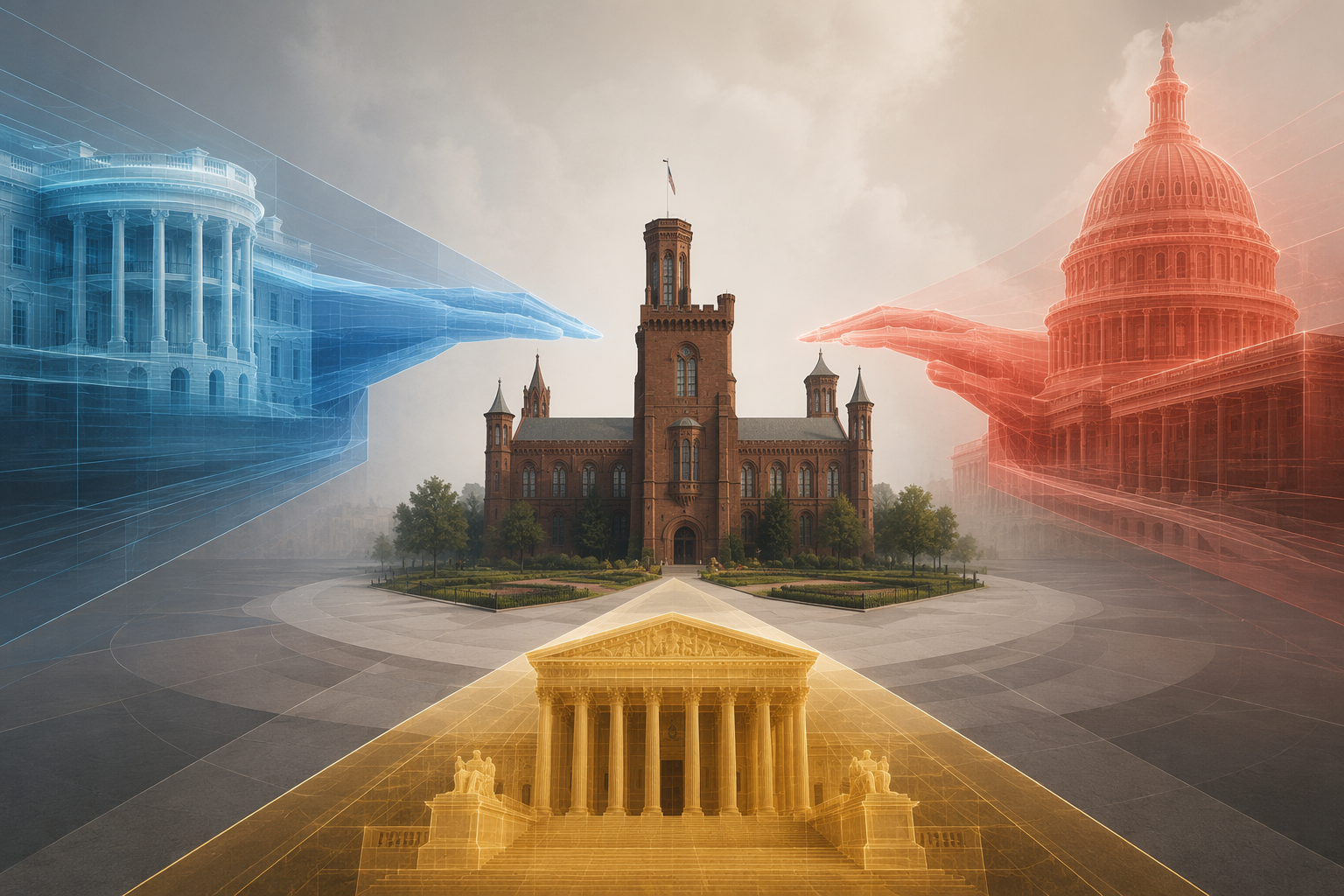
The Congressional Research Service put the point with useful restraint in its April 2025 analysis of Executive Order 14253. CRS concluded that the order’s scope over the Smithsonian is “unclear” and that most contemplated operational changes “appear to be exclusively subject to the decisions of the entire Board of Regents,” not the Vice President acting alone.[2] For lawyers, that sentence matters because it refuses the easy answer. The uncertainty is not a press strategy or an institutional dodge. It follows from the charter.
The Hearing Exposed an Authority Problem, Not Just a Museum Dispute
The White House’s March 2025 executive order directed the Vice President and the Office of Management and Budget to work with Congress to condition future Smithsonian appropriations on restrictions aimed at what the order called divisive or improper content.[3] By July 2026, that directive had become part of a larger institutional campaign: committee oversight, document demands, public reporting, and pressure on museum officials who must decide what to do before any court has said where the lines are.
That is why Hartig’s hearing matters beyond the National Museum of American History. A committee can summon officials, demand explanations, and threaten appropriations consequences. The executive can issue orders, publish reports, and press a theory of presidential supervision. The Smithsonian can point to its charter, its Board, and its trust funds. None of those moves, standing alone, answers whether a particular exhibit text must be rewritten, whether an official can be removed, or whether a funding condition would be enforceable.
The same-day House Democratic rebuttal to the White House report sharpened that point rather than resolving it. Its reported charge was not only that the administration had selected misleading examples, but that it had misstated who controls the institution. That disagreement over institutional premises is more important legally than the usual hearing-day exchange of competing historical narratives. If the premise is wrong, the remedy may be wrong too.
A Board Built to Resist Single-Branch Ownership
The Smithsonian’s Board of Regents is often described as if it were a quaint governance artifact. It is not. It is the legal hinge of the current dispute. The Board includes officers and members associated with all three branches, but it is not reducible to any one of them. The Vice President sits on it, but CRS did not treat that fact as conferring unilateral operational power. The Chief Justice sits on it, but no one would seriously call the Smithsonian a judicial agency. Members of Congress sit on it, but congressional presence on a board is different from committee command over daily museum judgment.[1][2]
That structure frustrates two common shortcuts. The first is the executive shortcut: if the Smithsonian receives federal money and performs public functions, the President must be able to direct its content and remove its personnel. The second is the appropriations shortcut: if Congress supplies most of the annual budget, Congress can purchase compliance with preferred viewpoints. Both contain a piece of institutional reality. Neither is complete.
The Board’s composition also makes litigation posture awkward. If a dispute ripens, a court may have to decide not only whether a restriction violates the First Amendment or exceeds statutory authority, but who is authorized to speak for the Smithsonian when branches represented inside its governance structure are also pressuring it from outside. That is not a clean plaintiff-defendant map. It is institutional law at its least chart-friendly.
The Appropriations Lever Has Force, But Not Total Force
Money is the most practical pressure point because it can alter behavior before a definitive legal ruling arrives. CRS reported that approximately 63% of the Smithsonian’s annual budget comes from federal appropriations.[2] No institutional lawyer can treat that as symbolic. Appropriated dollars support buildings, security, collections care, staff, and ordinary operations. A credible threat to those funds will be read inside the institution as an operational risk, not just as political theater.
But appropriations are not the whole institution. The Smithsonian also has independent trust funds derived from gifts, bequests, investments, and revenue-generating activities. Those funds are not subject to the same appropriations conditions as federal dollars.[2] That trust-fund firewall complicates any claim that Congress can control Smithsonian content simply by attaching conditions to annual funding.
The resulting problem is not merely accounting. Suppose Congress conditions a future appropriation on removing or revising certain museum text. If the affected activity is federally funded, the Smithsonian faces one set of questions about spending conditions, unconstitutional conditions, and statutory authority. If the activity is trust-funded, the question changes: can the condition reach activity outside the federal appropriation, or can Congress only decline to fund what it does not wish to support? The answer may depend on how the condition is written, what funds support the disputed program, and whether the condition is framed as a permissible allocation of federal money or as viewpoint control over a trust instrumentality.
The executive order’s funding provision sits exactly on that fault line. Section 2(b) directs the Vice President and the OMB Director to work with Congress to condition future appropriations on content-related requirements.[3] That may be politically potent. It is not the same thing as a present legal command to a curator, director, or secretary to change an exhibit. Between the order and the gallery wall sit Congress, appropriations language, the Board of Regents, the source of funds, and any constitutional limits on ideological funding conditions.
The August 2025 document demand shows why this distinction is not academic. After the White House demanded materials from eight Smithsonian museums and threatened to withhold funds, the Smithsonian submitted photographs of labels, placards, and display texts.[4] Compliance in that setting does not prove that the White House had full legal authority to compel the production, much less to dictate permanent content rules. It does show how funding pressure can produce institutional action before the legal theory is tested.
Government Speech Doctrine Does Not Fit Neatly
One tempting way to analyze museum content is to call it government speech. If an exhibit is government speech, then the government generally has greater latitude to decide what it says than it would have to regulate private speech. That framework is familiar from cases involving clearer governmental speakers, including monuments and specialty license plates. The harder question is whether the Smithsonian can be treated as the same kind of speaker when its organic structure places content authority in a multi-branch Board rather than a unitary executive chain.
The Smithsonian is public-facing, federally chartered, and substantially federally funded. Its museums also exercise curatorial judgment under a governance structure that Congress deliberately made more complicated than a cabinet bureau. If the “government” is speaking through a Smithsonian exhibit, which government actor controls the message: Congress through appropriations, the President through executive supervision, the Vice President through board membership, or the Board as a whole?
CRS’s answer does not dispose of the First Amendment question, but it matters for institutional authority. Its conclusion that most operational changes appear to belong to the entire Board of Regents undercuts any simple claim that one official’s participation in the Board converts that official into the Smithsonian’s content director.[2] Government speech doctrine may still be relevant, but it cannot do all the work unless a court first identifies the relevant governmental speaker with more precision than the public debate usually supplies.
Sajet Turned Removal Theory Into a Workplace Standoff
Personnel authority is where the abstraction becomes most visible. In May 2025, President Trump attempted to fire National Portrait Gallery director Kim Sajet. Sajet refused to leave and continued reporting for work. As of early June 2025, the standoff remained unresolved.[5] The reported trigger was Sajet’s refusal to remove or alter a portrait of the President from display.[5]
That episode is a better guide to Hartig’s legal vulnerability than any generalized statement about presidential control. If the Smithsonian were an ordinary executive agency, removal analysis would begin in one place. If it were a private museum receiving grants, it would begin somewhere else. The Smithsonian sits between those poles. The President may be able to exert political pressure. He may be able to influence funding strategy through OMB and allies in Congress. He may be able to shape the public controversy. But whether he can directly remove Smithsonian museum personnel is precisely the contested question, not the premise from which analysis starts.
The Sajet standoff also reveals a practical asymmetry. Formal legal uncertainty does not disable pressure. An official who is told she has been fired has to decide whether to keep coming to work. General counsel must decide what payroll, access, reporting lines, and public statements should say. Board members must decide whether silence will be read as acquiescence. Courts may eventually clarify authority, but institutional actors live in the interim.
That interim is where Hartig’s hearing sits. Even if a committee cannot order a curator to rewrite a label, and even if the President cannot unilaterally remove a museum director, the combined effect of hearings, reports, budget threats, and personnel pressure can shape what museum officials believe they can safely do. For counsel advising any public-adjacent institution, that is the uncomfortable lesson: legal authority and operational coercion are related, but they are not identical.
Older Exhibit Battles Supply Context, Not a Complete Rule
The Smithsonian has been here before in the cultural sense, if not in the same legal posture. The 1978 Crowley v. Smithsonian Institution case involved a challenge to evolution exhibits; the district court held that the exhibits were within the Smithsonian’s statutory authority and did not violate the Establishment Clause.[6] Later controversies over “The West as America” in 1991 and the Enola Gay exhibition battles in 1994 showed that disputes over national narrative and museum authority are hardly new.[6][7]
Those episodes should be used carefully. Crowley was a district court decision, not a Supreme Court rule for all Smithsonian content disputes. The West and Enola Gay controversies show recurring political pressure over museum interpretation, but they do not answer the current statutory and constitutional questions raised by an executive order, appropriations conditions, and attempted removal of museum personnel. History supplies warning signs. It does not supply a clean holding.
What Legal Professionals Should Track After the Hartig Hearing
The useful next questions are concrete. Does Congress draft appropriations language that targets particular content, general curatorial standards, reporting obligations, or governance procedures? Does the Smithsonian distinguish publicly between federally funded and trust-funded activities? Does the Board of Regents act as a board, or do individual officeholders continue to be treated as if their titles carry unilateral authority? Does any personnel action force the removal question into court?
| Pressure point | Legal issue | Why it remains uncertain |
|---|---|---|
| Appropriations | Whether Congress may attach content-related conditions to Smithsonian funding | Federal funds are substantial, but trust-funded activities may sit outside appropriations conditions |
| Government speech | Who controls the message if Smithsonian exhibits are treated as government speech | The Smithsonian is governed by a tri-branch Board rather than a unitary executive speaker |
| Removal authority | Whether the President may remove Smithsonian museum personnel | The Smithsonian is not an executive agency, and the Sajet standoff has not produced a definitive ruling |
| Board governance | Whether operational changes require action by the full Board of Regents | CRS indicated that most such changes appear to belong to the entire Board |
The temptation after a hearing like Hartig’s is to sort the matter into a familiar partisan or cultural category. That misses the institutional problem. The Smithsonian’s legal design permits oversight, funding, and political accountability, but it does not assign ordinary executive command. It permits congressional participation and appropriations, but it does not make every curatorial judgment a committee instruction. It gives the Vice President a seat, not a personal veto over museum operations.
The Hartig hearing therefore exposes a design gap rather than a likely winner. Legal professionals can identify the relevant frameworks: charter authority, appropriations law, government speech doctrine, removal power, and Board governance. None cleanly resolves what happens when Congress and the executive both pressure a trust instrumentality whose content authority appears to sit with a 17-member Board that no single branch owns.
References
- Legal History | Smithsonian Institution — Smithsonian Institution
- Smithsonian Institution: Potential Effects of Executive Order 14253 — Congressional Research Service, April 2025
- Restoring Truth and Sanity to American History (EO 14253) — The White House, March 2025
- Smithsonian submits report to White House after funding threat — The Washington Post, January 13, 2026
- Defying Trump, National Portrait Gallery director Kim Sajet is still at work — The Washington Post, June 4, 2025
- Control of Smithsonian Institution Exhibits | The First Amendment Encyclopedia — The First Amendment Encyclopedia, July 9, 2026
- With its executive order targeting the Smithsonian, the Trump administration opens up a new front in the history wars — The Conversation
Comments
Join the discussion with an anonymous comment.