
At Antwerp's Deurganck Dock in July 2026, hydrogen fluoride leaked from a container aboard the MSC Mia Summer II; 155 people were examined, 28 were hospitalized, one patient went to intensive care, and Belgian prosecutors opened a criminal inquiry while the cause remained undetermined. [1]
That timing matters because the IMO says the HNS Convention's entry-into-force conditions were met on 29 May 2026, even though the treaty itself does not take effect until 29 November 2027, so this casualty sits in the gap between a newly activated treaty threshold and the older rules that still govern the loss. [2]

What the cargo file has to answer
Public reporting has not yet settled whether the box held UN 1052 anhydrous hydrogen fluoride or UN 1790 hydrofluoric acid solution, and that distinction is not a footnote. It tells investigators which packaging record, declaration, and stowage paper trail they should expect before the container ever reached the berth.
- Was the cargo classified under the right UN number and hazard class?
- Did the declaration, manifest, and stowage plan match the cargo that was actually loaded?
- Did the package or cylinder meet the relevant specification and filling limits?
- What did the ship, terminal, and responders do once the leak was detected?
For hydrogen fluoride, packaging is not abstract. U.S. hazardous-material rules for UN 1052 require specification 3/3A/3AA/3B/3BN/3E cylinders and a filling density no higher than 85%, which is not Antwerp law but does show the level of detail that can decide whether a container was properly prepared. [3]
Where shipper and carrier split
The harder liability question is not whether the cargo was dangerous; everyone involved should have known that much. It is whether shipper and carrier each did the work their own rules required them to do.
In Senator Linie, Contship Containerlines, and especially In re M/V DG Harmony, the Second Circuit treated Section 4(6) of COGSA as more than a one-line strict-liability answer when both sides knew the cargo was dangerous: the focus moved toward whether the warning was adequate and whether the failure to warn or react caused the loss. [4]
That is Second Circuit precedent, not Belgian law, but it is the clearest reason not to repeat the claim that dangerous goods automatically make the shipper the only defendant. A Hague-Visby or Belgian court may frame the allocation differently, yet it will still want to know who declared what, who stowed what, and who had the better chance to prevent the release.
Why HNS still matters
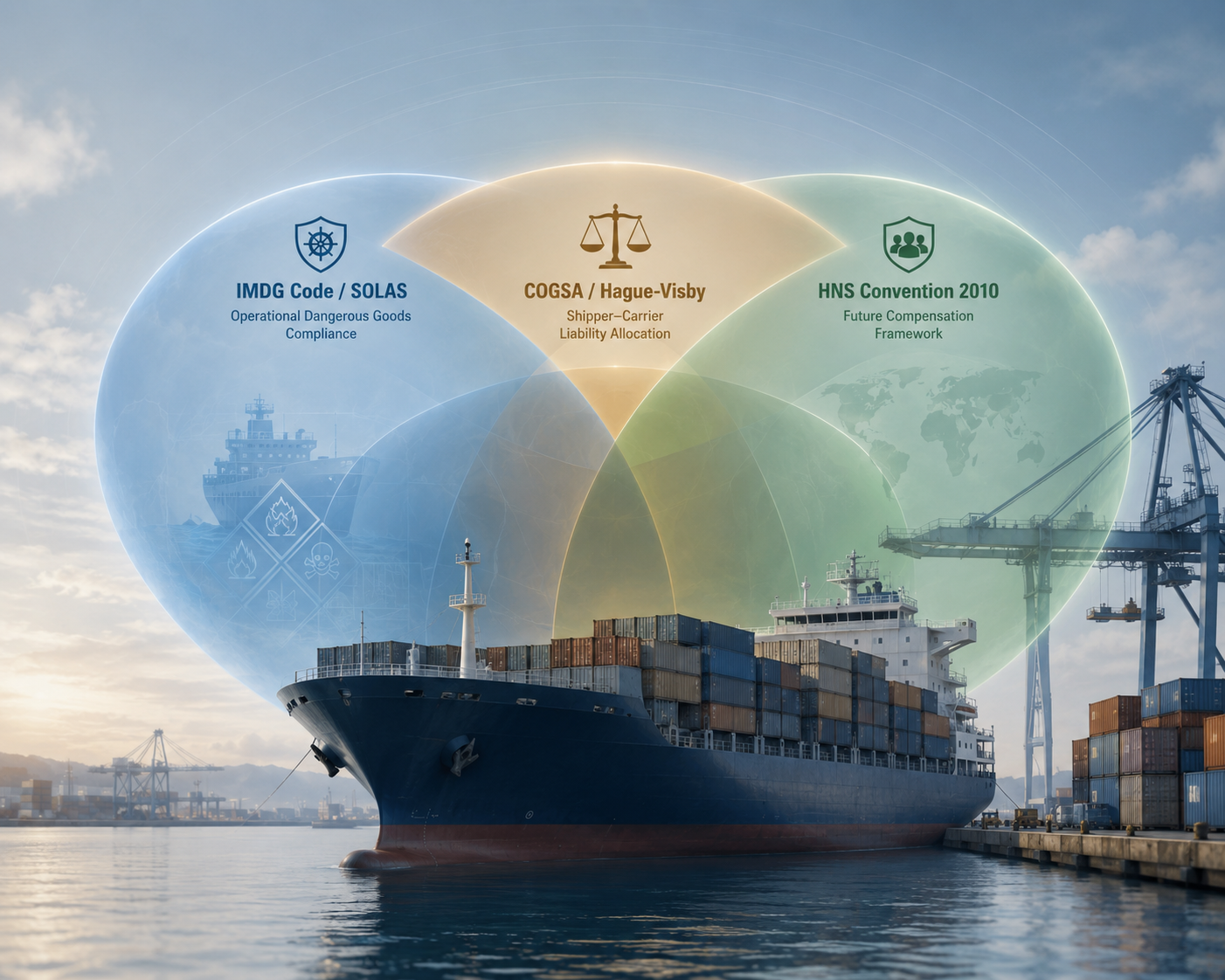
The HNS Convention belongs in the background because it shows where maritime hazardous-cargo compensation is headed, even though it does not govern this casualty. Its importance here is comparative, not controlling. [2]
Hill Dickinson's summary of the 2010 text describes strict shipowner liability with narrow defenses, insurance certificates for roughly 65,000 ships, and a two-tier structure that can reach a 250 million SDR ceiling overall, with the first tier around 100 million to 115 million SDR and a second-tier HNS Fund filling out the rest. [5]
That future regime matters because it shifts the compensation conversation away from proving fault in every case and toward proving whether the shipment fell within the treaty's HNS categories and insurance structure. But it will not be the law for a July 2026 Antwerp leak.
Antwerp's legal value is that it forces the regimes to line up against a real event rather than a tidy diagram. If the investigation shows a packaging failure, a misdeclared class, or a warning gap, liability can move quickly toward the shipper or other upstream actor; if it shows that the carrier accepted known dangerous cargo and handled it badly, the allocation changes too. Until the cause is known, the right answer is not a winner but the set of decisions that can still be proved.
References
- Port of Antwerp hydrogen fluoride leak report — AA.com.tr, July 2026
- HNS Convention entry-into-force announcement — IMO MediaCentre, 29 May 2026
- Hydrogen fluoride packaging requirements under 49 CFR 173.163 — eCFR
- COGSA Section 4(6) dangerous-goods case discussion — Steamship Mutual
- HNS Convention 2010 liability and insurance overview — Hill Dickinson
Comments
Join the discussion with an anonymous comment.