
The uncomfortable part of the July 15 approval is not that China’s cyberspace regulator allowed Apple Intelligence into a filing batch. It is that the approval arrived after Alibaba and Baidu had already been pulled deeper into the U.S. national-security record, and while Alibaba’s challenge to its Pentagon designation remained unresolved. The Cyberspace Administration of China registered Apple Intelligence among approved on-device generative AI services, but that does not mean Apple received a clean legal green light for China. It means Apple now has a Chinese regulatory file for a product architecture that U.S. officials can scrutinize through a different lens.[1]
That is the central legal problem in Apple’s Alibaba AI partnership. The same materials that help a foreign AI service satisfy China’s generative AI filing rules—local partner identity, parent-company relationships, data flows, technical integration, and model-routing decisions—are also the materials U.S. national-security agencies tend to examine when they ask whether a U.S. company has become operationally dependent on, or technologically entangled with, a Chinese ecosystem tied to military-civil fusion concerns.
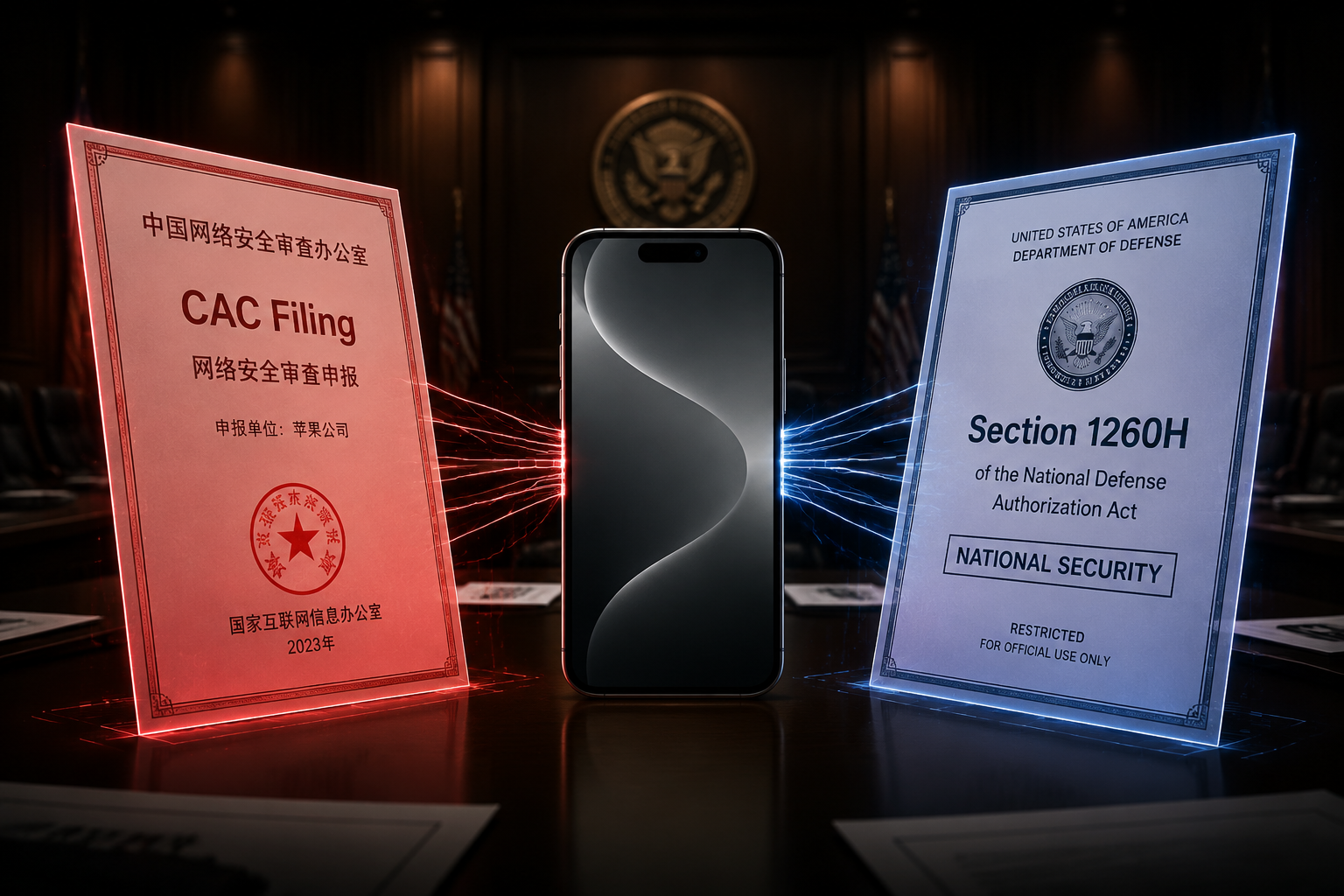
Approval Did Not End the Regulatory Story
The CAC approval came in a batch that reportedly included Apple Intelligence alongside six other on-device generative AI services from Samsung, Huawei, OPPO, vivo, Xiaomi, and Nubia.[2] That matters because the filing was not a private bilateral accommodation for Apple alone. It placed Apple’s China AI deployment into the same administrative channel as domestic and foreign device makers trying to put generative AI functions on handsets under China’s interim generative AI framework.
The public record remains narrower than many launch headlines imply. The July 15 registration confirmed regulatory progress, but it did not, on the available materials, specify a commercial launch date. Availability still depends on implementation steps such as security reviews and operating-system updates.[1] For counsel, that distinction is not cosmetic. A filing acceptance can create a record before it creates revenue.
The U.S. side of the record had already shifted. The Pentagon added Alibaba and Baidu to its Section 1260H Chinese military company list on June 8, 2026; earlier Reuters reporting had described Pentagon efforts to add Alibaba, Baidu, and BYD to the list.[3] Alibaba then filed a federal lawsuit in San Jose challenging the designation framework, and secured a temporary reprieve on a lobbying prohibition on July 5, 2026.[4] That reprieve did not resolve the underlying constitutional challenge.
So the legal posture on July 15 was not “China approved, issue closed.” It was closer to this: China had accepted Apple’s regulated path for an AI service built with Chinese partners, while the U.S. national-security apparatus had placed those partners in a category designed to warn the market about military-linked risk.
The Timeline Shows the Trap Forming
The sequence matters because no single event created the double bind. It accumulated through documents, letters, delay notices, technical incidents, agency lists, court filings, and finally a CAC approval.
| Date | Event | Legal significance |
|---|---|---|
| February 2025 | Alibaba chairman Joe Tsai said Apple would integrate Alibaba’s AI into iPhones in China. | The commercial partner became public before the regulatory file was complete.[5] |
| May 2025 | The House Select Committee on China scrutinized the Apple-Alibaba arrangement through letters to Apple’s CEO. | Congressional attention moved the deal from product localization into U.S. national-security oversight.[6] |
| June 2025 | Apple and Alibaba’s AI rollout in China was delayed amid the Trump trade-war context. | Market-access timing became linked to broader U.S.-China policy friction.[7] |
| March 2026 | Apple Intelligence was briefly pushed to Chinese iPhones for about three hours. | A technical deployment error raised questions under algorithm filing and cross-border data transfer rules.[8][9] |
| June 8, 2026 | Alibaba and Baidu were added to the Pentagon’s Section 1260H list. | The China partners became higher-risk counterparties for U.S. national-security review.[3] |
| July 5, 2026 | Alibaba obtained a temporary reprieve related to a lobbying prohibition while its lawsuit continued. | The immediate constraint narrowed, but the underlying designation dispute remained pending.[4] |
| July 15, 2026 | CAC registered Apple Intelligence in an approval batch for on-device generative AI services. | Apple obtained Chinese regulatory progress while preserving a documentary record of the partnership.[1][2] |
The eighteen-month arc is important because it leaves little room for the fiction that this is merely a launch-delay story. By the time the Chinese filing moved forward, the U.S. side had already generated committee correspondence, list-designation activity, and active litigation around one of Apple’s core China AI partners.
What the CAC Filing Likely Forces Into the Record
China’s Interim Measures for Generative AI, effective under a seven-agency framework from August 2023, require foreign AI providers to use an onshore Chinese legal path and provide documentation addressing matters such as overseas parent-company relationships.[2] For a handset AI service, the practical file does not stop at a corporate name. Regulators need to understand who provides the model, where the service is operated, how user requests are processed, and which domestic entity bears compliance responsibility.
That obligation is manageable when all legal regimes ask the same basic question: who is responsible if the AI service produces unlawful content or mishandles data? It becomes harder when one jurisdiction wants proof of local control and another treats proof of local integration as a national-security concern. Apple’s China file therefore cannot be assessed only as a CAC deliverable. It is also a potential evidentiary map of dependencies.
The available reporting indicates a multi-partner China architecture: Alibaba’s Qwen for large-language-model functions, Baidu for vision-related functions, and firmware-level flexibility that could allow provider switching.[10] That kind of design is often described as technical modularity, but here it also reads as legal risk management. If a provider becomes harder to use because of U.S. export-control, sanctions, procurement, or list-designation developments, the product needs some ability to route around the legal event without rebuilding the entire device experience.
The same modularity can create its own questions. If Apple can switch providers at the firmware level, Chinese regulators may want to know which provider is actually serving which function, under which approval, and with what update controls. U.S. reviewers may ask a different version of the same question: whether the architecture transfers know-how, embeds dependence, or normalizes Chinese model providers inside a U.S. company’s flagship device ecosystem.
Data Localization Is Not Just a Hosting Question
Data localization is sometimes discussed as though it were a server-location issue. In a China AI filing, it is more operational than that. The company must be able to explain which data is collected, where it is processed, how the local service connects to overseas systems, and what cross-border transfer controls apply. The March 2026 accidental rollout shows why these details are not theoretical.
Apple reportedly pushed Apple Intelligence to Chinese iPhones for about three hours before access was withdrawn.[8] Bridge IP Law Commentary assessed that the incident could raise issues under China’s algorithm filing rules and cross-border data transfer laws, while also estimating a low likelihood of public penalties because of the technical-error defense and diplomatic considerations.[9] That is a careful conclusion, and it should stay careful: the incident does not prove enforcement would follow every mistake, but it does show how quickly a technical event can become a regulatory file.
For a compliance team, a three-hour rollout is not just an engineering postmortem. Someone has to determine whether users were exposed to an unfiled algorithmic service, whether prompts or device data crossed a border, whether logs exist, whether a regulator must be notified, and whether the explanation given to one government creates a record the other government can later subpoena, request, or cite.

Section 1260H Does Not Automatically Ban Everything, but It Changes the File
Section 1260H designation is often overstated in public commentary. It is not, by itself, the same thing as a comprehensive sanctions prohibition. But understating it is just as dangerous. The list is a formal U.S. government statement that a company is treated as a Chinese military company for statutory purposes, and it can become a staging point for downstream measures, including NS-CMIC sanctions pressure or BIS Entity List risk.
Alibaba’s lawsuit keeps that status legally unsettled. The company’s federal challenge to the Pentagon designation remains pending, and the July 5 temporary reprieve addressed an immediate lobbying-related issue rather than the underlying constitutional question.[4] A U.S. company contracting with Alibaba therefore cannot sensibly treat the designation as either irrelevant or finally resolved.
The problem for Apple is that the Chinese filing process may require it to describe, in a disciplined way, the very facts that make a Section 1260H relationship sensitive: who supplies the AI capability, how deeply it is integrated, whether any technical information is exchanged, whether Apple personnel support adaptation or evaluation, and whether the China-specific architecture creates a dependency that cannot be quickly unwound.
Congressional scrutiny increases the cost of loose drafting. In May 2025, the House Select Committee on China sent letters to Apple’s CEO raising concerns about the Alibaba AI deal.[6] Once that happens, contractual descriptions, board materials, regulatory filings, and public statements should be assumed to live in the same factual universe. The risk is not that every sentence becomes unlawful. The risk is that inconsistent or overly optimistic descriptions collapse when agencies compare the records.
Why the Multi-Vendor Architecture Matters
The reported use of Alibaba for language functions and Baidu for vision functions is not a minor implementation note.[10] It divides regulated AI capability by function. That may help Apple satisfy China’s expectations for domestic providers while preserving some technical flexibility. It may also limit the consequence of a single provider becoming unavailable, challenged, or newly restricted.
But provider splitting is not the same as legal insulation. If both major providers are on the Section 1260H list, swapping between them does not necessarily move Apple out of the U.S. national-security concern zone. It may reduce operational concentration, but it does not eliminate the question whether Apple’s China AI product depends on listed Chinese technology providers.
The more useful question is narrower: what can be separated? A multinational can separate model-provider obligations from device-maker obligations. It can limit technical disclosure. It can require local partners to own China-specific content compliance tasks. It can create termination, suspension, and provider-substitution rights tied to sanctions, export controls, and military-company designations. It can document that U.S. personnel are not transferring controlled technology. None of that solves the conflict, but it gives the company a defensible operating record.
Where Compliance Teams Lose Room to Maneuver
The hardest point comes after business leadership decides that China market access is strategically necessary. At that point, legal teams are usually not choosing between a clean launch and a risky launch. They are choosing which risk gets documented, which risk gets contractually allocated, and which risk gets escalated before an agency or committee asks for the record.
- The CAC file needs enough specificity to satisfy Chinese regulators, but excessive detail can create admissions about integration depth.
- The U.S. risk file needs enough analysis to show diligence, but conclusory comfort memos can become damaging if the facts later show operational dependence.
- The product architecture needs provider flexibility, but every switching path may itself require regulatory explanation.
- The contract needs local compliance allocation, but allocation does not prevent U.S. agencies from examining the underlying relationship.
- The launch plan needs speed, but even a temporary deployment error can trigger algorithm, data-transfer, and disclosure questions.
This is why CAC approval can be legally adverse as well as commercially useful. It confirms that the company has entered the local compliance channel. It may also confirm that the company has accepted a China-specific architecture dependent on partners now relevant to U.S. national-security review.
A Practical Operating Posture
The practical path is not to pretend that one regime can be made invisible to the other. The path is to rank risks, separate obligations, and keep the record disciplined.
- Use risk-tiered compliance review: distinguish mandatory China filing content from optional technical narrative and keep unnecessary integration detail out of regulatory submissions.
- Separate contractual obligations: assign China content, algorithm, and data-localization duties clearly to local partners while preserving audit, suspension, and termination rights.
- Monitor U.S. export-control and sanctions developments continuously: Section 1260H may not be a full prohibition, but it can precede more restrictive measures.
- Track Alibaba’s litigation closely: the temporary reprieve does not settle the constitutional challenge or remove uncertainty for U.S. counterparties.
- Prepare incident files before launch: deployment errors, rollback logs, user-exposure analysis, and data-flow assessments should be ready before a regulator asks.
For Apple, the legal double bind is now visible in the sequence of public records. China’s regulator has moved the product forward. U.S. agencies and lawmakers have preserved the national-security question. Alibaba’s designation fight remains unresolved. CAC approval is therefore not the end of the legal problem. It is evidence that Apple has entered it.
This article is for informational purposes only and does not constitute legal advice. The legal consequences of AI filings, Section 1260H designations, sanctions exposure, export controls, and data-transfer obligations are jurisdiction-specific and unsettled; companies should seek qualified counsel in the relevant jurisdictions.
References
- Apple Intelligence AI service registered with Chinese cyberspace regulator, Reuters, July 15, 2026.
- Apple Wins Chinese Approval to Roll Out Apple Intelligence, GeopoliTechs, July 2026.
- Pentagon seeks to add Alibaba, Baidu, BYD to China military list, Reuters, November 26, 2025.
- Alibaba Challenges Pentagon Over Chinese Military Companies List Designation, BISI, July 2026.
- Apple will integrate Alibaba's AI into iPhones in China, Chairman Joe Tsai says, CNBC, February 13, 2025.
- Apple's Alibaba A.I. Deal Provokes Washington's Resistance, The New York Times, May 17, 2025.
- Apple and Alibaba's AI rollout in China delayed by Trump's trade war, Reuters, June 4, 2025.
- Apple's accidental AI feature roll-out in China risks regulatory backlash, expert says, South China Morning Post, March 2026.
- Apple Intelligence's Unauthorized Rollout in China: A Technical Accident or a Deliberate Regulatory Game?, Bridge IP Law Commentary, March 2026.
- Apple Intelligence approved for launch in China with Alibaba and Baidu, TechCrunch, July 16, 2026.
Comments
Join the discussion with an anonymous comment.