
Apple’s China AI milestone is easy to overread. On July 8, 2026, Apple filed Apple Intelligence with the Cyberspace Administration of China; on July 15, it appeared on the regulator’s approved list, nearly 22 months after Apple Intelligence launched in the United States in June 2024. The registration covers seven on-device generative AI services for smartphones and places Apple on a list that also includes Huawei, OPPO, vivo, Xiaomi, Samsung, and Nubia.[1]
That is not the same thing as a clean product launch. The sharper question is what Apple had to make acceptable: legally, through China’s layered AI filing system; technically, through an on-device-first architecture; and commercially, through Chinese model partners. For multinational counsel studying the legal and regulatory implications of Apple’s China AI partnerships, the value of this registration is not that Apple found a shortcut. It is that Apple made the cost of market entry visible.
Registered for What, Not Just Registered
The first narrowing matters. Apple did not receive a blanket approval for every feature that might sit under the Apple Intelligence brand. The reported registration is limited to seven on-device generative AI services for smartphones.[1] That boundary explains much of the architecture that follows. A local-computation service raises different questions from a cloud service that moves prompts, images, voice recordings, or other personal information across systems and potentially across borders.
On-device approval came first because it fits the least destabilizing regulatory path. Local computation reduces the need to trigger cross-border data transfer review and gives Apple a better story on containment: the device processes more, external routing does less. That does not make the product regulation-free. It only changes the set of controls that legal, privacy, engineering, and release-management teams have to coordinate.
Cloud-based AI features remain on a harder track. China’s amended Cybersecurity Law, effective January 1, 2026, expanded data localization mandates, and CAC cross-border data transfer security assessments typically take 6 to 12 months.[2] Apple already stores Chinese iCloud user data on servers operated by state-owned GCBD in Guizhou, a precedent that shows the kind of domestic data architecture China can require before sensitive digital services reach users.[1]
Biometric data makes that architecture still more sensitive. AI functions that touch faces, voices, camera inputs, or recognition tasks can implicate the strictest controls under China’s Personal Information Protection Law. A registration for smartphone-based on-device generative services should not be treated as an answer for cloud AI, Siri integration, visual recognition, or biometric processing at scale.[2]
The Dual Filing Is the Compliance Lesson
The approval path was not a single filing lane. Apple’s process required two regulatory tracks: an LLM security assessment filing under China’s Interim AI Measures, which took effect in August 2023, and an Algorithm Recommendation Filing under the 2022 algorithmic recommendation provisions.[2][3] For foreign AI providers, this is the part of the Apple template that travels most directly.
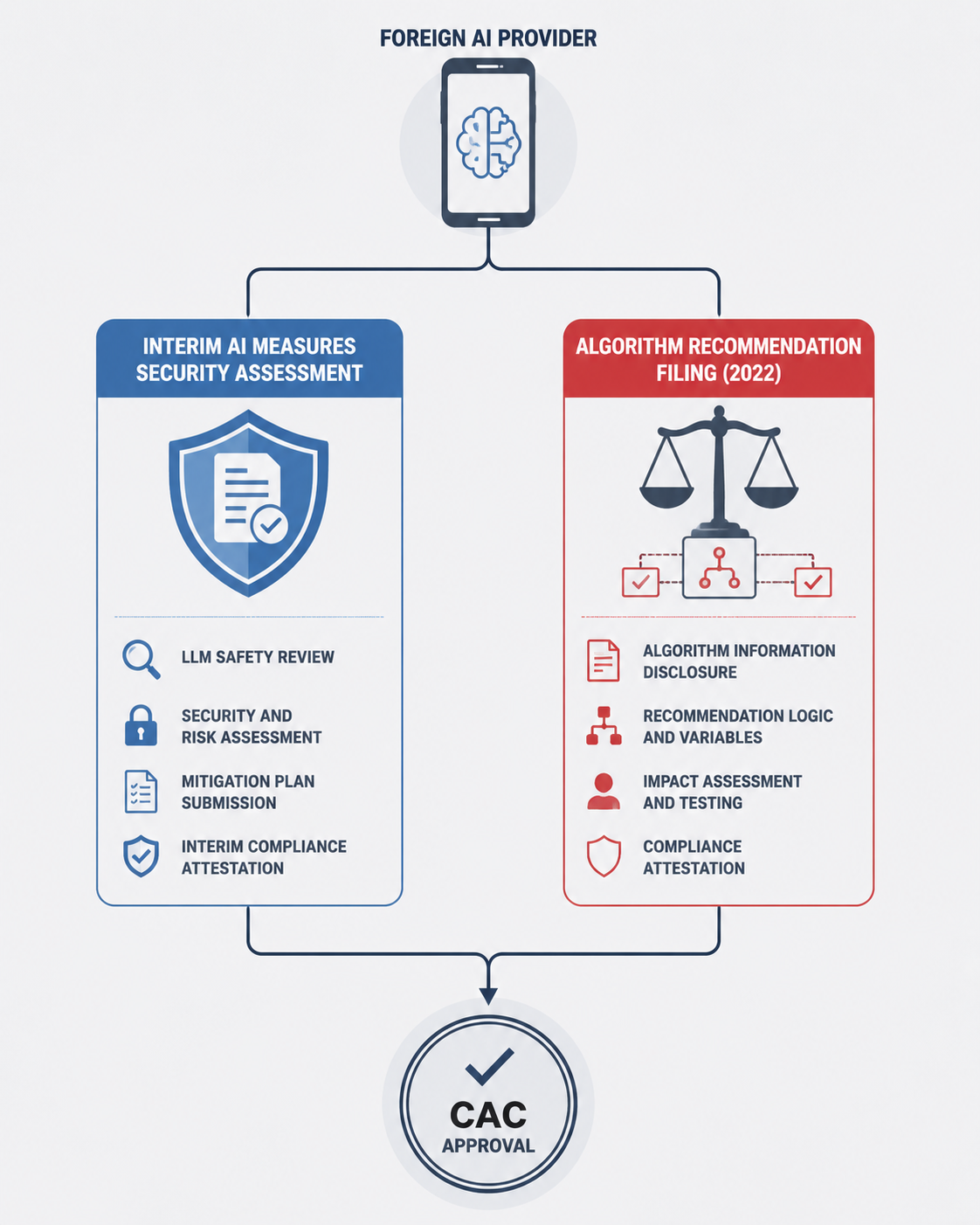
The Interim AI Measures track asks whether the generative AI service can satisfy China’s security and content-governance expectations. The algorithm filing track is different. It deals with algorithmic recommendation services and the administrative visibility regulators expect over systems that shape information flows. One filing looks toward the generative model and its safety posture; the other looks toward the algorithmic service embedded in a consumer product.
| Regulatory track | What it does in practice | Why it matters for foreign providers |
|---|---|---|
| Interim AI Measures security assessment | Places the generative AI service and LLM-related controls before Chinese regulators | Requires a China-facing safety, content, and provider-control posture rather than a translated global launch memo |
| 2022 Algorithm Recommendation Filing | Registers algorithmic recommendation functions that affect information presentation and user interaction | Forces product counsel to map AI features into existing algorithm governance categories |
The filing architecture also changes the work inside the company. A product team cannot simply ask whether a feature is “AI” and send one regulatory packet. It has to classify the service, identify whether recommendation functions are present, document model and algorithm behavior, align with local content controls, and preserve enough operational flexibility to respond if the CAC later demands changes.
That last point is not theoretical. CAC filing is an entry ticket, not launch clearance. Apple must still complete security reviews, feature localization, and operating-system updates before activation, and the CAC can order algorithm modifications, content removal, or service suspension with immediate compliance required.[3][4] A registration listing may satisfy one launch dependency while leaving legal ops with several unresolved gates.
Why Alibaba and Baidu Are Legal Infrastructure
Apple’s domestic partnership structure is not just a vendor story. Alibaba’s Qwen reportedly serves as the primary LLM for text and image generation across iOS, iPadOS, macOS, and visionOS, while Baidu handles camera recognition and visual search.[5][6] Those roles correspond to regulatory pressure points: language and image generation on one side, visual recognition and camera-mediated search on the other.
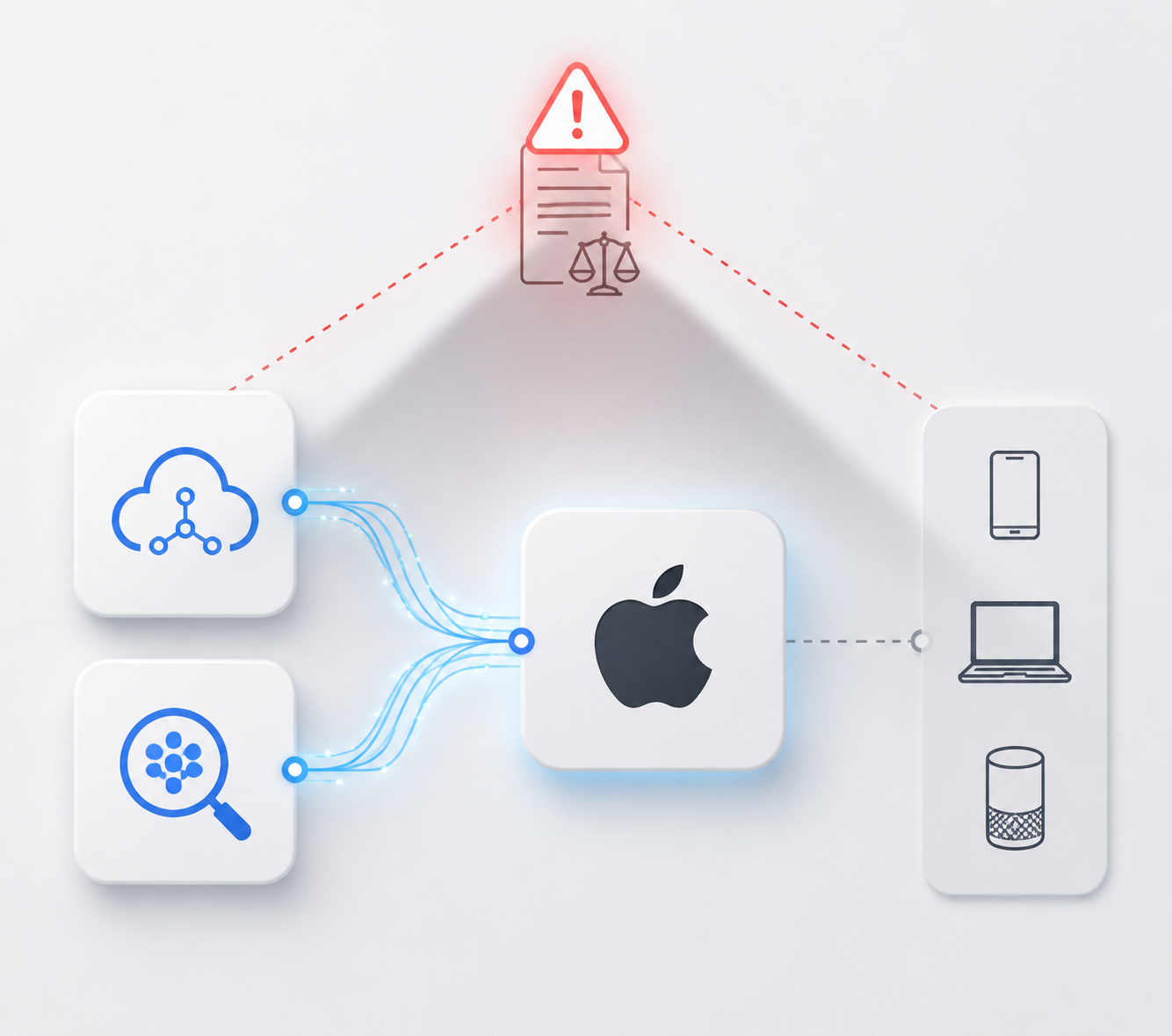
For China market entry, a domestic LLM partner does more than improve localization. It gives regulators an accountable local stack and reduces reliance on a foreign model provider for sensitive generation tasks. It can also make content controls, local hosting, incident response, and administrative communications more legible to the CAC. That is why the Apple arrangement matters as a compliance architecture, not only as a commercial compromise.
The reported multi-vendor switching mechanism is just as important. Apple built provider selection into system firmware so the device can dynamically choose providers by geography and function, a design described as a way to prevent any single Chinese AI company from gaining leverage.[7] The internal rationale has not been officially disclosed by Apple, so that explanation should remain attributed to reporting and analysis rather than treated as an Apple admission.
Even with that caution, the compliance logic is clear. A multi-vendor design gives the company more options if a partner’s model, filing status, enforcement posture, or geopolitical risk changes. It also gives regulators a cleaner functional map: one provider for text and image generation, another for camera recognition and visual search. For counsel, the hidden work is in the contracts and controls: audit rights, incident reporting, model-change notification, data-use limits, localization commitments, and an exit plan that does not break the product.
Samsung’s Galaxy AI approach in China reportedly follows a similar domestic-partner pattern, suggesting that this is becoming a market standard rather than an Apple-only accommodation.[7] But “standard” does not mean cheap, sufficient, or portable. Smaller providers may not be able to negotiate comparable switching rights, firmware-level routing, or partner redundancy. They still have to meet the same regulatory expectations with less leverage.
The March 2026 Incident Shows Why Release Gates Matter
The clean filing sequence came after a messier warning. On March 31, 2026, Apple accidentally pushed Apple Intelligence and Siri beta functionality to some mainland Chinese users before receiving regulatory approval.[8] For a global software company, the operational failure is familiar: feature flags, regional eligibility, beta channels, OS builds, and server-side availability do not always respect the same borders that law does.
Shanghai-based IP lawyer You Yunting said the accidental rollout violated AI security evaluation and algorithm filing rules and exposed Apple to administrative penalty risk, including service suspension.[8] That is not evidence that the harshest penalties were likely, and the research does not show a completed enforcement action. It does show why a regulatory listing has to be converted into a launch checklist before code reaches devices.
The practical control is not glamorous. Someone has to tie CAC filing status to build eligibility, localization readiness, partner routing, data-processing maps, app-store or OS-release timing, and customer-support scripts. In cross-border AI, compliance staging is not a legal memo sitting beside the product. It is a release condition inside the product.
Penalty Exposure Is Real, but It Should Be Sized Correctly
China’s penalty framework gives regulators meaningful leverage. Under PIPL, violations can carry fines of up to 50 million RMB or 5% of annual revenue, and criminal violations under China’s criminal law can carry imprisonment of up to seven years.[9] Those are statutory maximums, not a prediction of what Apple or any comparable provider would face in a given incident.
The CAC’s April 2025 “Clear and Bright Crackdown on AI Technology Abuse” campaign also matters, although enforcement patterns are still developing.[9] The relevant point for legal teams is not to dramatize every defect as a criminal case. It is to recognize that Chinese regulators have several tools short of maximum fines: ordering modifications, requiring content removal, suspending services, delaying launches, or conditioning future approvals.
The US-China Conflict Built Into the Partner Model
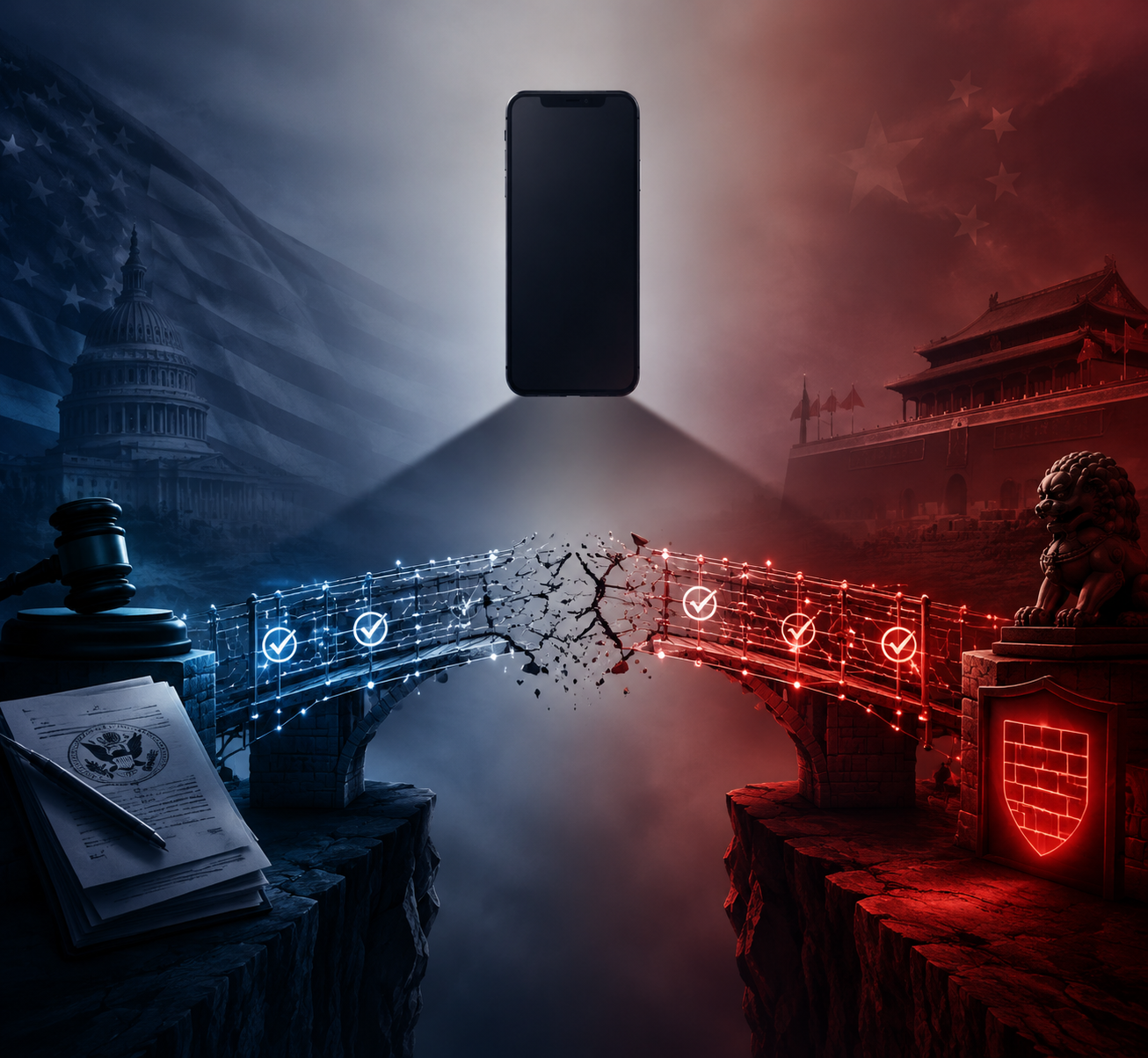
The same partner model that helps satisfy Chinese expectations creates a separate US-law tension. In June 2026, the US Department of Defense added both Alibaba and Baidu to the Section 1260H Chinese Military Companies List.[7] The research does not show any documented US enforcement action against Apple for these partnerships. The risk is unresolved, not current enforcement.
That distinction matters because Section 1260H exposure is easy to inflate in public discussion. A list designation is not the same thing as a sanctions prohibition, and it does not by itself establish that a particular commercial integration is unlawful. But it does change the diligence environment. A US company relying deeply on designated Chinese technology providers for consumer AI functions must be prepared to explain the scope of the relationship, the nature of data access, the contractual controls, and any contingency plan if US policy hardens.
This is the uncomfortable center of the Apple template. China market access pushes foreign AI providers toward domestic model partners, local data controls, and regulator-visible architecture. US national-security policy can make those same dependencies more sensitive. A provider copying the structure has to solve both sides at once; it cannot treat Chinese approval as the end of the legal analysis.
What the Apple Template Actually Gives Foreign Providers
Apple’s July 2026 registration gives foreign AI providers a workable map, not a safe harbor. The map has several visible components: dual filing, domestic LLM partnerships, on-device-first feature scoping, localized data architecture, partner-specific routing, and release gates that prevent accidental activation before regulatory conditions are met.
- Classify the AI service before filing: generative model functions and algorithmic recommendation functions may trigger different regulatory tracks.
- Limit the first launch to features whose data flows can be explained, localized, and technically constrained.
- Use domestic partners only with a clear allocation of model function, data access, incident duties, and change-control obligations.
- Treat CAC listing as one dependency in a launch system, not as permission for every OS build, beta channel, or cloud feature.
- Run US sanctions, export-control, procurement, and national-security diligence in parallel with China compliance work, not after partner selection.
What the template does not give is equally important. It does not announce a launch date for Apple Intelligence in China. It does not resolve cloud-based AI functions or Siri-related capabilities. It does not eliminate CAC authority to intervene after registration. It does not make biometric data processing routine. And it does not settle the Section 1260H tension created by reliance on Alibaba and Baidu.
The nearly 22-month gap between Apple’s US launch and China registration is the compliance cost in calendar form. Apple has shown a path foreign AI providers can study: make the product locally fileable, locally partnered, locally routed, and technically staged. But any company following that path still has to earn launch clearance feature by feature, keep its China data posture defensible, and live with the unresolved conflict between Chinese data-sovereignty requirements and US scrutiny of Chinese AI partners.
References
- Apple Intelligence AI service registered with Chinese cyberspace regulator, Reuters, July 15, 2026
- AI Watch: Global regulatory tracker - China, White & Case
- China AI Regulations 2026: Rules Companies Must Follow, Pertama Partners
- Apple Wins Chinese Approval to Roll Out Apple Intelligence, Geopolitechs
- Apple Gets Approval for iPhone AI in China With Alibaba, Baidu, Bloomberg
- Apple Intelligence approved for launch in China with Alibaba and Baidu, TechCrunch
- Apple Wins Chinese Approval to Roll Out Apple Intelligence, Geopolitechs
- Apple's accidental AI feature roll-out in China risks regulatory backlash, expert says, South China Morning Post, March 2026
- AI Regulatory Landscape and Development Trends in China - Data Protection Laws and Regulations 2025, ICLG / Fangda Partners
Comments
Join the discussion with an anonymous comment.