
Apple Intelligence was registered with China’s cyberspace regulator on July 15, 2026, giving Apple a regulatory foothold for bringing its generative AI features to Chinese users.[1] That sentence is easy to overread. Registration is not the same thing as a public launch date, a confirmed final feature list, or proof that the China version will operate exactly like Apple Intelligence elsewhere. It is better read as evidence that Apple has moved through a set of filings, partnerships, and governance commitments sufficient for the Cyberspace Administration of China to record the service.
For companies assessing the legal implications of Apple’s China AI partnership, the useful question is not whether Apple “won” approval. It is what had to be made true before that registration could happen: whose model would sit inside the product, which filings would be attached to the service, where China user data might be handled, and what content and labeling duties would follow the product after launch.

The registration headline sits on top of a local model arrangement
The most important commercial fact behind the registration is also a legal fact: Apple did not appear to be taking a foreign foundation model directly to Chinese consumers on its own. TechCrunch reported that Alibaba’s Qwen model would be integrated across iOS, iPadOS, macOS, and visionOS for Apple Intelligence in China.[2] Reuters had already reported in February 2025 that Alibaba chairman Joe Tsai confirmed an AI partnership with Apple for Chinese iPhones.[3]
That matters because China’s generative AI regime is built around accountable service provision, security assessment, model and algorithm filings, and content controls. Practitioner summaries of the framework describe a system in which public-facing generative AI services must be brought into the regulatory perimeter before deployment, and in which algorithmic recommendation and generative AI obligations can both be relevant to a single product.[4][5][6]
A local model partner therefore does more than improve product localization. It gives the foreign device maker a China-filed model layer and a domestic counterparty already operating inside the Chinese AI compliance environment. In Apple’s case, Alibaba’s Qwen role is more concrete in the available reporting than Baidu’s. The research record describes Baidu’s role only as developing Apple Intelligence features, not as supplying the same clearly identified, OS-wide model integration attributed to Alibaba.
Registration is better understood as a pathway, not a gate
China’s AI compliance pathway is not usefully reduced to a single approval stamp. The relevant map includes at least two filing tracks, service-provider obligations under the 2023 Interim Measures for generative AI services, algorithm governance rules, security expectations, and newer standards that make training data and labeling practices harder to treat as back-office choices.[4][6]
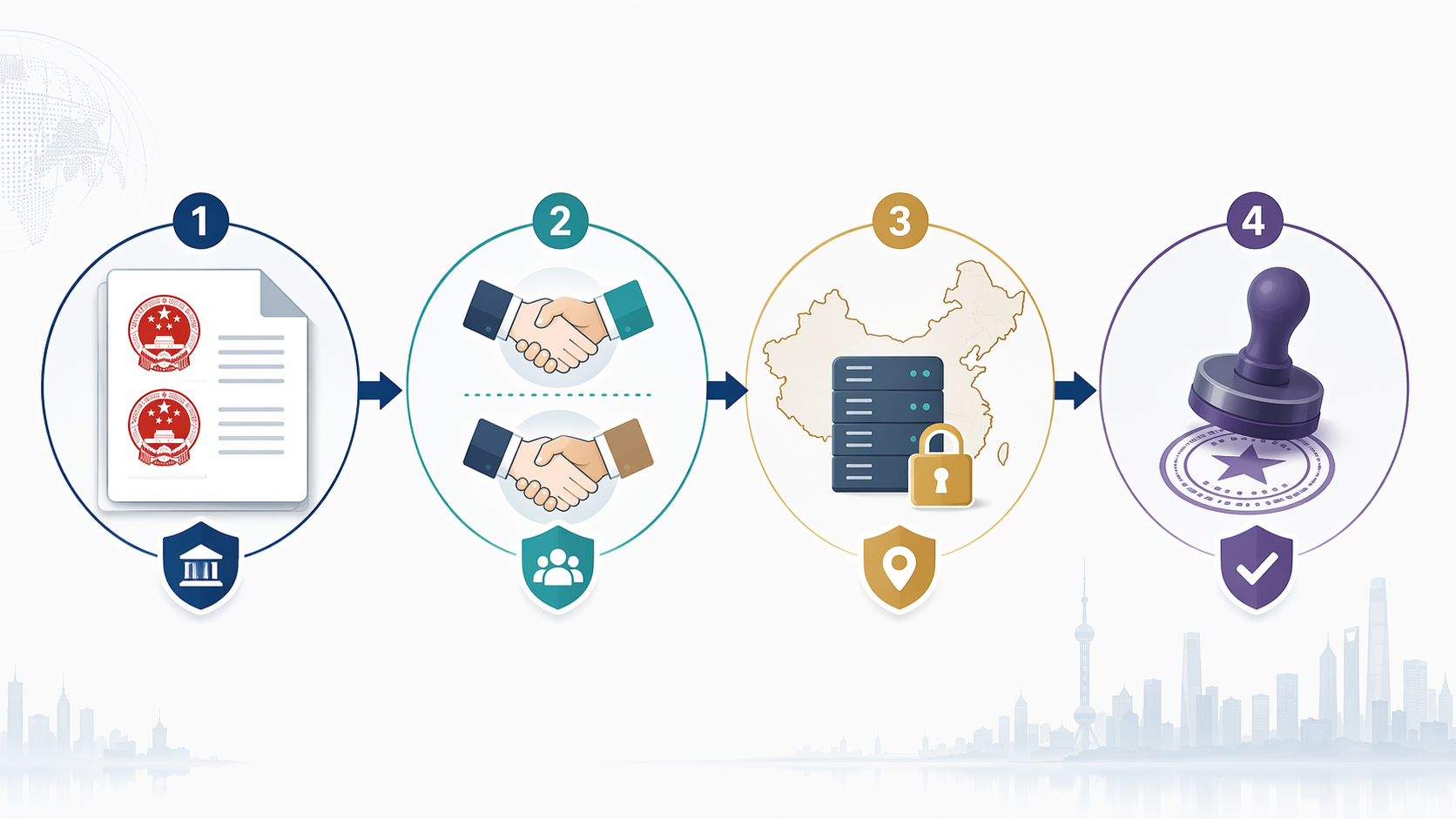
| Compliance layer | What it means for a foreign GenAI product |
|---|---|
| LLM filing | The model or service layer must be brought within China’s GenAI filing and security review expectations before public deployment. |
| Algorithm Filing | Recommendation, synthesis, ranking, or generation functions may trigger algorithm registration and disclosure obligations. |
| Local model partnership | A China-facing product may need to rely on a domestic model provider whose own compliance posture can support the filing. |
| Data localization | China user data handling may require localized infrastructure, contracts, and governance records. |
| AI labeling and standards | Generated or synthetic content must be labeled and governed under the newer compliance perimeter. |
The first filing layer is the generative AI or LLM filing. Practitioner accounts of China’s regime describe public-facing GenAI services as subject to filing and security assessment requirements, with special attention to training data legality, output safety, personal information protection, and measures to prevent unlawful or harmful content.[4][6] For Apple, the Alibaba arrangement appears to reduce a threshold problem: a foreign model not already cleared for China public use would be a poor foundation for a mass-market launch.
The second layer is Algorithm Filing. The point is not that every AI feature is the same kind of algorithmic recommendation service. The point is that a consumer AI system can combine generation, ranking, personalization, search assistance, and recommendation-like functions in ways that bring multiple regulatory instruments into view. ICLG’s Fangda Partners overview and Securiti.ai’s practitioner guide both describe a dual filing environment in which GenAI compliance and algorithm filing can operate together rather than as substitutes.[4][6]
This is where market-entry planning often becomes too casual. A company may think it is choosing a China model vendor for technical coverage, Mandarin quality, latency, or government-relations comfort. Those criteria matter, but the legal dependency is sharper: the partner’s filed model, content controls, training-data governance, and regulator-facing documentation can become part of the foreign company’s own launch architecture.
The 2025 standards turn training data into a documented control environment
The filing process is also no longer just a narrative about responsible AI principles. The 2026 ICLG/Fangda Partners overview identifies three national standards taking effect in November 2025: GB/T 45654-2025, GB/T 45652-2025, and GB/T 45674-2025.[4] The research brief describes these standards as setting security and training-data expectations for generative AI systems. For counsel, that shifts the conversation from “can we explain the model?” to “can we evidence the controls behind the model?”
That distinction is practical. Training-data compliance asks who collected the data, what rights or permissions attach to it, whether sensitive personal information is involved, how illegal or harmful content was filtered, and how the service provider can answer if a regulator asks for the basis of those controls. If the China-facing version of a product depends on a partner model, the foreign company still needs enough visibility to defend its own launch decision. A contractual promise from the model provider may be necessary, but it is rarely enough by itself.
This is one reason Apple’s route is more instructive than a clean-room hypothetical. Apple markets Apple Intelligence globally as deeply integrated into the device and operating system experience. In China, the regulatory record points toward a different implementation posture: the user-facing product remains Apple’s, but the model and compliance scaffolding appear to rely on domestic partners and China-specific filings.[1][2][3]
Data localization is the most visible unresolved issue
The available materials support a cautious conclusion on data localization, not a definitive one. Apple has not publicly described how Private Cloud Compute, Apple Intelligence requests, or any China-specific cloud processing will be adapted for Chinese users. The safest statement is that Apple’s China AI launch would likely require localized data arrangements and regulator-comfortable operational controls, but the exact architecture has not been confirmed.
The reason this issue attracts attention is Apple’s existing China precedent. In 2018, Apple moved Chinese iCloud operations to a local arrangement with Guizhou-Cloud Big Data, a state-linked Chinese partner.[7] CNBC’s 2024 coverage also captured analyst concerns that Apple’s privacy-forward AI model would face hard questions in China, including how data would be stored, processed, and made available under local law.[7]
That precedent does not prove the design of Apple Intelligence in China. It does, however, explain why privacy and infrastructure questions should be treated as operating assumptions for any foreign company planning a similar launch. A China deployment plan that stops at model selection and filings is incomplete if it has not assigned responsibility for data residency, access controls, incident response, regulator requests, audit trails, and cross-border transfer analysis.
For legal operations teams, the data-localization work is also where product diagrams start to matter. A compliance memo that says “China data stays in China” is not enough if the product team cannot show which prompts, embeddings, logs, attachments, diagnostics, and feedback signals are stored, routed, retained, or deleted. Generative AI services produce more than a simple account record. They produce input content, generated output, safety classifications, model-evaluation data, and support records that may each need a place in the governance map.
AI labeling adds a second life to generated content
China’s AI Labeling Measures, effective September 1, 2025, widen the compliance perimeter beyond model approval and data handling.[4] Once synthetic or AI-generated content moves through a consumer product, the company needs processes for labeling, user disclosure, and downstream recognition. This is not merely a front-end design issue. It affects product copy, interface logic, metadata practices, developer guidance, moderation queues, and recordkeeping.
Apple’s China version will likely need to translate labeling obligations into the polished interface expectations of its ecosystem. Other companies may have less room to hide the operational seams. If a service generates images, rewrites messages, summarizes documents, or produces assistant responses, the compliance team needs to know which outputs require visible labels, which require embedded or machine-readable identifiers, and how those labels survive sharing or export.
National security and chip policy sit in the background, but they are not background work
The China-side AI rules are not the only constraints around a foreign company’s GenAI deployment. U.S. export controls and chip-policy changes can affect what infrastructure, chips, cloud services, and technical support are available for AI workloads connected to China. Mayer Brown’s January 2026 analysis describes a BIS rule shift, Section 232 tariff activity, and know-your-customer requirements for advanced AI chips, while noting the unsettled enforcement and policy environment.[8]
For Apple, those constraints sit alongside a highly controlled hardware and services ecosystem. For smaller foreign entrants, they may determine whether a proposed China architecture is commercially realistic. A model-serving design can be acceptable under Chinese filing rules and still run into supply-chain, cloud, export-control, or tariff friction. That is why the compliance plan should be built with product, infrastructure, procurement, and export-control counsel in the same room.
What other foreign companies can infer from Apple
Apple’s registration shows that China is not categorically closed to a major U.S. consumer GenAI product. It does not show that foreign companies can bring their global AI stack into China with minor edits. The more defensible inference is that entry is possible when the product is reassembled around local model dependency, China-specific filings, localized data handling, and content-governance controls.
The first practical lesson is to identify the China-facing regulated service, not just the global product name. Regulators and filing teams will care about what the product does: whether it generates text, images, code, summaries, recommendations, rankings, or personalized responses; whether it is public-facing; whether minors or sensitive sectors are involved; and whether outputs can shape public opinion or distribute prohibited content.
The second lesson is to diligence the local model partner as a compliance dependency. A model partner should be assessed for filing status, training-data controls, content-safety systems, incident response, regulator-facing experience, audit cooperation, subcontractors, and the technical boundary between the partner’s model and the foreign company’s application layer. The contract should reflect those dependencies, but the operating model has to prove them.
The third lesson is to budget for permanent governance. China AI compliance is not exhausted by the packet submitted before launch. A public GenAI service will need update procedures, model-change review, labeling workflows, user complaint handling, safety testing, content incident escalation, personal-information controls, and records that survive staff turnover. The registration headline is the visible event; the maintenance burden is the cost center.
The fourth lesson is to keep the source hierarchy straight. A CAC registration confirmation is stronger evidence than analyst commentary. A named partnership announcement is stronger than speculation about infrastructure. Practitioner guides are useful for mapping obligations, but they are interpretations rather than official legal advice. Companies should use them to frame questions for Chinese counsel, not to replace a product-specific filing strategy.
The precedent is operational concession, not regulatory simplicity
Apple’s registration is a blueprint, but not a shortcut. Foreign companies should read it as proof that China market entry for GenAI remains possible when a company is willing to build local legal architecture into the product itself. The operating cost is that the architecture does not disappear after registration. It becomes part of how the product is launched, updated, explained, audited, and defended.
References
- Apple Intelligence AI service registered with China's cyberspace regulator, Reuters, July 15, 2026
- Apple Intelligence approved for launch in China with Alibaba's Qwen AI, TechCrunch, July 16, 2026
- Alibaba chairman confirms AI partnership with Apple for Chinese iPhones, Reuters, February 13, 2025
- AI Regulatory Landscape and Development Trends in China, ICLG / Fangda Partners, 2026 edition
- Shape of China's AI regulations and prospects, Law.asia
- Navigating China's AI Regulatory Landscape in 2025, Securiti.ai
- Apple AI push faces big challenges in China, CNBC
- Administration Policies on Advanced AI Chips Codified, Mayer Brown, January 2026
Comments
Join the discussion with an anonymous comment.