
Apple’s complaint against OpenAI is most interesting for what it does not ask the court to do. It does not lead with the proposition that former Apple employees know too much to work on competing AI hardware. It does not ask a California federal court to treat memory, experience, or career movement as contamination. Instead, the 41-page complaint filed on July 10, 2026, in the Northern District of California tries to make a narrower and more litigation-useful point: if OpenAI and io Products acquired Apple trade secrets, they allegedly did so through identifiable acts, documents, devices, access paths, interview tactics, communications, and supplier-facing conduct.[1]
That choice matters because the legal implications of Apple’s lawsuit against OpenAI turn less on whether Apple is worried about a rival hardware program, and more on whether Apple pleaded facts that California law will allow to proceed. Business and Professions Code § 16600 makes non-compete restraints generally unenforceable in California, and Whyte v. Schlage Lock Co. rejected the inevitable disclosure doctrine in 2002.[2] A complaint that sounds like “these employees inevitably will use what they know” is not merely weak rhetoric in that environment. It is a legal vulnerability.
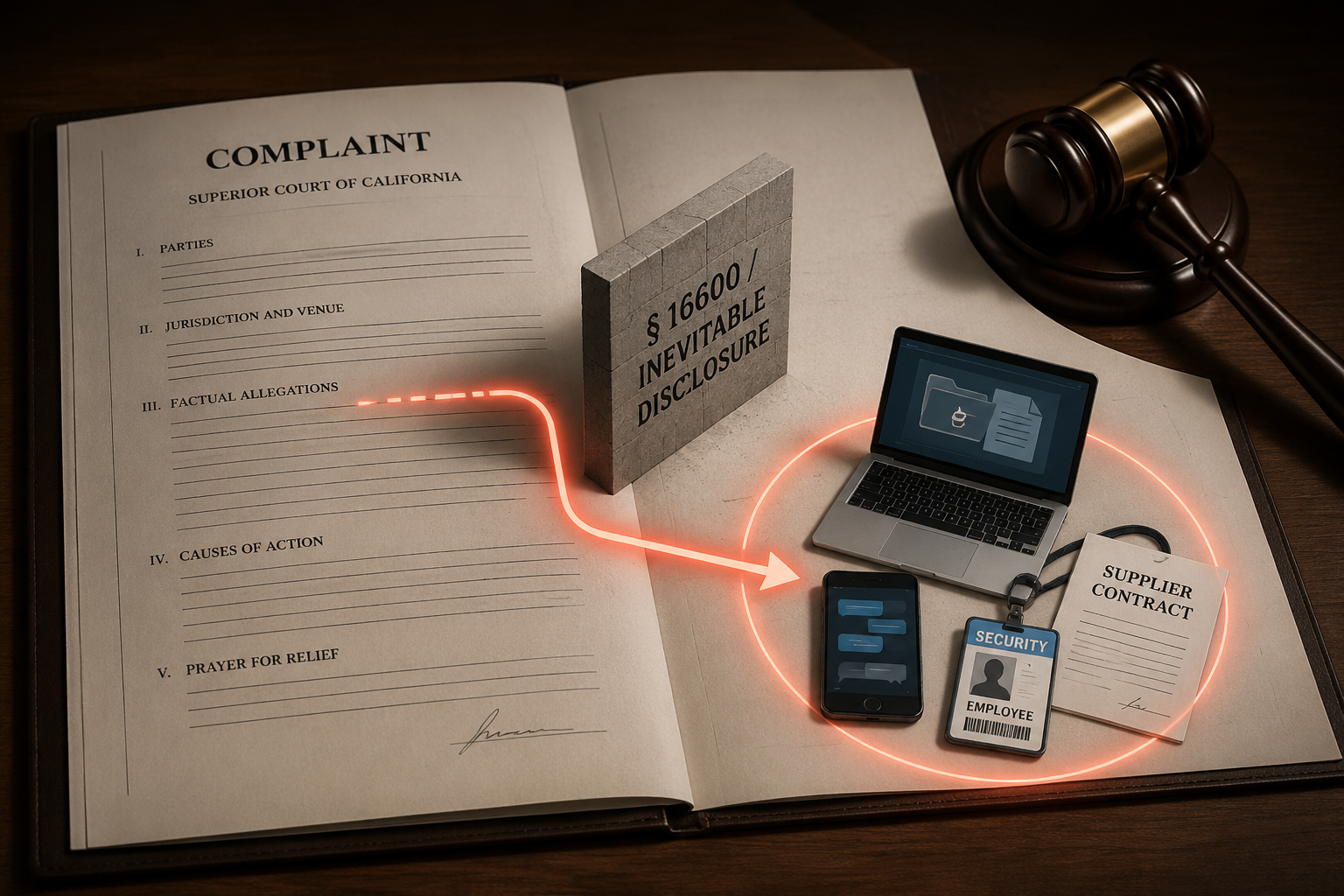
Apple Pleads Around the California Problem
The California problem is not a footnote. It is the pleading terrain. In a state that protects employee mobility, a trade secret plaintiff has to separate ownership of protectable information from ownership of people who once had access to that information. Apple’s complaint is built to make that separation visible.
Under the Defend Trade Secrets Act and the California Uniform Trade Secrets Act, Apple ultimately must establish the existence of trade secrets, misappropriation, improper means, and damages.[3] At the pleading stage, the question is not whether Apple has proved those elements. It is whether the complaint gives the court enough factual content to infer more than lawful recruitment of talented engineers.
So Apple does not begin and end with former employees’ general knowledge. It alleges retained Apple laptops, device logs, exploitation of an authentication bug described in commentary as a critical vulnerability that allowed onboarding access to Apple proprietary systems, messaging app communications, “show and tell” interview tactics, and deception of a shared supplier.[1][4] Those allegations are doing doctrinal work. They are meant to supply improper means without asking the court to infer misappropriation from employment movement alone.
The difference is easy to flatten in a business headline. Apple, OpenAI, io Products, hardware ambitions, and a large acquisition naturally invite a rivalry frame. But pleadings are not press releases. The complaint has to survive contact with a motion to dismiss, where the defendant can say: California lets employees leave; California lets competitors hire them; California does not let a former employer convert know-how into a portable injunction.
The Complaint’s Architecture: Trade Secret, Access, Then Use
Apple’s sequencing is not accidental. A trade secret complaint has to do more than recite confidential categories. It has to identify the kind of information at issue with enough specificity to make the misappropriation theory intelligible while avoiding a public disclosure of the secret itself. Here, Apple points to systems-level integration knowledge and hardware-related information, including information allegedly relevant to OpenAI’s device plans.[5]
That category matters because Apple is not alleging a single copied file as the whole case. The pleaded theory appears broader: an AI hardware effort allegedly benefited from information about how Apple integrates hardware, software, suppliers, manufacturing constraints, and device development practices. That is a plausible trade secret category only if the complaint can keep it concrete. Otherwise, “systems-level integration knowledge” risks sounding like a label for accumulated professional judgment.
The complaint therefore leans into factual mechanisms. Retained laptops matter because they are physical and forensic. Device logs matter because they can place access in time and context. Authentication access matters because it turns a departing employee’s continued presence in Apple systems into something more than memory. Messaging app communications matter because they can show direction, request, transmission, or coordination. Supplier conduct matters because it can move the case outside employee knowledge altogether and into third-party acquisition.
None of that proves misappropriation now. But it gives Apple a different answer to the expected defense. If OpenAI argues that the case is an attempt to penalize lawful hiring, Apple can point back to pleaded acts that allegedly occurred before, during, or after employee transitions. The complaint is drafted to say: this is not a case about what employees inevitably remember; it is a case about what defendants allegedly obtained and used through improper channels.
Why the Device Allegations Carry More Weight Than Headcount
Reports that more than 400 former Apple employees are at OpenAI help explain why Apple would scrutinize the relationship, but headcount does not make a trade secret case.[6] If anything, a large number can cut both ways. It may support a story of aggressive recruitment in a strategic market, but it also underscores the employee-mobility problem: hiring many people from a competitor is not itself misappropriation.
The retained-device and access allegations are different. They give the court something to evaluate that is not simply “employee X used to work at Apple and now works near an OpenAI hardware initiative.” A laptop can be imaged. Logs can be reviewed. Authentication events can be tested. Communications can be placed against dates. Those facts are the difference between anxiety about competition and a pleaded path to acquisition.
The Supplier Allegations Avoid the Pure Mobility Fight
The alleged supplier conduct is also important for a reason that has little to do with Silicon Valley drama. Apple alleges that metal-finishing techniques were obtained through a deceived shared supplier.[6] If that allegation is supported, it gives Apple a route around the hardest version of the employee-mobility defense. The issue would not be only what a former employee knew. It would be whether a third party was induced to disclose information it should not have disclosed.
That is a cleaner improper-means theory. It still has proof problems: what the supplier knew, what it was asked, what was disclosed, what confidentiality obligations existed, and whether the information qualifies as Apple’s trade secret. But as a pleading matter, supplier deception is easier to distinguish from ordinary recruiting than the fact that engineers moved from one employer to another.
The xAI Dismissal Gives OpenAI a Script, Not a Complete Answer
OpenAI’s most obvious early response will be to invoke xAI v. OpenAI, dismissed by the Northern District of California on June 15, 2026.[7] The defense narrative almost writes itself: another competitor tried to turn hiring into trade secret misappropriation, and the court refused to let generalized allegations proceed. For a defendant facing Apple’s complaint, that is useful motion-to-dismiss pressure.
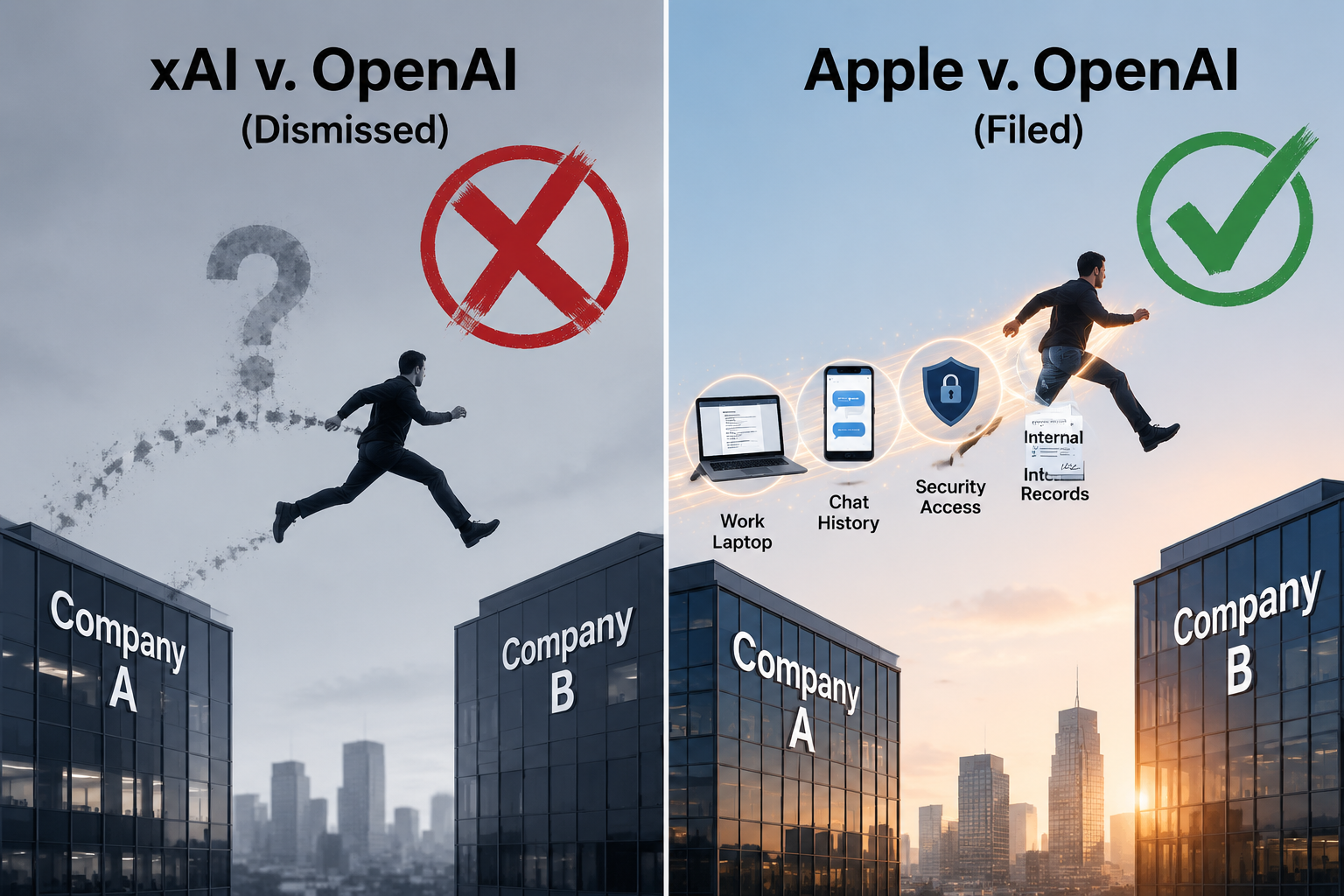
But xAI is not a universal solvent. Its usefulness depends on how closely Apple’s allegations resemble the allegations that failed there. If Apple had pleaded only that OpenAI hired people who knew confidential information and placed them in overlapping roles, xAI would be more than a citation; it would be a warning label. Apple’s complaint instead appears designed to distinguish itself on the facts: retained Apple property, alleged access after departure, messaging channels, interview conduct, and supplier deception.[4][7]
That distinction is not cosmetic. In trade secret cases, “improper means” often does the work that “competition” cannot. A court can reject inevitable disclosure and still allow a claim based on alleged unauthorized access, deception, or induced breach of confidentiality to proceed. The question becomes whether Apple pleaded those acts with enough specificity and tied them tightly enough to asserted trade secrets.
| Issue | xAI defense use | Apple’s attempted distinction |
|---|---|---|
| Employee movement | Routine hiring is not misappropriation. | Apple alleges conduct beyond hiring. |
| Trade secret access | Access alone does not establish use or acquisition. | Apple points to device logs, retained laptops, and authentication access. |
| Recruiting process | Interviews can lawfully test experience and skill. | Apple alleges “show and tell” tactics involving internal materials. |
| Third-party information | Employee memory remains protected by mobility principles. | Apple alleges supplier deception as an independent acquisition path. |
The table is not a prediction. It is the likely shape of the pleading fight. OpenAI will press the court to see the complaint as a more elaborate version of a rejected hiring theory. Apple will ask the court to treat the pleaded facts as concrete acquisition and use allegations under DTSA and CUTSA.
Where Recruiting Starts to Become Evidence
For counsel, the most useful part of the case is not the celebrity of the parties. It is the boundary problem. Competitive hiring is lawful. Interviewing candidates about their experience is lawful. Building a team from a competitor’s alumni can be lawful. The danger begins when the process creates discoverable facts that look like directed acquisition of confidential information.
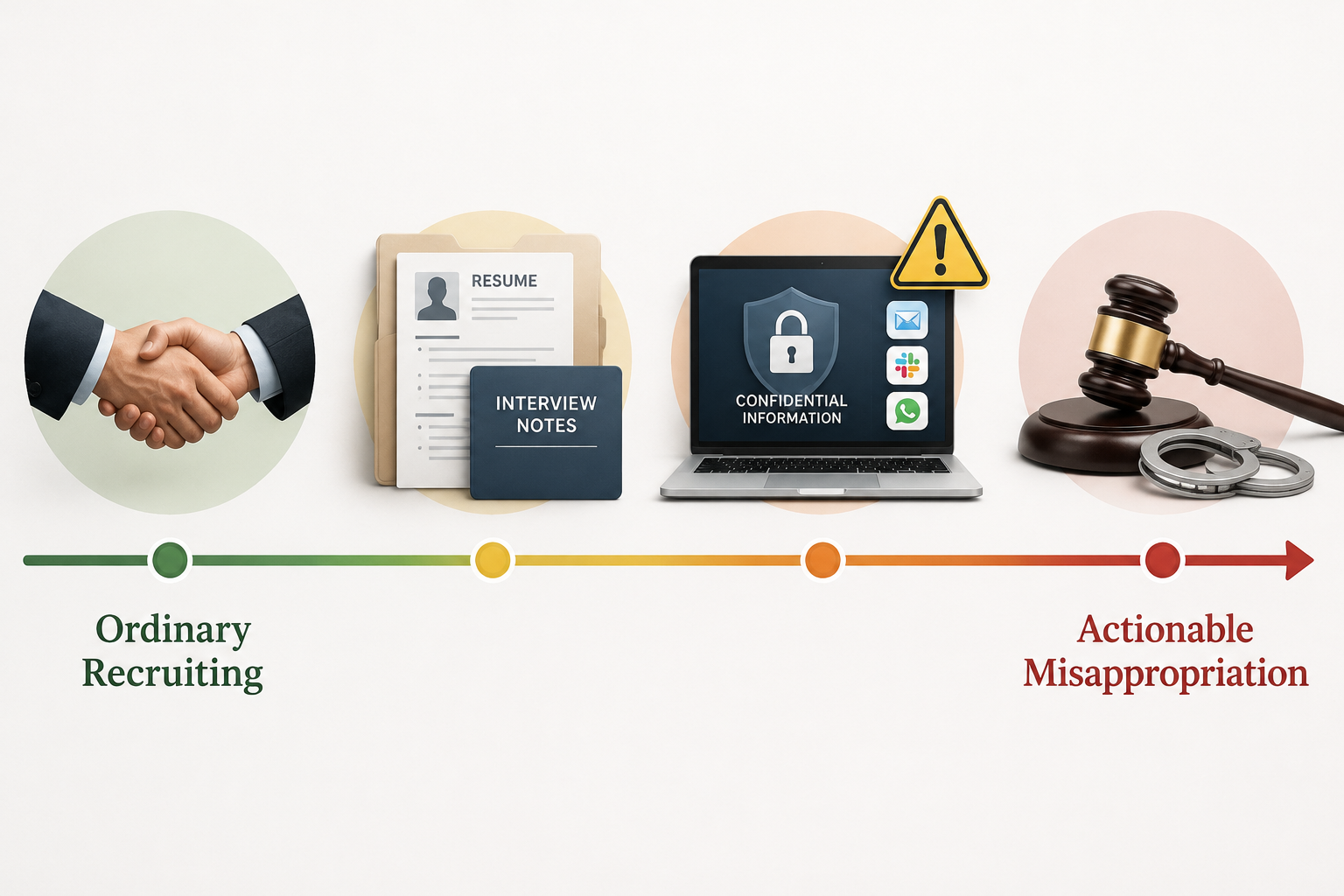
An interviewer asking a candidate to describe public accomplishments is one thing. An interviewer asking the candidate to bring, display, summarize, or reconstruct internal offboarding documents is another. The complaint’s “show and tell” allegations are important because they frame the interview process itself as a potential vehicle for acquisition. That is exactly the sort of allegation that can make onboarding files, calendar invites, chat threads, interview notes, and recruiter instructions relevant in discovery.
The same is true for offboarding. A clean offboarding process is not just an HR exercise. It is later evidence that the company took reasonable measures to protect its information and that the new employer had reason to treat certain materials as off-limits. Written acknowledgments, device return records, credential termination, and escalation protocols become much more important when the later complaint alleges retained devices or lingering authentication access.
Hiring-side counsel should read the complaint as a map of what can become problematic. A candidate’s retained laptop is not a curiosity. It is a litigation hold issue. A private messaging channel about a former employer’s internal processes is not an informal convenience if it shows requests for protected information. A supplier contact who previously served the competitor is not just a useful vendor introduction if the communications suggest concealment, pressure, or inducement to disclose protected specifications.
- Recruiting: document that interviewers may ask about skills, responsibilities, and public work, but not confidential designs, roadmaps, test data, supplier terms, or internal documents.
- Onboarding: require candidates to certify that they are not bringing former-employer devices, files, credentials, code, drawings, notes, or messages.
- Access: treat unexplained retained credentials or devices as legal escalations, not IT housekeeping.
- Suppliers: instruct business teams not to solicit competitor-specific information from shared vendors and to record the permissible basis for any technical request.
- Messaging: assume informal channels will be read later for requests, direction, and knowledge of confidentiality restrictions.
Those are not litigation-proofing slogans. They are the difference between a hiring file that shows ordinary talent acquisition and one that supplies a plaintiff with the verbs it needs: retained, accessed, requested, displayed, transmitted, deceived.
io Products and the Acquisition Theory
The corporate structure matters because Apple is not suing in a vacuum. OpenAI acquired io Products, described in reports as its hardware subsidiary, for $6.4 billion in 2025.[8] Apple’s theory is not merely that OpenAI wants to make hardware. It argues that io Products functioned as a vehicle for trade secret acquisition, including through alter-ego allegations.[4][8]
Alter-ego theories are easy to allege badly. Courts do not disregard corporate separateness simply because a parent company benefits from a subsidiary’s work or because the entities share strategic goals. The theory becomes more serious if the complaint can connect corporate control to the alleged acquisition or use of protected information. In other words, Apple has to do more than say io Products was part of OpenAI’s hardware ambitions. It needs facts showing why io’s role matters to misappropriation.
That is why the acquisition context should be kept in its procedural lane. The $6.4 billion figure helps explain stakes and motive. It does not establish improper means. The presence of former Apple employees may explain opportunity. It does not establish misuse. The pleading burden remains tied to specific acts and specific information.
Preliminary Relief Would Be Important, and Difficult
Apple is likely to seek preliminary relief, and commentary has focused on whether the case could disrupt OpenAI’s hardware plans.[9] The governing factors are familiar: likelihood of success on the merits, irreparable harm, balance of equities, and public interest.[9] Familiar does not mean easy.
A preliminary injunction would force Apple to show more than a plausible complaint. It would need evidence, and the hard parts of a trade secret case often sit behind discovery: what was accessed, what was transmitted, what the receiving party knew, whether the asserted information was secret, whether reasonable protective measures existed, and whether any use can be traced to the defendant’s work.
The remedy also has to avoid becoming an employee restraint by another name. A court can enjoin use or disclosure of trade secrets. It cannot casually enjoin people from working on a broad category of hardware because they once worked at Apple. That line is likely to shape any requested order. The more Apple can identify particular information, devices, documents, access events, or supplier disclosures, the more tailored its proposed relief can be.
At the same time, OpenAI can argue that broad relief would harm lawful competition and employee mobility, especially before any substantive ruling validates Apple’s theory. That argument has extra force in California, where courts are sensitive to restraints that function like non-competes even when styled as trade secret protection.
What the Case Tests
The case is still at the beginning. As of July 14, 2026, no answer had been filed, no substantive rulings had issued, Apple’s allegations remained unproven, and OpenAI had denied them.[10] That posture should discipline every conclusion about the complaint.
Still, the complaint is already useful because it shows what a plaintiff must try to do in California if it wants a trade secret claim to survive without leaning on inevitable disclosure. Apple identifies asserted categories of protected information, then ties them to alleged acquisition mechanisms: devices, logs, credentials, messages, interviews, and supplier contacts. Whether those allegations are true is a proof question. Whether they are enough to proceed is the pleading test.
For hiring counsel, the practical lesson is narrow but important. The legal risk is not that a former employee possesses valuable experience. California protects that movement. The risk rises when the hiring process appears to invite, preserve, or exploit former-employer information through acts that can be pleaded as improper means. Apple’s complaint is an effort to convert that distinction into a viable DTSA and CUTSA case against OpenAI and io Products. No court has yet said it succeeds.
References
- Apple Inc. v. OpenAI Inc., Complaint, N.D. Cal. No. 5:26-cv-07078, CourtListener public docket, July 10, 2026, link
- Apple-OpenAI dispute puts hiring practices under trade secrets microscope, Daily Journal, link
- Apple v. OpenAI: Trade Secret Lessons for Employers, Holon Law, link
- Apple v. OpenAI: A New Frontier in AI Hardware Trade Secret Litigation, MBHB, link
- Apple v. OpenAI trade secret analysis, Tajima LLP, link
- Reporting on former Apple employees at OpenAI, supplier allegations, and systems-level integration claims, The Hill, CNBC, The New York Times, and TechCrunch, link
- What to Watch As Apple, OpenAI Face Off Over Trade Secret Claims, Business Insider, link
- Reporting on OpenAI’s acquisition of io Products, Bloomberg, 2025, link
- Apple's Trade Secret Claims Could Disrupt OpenAI's Hardware Plans, Mondaq, link
- Procedural status reporting on Apple v. OpenAI, Business Insider, July 14, 2026, link
Comments
Join the discussion with an anonymous comment.