
The mediated settlement
The mediated settlement now governs Maricopa County, but it reads more like an operating truce than a victory lap. For anyone following the legal implications of Arizona's 2026 primary, the important point is not the tally from July 21; it is that the county now has a divided control structure and a new channel for future fights [1].
That deal only makes sense against the sequence that produced it: an April Superior Court injunction in Heap's favor, a June stay from the Court of Appeals, and then the Arizona Supreme Court's unanimous July 7 ruling restoring the injunction [2][3][4]. Once those orders collided with the election calendar, the parties had a practical reason to stop litigating each function in isolation and write the functions down.
Who controls what now
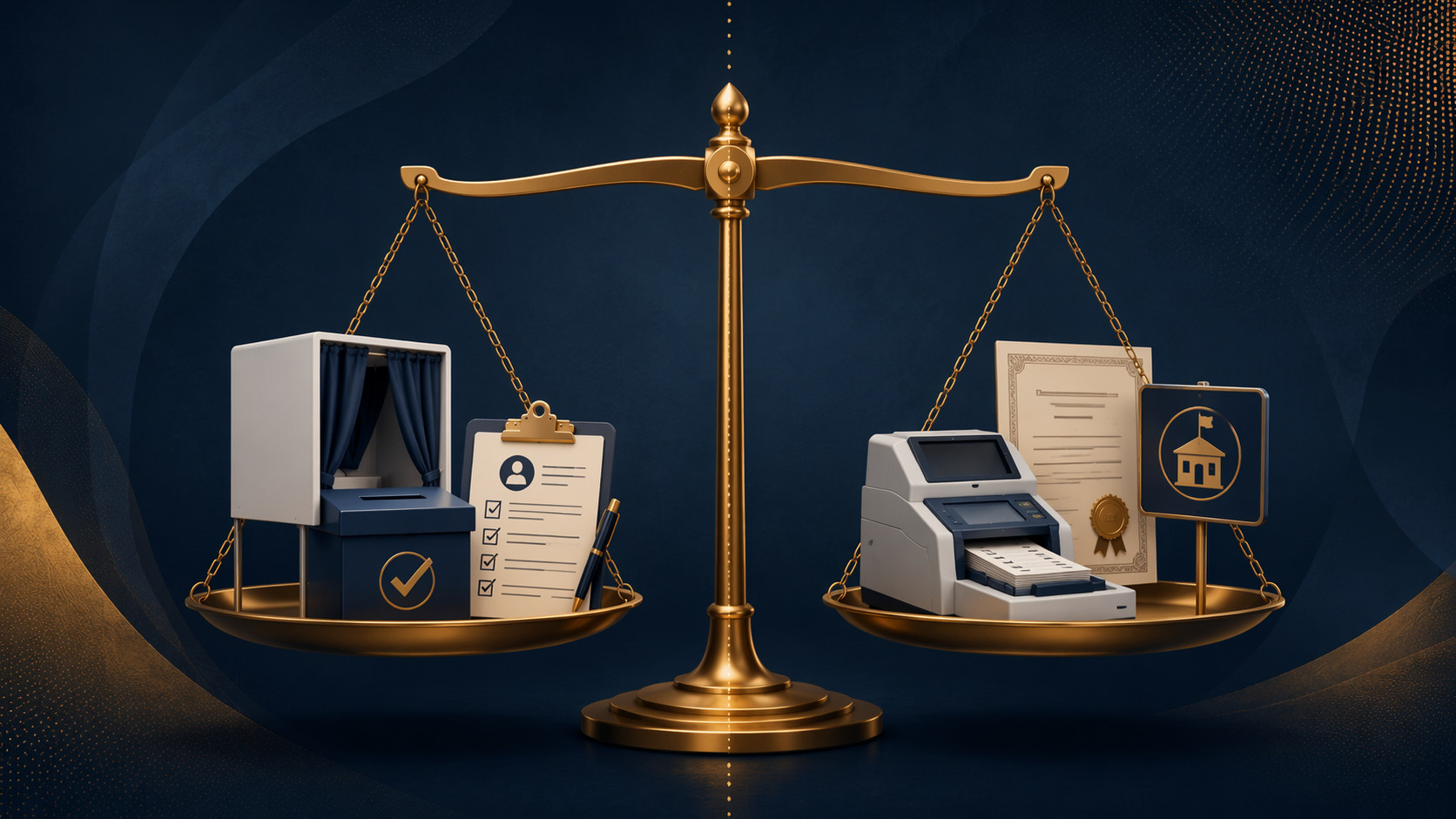
The settlement does something election lawyers notice immediately: it turns a jurisdictional tug-of-war into a functional partition. Heap keeps voter registration, early in-person voting, mail voting, and drop-box placement, while the Board of Supervisors controls precinct boundaries, ballot preparation, Election Day polling, ballot counting, and certification [1]. That split matters because the handoff points are where certification problems usually start.
| Function | Controller | Why it matters |
|---|---|---|
| Voter registration | Heap | Controls the rolls and the front end of ballot access |
| Early in-person voting | Heap | Affects pre-election access and turnout logistics |
| Mail voting and drop-box placement | Heap | Controls return channels for ballots |
| Precinct boundaries | Board of Supervisors | Shapes Election Day administration |
| Ballot preparation | Board of Supervisors | Determines what voters receive |
| Election Day polling, ballot counting, and certification | Board of Supervisors | Controls the final chain from casting to result |
The dispute channel is just as important as the assignment itself. Under the deal, Superior Court Judge Christopher Coury serves as special master for future disagreements, with discretionary appeal only to the Arizona Supreme Court [1]. That is cleaner than an improvised emergency skirmish, but it is still untested under the kind of deadline pressure that usually produces the ugliest election cases.

What the primary did not settle
The July 21 primary is useful context, but it is not the stress test that November will be. The settlement expressly excluded it, and the primary was governed separately by the Arizona Supreme Court's 12-point operational plan [1]. That means the primary can show that election administration continued, but not that the new dispute framework will hold when a certification deadline or ballot-access fight lands on top of it.
The parties' own descriptions of that setup were not fully aligned. Votebeat reported conflicting statements over whether primary disputes were controlled by the special-master arrangement or by the Court's liaison framework, which is exactly the kind of ambiguity that becomes expensive once a county starts racing the calendar [1].
The remaining fault lines
The background risk is not theoretical. The record still includes a special prosecutor investigation tied to allegations that Heap's staff removed a tabulation scanner, along with earlier contempt allegations [1]. Those issues do not decide the settlement's merits, but they do raise the odds that ordinary administrative friction gets recast as a litigation trigger.
That is the practical problem for election professionals. The county can describe the new architecture in a stipulation, but it still has to survive a real dispute over who owns the lane, who hears the emergency, and who can certify the result before deadlines harden.
November's test
November 3 is the first true test of the system. The useful checklist is narrow:
- whether the special master is actually used when the next dispute arrives
- whether ballot-access or certification questions are re-filed in new form
- whether the primary's unresolved authority questions resurface under deadline pressure
References
- Maricopa County's election dispute is finally over — at least on paper — Votebeat, July 15, 2026
- Judge sides with Arizona election official in ruling that could affect midterms voting — PBS NewsHour
- Arizona Court of Appeals pauses judge's ruling on election powers in Maricopa County — Votebeat, June 18, 2026
- Arizona Supreme Court gives election denier more control over Maricopa County elections — Democracy Docket
Comments
Join the discussion with an anonymous comment.