
A federal judge in Arkansas blocked the state’s latest social media age-restriction law in April 2026, finding that the challengers were likely to succeed on their First Amendment claim against Act 900’s limits on minors’ access to social media platforms.[1] NetChoice, which challenged the law, described the ruling as a First Amendment victory against an attempt to make online speech harder to reach through repeated regulatory cuts.[2]
That ruling matters for schools, but it does not answer the question principals usually have to answer by the end of the day: Can the district block the app, discipline the post, restrict the account, or cooperate with a state enforcement scheme? The phrase “school social media ban” hides several different legal problems. A statewide access law aimed at platforms is not the same thing as a school network rule. A student’s lunchroom livestream is not the same thing as a Saturday-night repost. A parent-consent statute is not the same thing as a suspension notice.

For school lawyers and compliance officers, the Arkansas injunction is best read as a warning against overclaiming. It shows one federal court treating a broad minor social media access restriction as constitutionally suspect. It does not give districts a clean operating rule for every student post, nor does it erase the school’s recognized interest in disruption, harassment, threats, or classroom order.
The First Question Is Who Is Acting
The legal standard changes depending on the actor. When a school restricts student use on campus or through school systems, the familiar student-speech framework is doing the work. When a school disciplines a student for off-campus social media speech, Mahanoy and newer appellate applications of it matter. When a state tries to require platforms to block minors or obtain parental consent, the litigation looks more like a platform-access and age-verification fight, even though schools may feel the spillover.
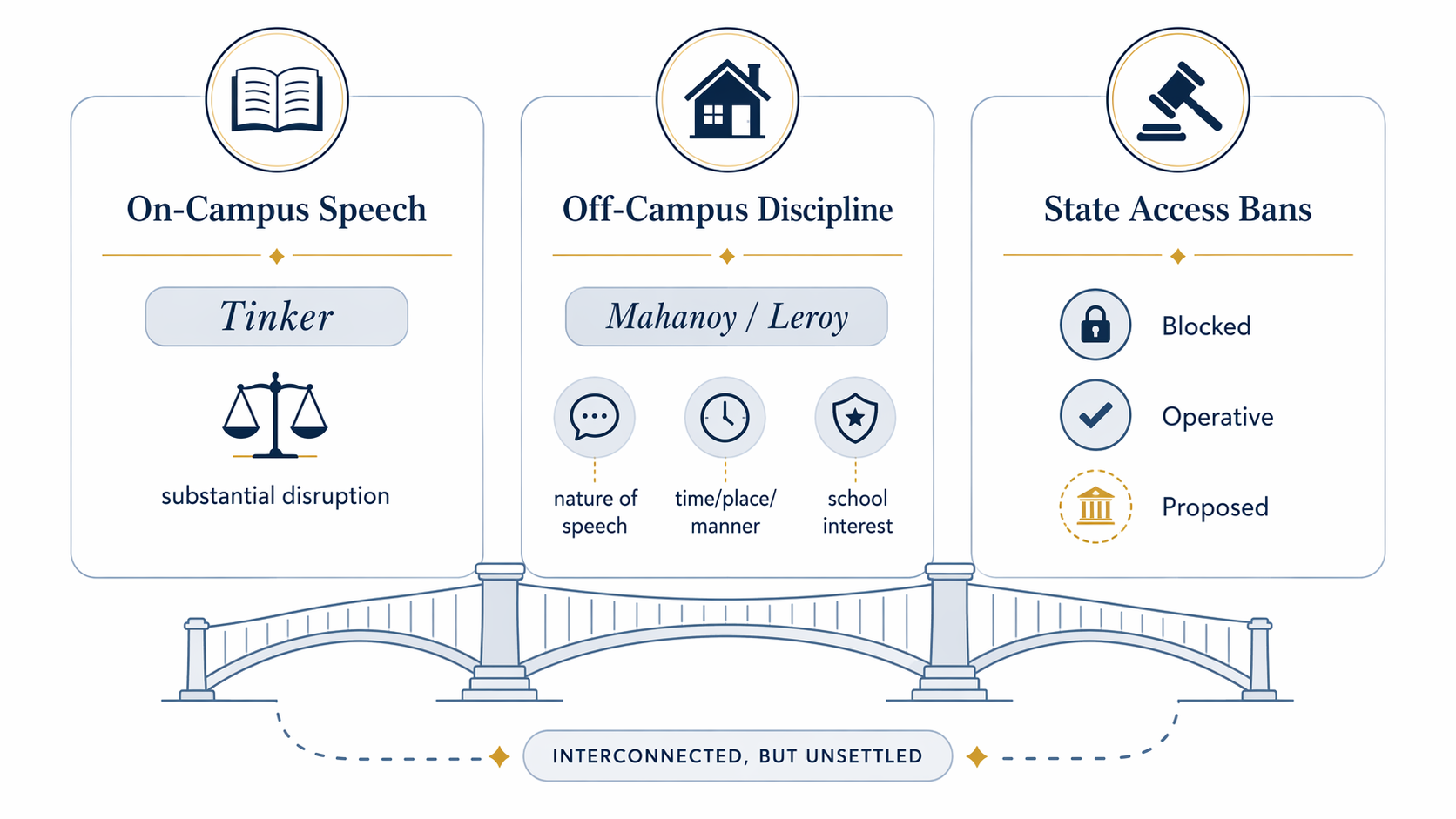
That separation is not academic bookkeeping. It decides who must document disruption, who must provide process, who must interpret a state statute, and who bears the constitutional risk if the restriction is too broad. A district that treats every social media problem as one legal category will either over-discipline speech it cannot reach or under-enforce rules it can lawfully apply on school grounds.
On Campus, Tinker Still Carries the Day-to-Day Load
Inside school, the starting point remains Tinker’s substantial-disruption frame. Schools may regulate student expression when they can point to material disruption or reasonably forecast it, and they have more room to manage instructional time, school devices, Wi-Fi networks, assemblies, and supervised activities than they have over a student’s private weekend speech.
That is why a school network rule blocking certain platforms during the school day sits in a different posture from a state law that tells platforms which minors may create accounts. The first is usually tied to classroom management, bandwidth, supervision, cheating, bullying response, or student safety during school-controlled time. The second restricts access to speech infrastructure outside the school’s own environment and therefore attracts a broader First Amendment challenge.
A district does not need to pretend that TikTok, Instagram, Snapchat, Discord, or YouTube Shorts are pedagogically identical to a notebook. It does need to say what rule it is enforcing. “No phones during algebra” is not “no student may maintain an account.” “No livestreaming classmates in the cafeteria” is not “no criticism of school staff online.” The closer the rule is to school operations and actual disruption, the easier it is to administer without turning every administrator into a platform regulator.
Off Campus, Mahanoy Keeps the School From Owning the Student’s Whole Day
Mahanoy Area School District v. B.L. remains the Supreme Court anchor for off-campus student speech. The Court held in 2021 that a school violated the First Amendment when it disciplined a student for a profane Snapchat post made off campus, while still recognizing that some off-campus speech can fall within school authority in circumstances involving serious bullying, threats, harassment, cheating, or security concerns.[3]
That mixed holding is why Mahanoy cannot be reduced to either “schools can never punish off-campus posts” or “schools can punish online disruption wherever it begins.” It places weight on the school’s diminished authority away from campus, the risk that 24-hour school control would swallow student speech rights, and the school’s role in protecting unpopular expression. At the same time, it leaves room for school action when off-campus speech predictably reaches school and affects the school environment in legally meaningful ways.
The practical consequence is that the first disciplinary question should not be, “Was it on social media?” The better questions are narrower: Was the speech threatening or targeted? Did it name students or staff? Did it reach campus? Did classes stop, staff intervene, students avoid school, or administrators investigate? Was the punishment imposed because of disruption and school safety, or because the school disliked the viewpoint?
Leroy Gives Districts a More Current Off-Campus Test
The Second Circuit’s December 2025 decision in Leroy v. Livingston Manor Central School District is now one of the more useful appellate signposts for off-campus social media discipline. According to Shipman & Goodwin’s analysis, the court used a three-factor inquiry: the nature of the speech, the time, place, and manner of the speech, and the school’s interest in regulating it.[4]
That test is valuable because it forces the district to slow down at the exact point where viral-post pressure usually speeds everything up. “Nature of the speech” asks whether the post involves threats, harassment, bullying, vulgarity, criticism, jokes, or political and personal expression. A crude complaint about school is not the same as a targeted threat against a student. A repost with no school audience is not the same as a message sent into a team chat before practice.
“Time, place, and manner” keeps the district from treating every post that eventually reaches a phone in the building as school speech. A post made off campus, outside school hours, on a private device, and outside a school-controlled forum starts with a different presumption than a post made during class on a district Chromebook using the school network. The distinction will not decide every case, but it prevents the word “online” from doing all the legal work.
The third factor, the school’s interest, is where documentation matters. If the stated interest is safety, the file should show the safety concern. If the stated interest is disruption, the file should show the disruption or a reasonable forecast of it. If the stated interest is protecting staff from criticism, the district is on much thinner ground. Leroy’s usefulness is not that it gives schools a magic phrase; it gives counsel a way to test whether the proposed discipline has enough school-specific weight to survive scrutiny.
State Access Bans Are a Separate, Unstable Layer
The state-law landscape is moving faster than school policy manuals. Arkansas’s Act 900 was blocked at the district-court level in April 2026.[1] Florida’s law, by contrast, has been allowed to remain operative in important part after the Eleventh Circuit’s Uthmeier ruling, while Ohio’s teen social media restrictions were allowed to proceed after a June 2026 Sixth Circuit ruling.[5][6]
That does not mean the legal tide has simply turned in favor of state bans. It means the appellate posture differs, and posture matters. A law may be operative because a stay was granted or an injunction lifted, not because the Supreme Court has supplied a final rule for all minor social media access laws. For a superintendent’s office, though, the distinction is uncomfortable: a law that is not finally validated can still require planning if it is currently enforceable.
MultiState reported that more than 16 states had enacted minor social media laws despite continuing court fights.[7] That number measures legislative adoption, not constitutional settlement. It tells districts that the pressure to regulate minors’ access is no longer isolated. It does not tell a principal whether she may suspend a student for a post made at home, or whether the district must help verify platform access.
This is the compliance gap that often gets missed. State access laws usually aim at platforms, parents, age verification, consent, design features, or account restrictions. Schools may be affected indirectly because students use the same platforms to organize activities, bully peers, contact teachers, share assignments, or criticize school decisions. But indirect pressure is not the same as clear authorization for school enforcement.
What the Different Regimes Actually Ask
| Situation | Main Legal Question | Operational Consequence |
|---|---|---|
| School blocks social media on district Wi-Fi during class | Is the restriction tied to school operations, instruction, safety, or disruption? | The district needs a school-based rationale and consistent administration. |
| School disciplines a student for an off-campus post | Do Mahanoy and Leroy support school authority based on speech nature, context, and school interest? | The district needs evidence, not just embarrassment or community pressure. |
| State restricts minors’ platform access | Is the statute operative, enjoined, stayed, or still being litigated? | The district should not assume the statute automatically expands school disciplinary power. |
| Proposed federal legislation addresses social media use in schools | Has it been enacted, and how would it interact with student-speech precedent? | The district can track it, but should not treat it as current law. |
KOSMA Would Add Pressure, Not Immediate Answers
The federal Kids Off Social Media Act, S.278 in the 119th Congress, is another reason districts are watching this area closely. The bill includes provisions directed at limiting social media use in schools, but it remains proposed legislation, not an enacted federal rule for school administrators to apply today.[8]
That status matters. A proposed federal bill can shape vendor planning, parent expectations, and state lobbying. It cannot, by itself, justify a suspension, account restriction, or district-wide enforcement program. Even if enacted, school-related provisions would still have to operate alongside student-speech doctrine, including Tinker’s substantial-disruption standard and Mahanoy’s warning against extending school authority over a student’s full off-campus life.
The available material also counsels caution about treating KOSMA as a finished compliance manual. The bill text is the relevant source, but school-specific readings circulating around it remain largely predictive. A district can monitor the proposal and map where it might affect acceptable-use policies, procurement, filtering, or classroom device rules. It should not treat the bill as if Congress, the Department of Education, and the courts have already answered the school-speech questions it would raise.
Feature Regulation May Be the Next Litigation Line
Some legal analysis has pointed toward feature-based regulation as a possible alternative to broad age-based access bans. A Harvard Law Review analysis in Volume 139 discusses content neutrality and intermediate scrutiny for social media age-verification laws, while noting that the content-neutrality question remains unresolved.[9]
For schools, that debate is relevant but still one step removed. A law targeting addictive design features, endless scroll, notifications, recommendation systems, or late-night access may present different constitutional questions from a law restricting whole categories of minors from whole categories of platforms. But unless a statute clearly assigns duties to schools, a district still has to return to its own authority: campus control, school devices, curricular time, harassment response, threat assessment, and documented disruption.
The Workable Map Is Narrower Than the Politics
The Arkansas ruling is a First Amendment event, but it is not a universal school-policy answer. Florida and Ohio show that some state restrictions are currently operative. MultiState’s count shows that legislatures are continuing to enact minor social media laws. Mahanoy and Leroy show that student-speech doctrine still constrains what schools may do when the speech happens away from campus.
The safest description of the law in Q3 2026 is tripartite and unsettled. On-campus restrictions remain primarily a Tinker problem. Off-campus discipline requires a Mahanoy-sensitive inquiry, with Leroy’s three factors giving districts a current appellate structure. State access bans create a separate compliance layer that may affect the school environment without clearly converting schools into state internet-access enforcers.
So the operative question is rarely whether a “school social media ban” is valid in the abstract. It is who is acting, where the speech occurred, what rule is being enforced, what disruption or harm is documented, whether the governing statute is actually operative, and which constitutional standard applies.
References
- Arkansas court blocks social media regulations, Courthouse News Service.
- First Amendment to Arkansas: You Cannot Sentence Speech on the Internet to Death by a Thousand Cuts in NetChoice Court Victory, NetChoice.
- Victory! Federal Court Upholds First Amendment Protections for Students’ Off-Campus Social Media Speech, Electronic Frontier Foundation, 2022.
- Second Circuit Finds School District Was Not Justified in Disciplining Student for Off-Campus Social Media Post, Shipman & Goodwin LLP.
- Restricting Minors’ Access to Social Media: Divided Ruling over Florida Law Reveals First Amendment Rifts, American Enterprise Institute.
- Tik-block: Federal court rules Ohio can restrict teen access to social media, Ohio Capital Journal, June 23, 2026.
- Eight States Enact Minor Social Media Bans Despite Court Fights, MultiState, October 8, 2025.
- S.278 - Kids Off Social Media Act, Congress.gov.
- Content Neutrality for Kids? Intermediate Scrutiny for Social Media Age Verification Laws, Harvard Law Review, Vol. 139.
Comments
Join the discussion with an anonymous comment.