
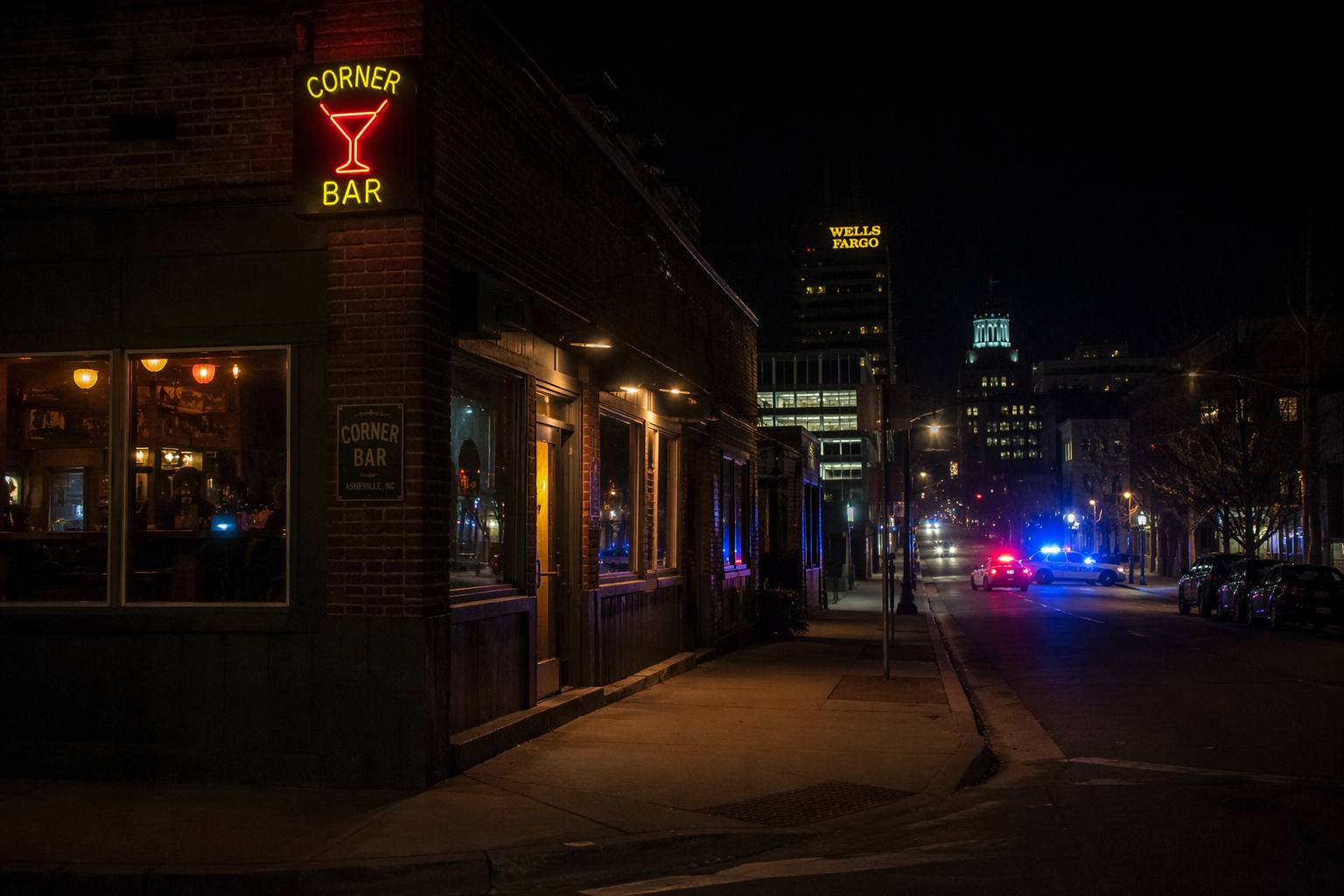
The reported facts of the Asheville gay bar shooting begin in the place Fourth Amendment analysis should begin: not with a slogan about police force, but with the scene officers were called into. Arturo Castillo Palomar, 25, was reportedly ejected from Shakey’s, a gay bar in downtown Asheville, went to his vehicle, retrieved a firearm, and fired at the building before police shot him outside the bar.[1] WLOS, citing the North Carolina State Bureau of Investigation, reported that officers arrived as shots were being fired and that Palomar died at the scene.[2]
That sequence matters. The legal implications of the Asheville gay bar shooting suspect being killed by police do not turn on the mere presence of a gun. A “man with a gun” call can produce difficult questions: visibility, distance, commands, intoxication, concealment, retreat, mistaken perception. This reported fact pattern is different. It is an occupied public venue, a firearm being discharged at the building, officers arriving to active gunfire, and a suspect who, according to the reporting available so far, did not surrender before being shot.[1][2]
There are still facts the public does not have. Body camera footage, forensic findings, and full witness statements had not been made public in the cited reports. The SBI investigation was ongoing, and Asheville officials described administrative leave for involved officers as standard procedure under department policy, not as a finding of misconduct.[2][3] Those limits should be taken seriously. But legal analysis is not suspended until every investigative file is complete. On the central facts now reported, this is one of the clearest deadly-force scenarios under both federal and North Carolina law.
The Governing Question Is Reasonableness, Not Hindsight
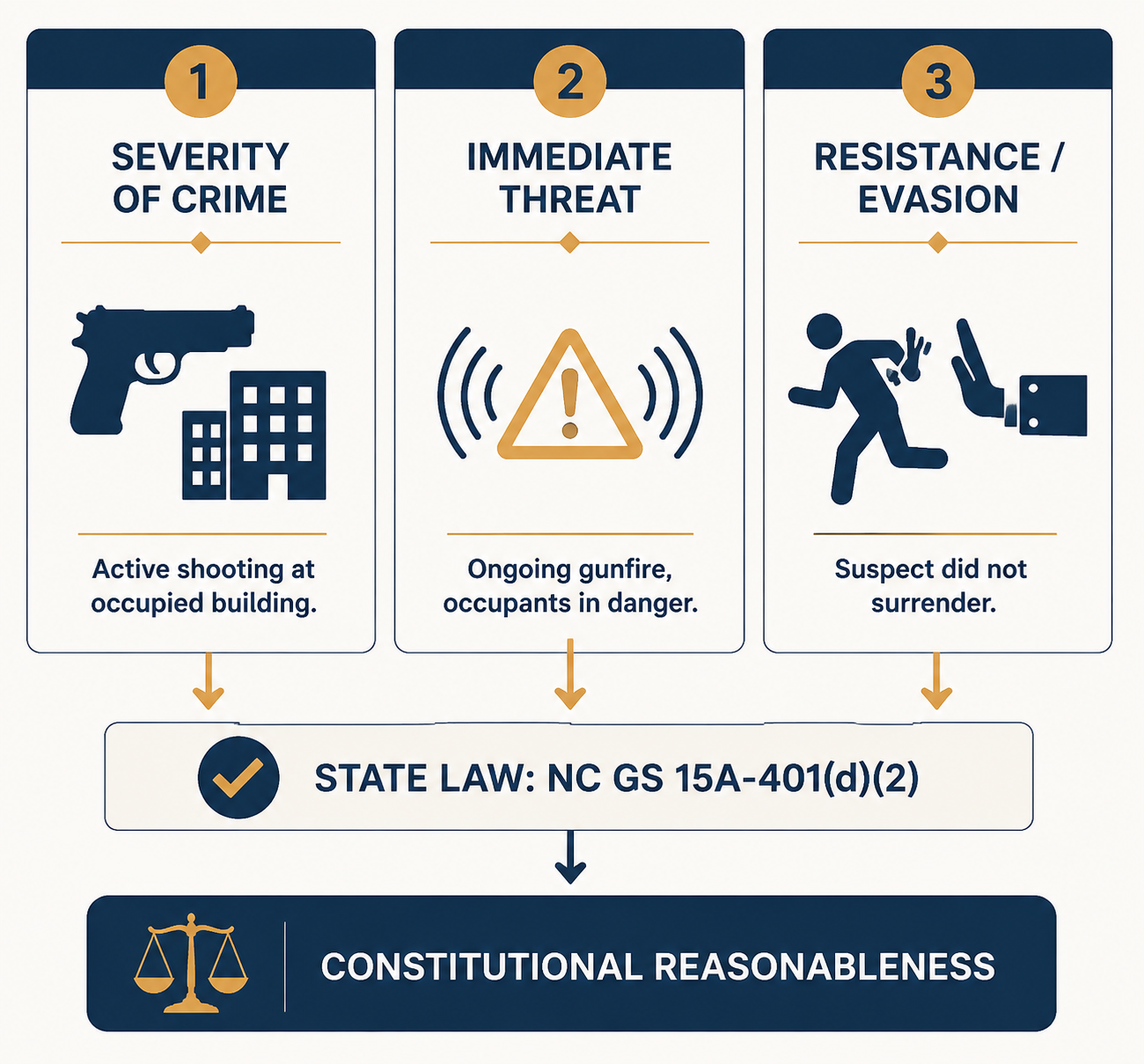
Federal excessive-force law asks whether the seizure was objectively reasonable under the Fourth Amendment. Graham v. Connor supplies the familiar frame: the severity of the crime, whether the suspect posed an immediate threat to officers or others, and whether the suspect was actively resisting arrest or attempting to evade arrest by flight. The inquiry is objective. It does not ask whether later commentators can imagine a cleaner version of events; it asks what a reasonable officer could believe in the circumstances confronting officers at the time.
North Carolina law points in the same direction. North Carolina General Statutes § 15A-401(d)(2) permits deadly force by a law enforcement officer when the officer reasonably believes it necessary to defend the officer or another person from what the officer reasonably believes to be the use or imminent use of deadly physical force, among other statutory grounds.[4] The UNC School of Government’s discussion of officer deadly force likewise treats the state-law inquiry as centered on reasonable belief and necessity in the face of death or serious bodily harm.[5]
In many officer-involved shootings, the hard work is in the facts: whether the suspect had a weapon, whether the officer could see it, whether the suspect was moving away, whether commands were audible, whether another tactic was available without increasing danger, or whether the officer helped create the emergency. The reported Shakey’s facts do not erase those categories from use-of-force law. They show what the analysis looks like when the central threat is not ambiguous.
Applying Graham to the Reported Shakey’s Facts
The first Graham factor, severity of the crime, is not close. Firing a gun at an occupied bar is not a low-level weapons offense, a suspicious-person call, or a possession case. It is conduct that threatens death or serious bodily injury with every round. The public reporting describes Palomar as having been removed from the bar, retrieving a firearm, and then shooting at the building.[1] The legal system can debate many uses of police force at the margins. Active gunfire at an occupied public establishment is not a margin.
The second Graham factor, immediate threat, is even stronger. “Immediate threat” can sound sterile in case law, but here it means patrons and staff inside an LGBTQ bar while shots were reportedly fired at the building. The Advocate and other outlets identified Shakey’s as a gay bar, and the accounts describe the firing as directed at the venue after Palomar was removed.[1][6] Whether the eventual criminal charging theory would have included a hate-crime component is a different question; the available reporting does not supply enough to assign motive. For Fourth Amendment purposes, motive is not needed. The threat came from the gunfire itself.
That is the point too often lost when these cases are discussed at a distance. The law does not require officers to wait until a bullet strikes a person before recognizing an immediate threat to life. When a suspect is firing at an occupied building, the people inside are already within the zone of deadly risk. Officers arriving to that scene are not merely protecting themselves; they are intervening in an ongoing threat to third parties.
The third Graham factor, resistance or evasion, also favors reasonableness on the reported facts. This is not described as a suspect who had discarded a weapon, submitted to commands, or been secured before force was used. The reports describe officers arriving to gunfire and shooting Palomar after he did not surrender.[1][2] If later evidence showed that he had plainly stopped, disarmed, and submitted before the fatal shots, the analysis would change. That is precisely why the investigation still matters. But it is not the fact pattern currently before the public.
| Legal Factor | Reported Fact | Effect on Reasonableness |
|---|---|---|
| Severity of the crime | Suspect allegedly fired a gun at an occupied downtown bar after being ejected | Strongly supports deadly-force reasonableness |
| Immediate threat | Gunfire was reportedly ongoing when officers arrived, with people inside the building | Strongly supports immediate intervention to protect life |
| Resistance or non-surrender | Reports state the suspect did not surrender before police shot him | Supports force if the threat had not been neutralized |
| North Carolina deadly-force standard | Officers confronted conduct reasonably understood as threatening death or serious bodily harm | Fits the state-law necessity framework |
North Carolina’s Deadly-Force Statute Reaches the Same Result
The state-law analysis does not add meaningful friction on these facts. Section 15A-401(d)(2) turns on whether the officer reasonably believed deadly force was necessary to defend against death or serious bodily harm.[4] If officers arrive while a person is firing at an occupied building, the belief that deadly force may be necessary to stop death or serious bodily harm is not speculative. It follows directly from what the suspect is reportedly doing.
This does not mean North Carolina law gives officers a blank check whenever a firearm appears in a call. A visible gun, without more, may require more careful parsing: possession may be lawful; a person may be stationary, confused, suicidal, surrendering, or not threatening others. The Shakey’s shooting is legally different because the reported firearm use was not passive possession. It was active discharge at a building containing people.
Nor does administrative leave carry the legal meaning sometimes assigned to it in public debate. WLOS reported that the officers were placed on standard administrative leave under Asheville Police Department policy and that the SBI was investigating.[2][3] Those steps preserve process. They are not evidence, standing alone, that the shooting was wrongful or that it was lawful.
Barnes v. Felix Does Not Make This a Close Case
Barnes v. Felix matters because it corrected a real analytical error in excessive-force law. In 2025, the Supreme Court rejected the Fifth Circuit’s “moment of threat” doctrine and reaffirmed that Fourth Amendment reasonableness must be assessed under the totality of the circumstances, not confined to the split second when an officer used force.[7][8] That clarification is important in cases where the officer’s prior decisions, the suspect’s movement, the visibility of a weapon, or the development of the encounter may change what reasonableness means.
But Barnes does not help every plaintiff, and it does not complicate every shooting. Its lesson is not that courts must become allergic to clear threats. Its lesson is that courts may not artificially narrow the field of view. Applied here, the broader view reinforces the same result. The totality does not show a benign encounter escalating because of police tactics, a confused command sequence, or a suspect whose threat status changed before officers fired. The reported totality begins with ejection from a bar, continues with retrieval of a firearm, includes shots at an occupied building, and ends with officers arriving to active gunfire and a non-surrendering suspect.[1][2]
That is why the case is useful as a baseline after Barnes. The Court’s rejection of the moment-of-threat frame prevents courts from freezing the encounter at a single instant when the preceding circumstances matter. In a closer case, that can be decisive. In the Shakey’s shooting, the preceding circumstances are not mitigating facts for the suspect’s threat level; they are the facts that make the threat unmistakable.
What Would Make a Deadly-Force Case Harder
The contrast matters because excessive-force doctrine is often taught through hard cases, and hard cases can distort the baseline. A fleeing suspect case may require asking whether the suspect still posed a threat to officers or the public. An ambiguous-weapon case may turn on whether the officer reasonably perceived a gun, a phone, or a harmless object. A de-escalation case may ask whether time, cover, communication, or containment changed what force was reasonably necessary. An officer-created-danger case may focus on whether police tactics unreasonably manufactured the crisis they then invoked to justify force.
Those are not academic distinctions. They are the ordinary working materials of Section 1983 litigation: timing, perception, distance, commands, cover, lighting, movement, and whether the suspect was threatening anyone at the moment deadly force was used. Barnes makes those materials harder to exclude by judicial shortcut. It does not require pretending that an active shooter at an occupied bar presents the same legal question as a person merely suspected of being armed.
The one timing question worth preserving here is factual, not doctrinal. If later public evidence showed that Palomar had clearly stopped firing, dropped or moved away from the weapon, and submitted before officers shot him, the reasonableness analysis would have to be revisited. If the central reports hold, however, the usual complicating facts are absent.
A Narrow Legal Judgment on the Current Record
On the facts currently reported, the Asheville shooting outside Shakey’s is a strong example of constitutionally reasonable deadly force. The severity of the suspected crime was extreme; the threat to patrons, staff, officers, and bystanders was immediate; and the suspect was reportedly not surrendering when officers intervened.[1][2] North Carolina’s deadly-force statute points the same way because the officers were confronting conduct reasonably understood as threatening death or serious bodily harm.[4]
That conclusion is deliberately narrow. It is not a prediction of the SBI’s findings, not a substitute for body camera review, and not a statement about motive beyond the reported conduct. It is a legal assessment of a reported active-shooter fact pattern. If those central facts remain intact, this is one of the clearer places where Fourth Amendment doctrine is settled rather than uncertain.
References
- Man enraged after getting kicked out of gay bar starts shooting at the place. Police killed him. - LGBTQ Nation
- Suspect killed in officer-involved shooting outside Asheville bar identified: SBI - WLOS
- 'Deeply concerning incidents' led to 3 officer-involved shootings: interim police chief - WLOS
- North Carolina General Statutes § 15A-401 - Arrest by law-enforcement officer - FindLaw
- When May Officers Use Deadly Force? - UNC School of Government
- Gunman killed after opening fire outside North Carolina gay bar - Advocate.com
- Supreme Court Rejects 'Moment of Threat' Doctrine in Deadly Shooting Case - IMLA
- Barnes v. Felix - Harvard Law Review (Vol. 139)
Comments
Join the discussion with an anonymous comment.