
By July 19, 2026, Asheville’s mass-casualty shooting response was already too crowded to describe as a single investigation. In four months, Asheville had two mass-casualty shootings and three officer-involved shootings in the same mid-size city, with public reporting describing four deaths and more than 16 injuries across the incidents. Asheville Police Department officers responded to the scenes; the State Bureau of Investigation entered the officer-involved cases; federal firearm tracing became relevant; the district attorney had to decide whether police uses of force were legally justified; victims and families faced compensation deadlines; and civil lawyers could already see premises-liability questions forming around the downtown nightlife corridor. Those processes do not wait politely for one another.
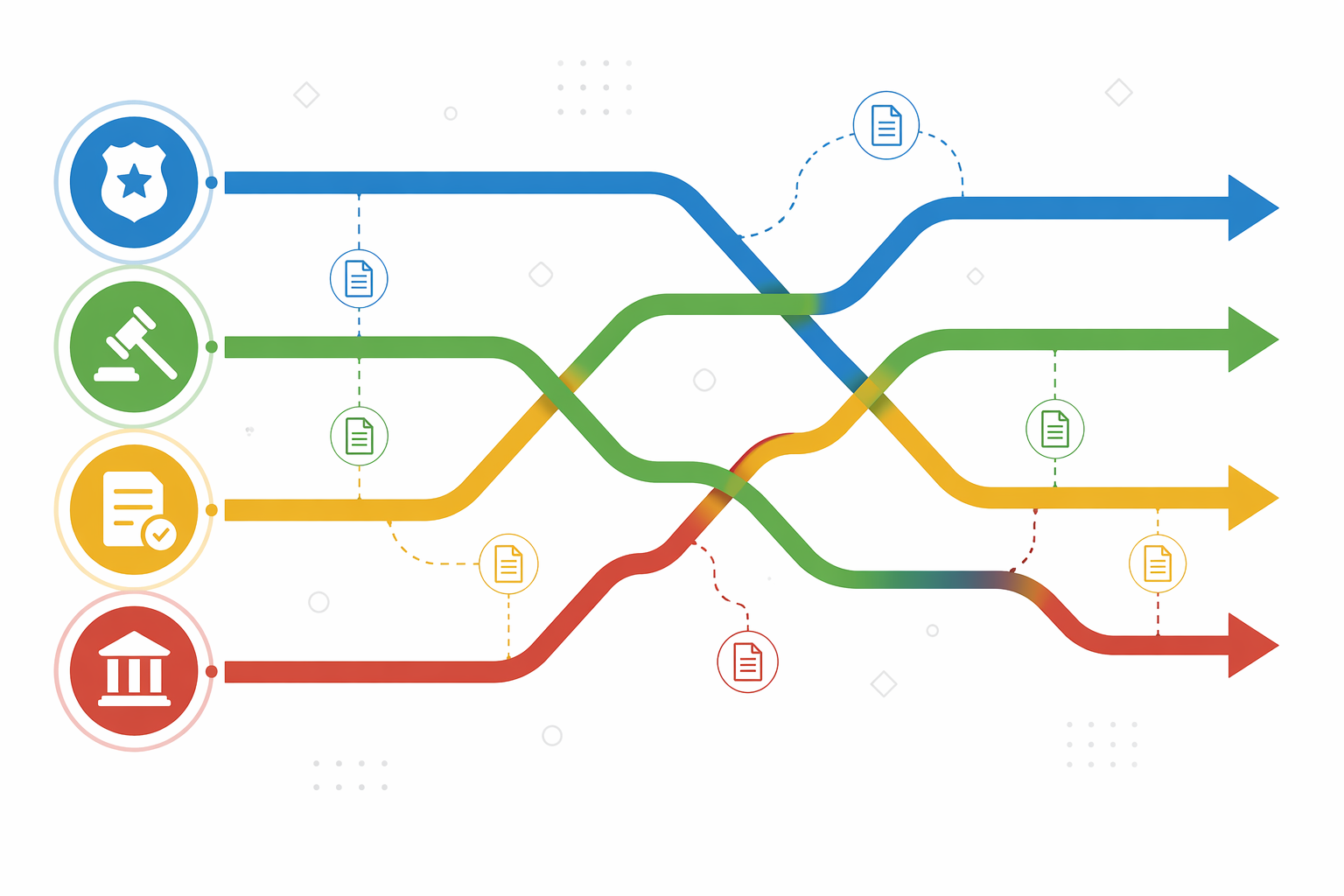
The useful starting point is not chronology for its own sake. It is authority. APD may be the first agency named in local reports, but that does not mean every later decision belongs to APD. SBI review has a different trigger and purpose. A district attorney’s charging decision is not the same thing as a completed civil record. A victim compensation file can move while criminal discovery is still incomplete. A bar-security comment made in a public-safety meeting may later matter in a negligence dispute even if it says nothing about who fired a weapon.
The first mistake is treating “the investigation” as one file
Local reporting described APD responses to at least four mass-casualty or officer-involved shooting scenes between March and July 2026, including the weekend shootings that left multiple people dead or injured. In that public record, APD appears as the primary local investigative agency, while SBI involvement attaches to officer-involved shootings and ATF firearm tracing appears as part of the multi-agency response. The reported numbers matter, but the agency lanes matter just as much: one police department can be collecting scene evidence, one state agency can be reviewing officer use of force, and one federal partner can be tracing a firearm without any of those acts answering the full liability question. [1][2]
That distinction is not clerical. It affects what a lawyer can responsibly tell a client. A family may ask whether “the police report” proves what happened. A premises defendant may ask whether a shooter has been formally identified. A criminal defense lawyer may need to know whether public statements are supported by court records or only by early news accounts. As of the reporting cutoff, specific shooter identifications came from news reports and had not been independently verified here against court filings. That is enough to describe the public reporting; it is not enough to treat those identifications as adjudicated facts.
| Process | Primary legal function | What it can produce | What it does not settle by itself |
|---|---|---|---|
| APD criminal investigation | Scene response, evidence collection, suspect investigation, local case development | Incident reports, witness leads, forensic requests, arrest or charging support | Civil negligence, victim eligibility, or final use-of-force legality |
| SBI officer-involved shooting investigation | Independent investigation after police use of force | Investigative findings for prosecutorial review | A tort damages calculation or a global public-safety conclusion |
| District attorney review | Decision whether officer force was criminally justified | Charging or no-charging decision | Administrative discipline, civil immunity, or premises liability |
| Victim compensation administration | Public benefit reimbursement for eligible crime-related losses | Payment or denial under program rules | Full tort recovery or proof of defendant fault |
| Civil litigation | Private claims over injury, death, security, notice, causation, and damages | Settlement, dismissal, judgment, or discovery record | Criminal guilt or public-program eligibility |
Officer-involved shootings move onto a separate review track
North Carolina’s officer-involved shooting process has its own statutory and institutional shape. Under N.C. Gen. Stat. § 15A-401(d), the SBI investigates officer-involved shootings, and the local district attorney conducts an independent review of whether the force was justified. In the April 21 Asheville shooting, Buncombe County District Attorney Todd Williams cleared the officers after personally reviewing SBI findings, body-camera footage, and surveillance video, according to public reports. [3][4]
That April 21 determination should not be stretched beyond its file. It tells the public that, for that incident, the district attorney had reached a formal criminal-law conclusion about the officers’ use of force. It does not clear every later officer-involved shooting in Asheville, and it does not answer whether a victim in a separate mass-casualty event can recover medical expenses or pursue a civil claim.
The July 15 officer-involved shooting outside Shakey’s bar illustrates the danger of collapsing the tracks. As of July 19, 2026, that matter remained under SBI investigation, and the district attorney’s formal legal determination had not been published in the materials reviewed. A legal intake note that treats the April 21 clearance as the posture of the July 15 case would be wrong in the way that often causes later confusion: it would substitute a familiar agency pattern for the actual status of the file.
Criminal records can help civil and compensation files, but they rarely arrive on schedule
After a mass-casualty shooting, victim-side work often begins before the clean public record exists. A paralegal may have a hospital bill, a funeral invoice, a wage-loss question, and a frightened family member long before there is a complete investigative packet. Criminal investigators may be protecting witness statements. Prosecutors may be deciding whether to file charges. SBI may still be reviewing video. None of that pauses a client’s rent, treatment schedule, or burial expense.
The criminal file can later become useful evidence. A confirmed timeline can help establish where a victim was injured. Firearm tracing can connect a weapon to a suspect or reveal how thin the available proof remains. Body-camera or surveillance footage can sharpen a causation dispute. But those records may be delayed, redacted, or unavailable while a prosecution or use-of-force review remains active. The practical consequence is that early civil and compensation work often has to proceed with provisional facts and carefully labeled assumptions.
This is where language discipline matters. “Reported by police,” “reported by local media,” “charged by prosecutors,” “found by a court,” and “accepted by a compensation administrator” are not interchangeable phrases. Each one tells a later reviewer how much weight the statement can carry.
Victim compensation is not a lawsuit waiting room
North Carolina’s Victim Compensation Program creates a remedial track with its own caps, timing rules, and evidentiary demands. The program provides up to $45,000 per victim for eligible medical expenses, lost wages, and counseling, plus up to $10,000 for funeral costs. Applications generally must be filed within two years of the crime date, and the crime must be reported within six months. Processing averages three to six months. [5]
Those numbers are modest compared with catastrophic injury costs, but they are not marginal for a family trying to cover counseling, missed work, or burial expenses while a criminal case develops. The program disbursed $9.8 million to more than 2,400 applicants in 2024, and the Commission approved $446,169 in reimbursements at a single quarterly meeting in March 2025. Those figures show administrative use, not civil-case value and not proof that every applicant receives the statutory maximum. [5][6]

For intake teams, the more immediate point is sequencing. A compensation application may need to be assembled while the police file is incomplete. A client may need help documenting lost wages before a premises defendant is identified. Counseling expenses may begin before the district attorney has spoken. A tort case might eventually seek broader damages, but the compensation deadline runs on its own clock.
| Victim-side issue | Operational consequence |
|---|---|
| Two-year application window | Create the deadline at intake, even if no civil defendant has been selected. |
| Six-month reporting requirement | Confirm the crime report early; do not assume hospital or media documentation substitutes for reporting. |
| Three-to-six-month processing average | Set client expectations around reimbursement timing rather than promising immediate payment. |
| $45,000 victim cap and $10,000 funeral cap | Separate public-benefit reimbursement from full damages analysis. |
| Pending criminal or SBI review | Label facts by source and update the file as official records become available. |
The Lexington Avenue facts raise foreseeability questions, not automatic liability

The downtown Lexington Avenue shooting, publicly reported as injuring nine people in a bar and nightlife corridor around closing time, puts civil lawyers on a different set of questions. The issue is not whether the scene feels dangerous in hindsight. The issue is what a specific defendant knew or should have known, what security measures were reasonable under the circumstances, whether any omission caused a particular injury, and whether North Carolina law allows the claim to proceed within the applicable limitations period. [2][7]
Councilmember Bo Hess’s public suggestion that bars should implement metal detectors or security wands is the kind of statement lawyers notice because it can enter a later foreseeability or standard-of-care fight. It does not prove that any one bar was negligent. It also does not prove that a wand would have prevented a particular shooting. But once public officials discuss security screening in a nightlife corridor, plaintiffs and defendants can both expect that the comment may be quoted back in discovery, motion practice, or settlement negotiations. [7]
North Carolina civil timing adds another quiet pressure. The research materials identify a three-year statute of limitations for personal injury premises claims and a two-year period for wrongful death. Those windows are longer than the victim compensation reporting and application rules, but they are not generous enough to ignore early evidence preservation. Surveillance video, staffing logs, prior-incident reports, door policies, security contracts, and communications about closing-time crowd control can disappear or become harder to authenticate well before the limitations period expires. [9]
National settlements are context, not a damages calculator
The national civil-liability record is useful mainly as a warning against assuming that criminal tragedy stays inside criminal court. The Las Vegas shooting litigation ended with an $800 million MGM settlement, while the Sutherland Springs church shooting produced a $230 million Federal Tort Claims Act judgment against the federal government, according to the cited materials. Those figures show that mass shooting litigation can reach large institutional defendants under specific theories and records. They do not forecast the value of any Asheville claim. [8][9]
The limits matter. Las Vegas involved its own premises facts, defendant structure, insurance posture, settlement dynamics, and confidential allocation issues. Sutherland Springs involved federal-government liability under the FTCA and may be affected by appellate or post-judgment proceedings. Asheville claims, if filed, would depend on local facts: prior incidents, ownership and control, security staffing, notice, causation, damages, immunities, insurance, and the conduct of nonparty shooters. A national number can justify taking the civil track seriously; it cannot do the work of proving foreseeability in Buncombe County.
Where the tracks cross
The tracks cross most often through records, timing, and words. A police incident report may support a compensation claim but still be too preliminary for a negligence complaint. An SBI file may resolve whether an officer’s force was criminally justified while leaving civil-rights, employment, or policy questions untouched. A district attorney’s no-charge decision may quiet one public controversy while a victim’s medical reimbursement claim remains pending. A councilmember’s safety proposal may be political speech in one setting and a discoverable statement in another.
The same fact can also carry different weight depending on the forum. Closing time on Lexington Avenue may be background for a criminal witness timeline, a foreseeability fact in civil litigation, and largely irrelevant to whether a victim’s counseling expense qualifies for reimbursement. A firearm trace may help investigators build a case but say little about whether a premises owner had reasonable security. A body-camera video may be central to an officer-involved shooting review and peripheral to claims by victims injured before police arrived.
That is why early response files should be built around source and status rather than narrative confidence. For each material fact, the file should identify who said it, when it was said, whether it comes from public reporting or an official record, whether a court or prosecutor has acted on it, and which deadline it affects. This approach is slower at the front end, but it avoids a more expensive problem later: discovering that a client-facing conclusion was built on a public statement that never became an admissible or official fact.
The dated frame
As of July 19, 2026, the Asheville materials support a procedural frame, not predictions. They show APD investigations, SBI review in officer-involved shootings, at least one published district attorney clearance for the April 21 shooting, an unresolved SBI posture for the July 15 Shakey’s bar incident, a victim compensation track with fixed caps and deadlines, and a possible civil-liability field shaped by nightlife-corridor facts, public security comments, and North Carolina limitations periods.
For legal professionals, the lesson is practical: do not wait for the criminal case to become tidy before identifying the other systems already in motion. Know which agency is speaking, which decision-maker has legal authority, which record is still missing, which client expense needs documentation now, and which deadline will keep running whether or not the public file is complete.
References
- 3 separate weekend shootings, WLOS.
- 2 dead, 7 injured, WLOS.
- DA: Officers not to be charged, FOX Carolina.
- District attorney clears Asheville police officers, WSPA.
- Victim Compensation Program, North Carolina Department of Public Safety.
- NC DPS press release, North Carolina Department of Public Safety, March 11, 2025.
- Asheville leaders unite on safety plan, WLOS.
- Government Faces Massive Civil Liability for Sutherland Springs, Duke Center for Firearms Law.
- Active Shooter Incidents: Prevalence, Theories of Liability, and Best Practices, Burns White.
Comments
Join the discussion with an anonymous comment.