
The phrase ashley webb maine senate race legal issues needs a narrower frame than it has been getting. The available record does not show Ashley Webb facing criminal charges, civil litigation, or a federal enforcement matter. The legal issues are election-law issues: how Maine Democrats replace a withdrawn Senate nominee, whether the replacement process can withstand challenge, and whether any candidate-specific qualification question is concrete enough to matter before the general-election ballot is settled.
The clock started with Graham Platner’s withdrawal. Maine’s replacement statute, 21-A §374-A, allows a party to replace a primary winner who withdraws by the second Monday in July; in 2026 that date was July 13. Platner withdrew on July 13, and the statute points the party toward replacement by the fourth Monday in July, which falls on July 27.[1]

That is the useful starting point. Webb is not facially barred on the record now available. But the statutory replacement mechanism, the convention design, the signature deadline, and the inhabitancy facts each give a disappointed candidate, delegate, voter, or party faction something to test if the nomination becomes close enough to litigate.
The Replacement Statute Does More Work Than Its Text Shows
Section 374-A supplies the trigger and the outer calendar, but the legal pressure comes from what it leaves to the party. Maine Democrats are not rerunning a statewide primary. They are using a convention process with 601 delegates: 500 county-elected delegates from Maine’s 16 counties and 101 state committee members.[1][2]
No statutory rule binds those delegates to any candidate. The party charter provisions described in the reporting are sparse on the mechanics that become important under stress: how nominations are presented, how challenges are preserved, how voting rounds are administered, and what procedural remedy exists if a candidate claims the convention has misapplied its own rules.[2]
Sparse does not mean unlawful. Parties have room to structure internal nomination procedures, and emergency replacement statutes generally assume some delegation of details. The risk is different: when the statute gives broad authority and the party rulebook does not fill in much process, a court asked to intervene may have very little text to anchor its review. That makes the record created before and during the convention unusually important.
| Date or mechanism | Legal significance |
|---|---|
| July 13 withdrawal deadline | Platner’s withdrawal by this date activated Maine’s replacement process under 21-A §374-A. |
| July 20 signature deadline | Candidates seeking consideration had to file 500 registered-Democrat signatures, including county-distribution minimums. |
| July 27 replacement deadline | The party’s process moved toward the fourth Monday in July statutory endpoint. |
| 601-delegate convention | The nominee would emerge from a delegate process rather than a renewed statewide primary. |
For Webb, that means the first serious legal question is not biography. It is whether she can become the nominee through a process that is authorized by statute, administered consistently enough to survive scrutiny, and completed before the legal value of a challenge begins to diminish.
Where a Convention Challenge Would Actually Aim
The most likely procedural objections are not mysterious. They would focus on delegate selection, delegate apportionment, and the absence of a statutory binding rule. Those are not automatically winning theories, but they are more legally relevant than generalized complaints that the process feels rushed.
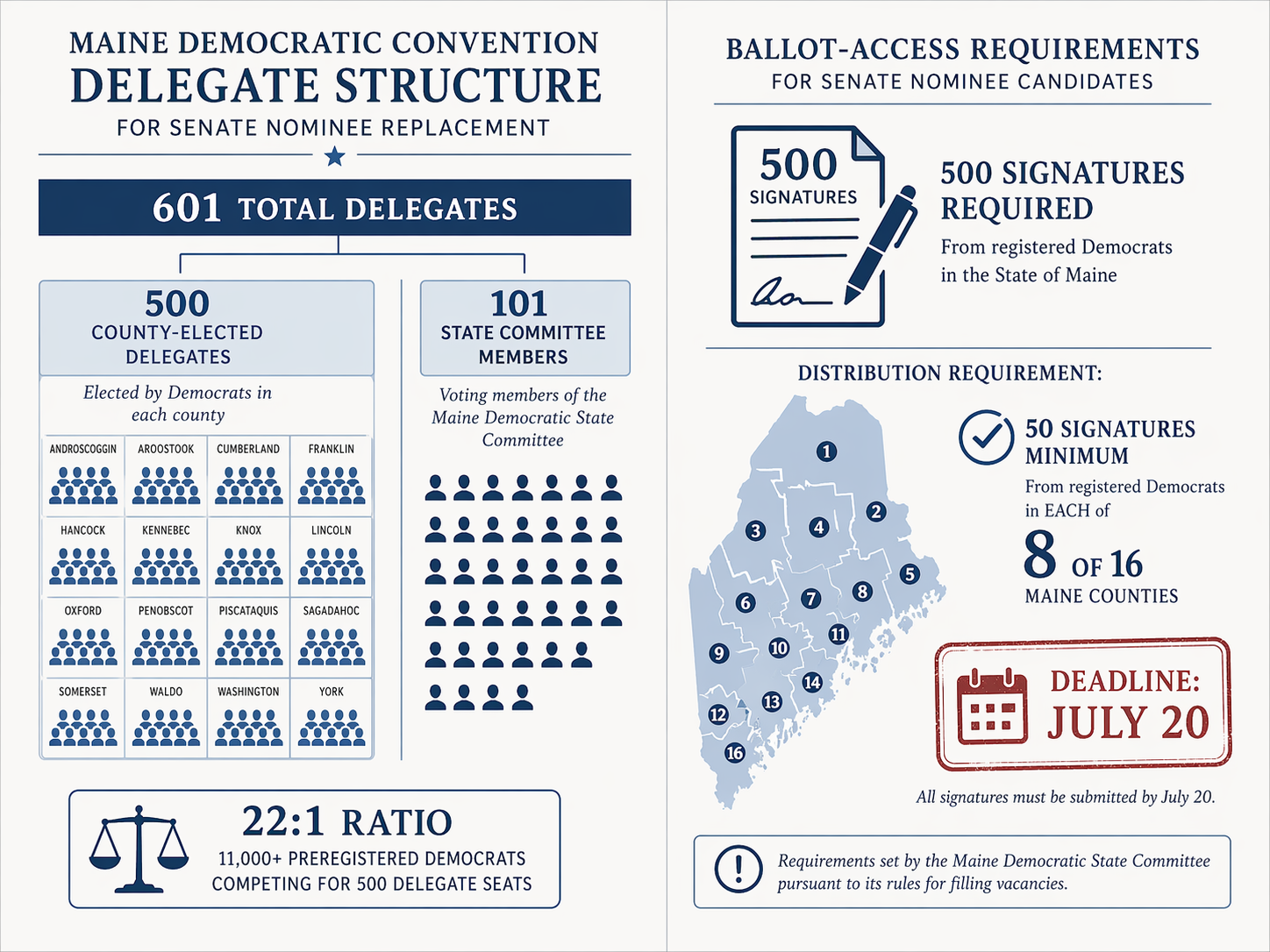
The delegate-selection numbers supply the first target. More than 11,000 Democrats preregistered for county delegate-selection meetings competing for 500 county-elected delegate slots, a ratio reported as about 22 to 1. A 200-member Coalition for Fair Nominations challenged the arrangement as anti-democratic.[3]
That objection has political force, but a legal claim would need a more exact theory. A court would not invalidate a party convention merely because many voters wanted to be delegates and relatively few could be seated. The harder question is whether the method of choosing delegates, allocating them among counties, and allowing them to vote without statutory binding produces a legally cognizable burden on voters, candidates, or party members.
The geographic allocation is a second target. The four largest counties — Cumberland, York, Penobscot, and Kennebec — will send 317 of the convention’s 601 delegates.[1] That concentration can be described as a one-person-one-vote concern, but the label does not resolve the case. The challenger would still have to show why this party replacement convention, operating after a nominee’s timely withdrawal, should be treated like a state-run election structure for apportionment purposes.
The unbound-delegate feature is the third target. If delegates are legally free to choose among qualified candidates, a candidate who wins more preregistration enthusiasm or county-meeting support may still lose at the convention. That is not necessarily a defect. It becomes legally interesting only if the party represented the process one way, administered it another way, or changed material rules after candidates and voters relied on them.
The Signature Rule Is Small in Number and Large in Timing
Before any convention theory matters for a particular candidate, the candidate has to get through the short ballot-access gate. Each candidate was required to file 500 signatures from registered Democrats, including at least 50 signatures from at least eight of Maine’s 16 counties, by July 20.[4]
In an ordinary statewide race, 500 signatures would not look large. In this setting, it is a compressed qualification test layered onto a replacement proceeding already moving from July 13 toward July 27. The county-distribution rule matters as much as the total: a candidate cannot simply gather all support in the most accessible or politically friendly part of the state.
The field size also changes the practical burden. Twelve Democratic candidates had filed by the July 15 deadline, and one, Paige Loud, withdrew the next day while calling the process “a deeply unserious spectacle.”[1] The withdrawal quote is not a legal conclusion, but it does illustrate the compressed conditions in which campaigns were trying to qualify, organize delegate support, and preserve objections.
A signature challenge would be narrower than a convention challenge. It would ask whether a candidate submitted enough valid signatures, whether the county minimums were met, whether signers were registered Democrats, and whether election officials applied the verification rules consistently. For Webb, that is an immediate operational issue rather than a broad theory about democratic legitimacy.
Webb’s Inhabitancy Record Raises a Factual Question, Not a Clean Bar
The Webb-specific qualification issue worth separating from the process objections is inhabitancy. Article I requires a senator, when elected, to be an inhabitant of the state for which that person is chosen. The question is not whether Webb has ever had connections outside Maine. It is whether, at the legally relevant time, she is an inhabitant of Maine.
The available public facts are limited. Webb ran unsuccessfully for New Hampshire state representative in 2012 and 2020, and the candidate record cited in the research materials lists a Farmington, Maine address.[5] Those facts create an obvious line of inquiry: when did Maine become her inhabitancy state for Senate purposes, and what evidence supports that conclusion?
That is a fact-specific issue, not a facial disqualification. Prior out-of-state candidacies may be relevant evidence, especially the 2020 New Hampshire race, but they do not by themselves answer where Webb is an inhabitant in 2026. A serious challenge would need documents and testimony: residence history, voter registration, tax and property records if relevant, physical presence, intent, and the timing of any move to Maine.
The timing also matters. The constitutional language asks about the point at which the senator is chosen, not simply the day a party convention selects a nominee. That gives a candidate room to cure some factual uncertainty before the general election, but it does not eliminate litigation risk if opponents can show that the claimed Maine inhabitancy is unsupported or too recently assembled to be credible.
Age and Treasurer Status Are Smaller Compliance Points
The age requirement should be handled carefully because the public record described in the research brief does not confirm Webb’s exact age. The Constitution requires senators to be at least 30. Her first New Hampshire candidacy in 2012 suggests she likely satisfies that threshold, but that is an inference, not a verified public data point. It should be checked before anyone treats age as either a problem or a closed issue.
Her campaign-finance structure is even less dramatic. Webb is listed as both candidate and treasurer. Federal law permits a candidate to serve as treasurer, although campaigns commonly separate those roles for practical compliance reasons.[6] Without a missed report, defective filing, or enforcement action, the candidate-treasurer overlap is a compliance footnote, not evidence of misconduct.
What Would Have to Happen for These Issues to Matter
A challenge that affects the general-election posture would need to arrive quickly and identify a remedy a court or election official can still administer. Delay is not just a scheduling inconvenience in this setting. Once ballots, certifications, and campaign reliance interests begin to harden, even a plausible objection can become less useful as a practical matter.
The plausible targets divide into two groups. Process challenges would attack how the party selected the replacement nominee: delegate allocation, delegate selection, convention voting rules, or the interaction between party rules and 21-A §374-A. Candidate-specific challenges would attack Webb’s ability to qualify: signatures, county distribution, inhabitancy, age verification, or campaign filing compliance.
- A delegate-process challenge would need to show more than dissatisfaction with a convention; it would need a legally enforceable defect in the rules or administration.
- A signature challenge would turn on verification records, county distribution, signer eligibility, and filing timeliness.
- An inhabitancy challenge would depend on evidence of residence, intent, and timing rather than campaign rhetoric.
- An age challenge remains speculative unless the public record fails to confirm the constitutional minimum through reliable documentation.
- A treasurer-role objection would need an actual campaign-finance defect, not merely the fact that the candidate holds the treasurer title.
That distinction is important because it keeps the Webb analysis from becoming a proxy fight over whether the replacement process is appealing. A flawed process could injure several candidates equally. A Webb-specific defect would have to attach to Webb’s filings, qualifications, or factual record.
On the available record, Webb is not disqualified. The better statement is narrower: she is trying to qualify inside a compressed, lightly specified replacement procedure that gives objectors several plausible procedural and factual targets. The decisive legal question is not whether a challenge can be imagined. It is whether any challenge lands, with evidence and a usable remedy, before the nominee’s general-election position becomes settled.
References
- Who are the candidates hoping to become Maine's Senate nominee, and what happens next? — Maine Public
- Which way are the delegates… — Press Herald
- Coalition urges Maine Democratic Party to reconsider… — Press Herald
- Meet the 12 Democratic candidates looking to replace Graham Platner — WMTW
- Ashley J. Webb — Press Herald voter guide
- Appointing a treasurer — Federal Election Commission
Comments
Join the discussion with an anonymous comment.