
The legal question behind Ashley Webb's Senate eligibility is narrower than the viral argument around it. Article I, Section 3 does not ask whether a candidate looks plausible, polls well, survived a debate clip, or satisfied a party's comfort level. It asks three things: whether the person is at least 30 years old, has been a U.S. citizen for nine years, and is an inhabitant of the state for which the person is chosen. Senate.gov summarizes those as the constitutional qualifications for senators, drawn from Article I, Section 3, Clause 3.[1]
Timing matters. The qualifications are not finally measured at the moment a candidate files paperwork, appears in a voter guide, or seeks a party nomination. Congress.gov's Constitution Annotated explains that, under S. Res. 155 of the 79th Congress in 1935, Senate qualifications must be met when the senator-elect is to take the oath of office.[2] That rule does not make the requirements optional during a campaign. It does mean the public eligibility question is not identical to a filing-screening question.
| Requirement | Legal source | What public sources show for Webb |
|---|---|---|
| At least 30 years old | Article I, Section 3; Senate.gov; timing rule discussed by Congress.gov | Not directly documented in identified public campaign, voter-guide, or news sources |
| Nine years a U.S. citizen | Article I, Section 3; Senate.gov | Reasonably inferred from prior New Hampshire candidacies, but not directly documented |
| Inhabitant of Maine when elected / seated | Article I, Section 3; historical treatment discussed by Cornell LII | Reasonably inferred from reported Farmington, Maine residence; duration is not specified |
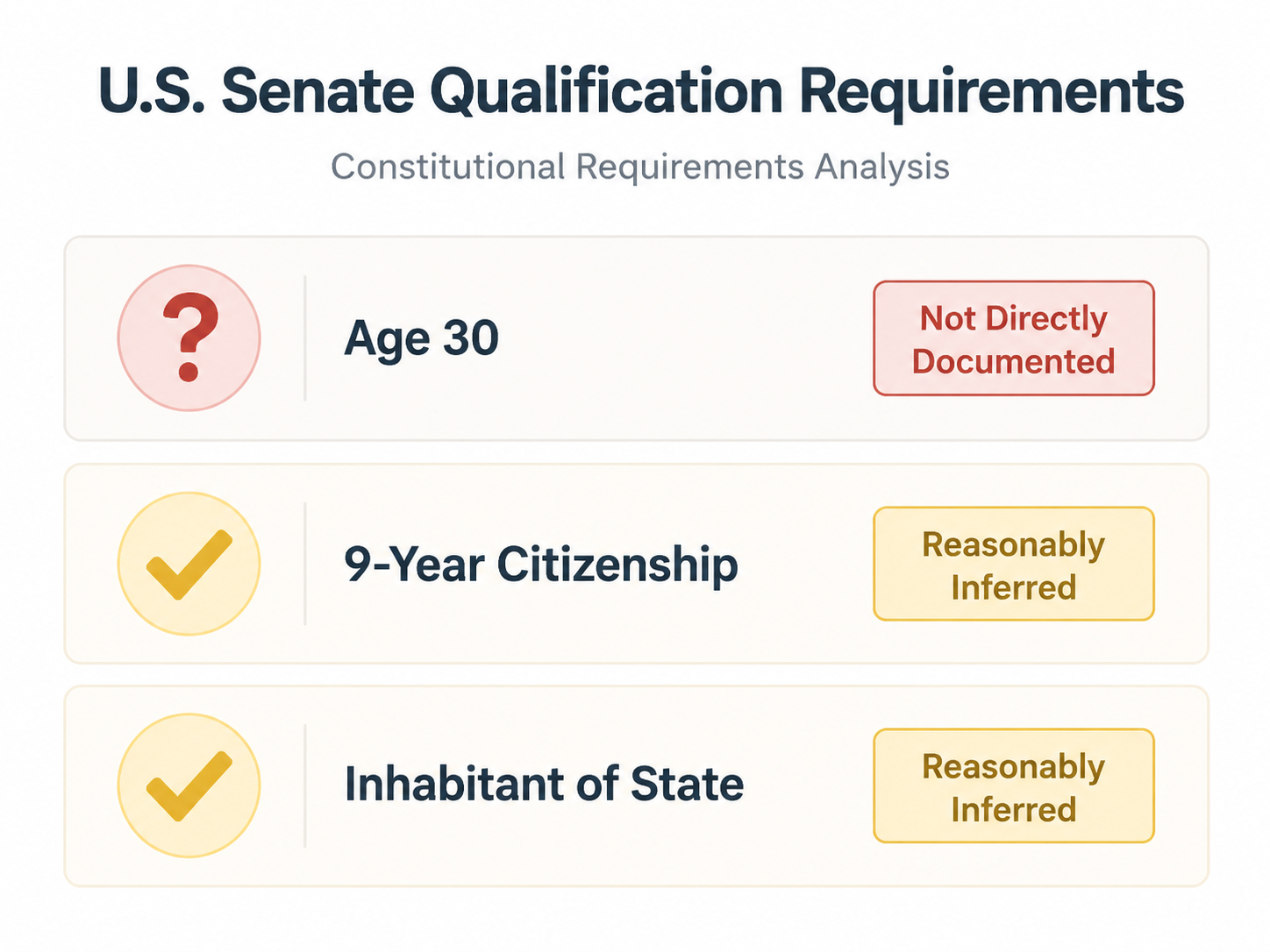
The age requirement is the unresolved one
The cleanest part of the law produces the least clean public answer. A senator must have attained the age of 30 years. The identified public record for Webb does not provide a date of birth, birth year, or stated age. The available campaign and voter-guide material identifies Webb biographically but does not publish the age fact that would close the Article I, Section 3 analysis.[4]
The Portland Press Herald voter guide includes Webb's statement that she is "on Medicare."[4] That is a clue, not a birth certificate. Medicare status may make some possibilities more likely than others, but it does not establish a constitutional age with the precision the question requires. A legal requirement stated as a number needs evidence that actually reaches the number.
That gap is unusual because age is normally one of the easiest facts in a Senate eligibility analysis. Most candidates disclose enough biography for the answer to be obvious, even when the exact birthday is not central to campaign coverage. Here, public sources do not appear to supply the necessary date or year. The right conclusion is therefore limited: Webb's age has not been directly confirmed from the identified public record.
It would be just as sloppy to turn that absence into proof of ineligibility. The Constitution requires that the senator-elect be 30 when seated, and the public record's silence does not prove the contrary.[2] It only means that readers looking for source-traceable confirmation cannot get all the way there on age from the presently identified sources.
Citizenship is reasonably inferred, not directly verified
The citizenship requirement is less murky in practical terms, though still not directly documented. A senator must have been a U.S. citizen for nine years.[1] The public sources identified for Webb do not include a naturalization record, passport record, birth record, or sworn public document independently establishing the start date of U.S. citizenship.
What they do show is a basis for inference. Webb previously ran for New Hampshire state representative in 2012 and 2020, and the Portland Press Herald voter guide includes that prior political history.[4] New Hampshire legislative office requires U.S. citizenship, and the research brief identifies no public challenge to Webb's citizenship status arising from those candidacies. That makes U.S. citizenship a reasonable inference, especially over a span that reaches well beyond nine years from the 2012 candidacy to a 2026 Senate election.
Still, inference is not the same as verification. Prior ballot access for another office can support an eligibility judgment; it does not substitute for direct documentation of citizenship or the date citizenship began. The distinction matters because the Senate clause is not satisfied by general confidence. It is satisfied by the underlying fact.
Inhabitancy is not a hidden residency-duration test
The third requirement is often the easiest to distort in ordinary political coverage. Article I, Section 3 requires a senator to be an "inhabitant" of the state for which the person is chosen.[1] It does not say the person must have lived there for a set number of years. Cornell's Constitution Annotated discussion of the Senate Qualifications Clause recounts James Madison's objection to replacing "inhabitant" with "resident" and Joseph Story's later explanation that inhabitancy avoided a fixed durational residency rule.[3]
That history matters for Webb because the public record includes prior New Hampshire candidacies and a current Maine address. The Portland Press Herald voter guide identifies Webb as residing in Farmington, Maine, while also describing her earlier New Hampshire political runs.[4] A move from one state to another may be politically relevant; it is not constitutionally disqualifying by itself.
The available sources do not specify how long Webb has lived in Maine. If this were a statute with a one-year, five-year, or seven-year residency requirement, that missing duration would be central. For the Senate, the better question is whether she is an inhabitant of Maine at the constitutionally relevant time. On the present public record, Farmington residence supports a reasonable inference of Maine inhabitancy, but it does not tell readers much about duration or the factual details of domicile.
The timing rule also prevents overreading the current snapshot. The Constitution uses "when elected" in the inhabitancy clause, and the Senate has treated qualifications as needing to be met when the senator-elect is to take the oath.[2] That distinction matters most if a candidate's status is in transition. The public record here does not show such a transition; it simply leaves the length and supporting details of Maine residence unspecified.
The party process can screen candidates, but it is not the final constitutional tribunal
The urgency around Webb's eligibility comes from the Maine Democratic Party's emergency convention process, not from a court ruling or Senate proceeding. Maine Public reported on the candidates hoping to become Maine's Senate nominee after Graham Platner's exit, including the party process that placed candidates before delegates.[5] WMTW reported a 12-candidate field and described the convention rules, including a 500-signature threshold with signatures from at least eight counties.[6]
Those rules may require candidates to certify that they meet constitutional requirements, but public reporting does not show an independent documentary verification process for age, citizenship, and inhabitancy. A certification is a procedural fact. It tells readers what the candidate represented to the party. It does not by itself prove the underlying constitutional facts.
That distinction is not hostile to the party or to Webb. Parties often rely on attestations because nomination processes move quickly and because many eligibility facts are not disputed. But when the public question is whether eligibility can be confirmed, the evidentiary chain matters. An attestation can be part of that chain; it is not the end of it.
Who ultimately decides if a senator-elect is qualified
Article I gives each chamber authority to judge the elections, returns, and qualifications of its own members. In the Senate context, that means the Senate has the institutional role in judging whether a senator-elect meets the constitutional qualifications.[3] Courts can decide some constitutional questions around congressional qualifications, and Powell v. McCormack is the standard warning against Congress adding qualifications beyond the Constitution's text. But the Senate's own seating and qualifications judgments remain the practical endpoint for a Senate eligibility dispute.[3]
That enforcement structure explains why public confirmation can remain incomplete. A campaign may not publish a birth date. A party may rely on a candidate certification. Reporters may identify residence and prior candidacies without obtaining primary documents. Unless a candidate releases documentation, a challenger produces contrary evidence, or the Senate is forced to judge the question, the public record may stop short of a definitive answer.
On the sources identified here, Webb's citizenship is reasonably inferred from prior New Hampshire candidacies, and Maine inhabitancy is reasonably inferred from her reported Farmington residence. Her age is different. No identified public source directly documents a birth date, birth year, or stated age, and the Medicare reference does not supply the missing constitutional fact. Public sources therefore do not fully confirm Ashley Webb's Senate eligibility under Article I, Section 3.
References
- Constitutional Qualifications for Senators, Senate.gov
- When Senate Qualifications Requirements Must Be Met, Congress.gov
- Overview of Senate Qualifications Clause, Cornell Legal Information Institute
- Ashley J. Webb voter guide, Portland Press Herald
- Who are the candidates hoping to become Maine's Senate nominee, Maine Public, July 17, 2026
- Meet the 12 Democratic candidates looking to replace Graham Platner, WMTW
Comments
Join the discussion with an anonymous comment.