
The compensation landscape for Aurora theater shooting survivors is easiest to misunderstand when the available routes are described as if they were interchangeable. Survivors and families encountered three visible paths: a criminal restitution order, a charitable relief fund, and civil litigation. Each looked like a compensation mechanism. Each operated under a different logic. Each left a different class of shortfall.
The restitution order imposed a large court debt on the shooter: $954,878.95, plus 12% annual interest, with language preserving future-expense obligations.[1] The Aurora Victim Relief Fund moved charitable money quickly, distributing a collected fund of $5,338,360.32 through strict tiers that paid some claimants substantial amounts and excluded outpatients entirely.[2] The civil case against Cinemark, the theater owner, did not become a compensation path at all; an Arapahoe County jury found Cinemark not liable after about three hours of deliberation.[3]

| Mechanism | Design logic | Practical outcome |
|---|---|---|
| Criminal restitution | Court-imposed obligation tied to criminal sentencing | $954,878.95 order with 12% annual interest, but collection depended on inmate prison-account limits |
| Aurora Victim Relief Fund | Administrative triage of donated funds | $5,338,360.32 allocated through tiers; deceased and permanently injured victims received the largest payments, outpatients received nothing |
| Civil litigation | Fault-based adjudication against a private defendant | Cinemark prevailed; the case produced no damages recovery for plaintiffs |
That table is not a ranking. It is a warning against false equivalence. A restitution judgment can define a debt without producing usable money. A charitable fund can pay quickly while drawing eligibility lines no court has tested. A civil claim can pursue institutional accountability and still fail on foreseeability, causation, or both. Advising victims in a mass casualty case requires keeping those differences visible from the first client conversation.
Restitution: a large order with narrow collection tools
On December 4, 2015, Judge Carlos Samour Jr. ordered the Aurora theater shooter to pay $954,878.95 in restitution.[1] The figure mattered. It was not merely a ceremonial number placed at the end of a sentencing file. The order identified a concrete debt flowing from the criminal case, separated amounts already paid by victim compensation from amounts owed directly to victims, and preserved an obligation for future expenses.
The base amount consisted of $851,493 for victim compensation and $103,385.95 directly to victims.[1] The order also applied 12% annual interest and covered future expenses including lost wages, physical therapy, psychiatric care, prescription drugs, medical services, and medical equipment.[1] By mid-2026, the interest term would substantially increase the amount owed if applied over time, but any current balance would require a verified calculation rather than a casual update.
The harder question is not whether the debt existed. It is what the enforcement machinery could realistically reach. The same reporting on the order noted that Colorado law permitted collection through inmate prison accounts, meaning the source was prison-account money rather than an ordinary defendant’s wages, assets, insurance, or attachable civil judgment proceeds.[1] Against a debt approaching seven figures before interest, prison-account collection turns a formal obligation into a long-duration ledger entry.
That does not make the order meaningless. Restitution can recognize loss, preserve a claim, and prevent the criminal sentence from treating economic harm as an afterthought. For some victims, having the amount entered by a court may have public and procedural significance independent of collection. But it is materially different from compensation in the ordinary financial sense. A lawyer who tells a family that restitution has been “awarded” without explaining collection limits has left out the most important part of the remedy.
The future-expense language is also easy to overread. It kept categories of future loss within the order’s reach: psychiatric care, therapy, medical services, equipment, prescription drugs, and wage loss.[1] It did not create a fund from which those expenses could be paid as they came due. A survivor facing continuing medical or mental health costs still had to live with the gap between recognized entitlement and available cash.
The relief fund paid money, but only through hard categories
The Aurora Victim Relief Fund solved a different problem. It did not try to impose fault. It did not wait for a tort judgment. It gathered donated money and converted it into payments through an administrative process. The fund collected $5,338,360.32 and was administered with the involvement of Ken Feinberg, whose work on other mass casualty compensation systems made him a familiar figure in this kind of emergency allocation.[2]
CNN reported that 38 of 57 claims were approved and 19 were denied.[2] The approved payments followed tiers: $220,000 each to the families of the 12 people killed and to 5 victims with permanent brain damage or paralysis; $160,000 to 6 victims hospitalized for 20 or more days; and $35,000 to 13 victims hospitalized for 1 to 7 days.[2] Outpatients received nothing.[2]
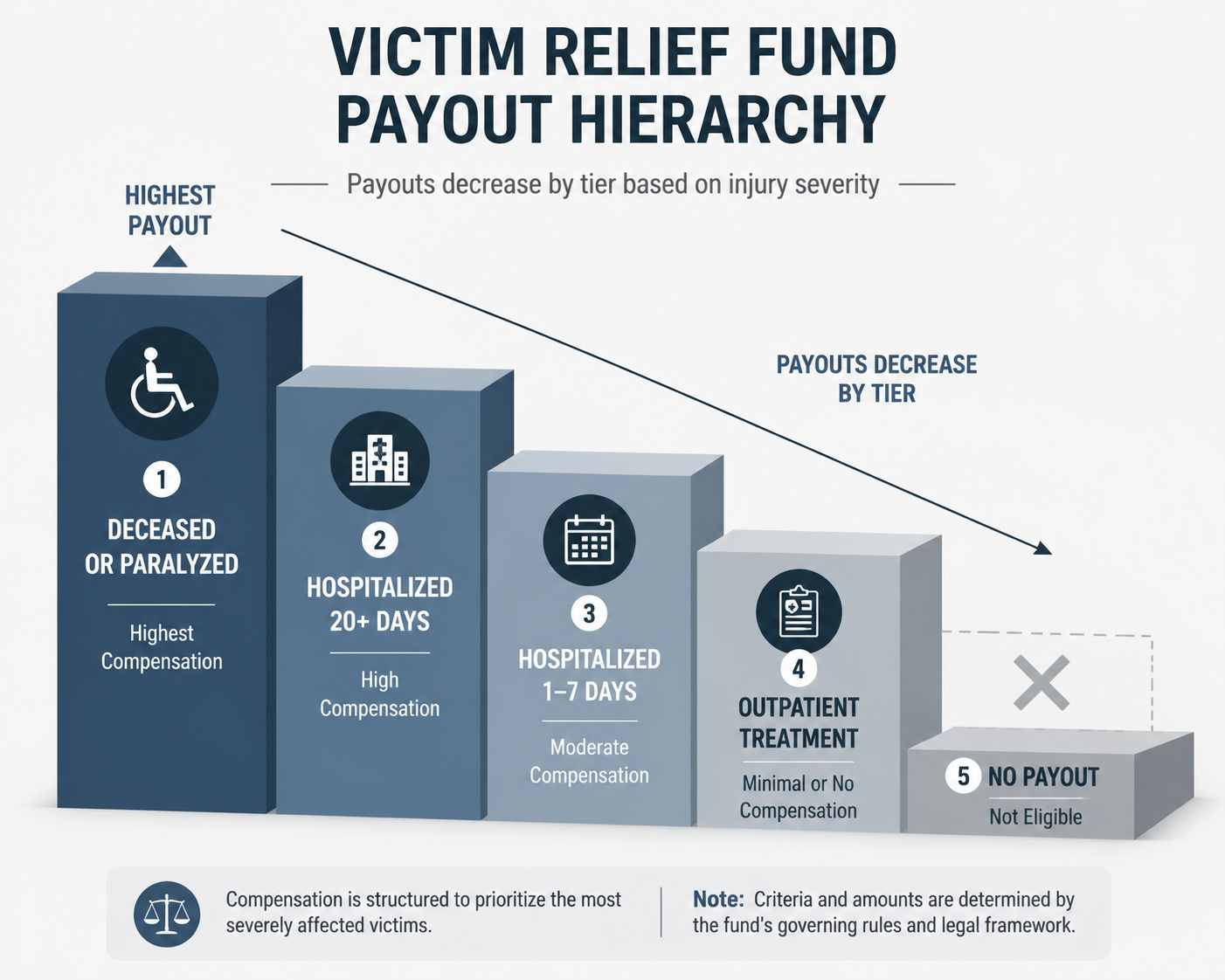
Those tiers show what charitable relief can do that restitution often cannot: put money in people’s hands on an administrative timeline. They also show what that speed costs. A fund with a finite balance cannot individually adjudicate every long-term consequence with the granularity of a life-care plan, a lost-earnings expert report, or a contested damages trial. It needs administrable markers. Death, paralysis, permanent brain damage, and hospitalization length became sorting devices.
The outpatient exclusion is the point at which the administrative logic becomes most visible. It does not prove that outpatients had no injuries, no trauma, or no expenses. It shows that the fund treated hospitalization status as a threshold for scarce charitable dollars. That choice may be understandable as triage and still brutal at the margin. The rule’s clarity is precisely what makes it both administrable and unforgiving.
This is why a relief fund should not be described as a substitute for a damages system. It has no reason to mirror tort categories of loss. It may not compensate pain and suffering as a court would. It may not track future psychiatric expenses. It may not distinguish between two people whose hospital stays were similar but whose long-term recoveries diverged sharply. Its legitimacy comes from speed, transparency, and consistent application of announced criteria, not from making every claimant whole.
Nor should it be dismissed as merely symbolic. Compared with a restitution order collectible only through inmate accounts, the fund made real payments. For the highest-tier recipients, those payments were substantial. For lower-tier or excluded claimants, the same process could confirm that public sympathy and donated generosity still produce rationing. In mass casualty compensation, rationing does not stop being rationing because the administrator is charitable rather than governmental.
Civil litigation pursued accountability and produced no recovery
The civil claims against Cinemark occupied a third category. They were not designed to distribute donated money or enforce the shooter’s criminal debt. They sought to establish that a private defendant bore legal responsibility for failing to prevent or mitigate the attack. That route carried the familiar promise and risk of tort litigation: broader accountability if successful, no compensation if liability failed.
In state court, the plaintiffs lost. An Arapahoe County jury took about three hours to find Cinemark not liable.[3] The jury was not shown a May 2012 Department of Homeland Security warning about potential theater attacks, a limitation that mattered to how the foreseeability evidence reached the jurors.[3] Whatever one thinks Cinemark should have anticipated as a matter of security planning, the state-court verdict did not convert that concern into a damages award.
The federal analysis drew a careful distinction that lawyers should not blur. Judge R. Brooke Jackson wrote that a mass shooting in a theater “was foreseeable,” but concluded that Cinemark’s lack of security was “not a substantial factor” in the deaths.[4] That is a legally important separation. Foreseeability may open the door to duty or negligence analysis, but causation still has to carry its own weight. A plaintiff can persuade a court that a general risk was foreseeable and still lose if the alleged security failure is not treated as a legally sufficient cause of the injuries.
Cinemark’s defense also invoked Lopez v. McDonald’s, the litigation arising from the San Ysidro massacre, as precedent.[4] The comparison underscores the recurring obstacle in mass shooting premises cases: courts may be reluctant to make a property owner financially responsible for an extraordinary intentional criminal attack unless the evidence ties the defendant’s omissions to the injuries in a way the governing causation standard accepts.
The bill-of-costs episode exposed another feature of civil litigation that compensation discussions often omit. After prevailing, Cinemark’s attorneys sought $699,187.13 in costs from victims, according to CBS News reporting.[5] Cinemark later withdrew the request in September 2016.[6] The withdrawal prevented that particular cost demand from becoming an additional financial injury, but the episode remains a blunt reminder: civil litigation can impose downside risk on already injured plaintiffs, even when the claim has public resonance.
The same claimant may move through three incompatible systems
For practitioners, Aurora’s lesson is not that one path was real and the others were illusory. The lesson is that each path answered a different question. Restitution asked what the convicted defendant owed as part of the criminal judgment. The relief fund asked how donated money should be distributed under emergency criteria. The civil suits asked whether a third party could be held liable under Colorado law. A survivor could have a serious loss and still receive sharply different treatment across those systems.
| Question | Restitution | Relief fund | Civil litigation |
|---|---|---|---|
| Who controls the process? | Criminal court | Fund administrator | Civil court and jury |
| What must be shown? | Loss tied to the criminal conduct and recognized in the order | Eligibility under announced fund criteria | Liability, damages, and legally sufficient causation |
| When can money move? | Only as collectible funds become available | On the fund’s administrative schedule | Only after settlement or judgment, if plaintiffs prevail |
| What is the main limitation? | Enforcement against an incarcerated defendant | Finite fund and categorical rationing | Complete loss if liability fails |
This incompatibility matters at intake. A family may hear “restitution,” “fund,” and “lawsuit” as three ways of saying money will be available. They are not. Restitution may create a right without liquidity. A relief fund may create liquidity without individualized damages adjudication. A lawsuit may create discovery, public accountability, and a chance at full damages, but it can also end with a defense verdict.
The counseling problem is delicate because precision can sound like discouragement. It is not. Survivors and families need to know which deadlines matter, which documents to preserve, which expenses may be covered, and which process cannot be relied on for immediate support. They also need to know that success in one mechanism does not cure the limits of another. A person might receive a charitable distribution and still face unreimbursed future care. A person might be named in a restitution order and still see little actual collection. A person might join civil litigation and still receive nothing from the defendant.
What lawyers should preserve from Aurora
Aurora should push mass casualty planning away from generic assurances and toward mechanism-specific advice. Prosecutors handling restitution need to explain both the amount ordered and the realistic collection channel. Victim advocates working with charitable funds need to make eligibility rules intelligible before claimants infer broader promises from the existence of a large fund. Civil lawyers need to discuss not only theories of liability but also adverse-cost exposure, evidentiary limits, and the possibility that foreseeability will not satisfy causation.
The practical file should be built for all three systems without pretending they share a standard. Medical bills, hospitalization records, wage-loss documentation, therapy needs, and future-care projections may matter differently depending on the forum. A hospitalization record that determines a relief-fund tier may be only one part of a restitution submission or a damages case. A security warning that matters to foreseeability may still fail to prove substantial-factor causation. A future psychiatric expense may be recognized in a restitution order even if collection remains doubtful.
Policy advisors should take the same lesson. If the goal is rapid cash, a relief fund can do that, but only by adopting categories that will exclude some injured people. If the goal is offender accountability, restitution can state the debt, but incarceration may make collection negligible relative to the harm. If the goal is third-party responsibility, civil litigation offers a forum, not a guarantee. None of those mechanisms should be sold as the answer to the others’ deficiencies.
The Aurora compensation record is therefore not a single story of recovery. It is a patchwork: a symbolic and continuing criminal debt, a finite charitable fund distributed by tiers, and civil litigation that ended without liability. Lawyers serving survivors in future mass casualty cases should prepare clients for that kind of fragmented process from the beginning.
References
- Judge Samour orders Aurora theater shooter to pay more than $954,000 in restitution — Sentinel Colorado
- Payments from Aurora Victim Relief Fund finalized — CNN, November 17, 2012
- LA Times investigation — Los Angeles Times
- The Aurora Theater Lawsuit: Were Lessons Learned? — Juris Magazine, October 1, 2016
- Cinemark attorneys want Aurora shooting victims to pay $700K legal fees — CBS News
- Aurora theater shooting victims won’t pay Cinemark legal costs — The Denver Post, September 13, 2016
Comments
Join the discussion with an anonymous comment.